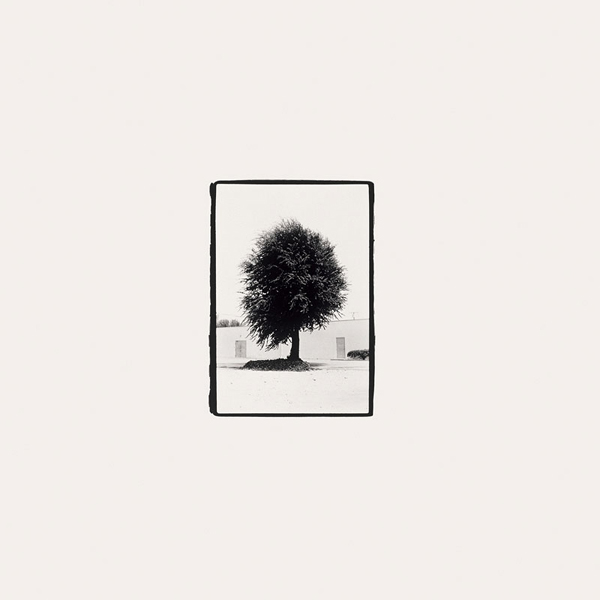
The tiny photographs of Judy Fiskin

Judy Fiskin, "Untitled," 1974. Gelatin-silver print, 7 x 5 in.

On the surface, Judy Fiskin’s tiny photographs of stucco apartment buildings (Stucco, 1973-6) and Southern California architecture (31 Views of San Bernadino, 1974) belong to a subset of works by artists obsessed with the typography of architecture, à la Bernd and Hilla Becher, or even Ed Ruscha. Each of these artists has produced dozens, if not hundreds, of images of buildings, usually in black-and-white.  The similarity ends there, however.  Whereas the Bechers were genuinely interested in documenting “type,” and Ruscha finds humor in investigating the banal, Fiskin’s photographs question where one draws the line between the mundane and the precious.

Judy Fiskin, "Signal Hill, Willow and Cherry, Facing Southwest, from the Long Beach," California Documentary Survey Project, 1980. Gelatin silver print on paper mounted on paperboard. 2 1/2 x 2 3/8 in. Collection of Smithsonian American Art Museum.

Straight-on shots of ordinary tract homes and businesses, the photographs in Stucco and 31 Views of San Bernadino average only a few inches in height, achieving gravitas through their position: centered in a vast white matte and frame. Other works—like the series Aesthetic Decisions (1984) and Portraits of Furniture (1984)—are more complicated, taking precious, intentionally artful objects and forcing them to hold up to sustained attention.  The viewer’s thoughts involve an internal struggle, noticing both the beauty and the awkwardness of an arrangement, with Fiskin staying pointedly neutral.

“They don’t hang straight!  They don’t drape!”

“Do you want to say they detract from elegance?”

“Yes, because they don’t drape properly.”

“They don’t drape properly.”

“Yes.”

Fiskin also uses that oh-so-unsentimental of mediums, video, to similar effect.  Perhaps the best example is 50 Ways to Set the Table (2003), a 26-minute long mini-documentary of the process of judging the Tablescaping Competition at the Los Angeles County Fair in 2001.  Without taking sides, Fiskin follows two female judges in their process of deciding the winners of categories like “Country Christmas” and “The Lion King,” plus the best-in-show.

“You know, this tablecloth is so white that it makes the salt off-white?  I had to take a second look at that—I’m wondering, is that Parmesan cheese in there?”

Judy Fiskin, "50 Ways to Set the Table," 2003. Still from a digital video with sound), running time 26 minutes. Courtesy Angles Gallery.

I love Fiskin’s sense of humor, but what I appreciate most is the reminder that to limit one’s toolbox to irony and sarcasm is to take the lazy way out. In the clang and clatter of all the artistic voices present for Pacific Standard Time, the Getty’s multi-venue, six-month initiative to showcase post-World War II art from Southern California, the tiny photographs and video of Judy Fiskin hold their own.

Judy Fiskin is represented in Los Angeles by Angles Gallery. Fiskin’s works are on view at various exhibits as part of Pacific Standard Time, including MOCA’s ‘Under the Big Black Sun': California Art 1974-81, California Museum of Photography’s Seismic Shift: California Landscape Photography, the Getty Museum’s In Focus: Los Angeles, 1945-1980, and the L.A. Municipal Art Gallery’s Civic Virtue: The Impact of the L.A. Municipal Art Gallery. For individual show information, please follow the links above.

Share

Abolishing War: A Conversation with Krzysztof Wodiczko

Krzysztof Wodiczko’s work is powerful, politically charged and bears great momentum. Best-known for transforming architectural structures and monuments through loaded public projections, Wodiczko’s projects fight for the change he wants seen in the world – a global society free from the destructions of war. When the artist and professor was recently in London for the occasion of his exhibition The Abolition of War at WORK gallery and launch of Krzysztof Wodiczko, a comprehensive monograph chronicling his decades of work, we sat down to discuss his ongoing projects and the loaded topic of war.

Krzysztof Wodiczko, War Veteran Vehicle, Liverpool, 2009. Photography courtesy Robert Ochshorn.

Michelle Schultz: With your project War Veteran Vehicle - a transformed military vehicle that fires fragments of statements by soldiers and their families on the façades of public buildings – the highly personal and revealing testimonies make the subject quite vulnerable, and I imagine there are many barriers that need to be overcome to achieve this. Could you begin by telling me a little about the process that is involved and how you approach those that you worked with in the project?

Krzysztof Wodiczko: Well, those projects would not happen if I did not establish some trustful contact with the social workers who are trusted by veterans, homeless, or immigrants – places where people try to connect and try to help each other. I first present an idea, then they have to test me and I have to pass their test – they have to protect people with whom they work from people like myself, and from people like you. Then, the project and myself, we have to be tested by those who are potential co-artists. This is not easy – very often you start with rejection or destruction, psychologically speaking, of my presence and of the work. It is something coming from outside and invading them and maybe manipulating them. They must first properly destroy any doubt, and if I survive this, and the project survives this, then I show up again, and I am ready to be of some kind of service. In this process, the confidence amongst some of these people develops and they might make use of this project for their own lives, and for lives of others who cannot join the project because it’s too early for them, it’s too dangerous, too risky…

MS: Do you continue to keep in touch with the people that you work with in your projects? Are you aware of how the project has affected their lives, and the long-term impacts of it?

KW: For them, and for me, the thing in itself is the end of sometimes a year-long process of recording. Inevitably some ties develop, also among people who are part of the project who normally would not connect. So something is sustained – some of the projects continue in the sense that the network established by the project is still operational for awhile. So they help each other, but I am not part of it. My job is to disappear, it is their project. When it all somehow works for them, it is their success. If it doesn’t, it is my failure.
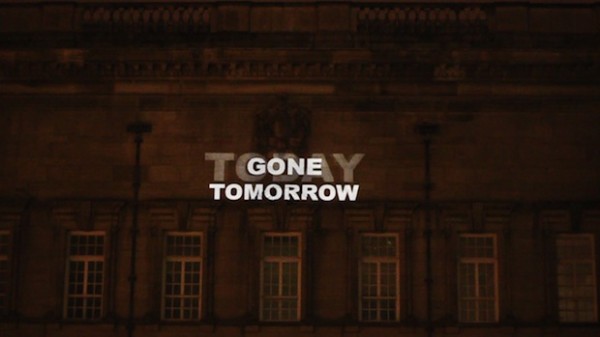
Krzysztof Wodiczko, War Veteran Vehicle, Liverpool, 2009. Photography courtesy Robert Ochshorn.

MS: Now, you have initiated the War Veteran Vehicle project in various locations, including Poland, Denver, Liverpool and most recently, Eindhoven. Do you plan to continue this work in other places?

KW: Yes, but not forever. Unfortunately, circumstances demand more work in this area because there will be an enormous amount of soldiers coming back, especially in the United States. In Europe, most of the people are coming back from so-called peace missions, but it is a normal war. And it is very important that they make sure that through their words they explain that it is a war, and what it means to be at war. Also what it means to be a family of those who come back from war, or who have left for war, or who are absent because they are somewhere fighting, and in what way those families are proper war veterans themselves.

MS: Yes, some of the most powerful statements come from the families of soldiers who have come back from war, as they convey how these veterans have returned home, yet are lost to them psychologically or emotionally.

KW: An incredible amount of people are victims or survivors of secondary trauma. Each time someone comes back, he or she re-traumatises seventy-nine people according to experts who work on this in the United States. And young people are blindly signing up for the army because there is enormous amount of propaganda, a certain image and a lofty sense of mission, duty, country. This is something veterans know very well. They were processed through this war machine and they know there is no relation between the way they were before and they way they are now. And they know how much they are resented by society. In fact, they are foreigners and they are homeless in their own country and in their own homes. When they came back, they didn’t really come back, they’re gone. And the chance that this will happen is very high in comparison to previous wars because most people will come back alive, rather than dead, because of better armour and medical technologies. The fallout of them being alive, in this way, is tremendous.

In Poland, half of the people who are speaking through the vehicle are women. In Liverpool there is one woman, but it is very significant as she is speaking about almost being killed by her husband, and the husband also says that he almost killed her and he doesn’t remember. These things are not only the facts, but the fact that they are being said by those people themselves, in the open, is significant. Speaking in a public space itself is an act of incredible shift – only one percent of veterans speak in public, and almost none of the families. It is also acoustically very powerful  – it reverberates and echoes and is reflected from the blank and blind façades of the buildings and monuments that have witnessed events in the past.

MS: So the buildings and walls you use are not only a physical or practical part of the project, but an important symbolic one as well?

KW: Yes, there is an extremely thick wall that separates those who know what war is, and those who don’t. So in a way, this is an attempt to shake the wall, and crack it, and maybe make a little a little break in it. In that sense, the wall is an important word here, and the façade is also an important word, and the monument is an important word – because walls, façades, monuments and memorials are obsessed with not only remembering and saying certain things, but also with not saying a lot of things, and forgetting a lot of things about the war.

Krzysztof Wodiczko, The Flame, Governors Island, 2009. Photography courtesy Michael Marcelle/Creative Time.

MS: Many of your earlier projects have a very utopian drive to them – an attempt to make the world a more cohesive place by overcoming communication barriers through technology. However, with War Veteran Vehicle the overriding message seems to focus on the impossibility of reintegration for these soldiers – do you think that there is a point where technology may actually fails, or simply can’t overcome certain disconnects?

KW: Well, you say it is about impossibility, but I still think it is about possibility. Technology here, can be understood as a kind of cultural prosthetic – one can develop a capacity to speak in the process of making use of this project and bring to the open something that is repressed, maybe even forgotten. I think that this does show the possibilities of communication, and examples where people communicate something that should not happen, they communicate things that should change, that are unacceptable, for them and for the entire world. It’s a critical projection, and it’s a brave projection. It’s an act of maybe an effective contribution to the democratic process. This is something else to consider – can these projects contribute to situations and conditions under which they will not be necessary? Their function is based on the hope that they will become obsolete.
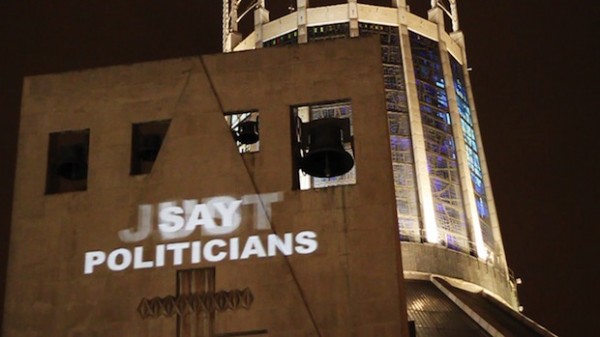
Krzysztof Wodiczko, War Veteran Vehicle, Liverpool, 2009. Photography courtesy Robert Ochshorn.

MS: And this is what your new project, Arc de Triomphe – World Institute for the Abolition of War, is looking at more specifically, isn’t it? It is a functional and symbolic structure proposed to encase one of Paris’s most famous monuments that would work in a practical way towards world peace. Can you tell me a little bit about the ideas behind the project?

KW: War memorials, of which Arc de Triomphe is the primary example, are actually mobilising people towards the next war, and perpetuate the cult of war and cult of leaders and sacrifice. They are not saying at all what is the cost of those wars – how many people lost lives, how many families were destroyed and how many generations suffered transmission of trauma. The mobilisation of people towards war is a very simple technique, used since Roman times, that happens over and over again. It is very easy to detect the falseness and manipulation in it, but people are not educated and  textbooks don’t bring that information.

MS: So how is it that you propose we liberate ourselves from war?

KW: In fact, war should be made illegal, as much as slavery became illegal. Slavery exists, the slave trade exists, but it is illegal, which has made a world of difference if you compare to the eighteenth and nineteenth century slave trade. So while war, also, would happen here and there, it would be very different. The abolition of war, as something illegal used to deal with conflicts, requires change, a major shift of consciousness, and an undoing of relations to memorials. So we begin by creating an institute, and an awareness.

MS: Do you think there is a realistic possibility for the abolition of war in this century?

KW: It might not be finished in this century, but we are moving in this direction. It is a process. However, there is evidence that societies and nations can be without war. There is no evidence that people were inflicting mortal wounds on one another in an organized way before six thousand years ago according to all of the archaeological diggings. And Europe has done this actually with the European community – it’s pretty difficult to imagine war between Germany and France right now, something that seemed to be potentially there every year before, or Britain and France, or wherever. We have no wars in Europe – but Europe is engaging in wars somewhere else, so we have to really be careful about this – but still, we don’t have wars here and it is a big change in the planet already.

People are very skeptical or cynical about this because they say it’s being manipulated. Sure – but there is nothing else but manipulation all the time, it’s called politics, but it’s better to have this kind of politics than the ones before.


Share

Best of 2011
World of Glass: A Conversation with Nathalie Djurberg and Hans Berg

Today we say hello to a new year, and conclude our selections for the Best of 2011, organized by DailyServing’s team of 30 international contributors. “This year, we have been able to produce an amazing array of original articles, interviews, reviews and essays, however I don’t think any piece excited me more than World of Glass, an interview between Nathalie Djurberg, Hans Berg and our London-based contributor, Michelle Schultz. As always Michelle didn’t let us down, asking probing questions and getting to the center of the artists collaborative process.” -Seth Curcio

The work of Nathalie Djurberg and Hans Berg is defined by duality. A partnership between artist and musician, their stop-motion animation videos and haunting audio tracks precariously balance horror and humour, immersing child-like puppets in a world where perversion, violence, aggression, and power dominate. In their latest exhibition in London, the artists explore the medium of glass and its materiality – fragility becomes threatening and desires are laid bare, exposing the traits that both define us and may lead to our demise. On the occasion of A World of Glass at Camden Arts Centre, Nathalie Djurberg, Hans Berg, and Michelle Schultz sit down to discuss puppets and process – and the relationship between art and music.

Nathalie Djurberg with music by Hans Berg, A World of Glass, film still, 2011. Courtesy of the artists, Zach Feuer Gallery, New York and Galleria Gio Marconi, Milan.

Michelle Schultz: Most of the materials you use – clay, fabrics, even the music – have a strong sense of malleability and fluidity to them, but in A World of Glass, the focus is on a very unyielding material that is both fragile and, I find to be, quite threatening – could you speak a bit about the significance of the glass for you?

Nathalie Djurberg: What this entire project is about is fragility – and transparency – and while it can be perceived as threatening in the way that it stands on the table, for me, it is almost like a shipwreck that has been washed up on a beach and reassembled again. It is almost apocalyptic. That is also how I made them, taking things that I could find – glasses, plates, and bowls – assembled them, worked on them with clay, and then had them moulded and casted.

Hans Berg: There were all these ugly parts – some things were just a pile of clay, made with the hands, and then you stuck glass on it, but then, through casting, it is turned into this crystal clear, fragile figure. I think that’s where you will find a connection between the frightening and hard stuff, and how fragile everything looks – when it is transformed.

I think that glass has so many different layers – it is about, like the title suggests, how the world is really fragile, but then the films are also about the fragility of the mind, or the transparency of the mind. At the same time that it is fragile, the large amount of glass almost makes it baroque as well.

Read More »

Share

Best of 2011
Things with Birds in Them

Every Friday morning, I wake up and go straight to Daily Serving on my phone from the comfort of my bed. Yes, this is a little sad, I know, but even as the managing editor, Fridays are exciting. I never know what sort of associations Catherine Wagley will come up with. Through her weekly column, L.A. Expanded, Catherine seemlessly intertwines events in her life with an artist’s process. Each week she finds new meaningful connections between her life and the artwork through which she sees the world. For my Best of 2011 pick, I have selected Catherine’s article, Things with Birds in Them. If possible, I would have picked every L.A. Expanded article. I hope you enjoy her column as much as I do. – Julie Henson

L.A. Expanded: Notes from the West Coast
A weekly column by Catherine Wagley

Richard Kraft, installation view from "Something with Birds in It" at Charlie James Gallery. Courtesy Charlie James and the artist.

I am in Wisconsin this week. My uncle picked me up at the airport Monday, and, within minutes, had reminded me that Madison was filled with nothing more than zombies and liberals—I’d come in to the Madison airport, but he and my grandmother live an hour’s drive out—and had asked me if I’d become a Valley Girl yet. “It’s just a matter of time,” he said.

He couldn’t remember what I did in California, so I told him. Had I ever seen a real Van Gogh, he wanted to know, or something Gaugin made before getting all wrapped up in that Tahitian business? And had I heard of Owen Gromme, who was one of those naturalist right up there with Remington? I hadn’t heard of Gromme, but I was in luck, my uncle told me: my grandmother’s independent living home is full of them.  Apparently, a local priest, the priest who said my grandfather’s funeral, had owned and donated a gaping number of Gromme prints to the Oak Park Senior Home, and now they hang across from the elevator, next to the stairs, on the walls of the TV room. “Before I even let you see your grandma, I’m giving you an education,” my uncle said. “The way he painted shadows, you can tell what time of day it was.”

Read More »

Share

Best of 2011
A California State of Mind, Circa 1970

Sometimes, we have to look at something a second, or third, or fourth time to understand it. This is one of the reasons that makes Danielle Sommer’s article on Pacific Standard Time so intriguing. Chosen for our Best of 2011 by Los Angeles based contributor, Catlin Moore, Danielle breaks through the steep history of 70s California art, giving us all a reason to take another look.

Eleanor Antin, “100 Boots,” 1971-73.

Alright, I’ll say it. A show that features conceptual art circa 1970 threatens to be dry. At the outset, you know you’ll be getting mostly documentation: photographic, video, film, and paper. Beyond the ordinary wall text, there will probably be artists’ statements explaining what was done while you weren’t looking. The typewriter, the mimeograph, and the camera will act as not-so-silent partners to the artists’ projects. “State of Mind: New California Art Circa 1970” at the Orange County Museum of Art doesn’t escape these confines, but ends up offering you just a little bit more.

Bruce Nauman, “Studies for Holograms (Pinched Lips; Pulled Lower Lip; Pulled Neck; Pulled Cheeks; and Squeezed Lips),” 1970.

The show is divided into categories like “Mapping the Land,” “Politics,” “Public and Private Space,” and “Language and Wordplay.” As with previous shows I’ve seen at OCMA, these divisions hinder the overall experience. I found myself wishing that the curators had stuck to working chronologically or geographically, simply because most of the works are more interesting when viewed across categories, instead of in isolation. Bruce Nauman and Bonnie Sherk, for instance, would have made interesting counterpoints to each other; “State of Mind” includes Nauman’s Thighing (1967), Studies for Holograms (Pinched Lips; Pulled Lower Lip; Pulled Neck; Pulled Cheeks; and Squeezed Lips) (1970), and Walking in an Exaggerated Manner around the Perimeter of a Square (1967-68), to name a few, which pair nicely with Sherk’s Sitting Still series, where the artist photographs herself sitting in public locations usually used for passing through, like the Golden Gate Bridge or the corner of Mission and 20th in San Francisco.

Read More »

Share

Best of 2011
Bring on the Dwarves: Social Practice and Protest in Poland

Today we bring you another great article from Poland. For Best of 2011, Ruth Hodgins selected Bean Gilsdorf‘s article, Bring on the Dwarves. One of my favorite articles was bring on the dwarves, it was new for me to learn about social art practice in Poland, and and was an interesting account of the changes that have happened in Poland since 10980’s. I also like the title: Bring on the Dwarves! – Ruth Hodgins

Dwarves, videos, homemade t-shirts and cardboard tanks: this is what you’ll find in Happenings Against Communism by the Orange Alternative at the Galeria Miedzynarodowego Centrum Kultury in Krakow.  It’s a multi-roomed tour of Polish protest in the 1980s, the retrospective of a social practice movement that swept an entire country.  Although the tone of the exhibition is playfully iconoclastic—that’s the whole point—I often found myself moved nearly to tears by the many video works scattered throughout the space.  It’s not often that art changes the world, but when it does it is extremely poignant and inspiring.

An uncredited photograph from the exhibition Pomaranczowa Alternatywa Happeningiem w Komunizm (Happening Against Communism by the Orange Alternative) at the Galeria Miedzynarodowego Centrum Kultury.

Some background: various political and economic factors plunged Poland into a period of deep decline around 1980, and on December 12, 1980 martial law was declared.  Both an immense buildup of Soviet military at the borders and the arrest of union members and intellectuals precipitated an economic sanction by the US and other nations.  Rapidly, Poland became a nation of fear and scarcity.  Working with the influences of the Surrealist and Dada movements, “Major” Waldemar Fydrych decided to take matters into his own hands.  As a former art history student at the University of Wroclaw, Fydrych had co-organized the Independent Students Union and a massive peace march as well as cooperatively publishing a student newspaper called Orange Alternative, so he was no stranger to both art and politics.  When he saw all the patches of white paint the government was using to cover anti-regime graffiti, he had an idea that eventually shaped itself into a revolution.  His goal was to protest the brutality and militarism of the regime without replacing one dogma for another by shouting political slogans or creating formal hierarchical structures.  From the moment he picked up a brush, Poland became a site for the absurd pushing against the militaristic.  Enter the dwarf.

Read More »

Share

Best of 2011
An Interview with Folkert de Jong

As the Best of 2011 continues, our Singapore-based editor, Marilyn Goh, chose Michael Tomeo‘s Interview with Folkert de Jong. “I’ve chosen Michael’s An Interview with Folkert de Jong because I’m intrigued by the stylistic strains of the old Dutch Masters that run through the artist’s work – it was also great to read about de Jong’s creative processes.”

FOLKERT DE JONG The Balance: Trader's Deal 9, (detail) 2010 Styrofoam, pigmented polyurethane foam Photo: Jason Mandella Copyright the artist Courtesy James Cohan Gallery, New York/Shanghai

The figures in Dutch artist Folkert de Jong’s work are both historical totems and cautionary tales. Suggesting that our darkest impulses are unavoidably cyclical in nature, he evades didactics through a combination of period details and contemporary imagery. de Jong seems to understand that every nationalistic conquest brings with it trumpet bleats, shiny shoes and other supposed finery—things that, while often treated as symbols of greatness, are often nothing more than cover ups. His current show, Operation Harmony, at James Cohan Gallery is up through May 7th. I had a chance to catch up with him over email this past week.

Michael Tomeo: I’m really into the Trader’s Deal pieces. From the moment we learn about it in grade school, Americans laugh at how foolish native people were to sell the island of Manhattan for a bunch of beads. You make the pitch made to the native people seem goofily transparent and demeaning, like some sort of song and dance. But there’s also an oddly hypnotic quality in the stares of the offerers. It’s like they’re half street hustler, half visionary. Could you elaborate on these?

Read More »

Share