Help Desk

Help Desk: On the Web and In Your Head

Help Desk is an arts-advice column that demystifies practices for artists, writers, curators, collectors, patrons, and the general public. Submit your questions anonymously here. All submissions become the property of Daily Serving.
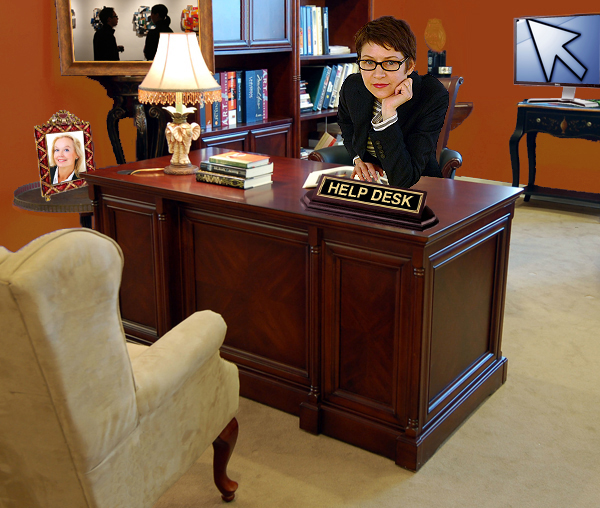
Your counselor, hard at work.

My question centers around income: does an artist truly need their own website to be successful? Do prospective buyers really look up your name and view your work? I’m a financially struggling student–I do not have an official website (only a facebook dedicated to art). Is this a serious drawback in the sense that others will not take me seriously as an artist even if my work is of good quality?

Worrying about being taken seriously is putting your cart before the horse, because how will these hypothetical people even find you in order to evaluate your work? I asked around about websites and this is what I heard:

One New York gallerist said, “One doesn’t NEED a website, but it helps curators and galleries find your work… I doubt that ‘buyers’ really come via the web, but I think it is advantageous so have some web presence if you want to be found.”

Likewise, the gallerist I contacted in Berlin said, “Yes of course people (collectors, curators, gallerists) are researching artists they are interested in – who doesn’t use Google? If an artist does not have a gallery representing them with a comprehensive overview of what they’ve done on their site, it’s probably good to have some information available that allows interested persons to see the work without contacting the artist directly.  I don’t know if it will make anyone successful though!  Most “buyers” are going to buy from galleries I think, and really it’s gallerists and curators who are going to reference the site, so it would be bad form to set up a website that was geared towards selling work.”

Make it easy for people to find your work. (image: affiliatemarketerscollege.com)

The most comprehensive answer came from a San Francisco gallerist (it must be that famous “California abundance” at work): “This is an interesting question. Ultimately, a website is one piece to the puzzle and the need is probably in relation to what an artist’s gallery (or galleries) is providing for them. Having one’s own website of course provides the greatest control of presentation so long as the artist is capable and willing to do the work. Most people do not realize the extent to which a website is an on-going project and an out-of-date website can easily give the impression that an artist has given up their practice. One needs to keep the images (individual works and exhibitions), biography and press updated and the photography should be as professional as possible. The design and photography on any given website has evolved so much in the past five years, and with it our sophistication as visual consumers on the web.”

Read More »

Share

From the Archives

Czech out the DS Archives!

I know, cheesy pun but too good to resist. And it’s relevant because today’s look into the DS Archives features Czech artist Monika Fryčová and the group exhibition, There is Nothing There at the Czech Center Gallery in NYC. The two exhibitions demonstrate the countless ways in which Czech artists and people interpret their lives in the current social and political state in the Czech Republic: “a tension suspended between the failure of the communist utopia and relentless capitalist expansion.” (Czech Center Gallery)

The following article was originally posted by Marilyn Goh on December 15, 2011: 

Monika Fryčová, Perpetuum Mobile, 2011. Image: Kling og Bang gallery.

Monika Fryčová’s show Perpetuum Mobile at the Kling og Bang Gallery propositions that the relationship between the visible and invisible is constantly in motion and ephemeral.

Locked behind the socialist borders in then-Czechoslovakia, stories of local culture were the only narratives that Fryčová heard. Like many artists who were restless for new physical activity and renewed visions after the fall of the Iron Curtain, Fryčová became in her own words, a traveller who charted her own routes and made her own narratives without maps or guides. Consequentially, Fryčová’s works are highly improvised, and dependent on the indeterminacy and spontaneity of human interactions.

Read More »

Share

Fan Mail

Fan Mail: Erin Rachel Hudak

For this edition of Fan Mail, New York based artist Erin Rachel Hudak has been selected from a group of worthy submissions. If you would like to be considered, please submit to info@dailyserving.com a link to your website with ‘Fan Mail’ in the subject line. One artist is featured each month—the next one could be you!

I have grown to love a television program entitled American Restoration, which chronicles a Las Vegas shop that restores rusty, beat-up items to their former beauty. After recently marveling at the rebirth of a 1940s USPS mailbox, it became evident that my fixation on these objects has little to do with the items themselves, but is instead tied to the stories I fashion for them in my mind and believe must be accurate.

Erin Rachel Hudak. Installation of "Promiseland," Ochi Gallery, Ketchum, ID. February 17-March 7, 2012.

Promiseland – Erin Rachel Hudak’s new body of work – responds to notions of storytelling, considering the ways individual narratives can be insinuated into more collective notions of cultural and national history. She mines Americana for her imagery, incorporating quilt patterns, lanterns and baskets, among others, into her paintings and collages. Her images immediately evoke an almost innate rehearsal of American folklore. At the same time, her slight subversions of these original symbols – coupled with the use of opened ended phrases like “this is where we begin” – invite a more personal interpretation of these signs.

Erin Rachel Hudak. "Promiseland," 2011. Acrylic on canvas. 58” x 66". Courtesy of the Artist and Ochi Gallery, Ketchum, ID.

While the works’ subject matters may initially appear benign – seemingly playful due to their bright colors and use of lighthearted materials such as glitter – there are often underlying political implications. The title painting, Promiseland, reconsiders the American Seal, presenting the bald eagle holding arrows, but missing the corresponding olive branch – that which nods to our preference for peace. The lightly colored wing on the left stands in stark contrast to the ominous, dripping black characterizing the right wing. I am particularly intrigued by the repeated appearance of fire in these works. What at first seems to be an innocuous allusion to a campfire – the quintessential site of storytelling in American culture – also references a headdress and crown, intimating those narratives often concealed from public consciousness.

Read More »

Share

LA Expanded

High Performance

L.A. Expanded: Notes from the West Coast
A weekly column by Catherine Wagley

Gail Devers in Athens

Do you remember track star Gail Devers, with her absurdly long nails? I noticed her for the first time in Atlanta, on television during the 1996 Olympics, where she one her third gold. Then, her nails were painted gold to match the medal she had yet to win. Eight years later, in Athens, her nails were blue. That she had those nails at all made her seem smarter than her competitors, like she alone had figured out how to bend norms and regulations to make her body entirely her own. “I run with my feet,” she once said, meaning it didn’t matter what flourishes she had on her hands.

I thought of Devers when I read that Caster Semenya, the 2009 World Champion in the 800 meters race who was hindered from competing in 2010 when huge improvement in her time and her butch appearance made officials and others question her gender, has a new coach, a woman from Mozambique. She will no longer be working with the men who managed her as her career began, when she was often going off with other racers to prove to them her femaleness: ‘”They are doubting me,’ she would explain to her coaches, as she headed off the field toward the lavatory.”

Semenya has long nails, too, or at least she did when writer Ariel Levy tracked her down for a brief moment in 2009, not long after she had been subjected to a series of uncomfortable, publicly debated gender tests. “She wore sandals and track pants and kept her hood up,” said Levy. “She didn’t look like an eighteen-year-old girl, or an eighteen-year-old boy. She looked like something else, something magnificent.”

Read More »

Share

London

My dog is dead, my pigeon is lost, and I fell down a rabbit hole

David Shrigley, Untitled, 2011. Courtesy of David Shrigley and Yvon Lambert. Untitled, 2011 Courtesy of David Shrigley and Yvon Lambert

When I first saw David Shrigley, I was taken aback by his calm aura and semblance of complete normalcy. A man known for his searing dead-pan humour, I half-expected to see a crazed post-punk artist living on the fringes of society. But here was a charming, clean-cut gentleman, tranquilly tattooing ink drawings onto willing participants in the middle of London’s most extravagant art fair.

Calm, cool and collected on the outside, seethingly acidic on the inside, Shrigley’s solo show at the Hayward Gallery, London, mirrors the state of the artist himself. Moving way beyond the drawings for which the artist is best known, Brain Activity includes Shrigley’s paintings, sculpture, installation, animation and photography – cracking open the artists’ cranium for us just a little bit.

I admire the brutal honestly in Shrigley’s work – he tells it exactly as it is, injecting humour and wit into the everyday with his veracious observations. His work is highly accessible – witnessed by the large number of children running around the exhibition – but never simply topical. Both referential and moralistic, Shrigley’s work extends far beyond the realm of cartoons, and is beginning to become an institutional staple.

Read More »

Share

New York

The 2012 Whitney Biennial: A Rehabilitated Production

The beginning of March sees New York erupt in an art world flurry with the 75th Whitney Biennial igniting the itinerary for the next couple months of art fairs, large-scale exhibitions, auctions, and not least of all, the parties that accompany such events. Presented by Elisabeth Sussman and Jay Sanders, who formed a fortuitous curatorial duo, the 2012 Biennial shone brighter than the previous Biennial in 2010 for many reasons. Sussman, curator/Sondra Gilman Curator of Photography at the Whitney, and Sanders, a freelance curator, writer and dealer for New York’s Greene Naftali gallery, not only pared down the number of exhibited artists, but also incited a dialogue that is both timely and urgent.

Werner Herzog, Hearsay of the Soul, 2012. Installation: four channel digital projection of twenty etchings by Hercules Segers; music by Ernst Reijseger. Image courtesy of the Whitney Museum.

This year, the Biennial acts as a platform – or even a forum if you will – for comprehending the expanded fields of contemporary art in relation to performance, film, literary, multi-media and curatorial praxis. Whereas the Biennial in 2010 acted as an acknowledgment of a benchmark – that being the year 2010 – taking its thesis from the roots of retrospection. It looked towards the history of the Whitney Biennial since its inception in 1932, in honoring the structure and legacy of the Biennial, while also commenting on the political and social structures of rehabilitation that were propagated from certain instances such as the presidential election of Barack Obama. Unfortunately – and probably at the fault of an overly expansive thesis – the 2010 Biennial fell flat, quite simply, and was remarkably unmemorable for me. However, the 2012 Biennial this year not only commands more cohesiveness in both content and intention, but its presentation of works from fifty-one artists – a list edited more so than any Biennial to date – granted a substantial significance to the curation as a whole production.

The 2012 Biennial, poignantly dedicated to the late Mike Kelley who passed away earlier this year, presents artists at all points in their careers, in a vast array of media from painting, sculpture, photography, installation, music, theater, film and dance. Not only did curators Sussman and Sanders instigate the notion of the “expanded field of the arts”, but they very much emphasized the connective points between one practice to another, or similarly one profession to another. As quoted in the 2012 Biennial press release, both Sussman and Sanders remarks that, “[…] a number of artists are functioning as researchers and curators, drawing on the histories of art, design, dance, music and technology. Artists are bringing other artists into their work – a form of free collage or reinvention that borrows from the culture at large as a way of rewriting the standard narratives and exposing more relevant hybrids”.

Dawn Kasper, THIS COULD BE SOMETHING IF I LET IT, 2012 (from the series Nomadic Studio Practice Experiment, 2009– ). Three-month durational performance and multimedia installation. Dimensions variable. Collection of the artist. Image courtesy of the Whitney Museum.

One of the most noteworthy aspects of the 2012 Biennial is the 6,000-square foot performance arena designed on the fourth floor. Complete with viewing bleachers, this space is dedicated to musical, dance, theatrical (et al.) performances through the end of the Biennial. Performances directed by choreographers such as Michael Clark and Sarah Michelson, as well as various musical acts such as the experimental rock band The Red Krayola and soprano singer Alicia Hall Moran, turn the fourth floor space into a theater of expansive talent, blurring the boundaries between context and vocation.

Read More »

Share

San Francisco

Weaving, Not Cloth: Mark Bradford

The difficulty in viewing photographs of artwork is that the camera flattens the object in its focus, relinquishing subtleties in order to capture a whole. Because his oeuvre is very subtle indeed, Mark Bradford’s work requires a viewer’s presence to be fully appreciated. Very little of the slender lines of collage, delicate papers built up in thin layers or washes of paint almost completely sanded away is apparent in reproduction. Each of the more than forty of Bradford’s works now on view at SFMOMA calls out to be felt, if not by the hand of the viewer then by the eye. They elicit a state of tactile vision, a reminder that visual perception is also connected to the faculty of touch.

Mark Bradford, Potable Water, 2005; billboard paper, photomechanical reproductions, acrylic gel medium, and additional mixed media; 130 x 196 inches; collection of Hunter Gray; © Mark Bradford; photo: Bruce M. White

In the scholarship regarding his work, much has been made of the condition and location of Bradford’s studio practice.* He grew up (and still lives) in South Central Los Angeles, a mainly black neighborhood mythologized for its urban decay. Bradford worked at his mother’s hair salon before attending art school, learning skills that he would adapt to his practice: hard work, repetitive actions and tactile processes. He gleans his materials from the posters, billboard papers, and hair salon permanent-wave end papers that are still part of his environment. And while all this information surely contributes to an important analysis of his work based in socio-economics, race and culture, it ignores the physicality and lushness of the actual surfaces and the connection of Bradford’s work to textiles.

Mark Bradford, Value 47, 2009–10. Billboard paper, photomechanical reproductions, acrylic gel medium, carbon paper, nylon string, and additional mixed media on canvas; 48 x 60 inches; courtesy of the artist and Sikkema Jenkins & Co., New York; © Mark Bradford; photo: Fredrik Nilsen

Up close, the dense materiality of each piece intrigues with a kind of sumptuous dissolution; there is tension between order and chaos, rigid geometries and decay. Layers and layers of papers and paint built up over time manifest the tactile nature of his working process, while the sanding between layers wears away the visible to the point of ruin. Each surface affirms Bradford’s physical presence, because these are techniques that can only be achieved by putting sinew and muscle in service of production. Though he calls them paintings, Bradford’s work more precisely exists in the productive space between painting, collage, and textiles. Many of the smaller and mid-scale collages are built on stretched canvases, allusions to the image-framing and containment of the traditional painting. However, several larger works are created on unstretched canvas that adds a layer of dimensionality to the form. For example, the surface of You’re Nobody (Til Somebody Kills You) undulates like fabric—it’s not really flat at all—and the edges are ragged and crusted with cracked paint. Though I include a photograph of the work below, the camera fails to capture the tangible thicknesses at the edges of torn papers, the white areas sanded smooth, the divots and pockmarks in the grids, or the directional marks of a brush dragged through thick gel medium. These surfaces create the haptic character of the work.

Read More »

Share