
London

Endless Plains: An Interview with Polly Morgan

Polly Morgan is an artist notorious for her taxidermied animal assemblages that skillfully transform a tradition often seen as kitsch or macabre into elegant and highly sought-after creations. Initially training with professional taxidermist George Jamieson, Morgan set out not necessarily to make art, but rather as a way to furnish her own flat. She continued to create, trying preserving the moments between decay and death, encouraged by many of the YBA artists whom she met while working in a bar in East London. Her pieces caught the eye of Banksy, commissions followed, and one of her first works, a small white rat curled up in a champagne glass, was snapped up at Zoo Art Fair in 2005 before it even opened. Collectors, exhibitions and infamy followed, and her story has since become one of urban art legend.

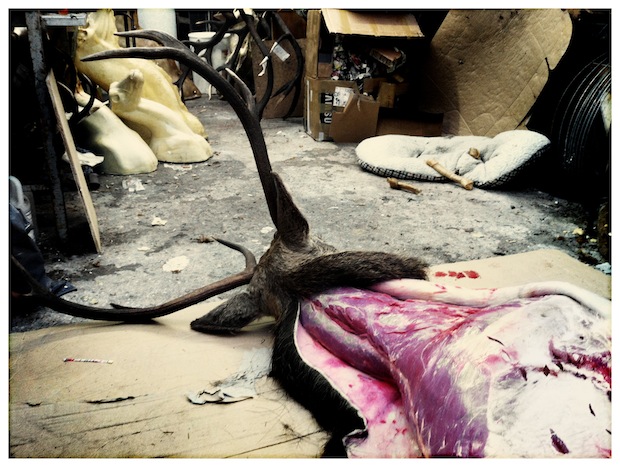
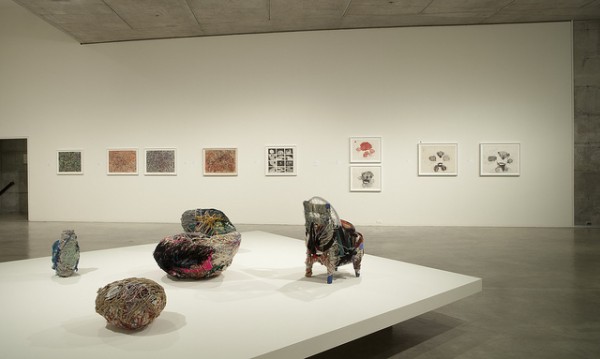
Morgan’s largest installation to date, currently on view at All Visual Arts in London, incorporates not only the taxidermic medium that drove her notoriety, but also hybrid mixed media sculptures, and drawings made from cremated bird remains, which remain true to her rather noir roots. The exhibition, entitled Endless Plains, was inspired by Morgan’s recent trip to the Serengeti and her own intimate encounter with mortality, interpreting the cycles of life and the inescapability of death through poetic and grotesque narrative forms. On the occasion of the exhibition, Morgan discussed with Michelle Schultz many of the inspirations for her latest work: those cannibalistic, parasitic and driven by decay.

Polly Morgan, Endless Plains, installation view, 2012. Courtesy All Visual Arts. Photography by Tessa Angus.

Michelle Schultz: Could you perhaps begin by telling me a little bit about your trip to Serengeti and how this is interpreted in your latest work in the exhibition Endless Plains?

Polly Morgan: I was inspired by the dead bodies littering the landscape, many of which had been hollowed out from within by vultures. Their skins had dried on the bones and they looked almost taxidermic. Seeing the dead alongside the living and just born, I felt I could see the whole of life being played out in front of me. Endless Plains, the translation of Serengeti, struck me as a perfect term for the landscape, which felt like a hall of mirrors – the same routine stretching from the past into the future.

MS: Your own encounter with mortality is something that is spoken about in relation to this exhibition – how this has influenced your work? In particular, perhaps how you have come to perceive the boundaries between life and death.

PM: It was just another reminder that I am part of this chain of life and death and there’s no avoiding it. I was particularly interested in the fact that I had had gangrene – a part of my body had died and decomposed inside me – and that I was simultaneously living and dying. I had a post-operative infection, where bacteria was spreading inside me – this felt like an invasion, leading me to think about the relationship between hosts and parasites, and changed the direction of my show slightly.

MS: Yes, I feel as though many of your previous works are quite quiet and poetic, but these recent sculptural works appear to be more violent and aggressive, and perhaps grotesque in a certain way – this could be seen as a result of your recent experiences.

PM: It might be. It is also a result of my becoming bored of my old work, which felt unchallenging and too easy on the eye. As soon as I stop feeling anything, I instigate change, in relationships/work/anything. I didn’t want to sentimentalise nature, which I was concerned some of my work was bordering on, I wanted to show it as it is; cannibalistic, predatory and unnerving.

MS: It no longer seems to me that you are trying to preserve that moment between death and decay as you have spoken about in relation to previous work, but rather now trying to preserve the state of decay itself. Would this be a fair statement?

PM: I hadn’t really thought of it like that but it is a fair remark. I felt it was no longer enough for me to present the animal as an ornament, I wanted to take it further and to show, albeit in a corrupted unrealistic way, what happens to a dead body or why it is dead in the first place.

Polly Morgan, production still, 2012. Courtesy of All Visual Arts.

MS: Now going back to the very beginning, can we talk about what instinctively brought you to taxidermy as a medium in the first place? When you began training with George Jamieson, were your intentions always to use taxidermy to create art, or were you considering a career as a traditional taxidermist?  Read More »

Share

Hashtags

#Hashtags: Lolo, the Virgin Bride


Lori "Lolo" Jones, HBO’s "Real Sports" in 2012, discussing her status as a virgin.

I am consumed by the Olympics. I’ve been counting down the seasons until the summer of 2012 and the days until July 29th. When the Olympic Games are being televised, I schedule my work and social life around watching my chosen events (gymnastics, swimming, and above all, track and field). This is a good moment to include the information that I was competitive runner, starting to train seriously even before the onset of puberty. Though I no longer participate in the sport and haven’t since I finished college, I revel in the one time, every four years, that it is performed internationally at its highest levels, and that other people care about it enough to watch it unfold in their living rooms.

One of America’s great hopes in track and field this summer in London is a hurdler by the name of Lori “Lolo” Jones. Though she is a few years older than I, we overlapped during our time in college; I was competing for UCLA when Jones was attending Louisiana State University (a longtime sprinting powerhouse). I never met Jones, but she once tried to steal my friend’s football-playing boyfriend, so I never thought that highly of her character. Athletically, however, she is an animal. While at LSU, Jones was a three-time national champion and eleven-time All-American in the 60- and 100-meter hurdle events. Once out of college and a pro athlete, Jones was the first woman ever to claim back-to-back World Indoor titles in the 60 meter hurdles while setting an American record in the process. How to describe these feats? Imagine being born with the right physiology, sense of purpose, and ability to absorb and withstand pain. Imagine being better at something than thousands of people who are really good at that same thing. Imagine being a woman, who, in front of the whole world, is unafraid of winning.

Lolo Jones, I must add, is quite beautiful. She is of French, African-American, Native-American, and Norwegian descent. She has wide cheekbones, green eyes, and a warm, easy smile. Her body is incredibly toned and muscular, but doesn’t tread into androgyny, as is the case with many Olympic-grade female sprinters. Being wildly attractive doesn’t hurt in winning her commercial endorsements — such as one from the oil company BP — magazine pictorials, and general mass appeal. But given her winning record, I can confidently say she would have accrued this attention anyway. Jones is an unmistakable champion. And, as the world learned a few months ago, she is a twenty-nine year old virgin.

Jones in a promotional photograph for Red Bull, one of her sponsors, 2012.

Much has been made of Jones’ May 22 proclamation of virginity, announced of all places on HBO’s Real Sports with Bryan Gumbel during a segment called “Olympic Sacrifices.” “It’s something, a gift I want to give my husband,” Jones said, continuing: “This journey has been hard…It’s the hardest thing I’ve ever done in my life. Harder than training for the Olympics. Harder than graduating from college has been staying a virgin before marriage.” She was at once self-deprecating and awkward in her delivery, clumsily justifying her choice to “remain pure” as a response to the dissolution of her parents’ union (they broke up after being together for twenty years and never marrying). She ends the segment by saying, “I guess I want that Norman Rockwell picture.” Since the interview, her Twitter followers (Jones generally posts between two and five times a day) have risen 40 percent, and her story has been picked up by People magazine, the Los Angeles Times and the Washington Post, among many others. Donald Trump, who has 1,320,454 followers on Twitter at the moment, wrote: “Lolo Jones, our beautiful Olympic athlete, wants to remain a virgin until she gets married — she is great.” The first comment under the YouTube clip of the interview, which I urge you to watch, reads: “Finally somebody that does the right thing!!!!!!!!!”

In light of this (largely) positive response from the public, Jones’ dissenters are quick to bring up the fact that she has posed, scantily clad, for several magazines.[1] Most recently, she was photographed fully nude and in a coy pose for ESPN Magazine, which has anointed her the “sexiest female Olympian.” But this is a tired argument, isn’t it? I’m less interested in the fact that Jones promotes a highly sexualized image of her body despite claiming moral virtue; Britney Spears, Jessica Simpson, and a plethora of other teen pop-tarts drained anything interesting or unpredictable about this “look-but-don’t-touch” sexy schoolgirl subterfuge in the late 90s. There is something decidedly more complicated and problematic about Jones’s recent declaration, and that shifts the critical conversation. Jones is not a pop star — a person whose very career hinges on the strategic contradictions of their public image. Rather, she is something less packaged and more aspirational, yet still bound up in the world of the bodily performance: a championship athlete. And not only any athlete, Jones is our great hope, who, barring injury, will likely win several gold medals in a few weeks.

“A boxer is his body,” wrote Joyce Carol Oates in her seminal 1987 book On Boxing,[2] and the same could be said of any Olympic-caliber athlete — particularly those who compete independently of external equipment or an immediate team structure. Jones has trained six hours a day, six days a week, for the past twelve years. That is almost 25,000 cumulative hours. Can you imagine that reality? Jones is training as you read these words on your computer screen. She is wholly accustomed to a life of the body — life as body, Oates would argue — which is punishing, ecstatic, and that above all, taps a primal consciousness.[3] How then, in a profession dedicated to pushing the boundaries of physicalized performance, is one to consider the disavowal of sex and suppression of desire? I am not sure I have the answer to this, but it’s a question worth asking.[4]

Jones poses in the pages of ESPN Magazine.

I have to admit, it is difficult to set aside here my belief that celibacy until marriage is a patriarchal anachronism that entails withholding (primarily female) sexuality as a weird prize. I can’t possibly do better on this than Emily Shire of Slate magazine, who wrote, on May 31st: “It’s disheartening that [Jones’] choice to remain a virgin is not for her own sake, but someone else’s. If virginity is commodified into the “perfect gift,” it becomes about a woman pleasing a man rather than herself, and it is difficult to picture the determined and forceful Jones being that submissive in any other aspect of her life.” However, the concern of this essay — the entanglement of abstinence and the athletic body — is not political as much as it is cerebral. In her HBO interview, Jones stated that maintaining her virginity was “harder than training for the Olympics”, and it’s an interesting comparison.[5] Both activities demand discipline over bodily desire, though in different, if oppositional, forms; athletic discipline requires the willing application of self and body, while the discipline of celibacy requires its continued refusal. Jones’ sexual status is of course her choice, but needless to say, it appears to me as perfectly incongruous with the virtuous rapture and abandon of athletic life.

Some people believe that Jones is not in fact a virgin. But who cares? She has publicly stated that she is, and that is what matters. Of course, if she weren’t a woman, much less a beautiful woman, her sexual status would not command so much media attention, not be considered the ‘prize’ that it is. Ultimately, Jones should decide if she wants to win the trophy, or be one. It’s a consequential distinction of which she appears dangerously unaware.

——————

[1] On May 25th, Twitter-user Taylor Maddox wrote on Lolo’s wall: “Respect n appreciation 4 ur purity, but I can’t wrap my mind around the body pics. Seems incongruent to ur strength and Christ :/)”, to which Jones responded: “go to a museum & look at naked pictures/statues of ppl & its considered art but what I did is not? u see no parts exposed.” http://twitter.com/lolojones

[2] Oates, Joyce Carol. On Boxing. New York: Doubleday (1987): 72.

[3] In his 1994’s essay, “How Tracey Austin Broke My Heart,” David Foster Wallace wrote: “It is not an accident that great athletes are called “naturals,” because they can, in performance, be totally present: they can proceed on instinct and muscle memory and automatic will such that agent and action are one.” In: Foster Wallace, David. Consider the Lobster. New York: Little, Brown and Company (2005): 154.

[4] In thinking more about matters of sexual economy and ritual, I turn to Michel Foucault. I was amazed to realize that he in fact dissects the connection between athleticism and abstinence in some depth in The History of Sexuality: Volume 2, writing: “A moral victory which the athlete needed to win over himself if we wished to be capable and worthy of assuring his superiority over others; but also that of an economy necessary for his body in order to conserve strength, which the sexual act would waste on the outside.” It’s a bit limited for my own purposes, as Foucault refers only the restrictive habits of male athletes, e.g., a regimen of non-ejaculation pre-competition. Still: fascinating! In: Foucault, Michel. The History of Sexuality, Vol. 2: The Use of Pleasure. New York: Vintage Books (reprint 1990): 120. 

[5] Interestingly, the use of the word “purity” in relation to Jones’s body stands in direct opposition to the recent, rampant steroid use in the sport, often referred to as “being dirty.”




Share

Help Desk

Help Desk: Flirtatious Collectors & Young Curators

Help Desk is an arts-advice column that demystifies practices for artists, writers, curators, collectors, patrons, and the general public. Submit your questions anonymously here. All submissions become the property of Daily Serving. Help Desk is cosponsored by KQED.org.

The work in this week’s column is by Rob Swainston, who will have a solo show at Neuwerk Kunsthalle in Konstanz, Germany in September. For those of you following the discussion around artist statements, Rob’s is worth checking out.

I work for a commercial gallery space and have been approached by male collectors who express an interest in taking me out. More often than not, I have no interest in these men, but I am always anxious my boss may be upset that I get a bit cold in order to put them off. What do you think is the appropriate way to handle this situation?

The easy way out is to buy a decoy engagement ring, a big eye-catching piece of sparkly glass, and wear it to work. If you’re a man, you could try the same with a traditional-looking thick gold band. It won’t stop all comers, but it might scare off the majority.

Rob Swainston, Centennial, 2009. Woodblock print on paper, each scroll 36 in x 10 ft., installation dimensions variable

But it would be better if you understood your employer’s expectations so that you could stop feeling anxious, and the only way to do that is have an open and honest conversation. Then the two of you can decide together what course of action to take. There’s no need to feel awkward, just ask for a quick meeting and state the facts: collectors are asking you out and you’re not interested. Say, “How would you like me to handle this situation?” Probably your employer will direct you to act similarly to what you’re already doing, but if she tells you to do something that you’re not comfortable with, you must speak up calmly but immediately: “I don’t think that’s going to work, can we find another solution?” Both parties need to put their cards on the table; that way you will know what’s expected, and also your boss can get your back should an uninvited flirtation get out of hand. You need to know that your boundaries are respected in the workplace, if not by the clientele then at least by your colleagues. And of course, if your boss tries to pimp you out in the interest of selling some work, you’ll know that it’s time to grab your bag and run for the door.

Without knowing exactly what you consider “a bit cold,” it’s hard to give detailed behavioral advice. Yet as a side note, you might consider learning how to say a firm, confident “Thank you, but no” with a pleasant look on your face. It will serve you well in your current predicament, and you will find it handy in all kinds of situations.

Rob Swainston, Triumphal Arch, 2007. Installation

A very close friend and I are curating an exhibit in Kansas City. The entire show consists of artists under the age of 21 including us curators. We have a pretty solid plan, filled with installations, video projections, paintings, sculptures, and performance. What are some words of advice you can give to us as we embark on our first and greatest endeavor to date? I think the hardest part is the fact that we are all so young. We are definitely talented, not to be modest. I feel that it is going to be hard for people to take us seriously and also hard to make a show worthy of critique and review from the establishment. It’s also hard to perceive the future issues we might face during set up and the opening. It’s also going to be hard to combine all these talents together without it being a sensory overload. What are some issues you’ve come across that we probably wouldn’t have thought of ahead of time?

First of all, bravo! I’m glad to hear that you are making and executing ambitious plans. I have no doubt that your work is going to be inspiring to the other artists and curators in your community.

Read More »

Share

From the Archives

Matrix at BAM/PFA

Berkeley Art Museum‘s MATRIX  series presents two new exhibitions by Lutz Bacher and D-L Alvarez. Since Lutz Bacher’s first MATRIX exhibition in 1993, the artist has become a leading figure in contemporary art. D-L Alvarez’s first solo museum exhibition presents a haunting meditation on the violent end of innocence. The artist focuses on the uncanny moments when social and domestic deviance collides. Today from the DS Archives we take another look at last year’s exhibition at BAM/PFA, Create.

The following article was originally published on July 23, 2011 Written by :

Installation view of Create, curated by Lawrence Rinder with Matthew Higgs. Photo: Sibila Savage.

Read More »

Share

Singapore

Seeker of Hope: Works by Jia Aili

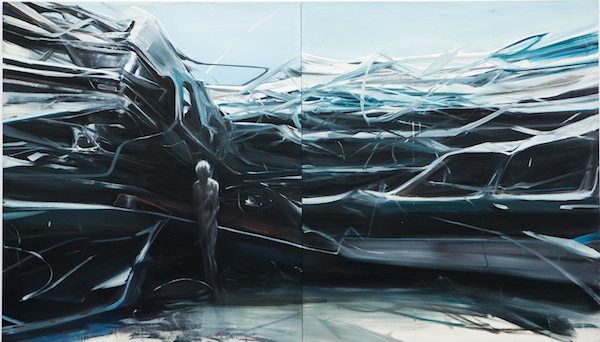
Jia Aili Untitled (无题), 2011, Oil on canvas, 200 x 290 cm. Artist Collection.

As Jia Aili grew up in the 1980s, it seemed as though post-Mao Zedong China was well on its way into transforming itself into a superpower, leaving in its wake the trauma of the Great Leap Forward and the Cultural Revolution, struggling more with material trappings and economic growth rather than ideological fulfilment. These reforms and attitudes quickly penetrated across China’s vast landscapes, accompanied by a rising contemporary aesthetic movement – or perhaps better known as the Chinese avant-garde – that expressed modernisation’s boons and banes through a visual language that is first gleaned from 2 centuries’ worth of Western cultural learning and development, then later applied to local cultural conditions.[1]

A common theme that ran through the ouevre of those who worked within the cultural infrastructure of the first few decades following the revolution was the critical documentation of the tension between tradition and modernisation, and the personal and the collective as China navigated the stormy waters of reform and restructure. The reactionary sentiments and styles of pioneering contemporary artists such as Fang Lijun[2] and Wang Guangyi[3] resulted in works that responded to official propaganda, their visual vocabulary and conceptual ideas serving as an evolutionary springboard for those who felt that they needed to give voice to the lingering but still-potent sting of the lingering Mao-ideology. Others like Ai Weiwei investigate their country’s complex relationship with its ancient past in a time when the seeds of unrest have begun to germinate amid its stratospheric economic growth.

Jia Aili, Old Painter I (老画家1), 2008-2009, Oil on canvas, 229 x 400 cm, SAM Collection

Jia Aili however, counts himself among those in the generation of emerging artists who, not having lived through the era of cultural regression, grapple with the mindsets of their contemporaries and pay little attention to the socio-political changes in the country unlike their predecessors. Stylistically experimenting with tropes and techniques of the Western art historical canon, they depart nonetheless from the stereotype that the Chinese contemporary art is inextricably entwined with politics or social problems.

Seeker of Hope is an exhibition of this growing sentiment that Jia Aili unmistakably expresses, detailing an oeuvre that encompasses conflated hints of romanticism, symbolism and surrealism to display the extent of loneliness and solitude of those who lived under markedly differing socio-economic conditions of the last 3 decades.

Jia Aili Untitled (无题), 2010-2012, Oil on canvas, 233 x 203 cm. Artist Collection.

The ghosts of other art movements, artists and literary tropes frequently drift in and out Jia’s ouevre: the Romantic celebration of emotion and flux, the expressionist distortion and exaggeration of formal elements, the memento mori of skulls and the remorseless passage of time that dates back to Antiquity, the high-contrast chiaroscuro of Caravaggio (1571-1610) and Rembrandt (1606-69). Jia’s Untitled (2011) greenish hues echo Caspar David Friedrich’s (1774-1840) mystical landscapes, yet his astronaut series (2010-12) is anchored in the present, a reflection on China’s first atomic bomb and astronaut programme, depicted in the clear tonal contrasts of light and shade characteristic of Mannerist and Baroque works.

Read More »

Share

LA Expanded

Summer Social

Two years ago, I had probably the best art summer I ever had. Ryan Trecartin’s show was at MOCA’s PDC satellite and I went 6 times, and it felt like a group show — or a show made by a group — even though it wasn’t. So as summer show season starts again, here’s a revisited homage to the group.

L.A. Expanded: Notes from the West Coast
A weekly column by Catherine Wagley


Jack Pierson, "Tupelo," 2008. In the group show Country Music, at Blum & Poe, through Aug. 21. Courtesy Cheim & Reid, via Blum & Poe.


“I remember thinking when I first saw a show of Jack Pierson’s that it looked like a group show–Jack’s photos, big letters, a desk. I was excited by this possibility,” wrote Eileen Myles, “that anyone might start to look like a group.” That the peripatetic Pierson–who’s like a travel photographer fixated on minutiae but doggedly committed to the obligatory sunset shot (Myles has called him a hobo with an “Ivy League crook look”)–isn’t interesting as an individual is the most interesting thing about him. It’s like his nostalgic signage, paired with undifferentiated photographs of horizon lines, open books, young-ish nude men or Visconti-worthy table settings are together accidentally. Even his technical finesse, evidence that none of his projects are as flip as they seem, doesn’t keep Pierson from looking like a library of other people’s wants, wallets and persuasions.

Summer is art’s season of group efforts, and Pierson’s Tupelo sign currently hangs in Blum & Poe’s seven-artist Country Music, a quaint homage to sappy love and Nashville twang. But what’s weirder and more exciting is the way in which the Jack-Pierson-effect, an unpretentious artist-as-meme mien, has somehow infected L.A.’s summer scene. The city’s best group shows aren’t really group shows at all.

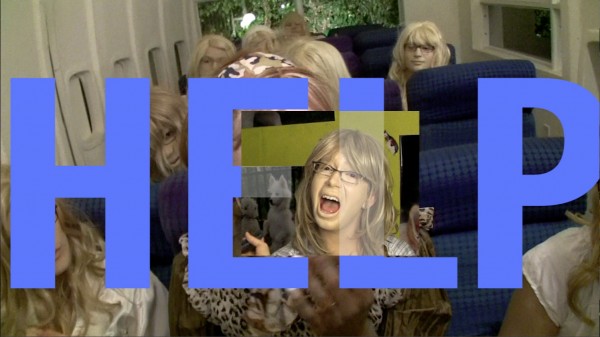
Ryan Trecartin, "K-Corea Inc.. K (Section A)," video still, 2009.

At MoCA’s Pacific Design Center, there’s Ryan Trecartin’s Any Ever, the topic of this column last week. It works intertextually (and that heady term fits Trecartin perfectly, though his version includes a text message shorthand that Kristeva and de Saussure couldn’t have imagined) as a labyrinth of prissy voices, over-the-top flamboyancy and brash epitaphs. Slippery ownership of person-hood is a coursing theme:

“Cut my hair shorter. I like that kind of person,” says one character. “I define myself as a situation hacker,” says another. “Help me define myself.” “The economy of my body is booming and everyone takes part.”

But collaboration, not slipperiness, gives Any Ever its group cred. Perfecting each of the show’s details involved a posse of helper-friends; Trecartin, though part control freak, manages to give his characters uncanny autonomy; and the videos fluidly feed actors, lines and moods to each other until it’s impossible to tell them apart.

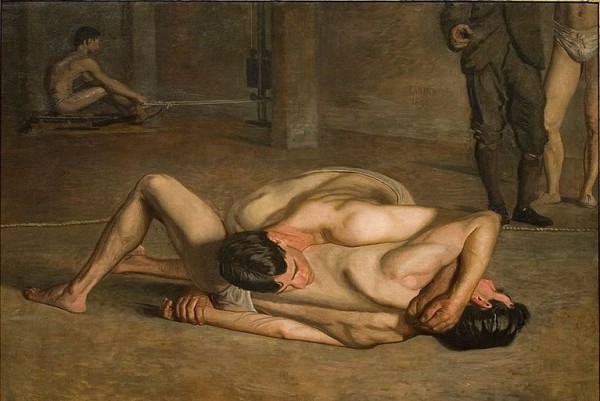
Thomas Eakins, "The Wrestlers," 1899.

LACMA’s Manly Pursuits: The Sporting Images of Thomas Eakins includes photographs and paintings from the wide-ranging sport-focused repertoire of Eakins, the royal of American Realism. Some are platonic and tame–like The Champion Single Sculls (Max Schmitt in a Single Scull) (1871), in which Max sits mid-water, lost in thought. Others get physically aggressive, like Wrestlers (1899), which shows bodies in a tangle. The exhibition also includes a swath of photographic studies featuring Eakins’ male students in the nude. It’s a show of many Eakins: the anatomist, the observer, the transgressor, the seducer, the sentimentalist. And it’s best when the different Eakins fit together awkwardly, as they do in a series of equestrian and hunting paintings that make conventional manliness look uncomfortable with itself and studies like this tug-of-war photograph in which sincerity becomes erotic and erotic becomes comic.

Brian Kennon, Installation view, July 2010. Courtesy Steve Turner Contemporary.

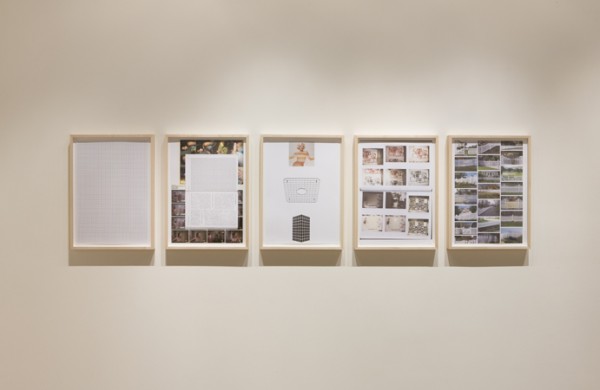
Brian Kennon, "Group Shows," Installation view, 2010. Courtesy Steve Turner Contemporary.

If Pierson begins to look like a group, Brian Kennon arrives as an already-assembled collective. His current exhibition at Steve Turner Contemporary (which closes tomorrow and is worth the last-minute dash) is called Group Shows and the plural–“shows” and not “show”–matters. Even Kennon’s groups are grouped. The exhibition includes two series and, for the first, Kennon composed mid-sized prints that put work of other artists, including John Baldessari, Franz West, Sherrie Levine and Wolfgang Tillmans, into curated conversations with each other. Though, in Dinner with Matthew, art talks to food. A bite-size image of Matthew Brannon’s Last to Know, which shows pink band-aids scattered across an invisible grid, anchors images of an entree and Bostini Cream pie. For the second series, Kennon merged gridded patterns with found photographs. One sleek print shows Bert Stern’s iconic striped-scarf photograph of Marilyn Monroe sitting above a gridded panel with an oval orifice which, in turn, sits above a vertical geometric column. It’s called Untitled (Monroe/Bochner Sex Joke).

Artist-linguist-prankster Mel Bochner plays a recurring role in Group Shows and, in the pithy Richard-Prince-quality narrative that serves as the press release’s epigraph, Bochner stands-in for Kennon:

Marilyn (through stripes) to Mel (measured): “If you were given the opportunity to initiate an orgy, one that would include anyone of your choosing, who would be in it?” Mel, in response: “Can you ask me the same question, but in regards to a dinner party? At a dinner party the host retains far more control over who can sit where.”

Kennon controls every interaction that occurs in Shows–which artist sits next to which, who appears in which grouping–but not in a stifling way. While Pierson’s work suggests “anyone might start to look like a group,” Kennon’s suggests a group might start to look like anyone and this sort of mutability makes summer seem really social, not just an excuse for another art-fair worthy melange.

Share

Santa Fe

More Real?: False Realities at SITE Santa Fe

In place of what would have been SITE Santa Fe’s 9th International Biennial, the exhibition More Real?: Art in the Age of Truthiness is mounted as a question. Through cumulative stagings, illusions, virtual worlds, and fictional archives the exhibition creates a circuit of “truthiness”. The term coined by the venerable pop icon Stephen Colbert essentially means truth through gut feeling or desire rather than fact. The survey of works, from the playful to the disturbing, left me with questions like: Is deception in art even possible? Do strategies of subterfuge and ambiguity offer the viewer new possibilities anymore? Aren’t we already swimming in the hum of a falsified reality?

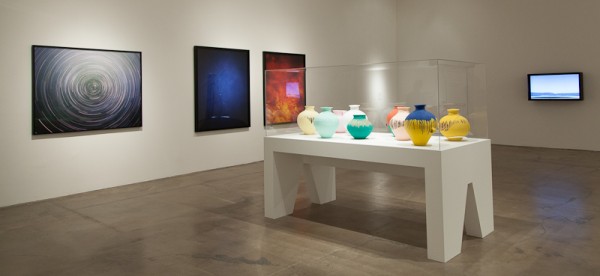
Trevor Paglen, Ai Weiwei, John Gerrard

The exhibition includes works of well-known master illusionists Thomas Demand, Vik Muniz, Ai Weiwei, Pierre Huyghe, Walid Raad and others. In Raad’s I Only Wish that I Could Weep we are informed that the high-speed archive video of nightly sunsets at a popular Beirut promenade is footage recorded by a Lebanese intelligence agent who, in his youth, yearned to experience the western sky, but because of war was isolated from it. The piece masterfully reveals genuine complexities of war through a dubious archive.

Walid Raad, still from I Only Wish That I Could Weep, 2002/2001; single-channel video, color, silent; 7:40 minutes; courtesy the artist and Paula Cooper Gallery, New York

Video and photography are material that has come to possess an inherent stickiness with the veracity of truth. An-My Lê’s documentary photographs in Small Wars and 29 Palms depict staged warfare training and reenactments located in the US while recalling foreign lands. Johan Grimonprez, in I May Have Lost Forever My Umbrella, uses passages from Portuguese poet Fernando Pessoa to narrate a collage of YouTube imagery, from chandeliers swaying to distressed deer fumbling in supermarkets and floating in gray waters. Here, the devastation of the 2011 Japanese tsunami is a residue mediated through computer screens and iPhones – heartbreaking in the most lovely way.  Read More »

Share