From the Archives

From Postwar to Postmodern and Transcool Tokyo

Another year has passed which means there are 365 more articles in the archives to choose from and bring to your attention every Sunday. Today we’re gonna talk about Japan. From Postwar to Postmodern, Art in Japan 1945–1989: Primary Documents, The Museum of Modern Art’s new publication features “more than four decades of Japanese art after World War II, both as it unfolded and from the perspective of the present day.” Our archive pick, Transcool Tokyo looks at contemporary art in Japan.

The following article was originally published on November 30, 2010 by :

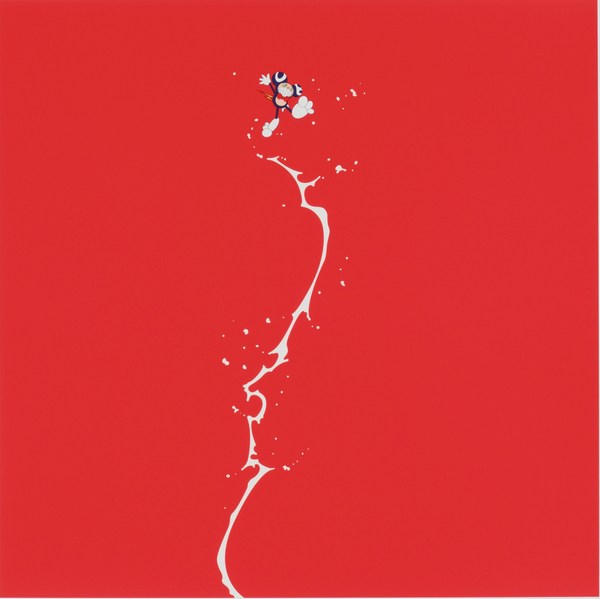
Takashi Murakami, DOB JUMP 1999, Silkscreen 40 x 40 cm, Museum of Contemporary Art Tokyo collection

Japan is utterly strange, if we are to follow in the footsteps of Bill Murray and Scarlett Johansson in Sofia Coppola’s Lost in Translation (2003) as visitors to a country for whose culture and language have (nor do they want to have) absolutely no affinity. Yet their acute sense of dislocation and turmoil in which we are caught up simply play out at the fringes of a site of metaphorical impenetrability that is Japan, like storms in teacups that fleetingly detract from an unimaginably large and unknowable entity. As the film unfolds in an exterior, immense site of unfamiliarity where space is dizzying extended vertically and horizontally, there is an incredible abundance of sights (billboards, people, temples, shrines, bright neon lights) that the panopticon of Tokyo affords as the landscape stretches out for Johansson’s character and the audience. But like her, we the audience, look at images and concepts associated with all things “Japanese,” but can’t understand the sum total of their meanings. Read More »

Share

San Francisco

Interview with Andrea Fraser, Part 1

As a part of our ongoing partnership with Art Practical, today we bring you an interview between Bad at Sports contributor  and Art Practical Director Patricia Maloney , UC Berkeley Art Museum Assistant Curator Dena Beard, and the artist Andrea Fraser.

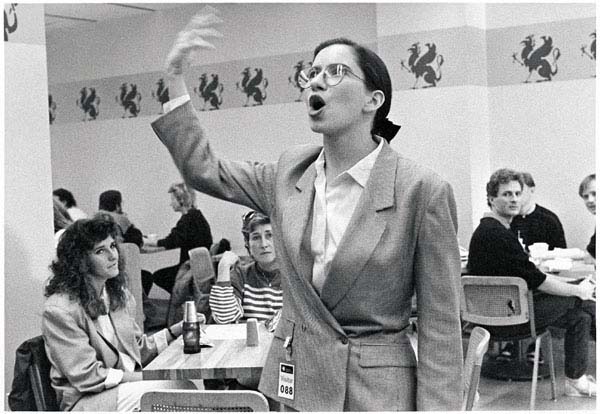
Andrea Fraser. May I Help You?, 1991 (still); performance at the Philadelphia Museum of Art. Courtesy of the Artist.

Andrea Fraser, who is currently a professor in New Genres at the University of California, Los Angeles, rose to prominence in the 1990s for performances that deliver with humor and irony incisive critiques of the economic, political, and social structures of art world institutions. On July 13, 2012, she performed one of her seminal works, Official Welcome (2001), before a very crowded and fervently attentive audience in the atrium of the San Francisco Museum of Modern Art; the performance’s notoriety derives from the moment in which Fraser undresses and eventually stands nude while continuing to speak. Bad at Sports contributor Patricia Maloney and UC Berkeley Art Museum Assistant Curator Dena Beard had the opportunity to speak with Fraser at length a few days following this performance. Their conversation will be presented in two parts: Part I, published here, delves into Official Welcome in-depth; Part II, to be published on October 23, includes a discussion of language, feminism, and museum architecture. You can listen to the entire conversation podcast as Andrea Fraser: Episode 370, presented by our partner, Bad at Sports.

Full Interview

Share

Hashtags

Here Be Dragons: Google Earth As Omniscient Atlas

#Hashtags: Viral Thoughts on Politics, Arts, and Culture

Originally published in February of last year, #Hashtags contributor Matthew Harrison Tedford’s article on Google Earth seemed appropriate to kick off 2013.  #Hashtags provides a platform for longer reconsiderations of artworks and art practices outside of the review format and in new contexts. Please send queries to hashtags@dailyserving.com.

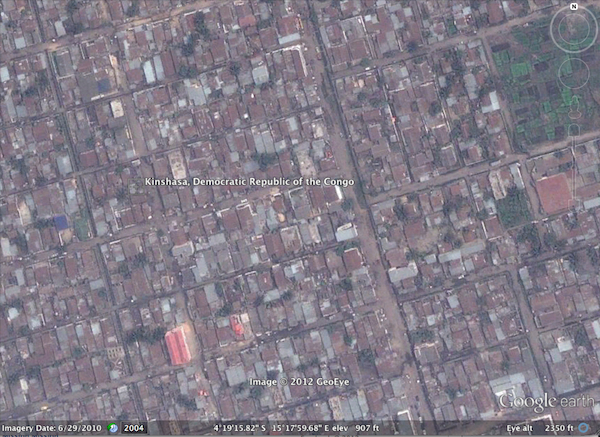
Kinshasa, Democratic Republic of the Congo. Screen capture using Google Earth.

When I was a child, I spent countless hours poring over a Cold War–era National Geographic photo atlas. I traced every road and river, in every country, some which no longer existed or were currently in the process of brutal disintegration (à la balkanization). Sometimes, when I was really lucky, a country would be represented by two or three photographs. Some countries earned no photographic representation. Nonetheless, these photographs helped me learn that Thai women had really long fingernails, Brazilian men wrestled anacondas naked, and Africa was an untamed land bereft civilization and modernity. This photo atlas provided a seven-year-old me with irrefutable evidence about my world, but it also left so many questions. Malawi and Kyrgyzstan had no photos; what were they like? As I grew older these questions became more nuanced: Are all Algerians really Tuaregs? Might South Americans actually wear clothes? Are Western Europe and the United States as idyllic and perfect as the amber waves of grain imply? As much of a colonial travesty as that book was, it sparked an intense interest in the world and provided me with enough information to later deconstruct its own narrative.

Jump forward a few decades. Croatia is firmly established as a tourist hotspot, Dubai is megalopolis, and Burma is now Myanmar. So much has changed. We also now have a qualitatively different kind of atlas: Google Earth. This new atlas—a seven-year-old technology that allows me access to every nook and cranny of the planet’s surface—ostensibly offers a potential antidote to the inaccuracies of older atlases. This computer software exposes the mysteries of the world; every single village, building, and street on the planet is immediately viewable to me, save those hidden beneath thick canopies.

Prior to photography, atlases were geometric abstractions, lines representing places that were theoretically real, but unconfirmed to those people who had never been to them. The dragons and mythical creatures that sometimes populated these maps speak to their susceptibility to distortion and myth making. But with the advent of photography, people believed they could see the unmediated reality of these places. Photography offered a form of documentation that then (and now) carried more authority than technical illustrations. A “higher” form of knowledge was now available. But as my childhood photo atlas shows in hindsight, nominal and highly selective representation does little to demystify those places we’ve never been, and this epistemic pitfall can be found in Google Earth as well.

Read More »

Share

Fan Mail

Fan Mail: Matt Hamon

For this edition of Fan Mail, Matt Hamon of Missoula, MT has been selected from our worthy reader submissions. Two artists are featured each month—the next one could be you! If you would like to be considered, please submit your website link to info@dailyserving.com with ‘Fan Mail’ in the subject line.

————————————-

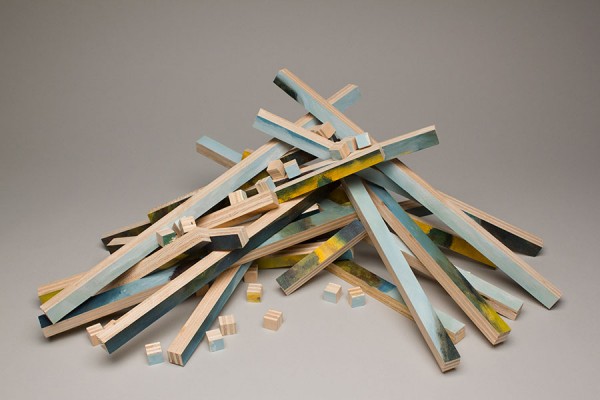
Potomac, Montana, created where Matt Hamon currently lives near the Blackfoot River, is part of his en plain air series. Done on site like many painters past who seek to capture the essence of place, the work takes on wider reference to human manipulation of the landscape. Hamon says: “I consider drawings and paintings to be records of a performed relationship with a subject….Much of my interest is in expanding what that record might suggest or contain. Once finished, the large paintings are cut at random into pieces of varying size. By assembling the resulting pieces in piles, stacks, and sometimes as individual paintings, they evoke disorientation, reference abstraction, and re-present the landscape.”

Matt Hamon, Potomac, MT, 2012, oil on panel

Lucy Lippard says in her book, The Lure of the Local, that landscape is always shaped by its inhabitants, and in art, an idea of the landscape is formed through the act of framing, rendering, or interpreting. She tells us that “British geographer Denis Cosgrove defines landscape as ‘the external world mediated through human subjective experience.'” She continues: “The word landscape originated in the German fifteenth-century term landscaft–a shaped land, a cluster of temporary dwellings or more permanent houses, the antithesis of the wilderness surrounding it, according to John Stilgoe…Today the word is commonly conflated with place, nature, view, scenery, and has radiated out into any number of meanings from the popular pretty rural scene to a complex social construction or produced space.”

Hamon says he is influenced by Walter Benjamin’s idea of “aura”, the sense of uniqueness or originality about a piece of art. Benjamin tells us “that which withers in the age of mechanical reproduction is the aura of the work of art” but what has been spawned is a type of art which is made to be reproducible and has no original, such as photography, cinema, and text. Viewing an artist’s website (as I do often in writing this column), we are faced with a reproduction. There is a diminished view of the art (especially sculpture), but an opportunity to explain and curate ideas and a greater potential for public viewing than the traditional gallery setting.

Reproduction allows for a mass cultural experiences. New media allows for new kinds of perception.  Similar to the idea of withering aura, Lippard sees the reproduction of a landscape as inferior to the original. “I personally get a lot of pleasure from looking at landscape paintings, though not as much as from landscapes themselves; a painting, no matter how wonderful, is an object in itself, separate format the place it depicts.” Hamon has a similar boredom: “I love the process of landscape painting as a way of interacting with a place. However, landscape paintings as images don’t interest me so much. The solution was to deconstruct them and reformat them. It’s amazing what a table saw can do for one’s work!”

Matt Hamon, After Albert Bierstadt’s Deer in a Clearing, 2011. Mixed media, 16"h x 10"w x 8"d, 2011.

About his construction of an oil rig on a strangely verdant land, Hamon says, “Regarding After Albert Bierstadt’s Deer in a Clearing, Bierstadt was a member of the Hudson River School, an informal association of painters who promoted westward expansion through their sublime and luminous images that idealized the American west via hyperbolic light, color, and scale. After Albert Bierstadt’s, Deer in a Clearing, is a playful and somewhat sardonic response to this late 19th century painting.”

Read More »

Share

The distance between two lovers: An interview with Chase Folsom

Chase Folsom, a recent graduate from the MFA program at University of Colorado Boulder, is trained as a ceramic artist but now practices across sculpture, photography and installation. His work itself is about tenderness and isolation in equal measure. As Roland Barthes’ wrote in his great A Lover’s Discourse, Folsom describes and rehearses the “logic of desire” (and the logic of anticipation) in every piece he makes.

Kelcy Chase, Abracadabra (1 of 3 sets), 2012. (digital print) 5''x7'' framed each.

Carmen Winant: You are fresh off the graduate school boat. How has the experience affected you, or your experience of making and thinking about your work?

Chase Folsom: I thought that graduate school would be an incubator, where all my ideas would quickly evolve and come to fruition. I thought it would be a haven in which I could ‘find answers.’ In fact, what grad school gave me was the luxury of time. Before going back to school, I was waiting tables and bartending in Atlanta, and, even though I had done some fantastic residencies, I never had due time.

CW: And what was the effect of that realization for you?

CF: Well, I used to make constantly. I was sort of a frantic maker — maybe there wasn’t time to think. I was a bit of a slave to the work in that way, and that has since shifted. I spend a lot of time now reading, writing, sketching, and sorting out my ideas before I begin on production. Sometimes it takes me many months to make a single piece. I also shifted from making semi-architectural installations to making objects. That was a pretty stark change, and one that sort of gave me my life back. Graduate school was good for me in that way, teaching me how to be disciplined without losing some inherent curiosity in process.

Kelcey Chase, What If I Could See My Reflection, 2012. (porcelain, platinum, steel pins). 3''x2.5''x1.5''.

CW: Can you speak a little bit about being a ceramic artist? You graduated from the University of Colorado, Boulder with a degree in ceramics, which is a very established and well-regarded department. However, as you know, ceramicists occupy an in-between place in contemporary art. Your own work crosses mediums, but can you speak a little bit to that position?

CF: My undergraduate degree was also in that field, so I never thought it unusual. But, as you mentioned, I work across mediums, as do many people in the department. I think a lot of people hold the misconception that ceramic programs are far more conventional – or less elastic – than they are. As with any area, some people did not work with clay at all. Leaving school now, and entering the vortex of the contemporary art world, I imagine that being an artist who works in ceramics will afford me certain challenges and opportunities. There is a lot of potential there.

Kelcey Chase, What If I Could See My Reflection, 2012. (porcelain, platinum, steel pins) 3''x2.5''x1.5''.

CW: Let’s talk more specifically about your work. It summons up, for me, a feeling of amorous longing. Much more so than a subsequent union, or the eventual meeting of desire. You seem to be interested in describing a perpetual and sustained distance between two lovers.

CF: Here is how it goes: I make work first, and attempt to understand the experience or feeling that prompted it second. Never the other way around. I think I have to produce at that distance like that, at a detach, in order allow myself to do it. The work then serves as evidence more than anything else. Evidence that I must have missed the first time.  I don’t psychologize myself. Maybe the work can do that for me.

Read More »

Share

Best of 2012 – #Hashtags: Lolo, the Virgin Bride

On the last day of 2012, we bring you an article from #Hashtags, our bi-weekly column on art and politics. This article was written by DailyServing contributor, Carmen Winant, and selected by DS publisher, Seth Curcio.

“Carmen seemlessly weaves her personal narrative into an article that wrestles with notions of performance, image, and control. Within this context, she is able to address so many issues relevant to visual art, while confronting the politics of contemporary culture.” -Seth Curcio
——————————————————


Lori "Lolo" Jones, HBO’s "Real Sports" in 2012, discussing her status as a virgin.

I am consumed by the Olympics. I’ve been counting down the seasons until the summer of 2012 and the days until July 29th. When the Olympic Games are being televised, I schedule my work and social life around watching my chosen events (gymnastics, swimming, and above all, track and field). This is a good moment to include the information that I was competitive runner, starting to train seriously even before the onset of puberty. Though I no longer participate in the sport and haven’t since I finished college, I revel in the one time, every four years, that it is performed internationally at its highest levels, and that other people care about it enough to watch it unfold in their living rooms.

One of America’s great hopes in track and field this summer in London is a hurdler by the name of Lori “Lolo” Jones. Though she is a few years older than I, we overlapped during our time in college; I was competing for UCLA when Jones was attending Louisiana State University (a longtime sprinting powerhouse). I never met Jones, but she once tried to steal my friend’s football-playing boyfriend, so I never thought that highly of her character. Athletically, however, she is an animal. While at LSU, Jones was a three-time national champion and eleven-time All-American in the 60- and 100-meter hurdle events. Once out of college and a pro athlete, Jones was the first woman ever to claim back-to-back World Indoor titles in the 60 meter hurdles while setting an American record in the process. How to describe these feats? Imagine being born with the right physiology, sense of purpose, and ability to absorb and withstand pain. Imagine being better at something than thousands of people who are really good at that same thing. Imagine being a woman, who, in front of the whole world, is unafraid of winning.

Lolo Jones, I must add, is quite beautiful. She is of French, African-American, Native-American, and Norwegian descent. She has wide cheekbones, green eyes, and a warm, easy smile. Her body is incredibly toned and muscular, but doesn’t tread into androgyny, as is the case with many Olympic-grade female sprinters. Being wildly attractive doesn’t hurt in winning her commercial endorsements — such as one from the oil company BP — magazine pictorials, and general mass appeal. But given her winning record, I can confidently say she would have accrued this attention anyway. Jones is an unmistakable champion. And, as the world learned a few months ago, she is a twenty-nine year old virgin.

Read More »

Share

Best of 2012 – BLUESKIES/BLACK DEATH

DailyServing’s Best of 2012 continues with BLUESKIES/BLACK DEATH, a review by Ruth Hodgins.

“Ruth is great at grounding the crux of her review in a way that is accessible and concise. This article demonstrates her ability to illustrate things clearly without relying on pure description, as she is good about situating the work within an art historical context.” -Catlin Moore

——————————————————

2012

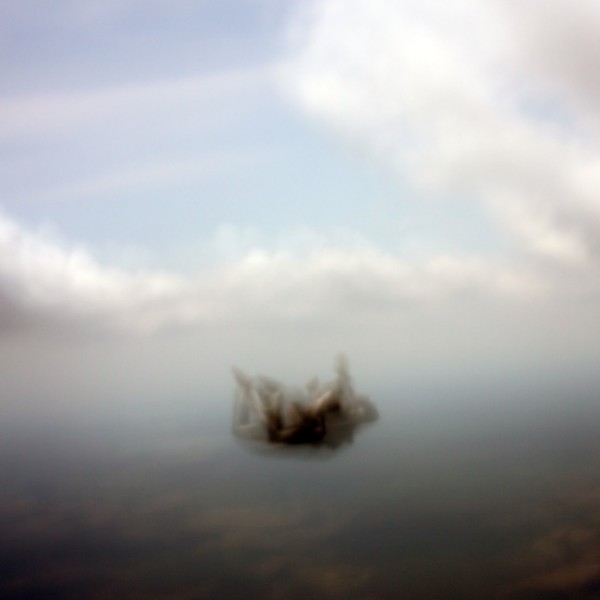
Decision Altitude 11, 2012, courtesy of Thomas Robertello Gallery.

In skydiving, the term Blue Skies, Black Death originated from the parachute infantry motto “Mors Ab Alto” in Latin, or “death from above”. To skydivers, it can be regarded as a greeting / farewell, or to indicate a fatality during a skydive. Yet, the exhibition BLUESKIES/BLACK DEATH by Noelle Mason at Thomas Robertello Gallery in Chicago is not about skydiving nor death. It is a metaphor more closely aligned with the articulation of linear narratives in a nonlinear practice . For Mason “Mors Ab Alto” is more an understanding of presence and absence, or in reflection of David Hume’s perspectives on  immediate sensations in parallel to “impressions” (as if in wax) of sensations.

2012

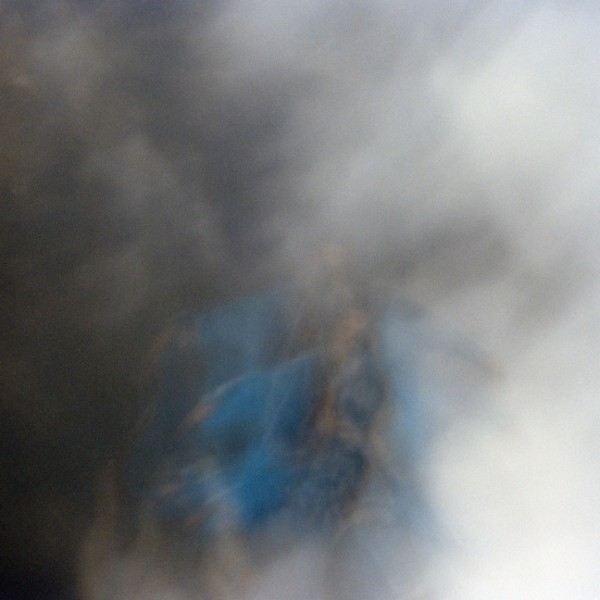
Decision Altitude 6, 2012, courtesy of Thomas Robertello Gallery.

In otherwords, the metaphor  functions as a movement between representation and abstraction, emphasizing the beauty, power, and emotional resonance possible when opposing notions act in collaboration. Some of Mason’s work offers a somewhat recognizable portrayal of skydivers filtered through artistic interpretation, and others are distilled vague forms, with minimal or unexpected colors, characterizing abstractions. All works are eloquently expressionistic renderings that are open to layered translations.

2012

Incident Report: 40 Years, 2012, courtesy of Thomas Robertello Gallery

On first impression, the collection of photographs “Decision Altitude” and photogravures “Incident Report” are representative of the jump, flight, power and consequence all blurred into rushing air and moving body parts. In skydiving terms, the photo works are close representations to “Ground Rush”, the optical illusion that the ground is abruptly rushing up to meet you, which occurs if you free-fall past your usual altitude before opening the parachute. But in art, the skydive becomes as much about material strategy as a source of interest. In the context of the exhibition, Mason highlights the unusual content of each work by listing skydiving among the materials. This strategy transforms an action into more than a conceptual mechanism.  The skydive becomes an expressionistic tool much like a paint brush. Allowing Mason to flip our expectations and  enabling us to look at things differently, to consider materials anew and to create formal configurations which become significant on purely formal grounds.

Read More »

Share