San Francisco

The XEROX BOOK

In December of 1968, Seth Siegelaub and Jack Wendler published The XEROX BOOK, an exhibition produced entirely in book form. The project included seven contributing conceptual artists: Carl Andre, Robert Barry, Joseph Kosuth, Sol LeWitt, Douglas Huebler, Robert Morris and Lawrence Weiner.

The Kadist Art Foundation in San Francisco recently spoke to Jack Wendler about The XEROX BOOK offering a unique glimpse into the history of this celebrated project. You can download The XEROX BOOK in its entirety here.

Share

New York Hashtags

#Hashtags: Claiming Modernism

One of the more thought-provoking pieces of art writing this month was not about contemporary work, but modern art. Tucked away in his review of “Radical Terrain” at the Rubin Museum, New York Times critic Holland Cotter called out the Euro-American belief that the West invented modernism, which was then either copied or imposed (inferiorly) across the globe. We might have missed Cotter’s article, if it wasn’t for Sharon Butler’s short piece over at Two Coats of Paint, which places images from the show in the context of Cotter’s argument.

“Radical Terrain,” the Rubin Museum’s third exhibition exploring Modernism in India, focuses on landscape, presenting work by the generation of artists who worked after India gained independence in  1950. Alongside work by the older artists, curator Beth Citron has included work by an international cohort of younger artists, including Meagan Boody, Hasan Elahi, Isca Greenfield-Sanders, Marc Handelman, Byron Kim, Lisi Raskin, Seher Shah, and Janaina Tschäpe.

Syed Haider Raza (b. 1922), "Untitled," 1956, oil and mixed media on canvas. Shelley and Donald Rubin Private Collection.


Narayan Shridhar Bendre (1910-1992), "Untitled," gouache. Collection of Virginia and Ravi Akhoury.

Sudhir Patwardhan (b. 1949), "The Fall," 1998, oil on canvas. Collection of Virginia and Ravi Akhoury.

Last week in the NYTimes Holland Cotter wrote a review of the exhibition questioning the West’s proprietary claim to Modernism:
The West tends to be proprietorial about Modernism, treating it as a Euro-American invention copied, in inferior versions, by the rest of the world. But more and more this view has come to look parochial and wrong. In recent years historians have been studying the reality of multiple (sometimes referred to as alternative) modernisms that developed in Africa, Asia and South America parallel with, or sometimes in advance of, what was happening in Europe…

Viewers coming to these works for the first time, knowing little about their history or context, may well see traces of European Modernism in them before anything else. It takes some looking and exposure to information to get beyond that and see what is really happening in these paintings. They aren’t about copying; they’re about artists making choices, trying out options, pursuing some, rejecting others, taking what they know and adding to it, editing it, blurring lines between South Asian and Western, shaping something distinctive from the sources used…

It’s great that the Rubin, a small institution with limited resources but imaginative thinking, has brought us exhibitions like this one and its two predecessors. Even together, though, these shows can only hint at the full history of global modernism, or modernisms, that everyone now knows is the true story of modern art. It’s a story that has yet to make its way into our big museums, but surely that day must come.

Put in this context, MoMA’s excellent abstraction exhibition “Inventing Abstraction, 1910-25,” seems a little parochial, doesn’t it?

– Sharon Butler, Two Coats of Paint, January 5, 2013.

Two Coats of Paint is licensed under a Creative Commons Attribution – Noncommercial-No Derivative Works 3.0 United States License.




Share

From the Archives

For a Long Time & The Song Itself is Already a Skip

Today from the DS Archives we highlight the 2011 group show, For A Long Time at Roberts & Tilton. The show included an all-star line up of Marina Abramović, Vito Acconci, Hamish Fulton, Whitney Hubbs, Erica Love, Raymond Pettibon & Kehinde Wiley. The Song Itself is Already a Skip, Whitney Hubbs’ first solo photography show in LA is on view now at M+B Gallery.

The following article was originally published on June 27, 2011 by :

Marina Abramovic, Rhythm 10 (1973). Black-and-white photograph and letterpress text panel. Image courtesy Roberts & Tilton Gallery.

In The Body in Pain: The Making and Unmaking of the World, scholar Elaine Scarry describes the inability of language to interpret and express physical pain: “By its very nature, pain resists, even destroys the language that grapples with it.” But what of the capacity of visual art to interpret and translate this bodily experience? “For a Long Time”, on view now at Roberts & Tilton in Culver City, attempts to answer this question by showcasing visual work that grapples with physical endurance and its effects. The result, though ambitious in scope, is a little too conventional. Read More »

Share

San Francisco

Picturing a Picture Collection

As a part of our ongoing partnership with KQED Arts, today we bring you a feature from writer Sarah Hotchkiss titled Picturing a Picture Collection: Taryn Simon at John Berggruen.

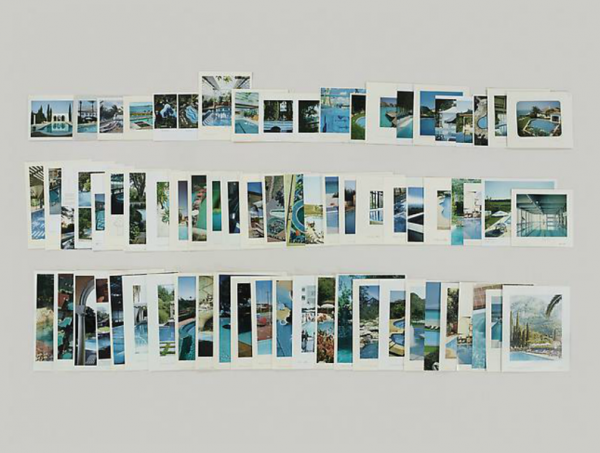
Taryn Simon, Folder: Swimming Pools, archival inkjet print 47 x 62 inches

For her first exhibition in San Francisco, photographer Taryn Simon delves into a unique archive to create a series of organized images about the organization of images. The Picture Collection contains photographs of the New York Public Library‘s circulating image library, a collection of 1.2 million prints, photographs, posters, postcards, and illustrations. Within over 12,000 subject headings, Simon selected one folder at a time to spread out and photograph its contents. The resulting prints, squarely capturing the materials from above in what resemble analog search engine results, tread an intriguing line between impartial document and subjective presentation.

These large-scale photographs, hung throughout both floors of the John Berggruen Gallery, feature the contents of twenty different subject folders. So many of the elements in The Picture Collection are standardized (lighting within the photograph, scale within the photograph, size of the prints, type of framing and hanging apparatus) that smaller discrepancies emerge more dramatically over time spent in the exhibition.

Read full article

Share

San Francisco

Claire Fontaine // Wattis San Francisco

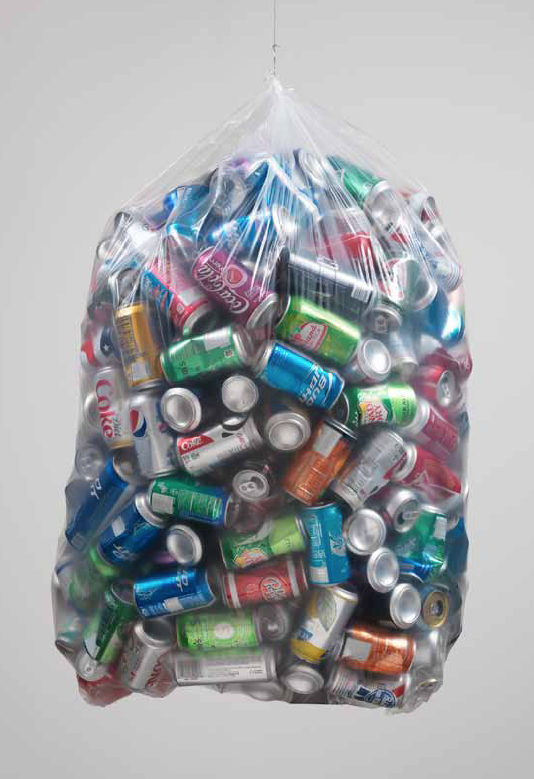
“Clairefontaine is famous for its exceptionally white and ultra smooth paper.” This ad for the French brand of stationary has little more to do with Paris-based collective artist Claire Fontaine than the name. Fontaine appropriated her “stage name” from the paper brand and declared herself a ready-made artist. She works internationally creating conceptual art and has just completed her installation in San Francisco. Her most recent work is entitled Redemptions and will be on view in San Francisco at CCA Wattis Institute for Contemporary Arts from January 22nd through February 16th.

Curated by Jens Hoffmann, Fontaine produced the work during her residency in San Francisco as part of the Capp Street Project, the first residency program created in the United States dedicated only to the making of art installations. The work hangs at the Wattis space on Kansas Street in Potrero Hill.

The new expansive Wattis gallery space has been congested by Fontaine’s confrontational installation composed of transparent plastic trash bags filled with thousands of aluminum cans hanging from the ceiling. Every square inch of the ceiling in the main space is covered by these hanging bags of colorful garbage. Suspended overhead, the objects are oppressive and heavy with connotation. The soda pop and beer cans are, of course, familiar to us. They are our everyday products, our recycling taken out to the streets. In an urban setting like San Francisco, the cans are associated with the homeless and unemployed who roam the city filling bags like these for the redemption price of aluminum. The cans represent our overuse, our consumerism, our destruction of the planet. While these weighty, dangling themes are heavy with innuendo, I can’t help but add that we are perhaps excessively familiar with them.

Though it may be true that the neo-conceptual and post-modern are bound to repeat themes from the spectrum of art history, this does not call for monotony. Perhaps it is true that nothing wholly novel can be created in Art today. Fontaine is among many contemporary artists who annunciate their inspiration and even direct emulation from past artists as part of their own artistic process. This method of idea-recycling is often interesting and novel in itself, however the work by Fontaine feels restricted and lacking in creativity. As contemporary art enthusiasts, we have seen trash displayed in a way that makes it aesthetically pleasing and/or thought provoking. Japanese artist “Mr.,” showcased piles of trash in a Chelesa gallery in 2012, Lara Favaretto used discarded found objects in her Monumentary Monument at documenta (13), New York City even has a museum of trash.

In the center of the gallery, Fontaine has built an aluminum smelter reminiscent of Marcel Duchamp’s Twelve Hundred Coal Bags Suspended from the Ceiling Over a Stove (1938). The connection between the famous ready-made antecessor and the “trash as art” theme is already made clear. I suspect, Marcel Duchamp would have hoped for more progress by now.

It is important for San Francisco to be exposed to artwork and artists like this. Fontaine is interested in the object, working with it to exhaustion: creating, discarding, recycling, and reconstituting. While it is certainly not novel, this principle here is interesting and perhaps telling of the route in contemporary art. If we have surrendered ourselves to the idea of avant-garde innovation, then perhaps this is our new artistic reality: trash bags hanging from the ceiling. The point we are trying to get across as artists may still be avant-garde, and in so express some personal novelties. Perhaps these are our new materials: we have replaced our oils for aluminum cans.

Share

New York

Tuymans @ Zwirner: a decade of partnership, and The Summer is Over

Belgian artist Luc Tuymans is perhaps best known for challenging the post Abstract Expressionism debate about the relevancy of painting by taking on subjects as Belgian colonialism, the Holocaust and the War on Terror. In his tenth exhibition at David Zwirner in New York, The Summer is Over, Tuymans scrutinizes the relevance of capturing reality in painting. Alluding to ghosts of the present and future, the works are tender, muted and enigmatic, but less sparsely colored and less ethereal than previous series. Reaching an unprecedented large scale, these new works ponder the mystery of the immediate, the everyday, the mundane through a simple and detached meditation. The large brushstrokes evoke the technique of pointillism and the viewer stands way back to capture the monumental pictures, and the endlessness of time spent in a studio. With shows at the Museum of Modern Art, Art Institute of Chicago, Documenta XI and Venice Biennale behind him, the prolific Tuymans is a rising superstar in the contemporary art world. I had the unique opportunity to speak with him about citizenship in a globalized world and industry, his inspirations and the beginning of a new approach to his painting style.

Luc Tuymans. "Zoo." 2011. Oil on canvas. 108 5/8 x 84 1/8 inches (276 x 213.6 cm). Courtesy the artist and David Zwirner, New York/London.

You are renowned as a rather exotic and rising legend of contemporary painting in the global art world, while in Belgium people know you as more provincially as an “Antwerpenaar.” Does this dual identity play in to your work? Why have you remained in Antwerp throughout your career, when your success seems much greater and expressly sought after in the US?

I relate to the European identity before I relate to the Belgian identity or that of Antwerp, when I am abroad. I do love Antwerp, however, where I come from, and the intricacies of the city’s personality which includes, for example a rather know-it-all cut-and-dry suspiciousness but also an immensely fascinating history deriving from the middle ages. I love Belgium also. There is a deep history of radical creativity and invention (from Jan Van Eyck, to James Ensor to Rene Magritte – to name but the visual arts) brought on by all the different cultural and linguistic diversity in this small country, as well as by its centrality in Europe. I remain because of my perceived ability to more strongly develop my individual history there, more connected to its past ghosts that live on. For me culture is not made to establish borders. It is rather, like time or like light, something that permeates through many moments and eras, and lives outside of the individual. And so, I travel as much as possible to different places, with a sense of openness and curiosity – letting the culture of others permeate.

Read More »

Share

Singapore

Agostino Bonalumi: The Glass of Shadows

Agostino Bonalumi, Untitled (Rosso), 2011. Acrylic on canvas, 130 x 220 cm. Image: Courtesy of Vedovi Gallery.

When Lucio Fontana published his Spazialismo series in the 1940s, a fundamental reiteration of this theory was that matter should be transformed into energy to invade space in a dynamic form. In essence, only the conceptually abstract offered the freedom within linear space to explore ideas about movement and time in art. Fontana’s slash series went on to demonstrate this idea, where linear slashes and the sharp holes were made through the sacrosanct surfaces of the canvas. The tears and holes in the canvas are as much philosophical as they are destructive physical rends on the material, meant to force the viewer’s gaze beyond the surface planes of the painting into an opening that Fontana termed ‘free space’ that existed without boundaries.

Lucio Fontana, Concetto spaziale, 1960, and Attese, 1966. Fondazione Lucio Fontana, Milan. Image: Courtesy of the Fondazione Lucio Fontana, Milan and Gagosian Gallery.

Heavily influenced by Fontana’s concept of Spazialismo, the modulated surfaces (superficies moduladas) within Agostino Bonalumi’s (b. 1935) canvases situate themselves within this conceptual discourse of demolishing the illusionistic plane to create new pictorial forms. Bonalumi’s oeuvre, now on view at Partners & Mucciaccia in a retrospective exhibition called The Glass of Shadows, is dedicated to demonstrating that the dimensions of a canvas can consist of a dynamic blend of form, colour, shadow, light and strategically-conceived space.

Read More »

Share