Claire Falkenberg’s Painted Apparitions

As part of our ongoing partnership with Beautiful/Decay we bring you the painted photographs of Claire Falkenberg. Falkenberg, who lives in Brooklyn, exhibited her work in a solo show entitled Threshold at Katharine Mulherin Contemporary Art Projects in Toronto earlier this year. The article was written by Larissa Erin Greer and originally published on May 23, 2013.

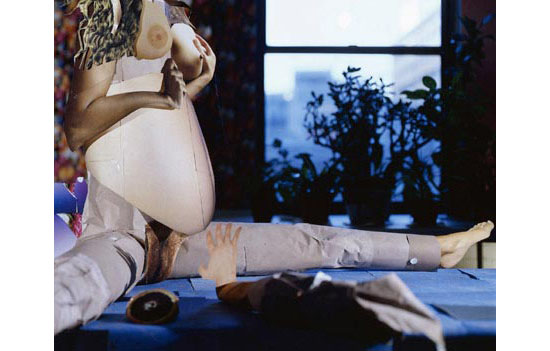
Claire Falkenberg, Cloud, 2010. Oil on C-print, 29 x 30 inches

With a toxic mix of oil-based paint, the surfaces of artist Claire Falkenberg‘s large-scale photos are transformed into mysterious and eerie clouds. The ominous, milky clouds obscure the space directly in front of the photographer, delaying the viewer’s ability to understand what lies just under the surface of each picture plane. This inclusion is generous, because it offers another layer of surface detail to the viewer who is willing to inspect the ghostly swirls of oil paint. The slick, snapshot-style images of trash slowly begin to reveal themselves—vanishing almost entirely at the center, and bringing into question just exactly what Falkenberg has chosen to cover up in her series.

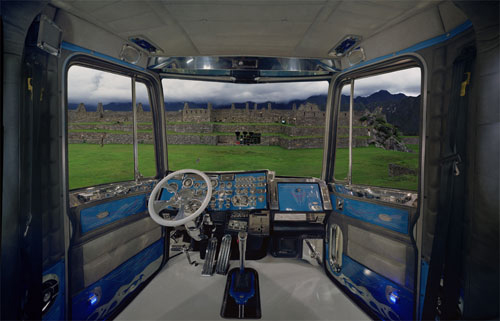
Claire Falkenberg, Moon, 2010. Oil on C-print, 30 x 30 inches

Read the full article here.

Share

Eating Cake at de Appel: an interview with one of the curators of Bourgeouis Leftovers, Amsterdam

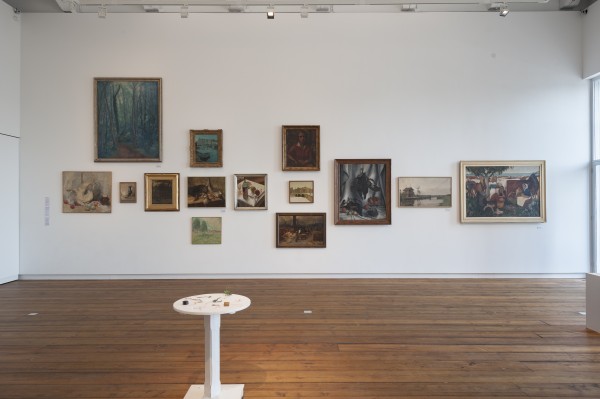
What does one eat in times of crisis? Leftovers. Of the bourgeoisie. Or, but that depends on your political stance, and the degree of hunger, perhaps the bourgeoisie itself. The current exhibition at de Appel Arts Centre in Amsterdam, which concludes this year’s curatorial program, was conceived after the six student curators encountered a bundle of paintings during a visit to the Van Abbe Museum in Eindhoven, The Netherlands. The paintings were labelled ‘Bourgeois Leftovers’ and the students, as it turned out, were hungry. So they took the paintings, and used them as a starting point.

I met with one of the curators, Srajana Kaikini, to talk about the show.

Georgia Haagsma: These works came here under quite random circumstances. What attracted you to the leftovers?

Srajana Kaikini: During our visit to the Van Abbe Museum and the tutorial with Charles Esche [Director of the Van Abbe Museum], he told us about his policy to be a transparent museum. The museum’s collection is open to the public so visitors can see how it operates. This is how we were able to see the Mondriaans and Picassos up on the wall but how we also encountered this pile of works labelled ‘Bourgeois Leftovers’ on the floor. The works kind of came to us, but with a very definite meaning already attached to them.

GH: So, the Van Abbe Museum wasn’t planning to do anything with these works?

SK: No, because there were other things that were more important for the museum’s narrative at the time. There were other factors they wanted to address in their exhibition, regarding the Museum’s context and the current Dutch context in general.

Bourgeois Leftovers - exhibition overview

GH: Do you know how they came up with ‘Bourgeois Leftovers’?

SK: The pile we originally found was bigger, it consisted of 73 works, mainly portraits and landscapes. For the museum, to call them ‘leftovers’ wasn’t a conscious decision of rejection. It was more to suggest that they could wait. Charles Esche, who came up with the name on the label, doesn’t seem to give any judgement to the word bourgeois, but it was certainly that word which attracted us to the works. If it wasn’t for that word, we probably wouldn’t have noticed them.

GH: Wasn’t Charles Esche surprised that you showed this interest?

SK: No, he was actually very happy and encouraging of the gesture.

GH: Even though the works are completely taken out of context?

SK: Yes, I think that in itself adds a layer, which gives the works more value. I mean, the crux of the exhibition was to displace these works by showing them in a contemporary art context, and to see what the status of these paintings would be in a contemporary scenario. We wanted to see how the specific academic language in these paintings corresponds with the contemporary art language today.

Read More »

Share

From the Archives

David Altmejd: Interior Labyrinth

Mixed media—that creative collision of materials rarefied and commonplace, refined and raw—is, one might say, something of a given in the contemporary art world. The Hirshhorn’s Over, Under, Next: Experiments in Mixed Media, 1913-Present is a fascinating and provocative overview of this now-ubiquitous, once-incendiary mode of art making. Such an illuminating look back prompts one to see the present anew, and considered in the light of past work, present art making often acquires still-more intricate, interwoven layers of meaning.

Among the many contemporary artists who embrace a mixed-media approach, David Altmejd produces work of an especially evocative, mesmerizing force. Thus, in the spirit of revisiting the present in light of the past, we delve into the DS archives to bring you Margaret Zuckerman’s David Altmejd: Interior Labyrinth.

This article was first published on June 13, 2012 by Margaret Zuckerman.

**********************************

An installation of what could be alien specimen in massive and intricately constructed tanks occupies the sun-soaked space in London’s sleek Stuart Shave Modern. The structures are made by Canadian-born sculptor, David Altmejd, (b.1974), an internationally acclaimed artist who is known for his frightening, strange and beautiful works – works that often involve decapitated werewolves, glittered kitsch, crystal caves, decomposed yeti, mirrors, mysticism and supernatural transformation. Being a particularly big fan of monsters – Altmejd’s figurative sculptures have always drawn me in. Mysterious and imbued with a supernatural energy, his past works have always evoked fear of the bodily grotesque paired with the seductive beauty of gruesome glamour. The artist has continued his shamanistic oeuvre and has again presented an exhibition at Stuart Shave that is exquisite, strange and delightfully puzzling. In walking around the large tanks, the perplexity evolves: the works are at once a landscape, a maze, a game and a creature. Those used to confronting half-decayed hairy and fanged monsters at Altmejd’s exhibitions may a bit disappointed in the boo factor. He transforms everyday materials into odd network of sculptures using thread, gold chains, Perspex, and bits of wire, and while there isn’t anything too scary, there is one thing that is hairy – coconuts.

David Altmejd, La gorge (detail), Plexiglas, resin, coconut shells, chain, thread, acrylic paint, metal wire, 231 x 177 x 457.2 cm, 2012. Photo courtesy of the artist and Stuart Shave Modern

In the first room, La gorge (2012): milky, multi-colored blobs pour out of the puzzling halved coconuts and through canals of a clear, labyrinthine, stepped structure. Set in a massive vitrine, the work looks like a frozen mechanical maze through which mystic substances flow. Like plasma – there is energy impregnated in this gluey waterfall of numinous fluids. The nonsensical coconut contains these colorful potions; the often-farcical object transformed into a mystic egg filled with a witch’s brew. The sprawling Perspex palace of cascading steps leads from an apex down towards low lying pool, then, perhaps suggesting this is an enclosed eco-system, the substance that pours from above is simultaneously pulled up again in cloud-like blobs. Is this work, called ‘the throat’, the mouth of a river, a flowing ravine or funnel of a machine? Walking around this strange space, one feels a sort of energetic succession in motion, one as elaborate, complex and nonsensical as Fischli and Weiss’s Rube Goldberg contraption in The Way Things Go (1987). Gold chains crown this river like chandeliers from above, tracing the flow of energy through the tank while liquids finally disappear through holes in the plinth below. This suggests the landscape is part of never-ending series of compartments beyond, through which fluid will continue on. Moving, seeping, globing these substances pour, some as red as blood.

David Altmejd, La gorge, Plexiglas, resin, coconut shells, chain, thread, acrylic paint, metal wire, 231 x 177 x 457.2 cm, 2012. Photo courtesy of the artist and Stuart Shave Modern.

In the second gallery, another large vitrine encloses a second form: an angelic, swan-like wisp made of a plethora of pulled pink threads. Each thread creates one line and curling striations made by a thousand come together into rounded forms. It is alien, ghost-like, taking over the space like an overgrown spider web. Walking around the enclosure, the threads create a shimmering effect and vibrate like a kinetic artwork. Much more organic in form and motion, the webs radiate from a center tube, and lines of threads seemingly contract and expand like musculature into a multi-layered transparent core. It is delicate, intricate and elegant, albeit a bit ominous in the dramatically lit and darkened room.  Although Altmejd’s works seem like landscapes, mazes or machines, the name of the second work Le ventre, (the belly) reveals the underlying theme, that the tanks, in fact, encapsulate depictions of body parts, on display like a scientific specimen. The swan’s neck becomes the arch of the J-shaped stomach organ and the movement is revealed to be through that of a digestive tract. The whole of the exhibition shows parts of the interior labyrinth of an unfamiliar creature, tracing the biological system through various compartments – some machine like, some organic and all bizarre.

Read More »

Share

Northwest Photography: The Same but Different

Some shows demand a second viewing. Sometimes because they’re great, sometimes because they’re a totally different experience on a second viewing, and sometimes because they’re a slightly different exhibit on a second viewing.

And then, of course, some shows are simply demanding. All of the above are true in Place Gallery’s survey of Northwest contemporary photography, Off the Plain. Curated by Portland photographer TJ Norris, it’s a packed group show with 17 artists and showcases a mix of non-traditional photographs. I first went to the opening reception for the exhibit. It was abuzz with people. During my second visit, by contrast, I was the lone body in the gallery, accompanied by the noise of a scratchy record player, and a distant but distinctive tune by Michael Bolton playing over the mall’s intercom (Place, which used to be a Pottery Barn, is located on the third floor of a mall).

Upon second viewing, some of the pieces in Off the Plain had actually physically changed. Some pieces had sagged or decreased, and some had been shuffled. To start, the central piece in the gallery had twisted and morphed. Organizing Principles by Brooks Dierdorff consists of two cubes of ballistic gel on pedestals, sandwiching a close-up photograph of an animal’s fur. Formerly confident, minimalist blocks of gelatin had become saggy, bowing forms.

Brooks Dierdorff. "Organizing Principles." Ballistics Gel, .22 Caliber Bullets, Double-Sided Inkjet Print. 52"x34"x17." 2012. Image courtesy of the artist, taken as installed at Disjecta.

Organizing Principles is alarming in how simple it is and yet how alive it feels; the sagging forms have given it a grotesque and deflated feeling. To the left of it is Winter Garden by Joshua Kim, which features a pot of flowers have that have over time wilted and died. Just ahead of this piece is a grid, Photo Swatch Grid #1 by Michael Sell, which consists of wooden blocks of color accompanied by a small sign that invites you to move around the panels. The arrangement has been shuffled. There’s a shelf to the left of them, with canisters of paint for the taking. A third of the canisters have disappeared.

If the show represents Northwest photography, then Northwest photography asks for engagement and participation. This makes sense: Portland itself has long been recognized as a city of socially engaged art (see Portland State University’s early inception of an Art and Social Practice Program in 2006). Involuntary Souvenirs by Tricia Hoffman tacitly implores you to thumb through index cards. The work consists of a turquoise desk that belonged to the artist’s mother, a hoarder. Inside the desk and on top of the desk are indexical photos, which document every item that her mother astoundingly packed into the desk’s drawers. Another piece, Ted Hiebert’s Anaglyph 3D Mashups, encourages the viewer to wear a pair of 3D glasses to see a mash-up of the artist’s face and another male face. Wear the glasses, and the faces merge; close one eye, however, and you see distinct separate faces.

Ted Hiebert. "Anaglyph 3D Mashups: Doug Jarvis + Ted Hiebert." Anaglyph print. 18"x24." 2013.

Read More »

Share

Hashtags

#Hashtags: Liberaceón

In his 2011 video, “Liberaceón,” Chris E. Vargas inserts radical, queer rhetoric into the arguably apolitical, high zest that was Wladziu Valentino Liberace’s life. HBO’s biopic about Liberace is headed to Cannes this month. Jacqueline Clay’s article was originally published September 5, 2011.

Chris E. Vargas, Video still from Liberaceón, 2011. 16 minutes, three channel video installation looped color (DV).

History, like most things, is subjective. What is culled from individual accounts is accepted as fact and eventually translates into some kind of truth. But truth can be different at any moment—past, present, and future. The events in London were either riots or long overdue, civil unrest. Depending on whom you ask, in 2005 the people of New Orleans were either looting or just surviving. This parsing of history renders “truth” and “fact” malleable, constituent materials for narrative and artistic practice. In his video work Liberaceón (2011), Bay Area artist Chris E. Vargas makes histories, meshing the life of the pianist Liberace, late-80s direct actions to end the AIDS crisis, and a nonapologetic use of green screening.

Vargas is best known for his collaborative, narrative videos and films. In Falling in Love…with Chris and Greg (2008–ongoing), we watch the dark satire of Vargas and his artistic/romantic partner Greg Younmans’s relationship. Through the structural lens of traditional sitcom, the couple questions notions of monogamy, marriage, and gender, while consistently establishing their own, not always hyper-radical or “appropriate,” notions of companionship.

Not unlike Falling in Love, in Liberaceón, Vargas inserts radical, queer rhetoric into the arguably apolitical, high zest that was Liberace. Liberaceón includes footage of the showman’s TV specials, Liberace’s nightly news obituary, and various ActUp protests beside Vargas’s molty wigs, camp, and classical, non-method forms of acting. True to Liberace’s mid-1980s opulence and Vegas styling, the video begins with Vargas-as-Liberace’s grand entrance, which includes a balloon ride over “the Strip,” a reclaimed parking lot with a sequined American flag and a Rolls Royce. The film quickly cuts to Liberace and lover Cary James’s visit to a doctor (Younmans), who has an unfortunate bedside manner and gives a dreadful—but at the time, not uncommon—diagnosis.

Inspired to make James feel better, Liberace takes to preparing some chicken soup (again, epic use of chroma key by Vargas). While watching the news in his decadent kitchen, Liberace becomes frustrated by the many AIDS-related deaths, President Regan’s continued silence and the US Congress’s conservative funding of AIDS research. The performer decides to take direct action by constructing a gift with his “special ingredient…to scare ole Ronnie.” What follows is the most compelling and sensual use of a double boiler, all in an attempt to make a Liberace-laced, bloodied chocolate piano.

Chris E. Vargas, video still from Liberaceón, 2011. 16 minutes, three channel video installation looped color (DV).

The glittering stone on this work’s bejeweled finger is the deathbed scene between Liberace and James. Vargas’s slow collapse, full of gasping and eye-flickering, is at once hilarious and disquieting. One knows that Liberace’s many requests not to be memorialized with sap, nor to reduce his or others’ experiences to melodrama, but to honor the experience of any person with AIDS, including himself, have gone largely unanswered. Yet, as the work closes with Liberace’s rendition of “I’ll Be Seeing You” over the tense excitement of ActUp action footage—which includes his own disrupted, TV news obituary—one understands that these histories are strangely enmeshed, joined at the site of their presumed queerness or temporality by Vargas, where they transform one another. In Vargas’ telling, the closet Liberace comes out of is that of radical queerness. Although he calls himself “just an old queen,” Liberace’s anger speaks to the continued complexity of our histories and picturing of self.

Liberaceón (2011) was on exhibition most recently in San Francisco as part of ProArts Gallery’s Bay Area Currents 2011, curated by Julio César Morales. You can also find Vargas’s work at www.chrisevargas.com.

Share

From the Archives

Daniel Gordon: Studio Visit / The Constructed Image

In honor of Daily Serving’s roots, today we feature two articles written by the website’s founding father, Seth Curcio. The second article featured below is on a show that he assembled and curated at Redux Contemporary Arts Center in Charleston, SC. The group show included artist Daniel Gordon who is now represented by M+B Gallery and whose first solo show in L.A. The Green Line opened yesterday evening. The first article features a video made during a studio visit with the artist in 2009.

The following article was originally published on April 1, 2009 by Seth Curcio.

Artist, Daniel Gordon, creates amazingly innovative, albeit low-tech photographs. His photos begin as cheaply printed internet-based images constructed into temporary sculptures which are re-photographed for their final presentation. The process resembles something from Frankenstein’s studio, as the artist assembles body parts and objects to reconfigure them in an endless cycle of creation. During a much anticipated visit, DailyServing.com had the pleasure to meet the artist in his Brooklyn-based studio to catch a rare glimpse of his unique process.

Daniel Gordon.jpg

Daniel Gordon graduated from Yale University School of Art in 2005 and has since exhibited with Zach Feuer Gallery in New York and Groeflin Maag in Basel and Zurich, Switzerland. The artist is currently presenting new work in the exhibition Portrait Studio with Groeflin Maag in Zurich, on view through April 10th. This year, Gordon was selected for the annual New Photography exhibition, opening this fall, at the Museum of Modern Art in New York. The exhibition will highlight a selection of only six young artists who each address the concept of image collection, assembly, and manipulation beginning in the studio or darkroom.

The following article was originally published on May 8, 2008 by Seth Curcio.

Luis-Gispert.jpg

Artist Luis Gispert: All images courtesy Redux Contemporary Art Center

Redux Contemporary Art Center in Charleston, SC is opening a new exhibition today titled The Constructed Image, curated by DailyServing.com Founder and Editor, Seth Curcio. The show features five contemporary photographers whose work challenges the very nature of truth as documented by the photograph. Through a variety of techniques, including digital and traditional photographic manipulation, set constructions, temporary sculpture, models and intricate dioramas, the artists create a very calculated visual experience. The exhibition includes works by artists Luis Gispert, Lori Nix, Daniel Gordon, Schneider Gallery in Chicago.

This collection of works in the exhibition presents the viewer with a variety of experiences and questions about the role of truth in contemporary imagery. Each artist confronts the viewer with a hyper-real version of life; one that physically transforms our understanding of what is possible. This work expands our awareness of the manipulation in photographic sources while also bringing attention to the saturation of constructed imagery in contemporary society.

Read More>>

Share

Painting Expanded

As a part of our ongoing partnership with Art Practical, today we bring you Leigh Markopoulos‘s review of the recent Painting Expanded Symposium at the California College of the Arts in San Francisco. The one-day symposium was held on April 13, 2013 and included presentations and panel discussions with ten internationally-known artists from around the United States.

Tom LaDuke, Run Generator, 2009. Graphite, glue, mirror, 6 x 19 x 9 1/2 inches

On Saturday, April 13, 2013, ten artists representing a range of painterly approaches and hailing from Los Angeles, New York, and the Bay Area gathered in San Francisco to take the pulse of a practice that is denigrated as often as it is celebrated. Linda Geary and James Gobel (the chair and associate chair, respectively, of California College of the Arts’ painting program) organized the symposium, which was attended by a large, enthusiastic audience, and introduced it with the stated intention to address issues of practice and theory as well as matters of material, form, and context that seem urgent in contemporary painting. They addressed neither the specter of Rosalind Krauss invoked by the title of the day’s proceedings nor the legitimation of painting after the advent of conceptualism, paving the way instead for an exemplary range of perspectives linking painting to both life and art. The subsequent ten-minute presentations by each of the invited artists set the stage for two roundtable discussions in which shared concerns and interests quickly coalesced.

Any unease caused by the prospect of one hundred minutes of painterly presentation was instantly dispelled by the Los Angeles–based practitioner Tom LaDuke’s high-octane, confessional exposé of the “humiliation” of painterly practice. With deadpan drollery, LaDuke raced through a gamut of concerns, from abject life to brutish death, presenting images of paintings that veered from the photorealistic to the abstract and of extraordinarily painstaking, lifelike sculptures. He candidly voiced the angst of striving to sustain a hermetic studio-based existence, of imbuing painting with conceptual and metaphysical validity, of being stuck with oneself and one’s compulsive behaviors, and of constantly seeking the means to short-circuiting one’s predilections in pursuit of an innovative artistic practice that retains urgency for both practitioner and viewer. In situating the development of his art directly alongside his life experiences, and in expressing doubt and desperation, LaDuke placed painting firmly at the center of a sentient artistic practice. In a way, he said it all.

Read the full article here.

Share