San Francisco

Epic Fail: Levi’s Station to Station Derails in Oakland

Today we bring you an an update to Christian L. Frock‘s mid-September article about the Station to Station project by Levi’s. Although Frock originally balanced her skepticism about corporate sponsorship for the arts with a healthy dose of optimism by concluding, “Perhaps there is hope yet for privatized culture,” when she finally attended the event at the end of last month she was met with a host of problems. What follows is her damning account of the evening and the project, and it provides food for thought regarding the ways in which the arts and corporations should—and should not—work together. This article was originally printed by our partners at KQED Arts on October 5, 2013.

Modified promotional image for Levi’s Station to Station project, 2013; organized by artist Doug Aitken

Modified promotional image for Levi’s Station to Station project, 2013; organized by artist Doug Aitken

Earlier this month a so-called public art extravaganza featuring a changing cast of “artists, musicians and creative pioneers” made its way across the country by rail. Station to Station, as it was called, was a project by multi-media artist Doug Aitken and made possible by Levi’s, whose corporate sponsorship has quietly supported an astonishing number of recent public art projects. The list of “participants” in Station to Station was an impressive array of creative personalitiestoo many to list hereincluding Patti Smith, Ernesto Neto, James Turrell, Alice Waters, Theaster Gates, Olafur Eliasson, and Nam June Paik, among many others. The train started in New York with stops in Pittsburgh, Chicago, Minneapolis/St. Paul, Kansas City, Santa Fe, Winslow, Barstow, and Los Angeles, before it came to a stop in Oakland last Saturday, September 28, 2013. While the marketing folks (as quoted in the New York Times) at Levi’s might consider this experiment a success based on the envy of other brands, this singular criterion means nothing in contemporary art or to the people who actually care about it. Herewith are some of the things I hated most about Station to Station, culled from a long list.

The train itself was to be a moving kinetic light sculpture, additionally the “programming” was designed to bring together widely known creative figures with local legends from each municipality drawing from art, music, food, literature and film. Oakland was promised performances by Dan Deacon, Lia Ices, No Age, Savages and several other musicians, along with art by Kenneth Anger, Urs Fischer, Liz Glynn, Evan Holm, Carsten Höller and Ernesto Netoall staged in and around Oakland’s historic landmark train station designed circa 1912 in the Beaux Arts style by renowned architect Jarvis Hunt. “Moving images” by Yayoi Kusama, Raymond Pettibon, and Ryan Trecartin, among others, were to be featured along with “printed matter” by a host of incredible artists, including Karen Kiliminik, Catherine Opie and Ed Ruscha. In the weeks leading up to the event, all of the venues nation-wide were listed as “sold out” online; tickets were around $30 a pop.

Read the full article here.

Share

San Francisco

Valediction at Electric Works

Today we bring you an article from our San Francisco/Bay Area sister publication Art Practical: a review of the Hughen/Starkweather exhibition at Electric Works. The works in this show use the architecture of the now-closed span of the Bay Bridge as their point of departure. Author Mary Anne Kluth notes, “[they] build a nuanced, haunting portrait of a Bay Area icon.” The article was originally published on September 30, 2013.

Hughen/Starkweather. Valediction 3 from the Bay Bridge Series, 2013. Gouache, pencil, and ink on paper.

Hughen/Starkweather. Valediction 3, from the Bay Bridge Project, 2013. Gouache, pencil, and ink on paper.

Valediction, at Electric Works, is a collaborative exhibition of drawings on paper and Mylar by Amanda Hughen and Jennifer Starkweather, known together as Hughen/Starkweather.

The exhibition uses the recently decommissioned eastern span of the Bay Bridge as a starting point―the sole video piece even documents the pair’s last trip across the bridge. Hughen/Starkweather traded the pieces in the exhibition between their studios until they were deemed complete, with some artworks making several trips back and forth. All of the works on paper, such as Valediction 3, from the Bay Bridge Project (2013), feature geometric patterns, marks suggestive of sea and landscape, and pigment dispersions that appear influenced by the duo’s research and site visits, which took place over several years as the new eastern span was constructed.

But the works in Valediction are anything but simple documentation. Requiem 22, from the Bay Bridge Project (2013), done in gouache, ink, and pencil on Mylar, bears thin, mechanical hatch marks that have been covered with translucent white ink grids. The wall can be seen through the materials, their insubstantiality suggesting an ephemeral memory, one already ghostly and fading.

Read the full article here.

Share

Fan Mail

Fan Mail: Sarah O’Donnell

In Sarah O’Donnell’s work, cinema, the diorama, and immersive installation come together to give shape to her fascination with and investigation of human memory. O’Donnell is specifically interested in the places and characters through which memories are made. She often re-creates memories through her own ever-evolving methods of mise-en-scène and editing. In this way, her works all seem to reside somewhere between explaining and further complicating the processes and results of film making and memory production.

Sarah O’Donnell. The Light is the Source of the Land, 2011; Panoramic photograph printed on 5 x 65 in., transparency, high powered flashlight, 2 rpm motor, Styrofoam rocks, fog; dimensions variable. Courtesy of the artist.

Sarah O’Donnell. The Light is the Source of the Land, 2011; Panoramic photograph printed on 5 x 65 in., transparency, high powered flashlight, 2 rpm motor, Styrofoam rocks, fog; dimensions variable. Courtesy the artist

The artist describes her work, broadly, as “ideas about place, memory, home and how we come to know ourselves and our world through our experiences, both firsthand in real life, and secondhand through things like movies, theater, and storytelling. My work occupies that fine line between fiction and reality. Is it a memory from my own childhood, or am I just recalling a scene from a movie?” What may be most important in this is the idea that memories can be artificial or even superimposed by a film or, in her case, an artwork. Is there a distinction between memories from firsthand experience and those accumulated through a stream of life-imitating media forms?

Read More »

Share

New York

Rinko Kawauchi at Aperture Gallery

In Japanese, the word ametsuchi contains two characters, side by side. Together, they mean heaven and earth and make up the title of the oldest pangram in Japanese—a bare-bones chant that contains only six lines but, somehow, also includes every character in the Japanese syllabary. Japanese photographer Rinko Kawauchi borrows the title and theme of this ancient poem in her latest body of work, currently on display at Chelsea’s Aperture Gallery.

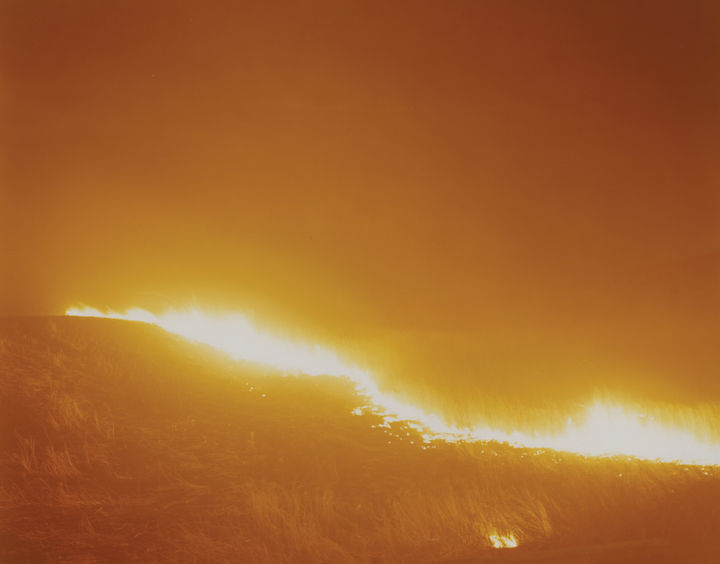
Untitled, 2013; Lambda Print; 25.19 x 31.5 in. Courtesy of the artist and Aperture Gallery. Photo: Rinko Kawachi.

Rinko Kawauchi. Untitled, 2013; Lambda Print; 25.19 x 31.5
in. Courtesy of the artist and Aperture Gallery.

In translation, the poem’s words bleed together. The first line reads, “Heaven, earth, star, sky/Mountain, river, peak valley.” These evocative words point to the driving theme behind the exhibition: an understanding of the universe as a constant moving cycle that lacks a beginning and an end. Heaven melts into earth, which melts into the stars.

Read More »

Share

Elsewhere

Grid’s World at Locust Projects

In any survey of post-war abstract painting, an inescapable topic of discussion is the grid. Usual examples cite artists such as Agnes Martin and Ad Reinhardt, and the grid as aesthetic style typically bears descriptive qualities like “clinical,” “sterile,” and “objective”—words that have minimalistic sensibilities. However, as Zachary Cahill points out in an introductory text for Grid’s World at Locust Projects in Miami, grids are “messy in their anti-hierarchical nature,” structurally speaking.[1] The end result of this collaborative group show proves Cahill’s declaration a bit of an understatement.

Alexandra Hopf, Odalis Valdivieso, Marcos Valella, Siebren Versteeg, and Gabriel Vormstein. Grid’s World, 2013; installation view, Locus Projects, Miami. Courtesy of Locust Projects. Photo courtesy of Zack Balber with Ginger Photography Inc.

Alexandra Hopf, Odalis Valdivieso, Marcos Valella, Siebren Versteeg, and Gabriel Vormstein. Grid’s World, 2013; installation view, Locus Projects, Miami. Courtesy of Locust Projects. Photo courtesy of Zack Balber with Ginger Photography Inc.

Instead of a typical curated group show, Locust Projects invited the five artists involved—Odalis Valdivieso and Marcos Valella, from Miami; Siebren Versteeg, from New York; and Alexandra Hopf and Gabriel Vormstein, from Berlin—to participate in a three-week-long collaborative process in order to organize the exhibition. An experiment in exhibition-making, the artists were given the authority to determine the aesthetic outcome of the show. Naturally, this process involved various disagreements, compromises, and long nights at the gallery. While one of the show’s main elements consists of a large grid-like installation encompassing individual works from each artist, there are also collaborative works, including a sculptural installation, a series of wall paintings, and a back-room installation consisting of a generative video work projected on the grid of a garage door and several palm fronds strewn about the floor.

Read More »

Share

Hashtags

#Hashtags: The Ideological Venice Biennale

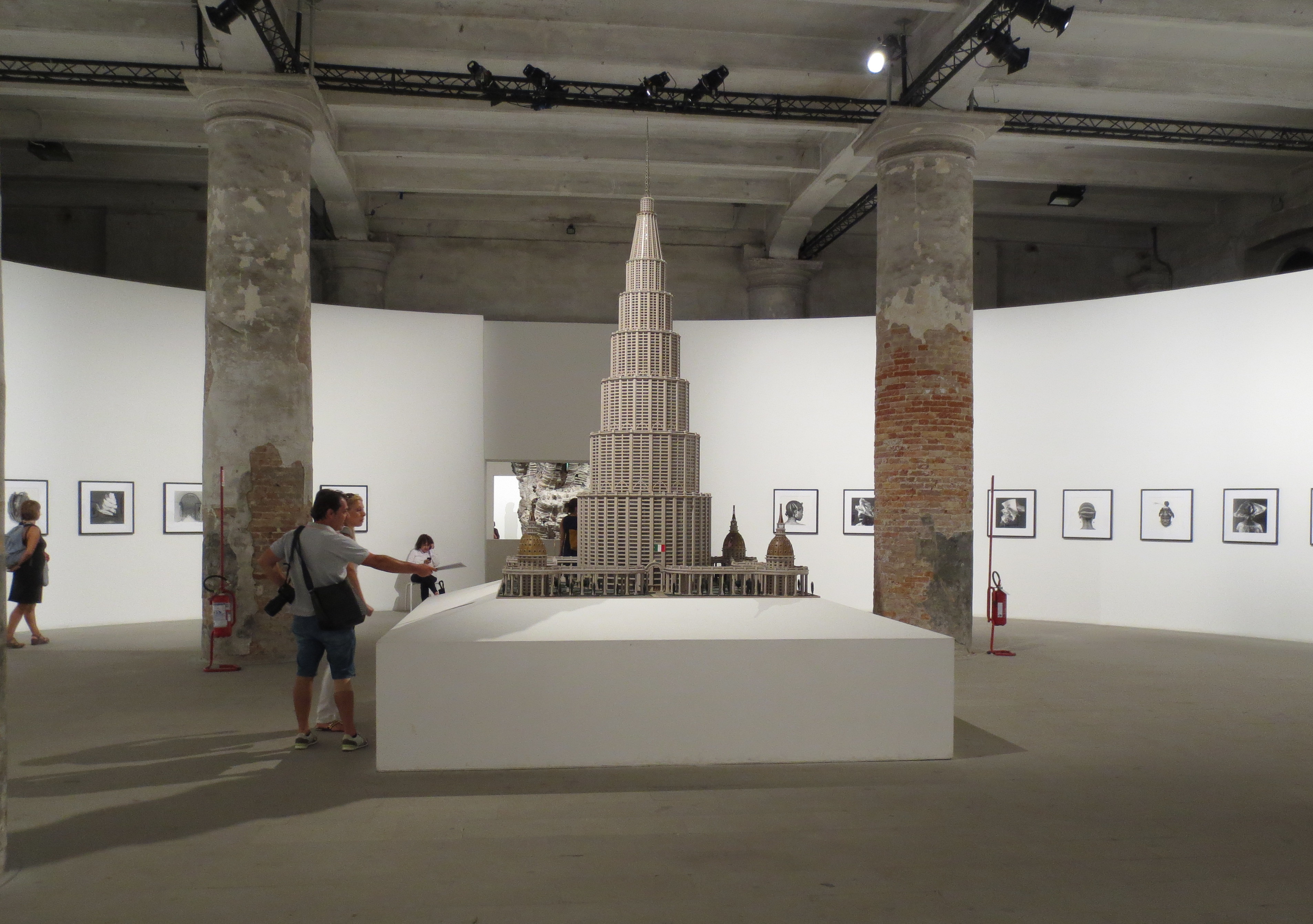
The title of this year’s Venice Biennale, Il Palazzo Enciclopedico (The Encyclopedic Palace), illuminates the event’s political ideology via its philosophical and curatorial conceits. The main exhibition centers on a utopian fantasy of comprehensive knowledge, aspiring to a completist vision of human achievement with the caveat of inevitable failure built in. Though self-reflective in that sense, this theme does not acknowledge the long shadow of cultural erasure that the rhetoric of total objective knowledge has cast since the Age of Empire. Rather, the show celebrates a primitivist rhetoric of “naïve” knowledge as a foil for the rationality of European academicism. As such, it reinforces age-old cultural hierarchies that have remained surprisingly intact in contemporary times.

Marino Auriti. The Encyclopedic Palace of the World, c. 1950s. Wood, plastic, glass, metal, hair combs, and model kit parts. American Folk Art Museum, gift of Colette Auriti Firmani in memory of Marino Auriti, 2002.35.1. Photo by the author.

Marino Auriti. The Encyclopedic Palace of the World, c. 1950s. Wood, plastic, glass, metal, hair combs, and model kit parts. American Folk Art Museum, gift of Colette Auriti Firmani in memory of Marino Auriti; photo by the author

This ideological subtext is absent from the discourse around the exhibition. For example, Kadist Art Foundation has supported a smartphone app for Biennale-goers, The Venice Biennale Ideological Guide, created by Dutch artist Jonas Staal. This guide evaluates each national pavilion according to the political and demographic conditions of each sponsoring nation. The ideological position of each nation’s ruling party is articulated, as is the ideological bent of each contributing writer. However, no critique is offered of the main exhibition that sets the tone for the whole event.

Read More »

Share

From the Archives

A Gentle Art of Disappearing

I remember the first time I learned about Yves Klein in art history class. It was one of those moments (and I had many during that course) where I not only chuckled and admired the artist’s audacity but thought, “If only I could have been there to see this myself.” For Yves Klein’s work, this, of course, is the premise of its strength. Having an audience present is part of what gives the work its weight, but the work would exist without the audience at all. Those that were fortunate enough to have seen, heard, or experienced Yves Klein at work were just that—very fortunate (as you will read below). For the rest of us, there are exhibitions like the one currently on view through November 16, 2013, at Dominique Levy, entitled Audible Presence: Lucio Fontana, Yves Klein and Cy Twombly. Today we bring you an article written by Andrew Tosiello on the kind of evanescent art made by Klein and its kin. The article was originally published on October 19, 2010.  

True story: A student goes to his teacher for instruction. The guru, having observed him, says, “You are charming. This is an obstacle to your growth. From now on, when you are in a room of people, do nothing; do not seduce them, and do not charm them, but leave behind only a scent.” “What scent is that, teacher?” “Love.”

I’ve heard this story a couple of times from a friend (a friend of the student in the story, in fact), who brings it up when personal or social ambition is troubling someone. As I’ve understood it, the instruction of the guru is meant as an antidote to the hidden, ego-driven desire to possess people through charm. The lesson, to be generous and give (subtly, invisibly, almost) rather than take, without imposing oneself, seems an impossible instruction. I’ve sometimes wondered if it is a Zen koan meant to quiet the mind for meditation rather than a directive for actual application. I try to imagine what would occur if one truly attempted this as a way of moving through the world? Leaving only a slight impression of one’s presence, rather than an indelible mark. I’m not referring to the question of one’s legacy (that’s out of one’s control and indicative of too high-self regard, if not hubris), but to the simple, daily interactions with people. Conceiving of a convincing way in which one could leave people with an unnameable sense of love without being overbearing (missing the mark, therefore) at worst or wishy-washy (unconvincing) at least escapes me.

Robert Morris. Box with the Sound of Its Own Making, 1961; walnut box, speaker, and 3.5 hour recorded audiotape.

As impossible as it is for me to convince myself of this as a practical approach, I can imagine it, at least a little, when I think of artists like Yves Klein, Lee Lozano, Robert Barry and Tino Sehgal, for example. Not that they achieved enlightenment, but that their artistic practices, at least in part, turn away from the art object in favor of something less immediate. This, of course, is not a new identification. Lucy Lippard noted it decades ago in Six Years: The Dematerialization of the Art Object from 1966 to 1972.

Read More »

Share