New York

Repetition and Difference: LTTR

Today from our partners at Art Practical we bring you an essay on the New York-based LTTR, who describe themselves as “a feminist genderqueer artist collective with a flexible project-oriented practice.” As author Julia Bryan-Wilson notes, “…LTTR rallies people together with ardent enthusiasm.” This article was originally published on December 4, 2013.

LTTR. Cover of “Listen Translate Translate Record,” no. 2; August 2003; edition of 1000; 12.5 x 12.5 in, folded. Silka Sanchez. Untitled, 2003. Courtesy of LTTR.

LTTR. Cover of “Listen Translate Translate Record,” no. 2; August 2003; edition of 1000; 12.5 x 12.5 in, folded. Silka Sanchez. Untitled, 2003. Courtesy of LTTR.

“It is our promiscuity that will save us,” AIDS activist and art theorist Douglas Crimp asserted in 1987, a time often marked by the brutal vilification of gay sex, when a devastating health crisis was portrayed in the media as punishment for pleasure. Crimp defied this moralism by arguing that gay men’s sexual flexibility might help them adapt to safer sex strategies. While the AIDS crisis continues, albeit cushioned for some by the effects of life-extending drugs, it is nevertheless difficult to render Crimp’s claim intelligible today. The value of promiscuity considered literally, as Crimp did, seems impossible to imagine given the profound conservatism of much of the contemporary gay and lesbian movement. (The terms of public discourse have changed, clearly, when debates focus on the participation of gays in the institutions of marriage and the military.) Gay couples have perhaps become more tolerated in U.S. society, but other queer practices and community formations have arguably become more limited. Given the current, narrow visions of queerness, there are still lessons to be learned from Crimp’s promotion of openness and diverse encounters.

An embrace of a kind of promiscuity, then, has driven the New York–based collective LTTR from the outset. LTTR is a shifting acronym; it started in 2001 as “Lesbians to the Rescue”—a superhero slogan if there ever was one—and has since stood for phrases ranging from “Lacan Teaches to Repeat” to “Let’s Take the Role.” Just as the words behind its initials are variable, so too are its membership and output. Founded by Ginger Brooks Takahashi and K8 Hardy, LTTR has been joined by Emily Roysdon and Ulrike Müller; all four have ongoing individual practices as artists, videomakers, writers, and/or performers, and they frequently participate in other artistic and activist projects. (Lanke Tattersall was also an editor for the fourth issue.) While LTTR began as a collectively edited and produced journal, the group now also organizes screenings, exhibitions, performances, read-ins, and workshops. The original phrase “Lesbians to the Rescue” suggests that someone, or something, needs to be saved (the phrase is missing only an exclamation point to drive home its campy urgency)—and it is clear from the excited, even libidinal ethos of its projects that LTTR sees this redemption as rooted in desire.

Read the full article here.

Share

Fan Mail

Fan Mail: Rachel Debuque

Rachel Debuque works with myriad subjects and forms. In her work, installation, performance, video, and sculpture collide with themes of domesticity, the still life, and the eccentricities of both individual personalities and physical spaces. Through all of this, her oeuvre coheres around a central concern: the visual re-codification and conveyance of memory through spatial sensitivity.

Rachel Debuque. Cacti-Smash (Performance and Installation), 2013; paint, wood moon cacti, gloves, plastic goggles, test tubes, knife, glass bowl, watch glasses plaster cast moon cacti, plaster cast cat sticks, cast plastic cat stick, aluminum, plastic roofing, extension cords, power strip, fake plants; 8’ x 10’ x 8’ feet. Courtesy of the artist.

Rachel Debuque. Cacti-Smash (Performance and Installation), 2013; paint, wood moon cacti, gloves, plastic goggles, test tubes, knife, glass bowl, watch glasses plaster-cast moon cacti, plaster-cast cat sticks, cast-plastic cat stick, aluminum, plastic roofing, extension cords, power strip, fake plants; 8 x 10 x 8 ft. Courtesy of the Artist.

Debuque’s Cacti-Smash (2013) is an installation-based performance that features two swimsuit models, nearly identically dressed, as well as a series of small, color-coordinated cacti and logs. Two colorful and brightly patterned walls and a matching floor frame a space that reads simultaneously as an interior and exterior room. As the two models begin their performance, a looped vocal track plays and then fades out, and the two women don laboratory-style safety goggles and classic yellow rubber gloves. The performance continues as the two cut, smash, and place a cactus in a test tube—this process, repeated with each performance, enacts an alternative yet nonsensical type of housework. With its candy-striped colors, combination of faux and real objects, and deliberately confident choreography, Cacti-Smash reads as a scene borrowed from some music video or commercial studio set, combining incredibly bright colors in attention-grabbing graphic patterns.

Read More »

Share

Boston

Amy Sillman: one lump or two at the Institute of Contemporary Art/Boston

Amy Sillman? All I can say is pentimenti. The artist’s working process provides so many transitory parts that the brain has to protect itself by combining them into a whole. The work comes to a rest, but hiding under the surface are two interpretive horizons: The complete painting and the individual paint strokes. The whole work is inseparable from each stroke, and yet the individual stroke is unrelated to the whole.

Amy Sillman, C, 2007; Oil on canvas; 45 x 39 inches. Collection of Gary and Deborah Lucidon. Photo: John Berens.

Amy Sillman. C, 2007; Oil on canvas; 45 x 39 inches. Collection of Gary and Deborah Lucidon. Photo: John Berens.

Her more recent abstract paintings (she’d say drawings), now on view at the ICA Boston, are certainly framed this way. Each is built up by forming an impulse, trying a layer, reversing it, repainting something new, rotating the painting, reacting to what is there, being surprised, drawing the thing again, and finally ending up with a ream of ideas painted in layers. The resultant painting is like seeing an entire novel or movie as one thing, at one time. They are born of inclusivity. They are filled with cellular veins of information; crowded swills of moments that incorporate their neighbors instead of disregard them.

Read More »

Share

Best of 2013 – AFRICOBRA at the Logan Center for the Arts

Happy New Year! For the last day of our Best of 2013 series, we bring you Randall Miller‘s review of AFRICOBRA at the Logan Center for the Arts in Chicago. This review was originally published on July 23, 2013, and as a consideration of art, activism, race, class, and collectivism, it bears a second look as we move forward into the new year. What changes—in art, in politics, in social justice—can we look forward to in the coming 365 days? 

The assembly of works by AFRICOBRA (African Commune of Bad Relevant Artists), a collective of African American Chicago-based artists active during the 1960s and 1970s, now on display at the Logan Center for the Arts could fairly be described as a time capsule; it is more important for the moment it captures than for its contents. In addition to this exhibition, titled AFRICOBRA: Philosophy, the collective currently has two other exhibitions on the southside of Chicago: AFRICOBRA: Prologue—The 1960s and the Black Arts Movement, at the South Side Community Art Center, and AFRICOBRA: Art and Impact, at the DuSable Museum of African American History. Historically and aesthetically, the work in Philosophy conveys a palpable yearning on the part of the artists to carve out a viable place for African American identity within the visual arts and society at large. The show is all about the urgency of a political moment that still resonates forty years later.

Gerald Williams. Wake Up, 1969; Acrylic on canvas; 36 x 48 in. Courtesy of the artist and Logan Center for the Arts

Much of the work on display features iconic compositions of figures, standing front and center in an almost neo-Byzantine style. The simple messages surrounding the figures are frank and explicit, creating a collection of works that border on propaganda. This is by design, according to the pillars of AFRICOBRA’s aesthetic philosophy described by founding member Barbara Jones-Hogu’s 1973 manifesto, “The History, Philosophy and Aesthetics of AFRICOBRA.” Jones-Hogu states that compositions must feature “the figure frontal and direct to stress strength, straight forwardness, profoundness, and proudness” and that “subject matter must be completely understood by the viewer, therefore lettering [ought to] be used to extend and clarify the visual statement.” [1] Steeped in the politics of self-determination, black nationalism, and Black Power espoused by the burgeoning Black Arts movement, AFRICOBRA artists Jeff Donaldson, Jones-Hogu, Carolyn Lawrence, Jae Jarell, Wadsworth Jarell, and Gerald Williams created colorful figurative works loaded with messages calling for greater political consciousness.

Read More »

Share

Best of 2013 – #Hashtags: The State of Art: Bangladesh, Portugal, Greece, and Palestine at the Venice Biennale

Continuing our Best of 2013 series, today’s pick comes from co-founder and former managing editor Julie Henson, who explains her choice: “The Venice Biennale is the Olympics of the art world. An event of this scale always manages to reflect the state of the artworld in both intended and accidental ways — drawing parallels between complex relationships such as nationality and race, or economics and globalization. That’s why I fell in love with this article on the Venice Biennale. The context of cultures as they cross boundaries in an event as oversaturated and unapologetic as the Biennale is fascinating. I am pleased to read about projects that aren’t from the countries with ultimate socioeconomic prowess, but instead, read an assessment focused on the interactions between art, politics, and nationality. To me, that’s what Daily Serving really has to offer.” This article was written by Anuradha Vikram and originally published on November 4, 2013.

#politics #statehood #borders #biennials #nationalism

The Venice Biennale is fundamentally shaped by its founders’ belief in statehood. Each nation-state secures its site, much like an embassy, and asserts its self-image through the choice of curators and artists. Four pavilions at the 2013 Biennale demonstrate how the notion of the nation-state is constructed and deconstructed in the face of contemporary global pressures. For Bangladesh, the pavilion is a platform to assert a distinct national identity and to distract from tensions prompted by multinational, neocolonial actors. For Portugal, the pavilion is an emissary transporting national essence across geographical borders. For Greece, the pavilion is a catharsis for anxieties about an unstable economic and political system. For Palestine, the pavilion is a non-site reflecting the nebulous identity of a stateless people. Art serves politics in each exhibition, whether representing patriotism, diplomacy, reckoning, or refusal.

Dhali Al Mamoon. Elimination, 2013. Installation. Bangladesh Pavilion, 55th Venice Biennale. Photo by the author.

Dhali Al Mamoon. Elimination, 2013. Installation. Bangladesh Pavilion, 55th Venice Biennale. Photo by the author.

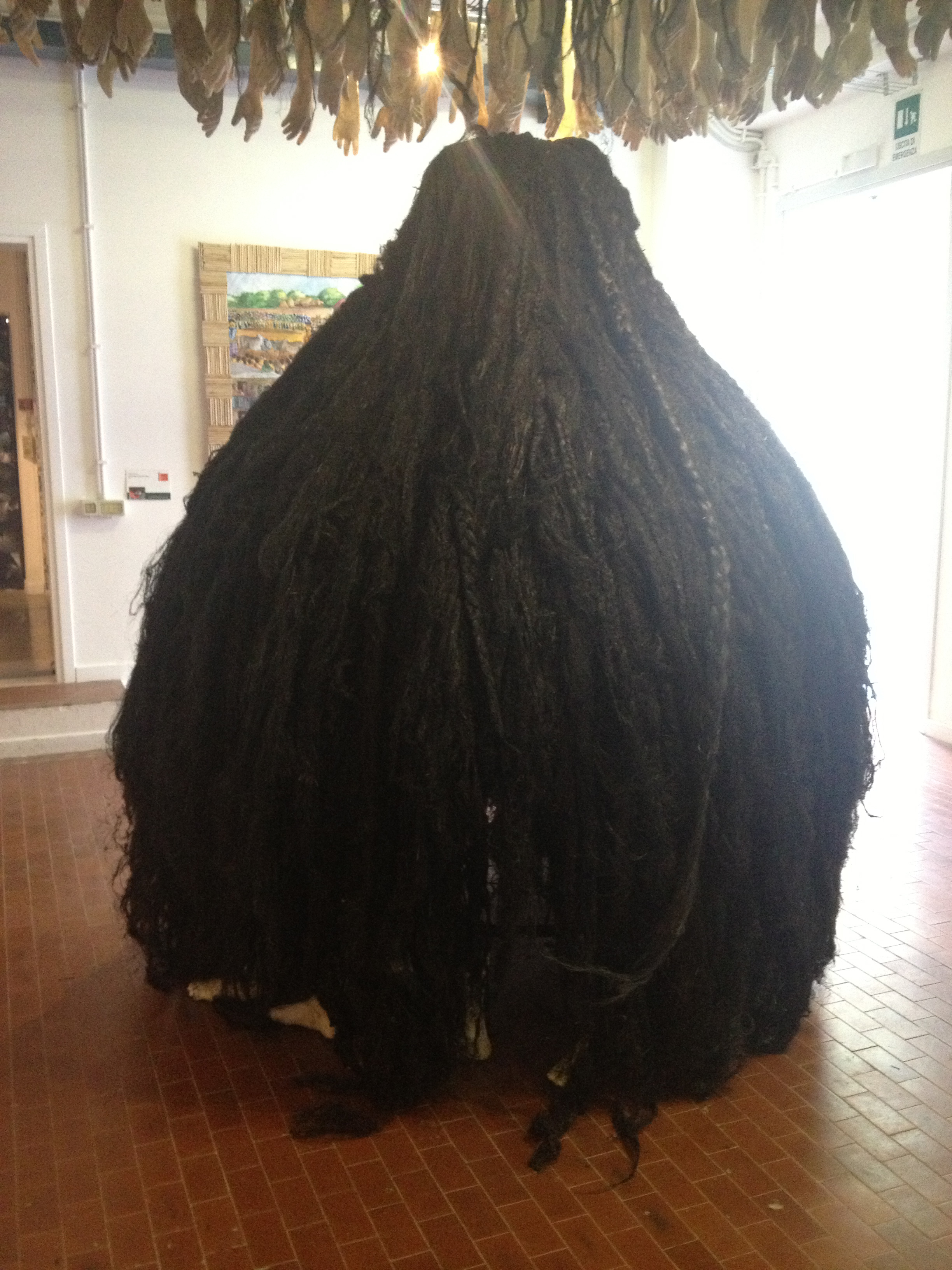
Bangladesh’s pavilion hosts a group show, Supernatural, that features eight Bangladeshi artists, two international artists, and a collaborative project by the Charupit Art School. The show is commissioned by Francesco Elisei, an Italian who is also responsible for the current and 2011 Costa Rica pavilions, and curated by another Italian, Fabio Anselmi, who curated the 2011 Syrian pavilion. The Bangladeshi artists Mokhlesur Rahman, Mahbub Zamal, A. K. M. Zahidul Mustafa, Ashok Karmaker, Lala Rukh Selim, Uttam Kumar Karmaker, Dhali Al Mamoon, and Yasmin Jahan Nupur are all members of a collective, the Chhakka Artists’ Group. They are joined by Gavin Rain of South Africa and Gianfranco Meggiato of Italy. The works are a broad mix of modernist painting and sculpture, multimedia works, installations, and folk art. Very little holds them together materially, stylistically, or thematically. Large-panel paintings by Mokhlesur Rahman sit adjacent to gleaming geometric abstractions in bronze by Gianfranco Meggiato. The paintings invoke the folk figures and rural landscapes of an idealized Bengali past, while the sculptures are quintessential mid-century European modernism of the sort that has come to be identified with corporate architecture. A mixed-media sculpture installation by Dhali Al Mamoon has a creepy vibe that doesn’t gel with the adjacent cheerful, naïve paintings from the Charupit School. Mamoon’s work is a mountain of matted black hair atop a circle of pale feet that poke out from beneath, with hands suspended from above. Ambiguous and menacing, it is among the show’s best works as it occupies a space that is neither nationalistic nor nostalgic.

Read More »

Share

Best of 2013 – Robert Heinecken at Cherry & Martin

For today’s installment of our Best of 2013 series, we have a selection from co-founder Seth Curcio, who writes, “Robert Heinecken has always lived near the top of my favorites list. So, reading this lovely review of his recent project in LA was a nice little surprise. It gave me the opportunity to reflect on how Heinecken’s work operates in today’s context—shedding light on how the issues addressed in his work are still present and how many young artists continue to reflect his sensibilities.” This review was written by Matt Stromberg and originally published on October 15, 2013.

Robert Heinecken is an artist who is hard to pin down. A photographer who rarely used a camera, he founded UCLA’s photography department in 1964. Skeptical of the documentarian role of photography, he mined images from mass media, prefiguring the appropriation strategies of Pictures Generation artists like Richard Prince and Sherrie Levine by at least a decade. Despite this, he was never able to achieve the notoriety accorded these artists. The exhibition Robert Heinecken: Sensing the Technologic Banzai, now on view at Cherry and Martin through November 16th, aims to set the record straight with a reconsideration of his oeuvre.

Robert Heinecken, P.P. Three Women A, 1990; Cibachrome photogram; Edition of 3; 14 x 11 inches, 35.56 x 27.94 centimeters. Courtesy of Cherry and Martin, Los Angeles. Photo: Robert Wedemeyer.

Robert Heinecken, P.P. Three Women A, 1990; Cibachrome photogram; Edition of 3; 14 x 11 inches, 35.56 x 27.94 centimeters. Courtesy of Cherry and Martin, Los Angeles. Photo: Robert Wedemeyer.

Covering work from the 1980s—the second third of Heinecken’s career—the show features four main bodies of work, each showcasing a different artistic technique. Perhaps most well known are his magazine photograms, which he began making in the 1960s (the ones in this exhibition are from around 1990). To make these, Heinecken treated magazine pages like negatives; the resulting image is a composite of both sides of the page. Using mostly advertisements, Heinecken’s only artistic intervention is the selection of the pages. The final images appear natural at first—front and back unified by the common language of seductive luxury—but the more one looks at these, the more an awkward dialogue between the different sources causes an unsettling disjuncture. Heinecken’s skill as an editor is what makes these images so compelling; they attract us with the aesthetics of advertising, and then thwart our gaze by subtly complicating their messages of desire.

Read More »

Share

Best of 2013 – Mike Kelley at MOMA PS1

For our Best of 2013 series, Fan Mail columnist A. Will Brown selected Alex Bigman‘s review of Mike Kelley’s retrospective at PS1. Says Brown, “The untimely death of Mike Kelley is a potent reminder of how important every minute can be, particularly for those exploring and challenging the very mesh of society. This article, while particularly well written, hints at the importance of displaying Kelley’s oeuvre, yet also addresses the complex problems in showing a body of work that was cut short due to the artist’s death, as a career retrospective. Perhaps it was too soon for a show like this, not just because the painful memory is fresh but because Kelley, like all artists, deserves more time and consideration before being staged so distinctly.” This article was originally published on November 27, 2013.

Mike Kelley, now at MoMA PS1, is massive. The largest retrospective of the artist’s work to date, it is comprehensive perhaps to a fault, filling each of the exhibition space’s four floors to capacity and arguably beyond. The former school building’s multiple stairwells allow for various paths through the exhibition—a feature that is liberating if potentially disorienting—but the overall impression is one of totality; of a lifetime of practice gathered together and laid out for inspection. Even after several hours navigating the show with the aid of a floor plan, I’m not confident I saw everything, but in any case, I had had enough.

Mike Kelley. Day is Done, 2005; installation view, Mike Kelley, 2013. Courtesy of MoMA PS1. Photo: Matthew Septimus.

Mike Kelley. Day Is Done, 2005; installation view, 2013. Courtesy of MoMA PS1. Photo: Matthew Septimus.

This is to say that the show is taxing, partly because Kelley’s art is itself often stress-inducing, concerned as it is with giving stage to images of trauma and giving form to anxieties that society would otherwise repress—and doing it with a fierce impudence and black humor that has been aptly classified as punk. To be sure, this disdain for the polished and the decorous is what makes Kelley so outstanding as an artist, and Mike Kelley deserves praise for including so many of his hard-to-stage projects. Take, for instance, his quixotically ambitious Day Is Done video installation series, which sets out to stage twisted “repressed memories” purportedly lurking beneath 365 high-school yearbook photos of extracurricular activities. Here we encounter twenty-five of the thirty-two completed installments together in one rich, cacophonous gallery.

Read More »

Share