Hashtags

#Hashtags: Critiquing Museums from the Outside In

#museums #architecture #philanthropy #urban development #institutional critique #spectacle #metaphor

In January, the Los Angeles 2020 Commission, a group of thirteen experts convened by the Los Angeles City Council to assess the city’s civic problems, delivered a damning report. Titled “A Time for Truth,” it begins with the statement “Los Angeles is barely treading water while the rest of the world is moving forward,” and gets progressively bleaker from there. Citing economic shrinkage, severe poverty, income inequality, an intractable traffic-congestion problem, and a government that will soon be too broke to provide basic services and promised pensions as among the city’s plagues, the report effectively suggests that nothing short of a white knight could reverse the process of decline.

The Broad_exterior rendering

Exterior of the Broad from 2nd Street and Grand Avenue. Image courtesy of the Broad and Diller Scofidio + Renfro.

Yet people do not seem to have given up hope for Los Angeles, in particular its potential as an art capital. The Hammer Museum was recently able to eliminate its admission fee thanks to a generous gift by two longtime donors, joining its neighbor the Getty in this regard, and LACMA may follow suit: The Dallas Museum of Art is currently using a $450,000 grant to study how its novel free-membership program could be applied to the West Coast institution, among two others. Across town, philanthropist Eli Broad is preparing to consolidate his formidable art collection at the Broad, his new storehouse-cum-contemporary art museum on Grand Avenue. Broad’s investment is a strong vote of confidence for the city’s downtown, which has long wavered between abandonment and renewal. Moreover, the museum is not to be a billionaires’ club; admission will be free here as well. Come 2015, L.A. will be able to boast, by many measures, greater access to major museums than any other American city—provided the traffic isn’t too bad.

Read More »

Share

Shotgun Reviews

Forrest Bess: Seeing Things Invisible at the Berkeley Art Museum

Shotgun Reviews are an open forum where we invite the international art community to contribute timely, short-format responses to an exhibition or event. If you are interested in submitting a Shotgun Review, please click this link for more information. In this Shotgun Review, Maria Porges reviews Forrest Bess: Seeing Things Invisible at the Berkeley Art Museum in Berkeley, California.

Forrest Bess. Bodies of Little Dead Children, 1949; oil on canvas; 6 x 7 5/8 in. The Menil Collection, Houston. Photo: Paul Hester.

Forrest Bess. Bodies of Little Dead Children, 1949; oil on canvas; 6 x 7 5/8 in. The Menil Collection, Houston. Photo: Paul Hester.

Forrest Bess (1911–1977), a talented, visionary artist whose work was exhibited in notable galleries and museums during his career, spent most of his adult life in poverty and isolation because that was the only way he could stand to live—away from others, entirely on his own terms.  This monographic exhibition of his work presents a selection of nearly forty pictures, the majority of them dating from the period during which he was most active as an artist, the 1940s and ’50s. A prodigious reader and letter writer (and, as an artist, an autodidact), Bess based his small, mostly abstract paintings on visions that often arrived in the last moments before falling asleep or waking, recorded as soon as he opened his eyes. Despite the fact that he lived in relatively primitive circumstances in a fishing shack on the Gulf of Mexico, he did travel to New York, met the fabled gallerist Betty Parsons, and persuaded her to show his paintings six times between 1950 and 1967.

Read More »

Share

San Francisco

Valuing Labor in the Arts: Can We Talk About the Audience?

From our partners at Art Practical, today we bring you an excerpt of author Michael O’Hare’s response after participating in the “Big Soft (BS) Contract” workshop. This workshop was part of  the practicum “Valuing Labor in the Arts” at the Arts Research Center at UC Berkeley, a daylong series of artist-led workshops that explored questions of art, labor, and economics. O’Hare, who is a Professor of Public Policy at UC Berkeley, notes: “Arts policy, which includes nonprofit presenting institutions as well as all levels of government in the U.S., is neither a hobby and dilettante diversion nor inconsequential for artists and their audience.” This article was originally published on May 22, 2014.

Introduction, Valuing Laboring in the Arts practicum, April 19, 2014, UC Berkeley Art Museum. Courtesy of the Arts Research Center, UC Berkeley. Photo: Joseph del Pesco.

Introduction, Valuing Laboring in the Arts practicum, April 19, 2014, UC Berkeley Art Museum. Courtesy of the Arts Research Center, UC Berkeley. Photo: Joseph del Pesco.

The implicit proposition of the practicum, that artists are workers who should be paid for the value they create just like anyone else, was also the view of my mother, whose socialism never got her all the way to “from each according to his abilities, to each according to his needs.” It is also mine. Western societies are ill served by the infantilizing idea that artists are not really grownups who can take care of themselves but instead need to be maintained by a perpetual charitable regime of subsidy and gifts. There are certainly market failures and justice issues in the economics of the arts that need government action, but some of those policies, such as those concerning the poor and distressed, are not specific to the arts. Those that are should be directed at paying artists properly for the value they create for others, not just to “funding the arts.” These two are not the same thing, not at all.

Worse than ill-targeted policies, of course, is all the talent lost when painters or actors are paying the rent by doing carpentry or waiting on tables. We need good carpenters and waiters, and it’s wasteful at both ends for those things to be done by people whose talents lie elsewhere.

Why is this system broken? (It isn’t working for people who aren’t artists, either.) How can we turn the creative, optimistic, earnest innovations we heard about at the practicum into realistic initiatives with coherent core principles? And how can we treat society’s relationship to the arts with the same softhearted, hardheaded realism we demand in fields such as criminal justice, education, and environmental policy?

Read the full article here.

Share

Los Angeles

Men in L.A.: Three Generations of Drawings at The Box

Men in L.A.: Three Generations of Drawings at The Box features a massive collection of over 400 drawings created by artists Naotaka Hiro, Benjamin Weissman, and Paul McCarthy, individually and in collaboration with one another. The title of the exhibition overreaches somewhat—there are not really three generations, but rather three artists separated by less than thirty years in age. Yet what the exhibition does accomplish is to gather together twenty-five years of drawings by artists who depict the body in all its grotesquely sexual, scatological, and effluvial glory.

Paul McCarthy & Benjamin Weissman, Quilting Sessions, 1997-2008 (installation view)

Paul McCarthy & Benjamin Weissman. Quilting Sessions, 1997-2008; installation view at The Box Gallery, Los Angeles. Image courtesy of the Artists and The Box, Photo: Fredrik Nilsen.

Fittingly, the oldest artist in the show is Paul McCarthy, who has been creating all manner of abject and provocative art since the early 1970s. Beginning with simple early performances, McCarthy’s oeuvre has come to include sculpture, video, and installation, culminating in recent big-budget cinema spectacles. McCarthy’s “signature ingredients: violence, humor, sex, impotence, appetite, degradation, art history, politics, and pop culture”[1] are all present here, most notably in his collaborations with Benjamin Weissman in Quilting Sessions (1997–2008). Although they are still quite graphic, these mostly black-and-white drawings have a different impact than McCarthy’s more substantial works. Instead of being confronted by the over-the-top viscera and obnoxious characters of his films, here the intimacy of the crude ink-on-paper drawings pulls viewers in, even while their transgressive imagery repels. The repetition of so many images, hung in tight rows four high, only strengthens this dynamic. These works recall an adolescent’s notebook doodles, page after page of feverish attempts to conjure as many naughty scenarios as possible. Bits of text hint at disturbing or absurd narratives. (“Mommy Daddy on all 4’s in the Kitchen,” reads one.) Elsewhere, placed on tables, are preliminary sketches for McCarthy’s upcoming Stagecoach piece, as well as Placemat Drawings (2009–2014). This latter series proves interesting for its diversity of subject matter and the casual manner in which various ideas have been developed while the artist dined.

Read More »

Share

New York

Sze Tsung Leong: Horizons at Yossi Milo Gallery

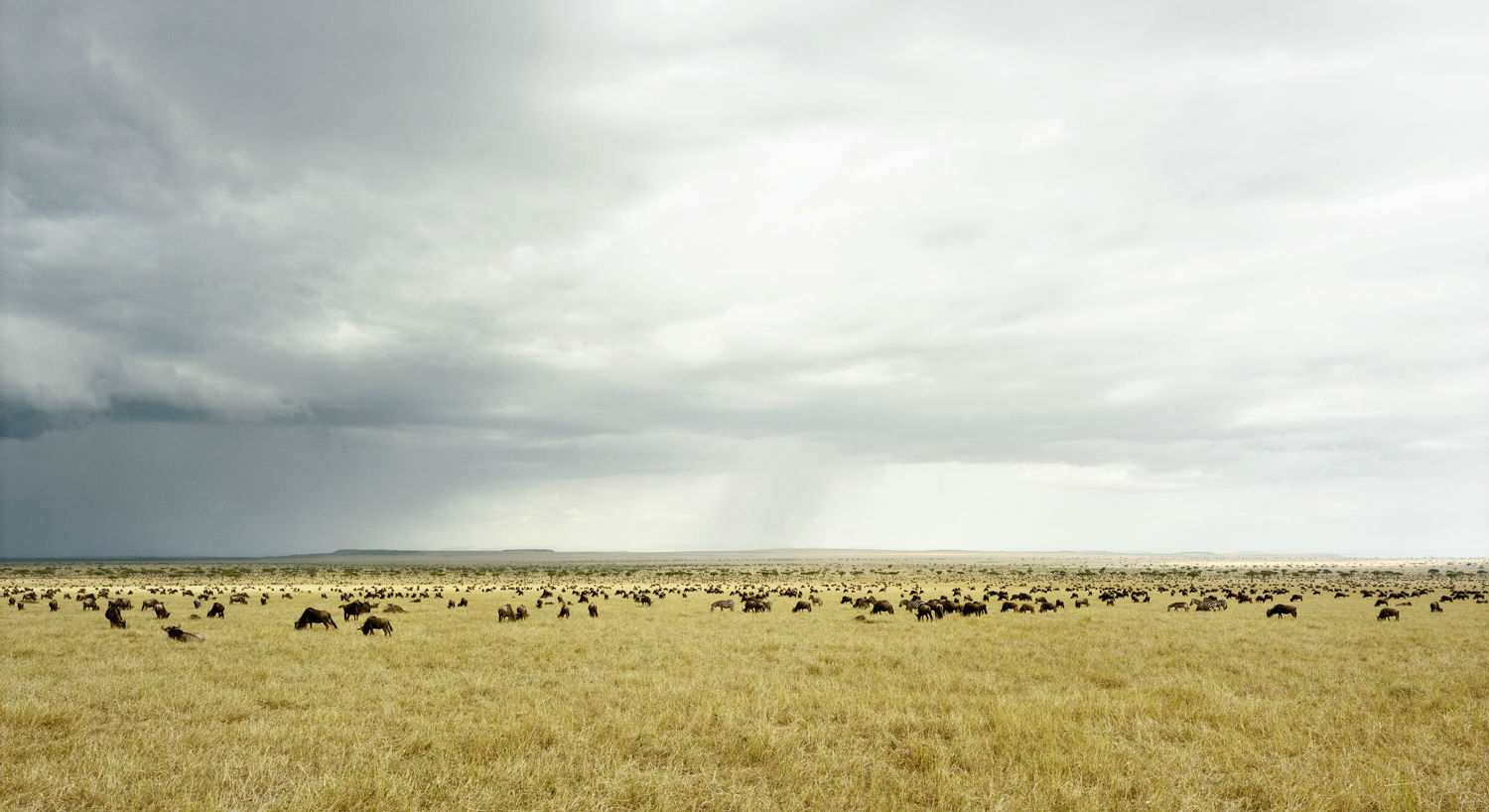
Mexican-born, British-American photographer Sze Tsung Leong photographs vast, spare landscapes from around the world in his ongoing series, Horizons, on view at Yossi Milo Gallery. The arrangement of photos hops from place to place while remaining visually cohesive due to the shots’ shared composition: The horizon line bisects the image at the same point in each photograph, producing the perception of a single line unrolling along the walls of the gallery. The resulting composite panorama gives us a unified view of a disparate world, allowing us to see similarities among varied landscapes by forming visual relationships between them.

Sze Tsung Leong. Masai Mara I, 2009; Chromogenic Color Print; Courtesy of Yossi Milo Gallery.

Sze Tsung Leong. Masai Mara I, 2009; chromogenic color print; 28 x 48 in. Courtesy of Yossi Milo Gallery.

Though no two images in the exhibition are the same, they are all rendered equivalent, to a degree, by Leong’s compositional device. Whether looking at chalky red earth dotted with feeding animals, a group of anonymous suburban houses nestled in a sandy, unfinished development, or the gray skyscrapers that sprout from the shores of Chicago’s Lake Michigan, the viewer’s eye is constantly drawn to the bifurcating line that divides sky and land. In programming the field of vision in this way, Sze Tsung Leong strips the world down to top and bottom, making it seem smaller. This quality is accentuated by the images’ uniform palette of muted colors. Any given photograph is likely to depict woolly cloud cover hanging over Velcro-textured tan grass or silky gray ocean, regardless of the continent on which it was taken. As the exotic coalesces with the recognizable in continuous landscape, foreign places become more familiar. Continents connect as ancient terrains blend into modern cities.

Read More »

Share

Miami

William Cordova: Ceiba: Reconsidering Ephemeral Spaces at MDC Museum of Art + Design

Installed in the Freedom Tower in downtown Miami, William Cordova’s exhibition Ceiba: Reconsidering Ephemeral Spaces shares a geopolitical bond with the building in which it is located. Now a venue for Miami-Dade College’s Museum of Art and Design, the Freedom Tower’s original tenant was the Miami News & Metropolis newspaper. After a period of vacancy, it served as an immigration center for Cuban refugees fleeing Fidel Castro’s regime. The tower once again fell vacant in the mid-1970s and was purchased and resold several times before finally being donated to Miami-Dade College in 2008. A steadfast icon of the Miami skyline since 1925, the building—one that vastly predates the myriad condominium buildings surrounding it—has served itinerant purposes only.

1.William Cordova. Ceiba: Reconsidering Ephemeral Spaces, 2014; installation view, MDC Museum of Art + Design, Miami. Courtesy of the artist and Sikkema Jenkins Co., New York. Photo courtesy of MDC Museum of Art + Design, Miami.

William Cordova. Ceiba: Reconsidering Ephemeral Spaces, 2014; installation view, MDC Museum of Art + Design, Miami. Courtesy of the Artist and Sikkema Jenkins Co., New York. Photo courtesy of MDC Museum of Art + Design, Miami.

Such ephemerality is embraced by Cordova in this exhibition. Consisting of film, photography, and sculpture, his works are often made up of found ephemera and other reclaimed materials. The use of such objects is immediately recognizable upon entering the main gallery—from his Untitled (Geronimo I y II) (2006–2014), composed of a “reclaimed paper bag, feather, brick, [and] pocket-size Art of War by Sun Tzu,” to his Untitled (White Nebula) (2013), whose quotidian components—steel and reclaimed ball bearings—form a very simple work. A diverse set of everyday objects make up other works throughout the gallery and are presented with little context; each work requires the viewer’s reckoning to help complete each work.

Read More »

Share

Philadelphia

Report from Philadelphia

The third-most-popular visitor destination in Philadelphia is a ruined prison: the Eastern State Penitentiary (ESP). Based on the concept of the Panopticon, in which all inmates are housed in a circular building and under the surveillance of guards in a central tower, ESP opened in 1829 and closed in 1971. At the time of its completion, the fourteen-acre complex was the largest construction in the country. Its wagon-wheel design enabled all of the cellblocks to be monitored centrally. Previous prisons were mere storehouses where chaos prevailed. Quakers attempted to bring order and inspire repentance (hence the name “penitentiary”) by placing individual prisoners in meditative, monkish cells, which amounted to a permanent state of solitary confinement. The cruelty of this system revealed itself early on, and reforms gradually ensued.

Cindy Stockton Moore. Installation view, Other Absences, 2014; Eastern State Penitentiary, Philadelphia

Cindy Stockton Moore. Other Absences, 2014; installation view, Eastern State Penitentiary, Philadelphia. Courtesy of the Eastern State Penitentiary, Philadelphia.

Today, like the U.S. National Park Service’s Alcatraz Island, the ESP offers the frisson of criminality, suffering, and punishment to tourists living in a supposedly more enlightened age. Walking through this massive complex is a living Ozymandias experience, but from a museological perspective, the current caretakers have made several nice choices. One is an active artist-in-residence program, in which artists install works around the grounds of the prison and in the crumbling cells. Currently on view is a project by Philadelphia artist Cindy Stockton Moore. She researched the stories of fifty murder victims killed by inmates held at ESP and hung small banners with drawings of their portraits. She noted that most of the images she could locate were of policemen killed in the line of duty; images of working-class victims and victims of color were almost impossible to find. A second example is a re-created synagogue, which in its first incarnation served the small percentage of Jewish inmates during the 20th century. One can’t help but be moved by these occasional instances of kindness and community that brought solace to some of the prisoners amid the immense, crumbling, stone-cold power of the state.

Read More »

Share