Interviews

Talking About 100 Days Action, Part 1

On November 8, 2016, Donald J. Trump reached the nation’s highest political office after a long and brutal election cycle. In response, artists throughout the United States mobilized to resist regressive policy changes that would set progressive efforts back by at least fifty years. Writer and activist Ingrid Rojas Contreras collaborated with numerous Bay Area artists to form 100 Days Action, a creative affiliation described as a “forum for resistance” and “a call to all bodies that stand against bigotry, xenophobia, racism, sexism, and the destruction of our environment to act together.” I spoke with Contreras, Zoë Taleporos, and Dana Hemenway of Oakland’s Royal NoneSuch Gallery about how artist–activist gestures for 100 Days Action are selected, and the role that arts institutions can play in times of political crisis.

Jenifer K Wofford. No Scrubs, 2017; participatory action, performed on January 21, 2017, at the Women's Marches in San Francisco and Oakland, as part of 100 Days Action. Courtesy of the Artist.

Jenifer K Wofford. No Scrubs, 2017; participatory action, performed on January 21, 2017, at the Women’s Marches in San Francisco and Oakland, as part of 100 Days Action. Courtesy of 100 Days Action.

Roula Seikaly: How are interventions vetted and selected? Have you received proposed gestures that haven’t aligned with the 100 Days Action mission?

Ingrid Rojas Contreras: Our curatorial team sits together in pairs to review each proposal. We look at each gesture and decide if it is within our mission, and if it is, we ask which dates are appropriate or workable, and then situate them within the calendar. We received a proposal that was physically violent, where the gesture crossed a line we don’t want to violate. We’re trying to be inclusive and to reach out, but there have to be hard limits to what we support. We’ve published actions that are edgy, but not too extreme. We don’t want it to go that far. We’ve also received suggestions that we wouldn’t feature in the calendar. For example, people getting together to write postcards and sending them to senators and representatives. Since that isn’t an artistic gesture, we agreed to signal-boost the effort through social media, but not add it to the calendar.

Dana Hemenway: I wanted to add that even though there are some gestures that were not included, the 100 Days Action project is still monumental. It’s a huge undertaking. As anyone who plans events knows, lead time before an event is crucial for preparing and promoting it. There’s something to do every day—from an administrative perspective, it can be overwhelming. That said, it’s also what makes it such a powerful project.

Zoë Taleporos: The organization was built in such a small amount of time. To mobilize that many people and to settle on decision-making modalities and set the mission—Ingrid and company just jumped right into it. I think sometimes a narrow response time can prompt the most creative and organic things.

Read More »

Share

Refusing to Be Fed

From our sister publication Art Practical, today we bring you Vivian Sming’s article from issue 8.3: Art can’t do anything if we don’t. The issue takes its name from Sming’s article, where she states, “Raising these questions is not to say that we don’t need art, or that art can’t do anything at all, but rather that art is not exceptional. Art can’t do anything if we don’t. We cannot fail to recognize when and how artists participate in an exploitative market, which does not only include commercial galleries and auction houses, but also museums, nonprofits, and academic institutions.” This article was originally published on March 23, 2017.

Screenshot, @age103, Instagram post.

Screenshot, @age103, Instagram post.

In the days following the 2016 presidential election, a seed of instinctual fear was planted and lodged within me. I live in a suburban neighborhood that is mostly White, in close proximity to a large and diverse immigrant population. As soon as all the votes were counted, I looked up the results within my precinct, and found that 25 percent were votes for Trump. While this is certainly a minority, I became obsessed over the fact that this percentage accounted for over 200 people—200 of my neighbors. Indeed, the personification of these very percentages are how the cracks between family, friends, and neighbors start to emerge.

The first week following the inauguration pushed me further to the edge, bringing me closer to survivalist thinking. With the signing of each executive order, I weighed my fight-or-flight options. As diplomatic relationships corroded, I almost too casually browsed NUKEMAP, a site that displays the detonation radius of different nuclear bombs that are known to exist on Google Maps. I mulled over our past as humans, and felt as if thousands of years of history had been compressed and brought into the present. I had always thought (and have had the privilege of thinking) of history as a document of the past—events that had happened that we, as a society, were progressing away from. However, history is not a record of the past; it is evidence of future possibilities, showing us who we are capable of being and what we are capable of doing, in all the horror and glory.

Read the full article here. 

Share

Shotgun Reviews

Richard Mosse: Incoming at the Barbican

Shotgun Reviews are an open forum where we invite the international art community to contribute timely, short-format responses to an exhibition or event. If you are interested in submitting a Shotgun Review, please click this link for more information. In this Shotgun Review, Eva Mak reviews Richard Mosse: Incoming at the Barbican in London.

Richard Mosse in collaboration with Trevor Tweeten and Ben Frost. Incoming, 2017; Installation view. The Curve, Barbican Centre, 15 Feb - 23 April 2017. Photo: Tristan Fewings / Getty images

Richard Mosse with Trevor Tweeten and Ben Frost. Incoming, 2017; installation view, the Barbican, London. Courtesy of the Barbican. Photo: Tristan Fewings/Getty Images.

No matter race, age, origin, or legal status, while the human body performs the physiological processes that keep its vital functions intact, it radiates heat, thereby making it detectable to thermographic cameras like the ones used for military-grade surveillance. In Incoming, on view at the Barbican, Irish conceptual documentary photographer Richard Mosse repurposed heat-sensitive surveillance technology to create a powerful piece of humanist art: a portrait of today’s refugee crisis, registered in black-and-white signatures of relative temperature difference.

Flipping a dispassionate war mechanism to function as a subversive documentary tool, Mosse worked with cinematographer Trevor Tweeten to scan the land- and seascapes traversed by today’s staggering numbers of migrants: from Syria and Libya to Berlin; from Sahara Desert to the Calais camp. The photographic project is a chilling document of human suffering, yet resonates with a striking lyricism. The mesmerizing footage shows glowing ghosts—without identities, without origins—moving in slow motion through dark, otherworldly settings.

Read More »

Share

San Francisco

Gary Simmons: Recapturing Memories of the Black Ark at Southern Exposure

Depending on when one visits Recapturing Memories of the Black Ark, the current exhibition by the visual artist Gary Simmons at Southern Exposure, one will experience two very different, equally worthwhile shows. A visitor attending the show during regular gallery hours on any given day will face a work of installation art: An impressive tower of speakers sits, along with a boxy old television, on a low plywood stage. Encountering this ensemble feels like walking into a site with a history, a space where bodies once moved and sounds were made. Traces of this history are visible: shoe prints mark the stage; the wood encasing the speakers is worn, flecked with splattered paint and stained by graffiti; the television displays looped recordings of musical acts performed in front of those same speakers.

Gary Simmons. Recapturing Memories of the Black Ark, 2014; installation view, Southern Exposure, San Francisco, 2017. Courtesy of the Artist and Southern Exposure, San Francisco. Photo: Shahrzade Ehya.

Gary Simmons. Recapturing Memories of the Black Ark, 2014; installation view, Southern Exposure, San Francisco, 2017. Courtesy of the Artist and Southern Exposure, San Francisco. Photo: Shahrzade Ehya.

But the installation refers to pasts beyond the performances playing on the television. The work as a whole is inspired by the producer Lee “Scratch” Perry’s legendary Black Ark recording studio in Jamaica, the site where reggae and early dub music developed. Artists like Bob Marley and the Wailers, The Heptones, and Max Romeo recorded there, to name a few. Celebrated for its unique and inimitable acoustics, the Black Ark was an improvised setting and space of experimentation. Both the studio building and many of the innovative sounds and effects made there were created with found materials and everyday objects like corrugated metal, chicken wire, and broken glass. Sadly, the studio was short-lived. Built in 1973, it burned down in 1979, and while many have since tried to imitate the unique style of sound produced there, none have had any great luck.

Read More »

Share

Reykjavik

D30 Ragnar Þórisson: Human Disguise at Reykjavík Art Museum

The Reykjavík Art Museum’s Gallery-D is dedicated to showcasing the work of Icelandic artists who have never mounted a solo exhibition in any of the country’s major museums. D30 Ragnar Þórisson: Human Disguise, the 30th iteration of the series, presents Ragnar Þórisson’s body of psychologically evocative paintings that blur the lines between human experience and myth. These paintings portray states of mind and being with varying degrees of realism, providing numerous interpretations of commonplace sensations and occurrences.

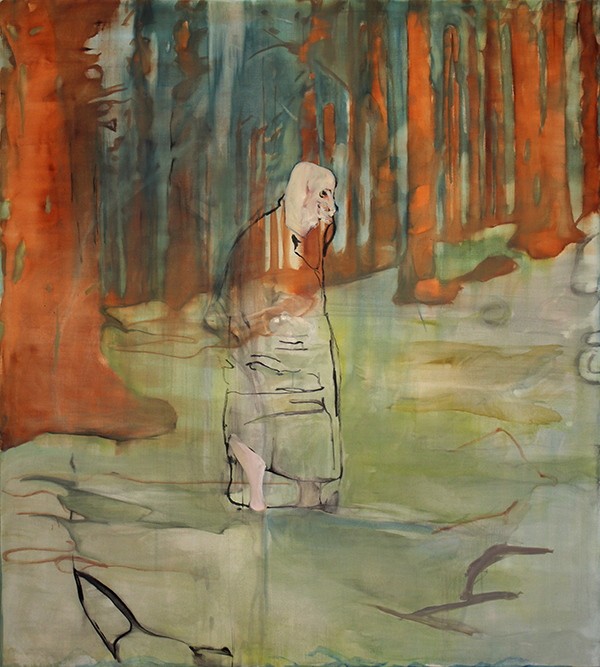
Ragnar Þórisson. Untitled, 2013; oil on canvas; 200 x 170 cm. Courtesy of Reykjavík Art Museum.

Ragnar Þórisson. Untitled, 2013; oil on canvas; 200 x 170 cm. Courtesy of Reykjavík Art Museum.

Ragnar’s work exhibits a clear influence from Expressionist artists while presenting something fresh and unique. The terror and anxiety present in certain iconic Expressionist works is mostly absent, but an aura of uncertainty persists. The hard lines of Egon Schiele and Erich Heckel are apparent, which at times also seems to be a nod toward printmaking. Many of Ragnar’s works, however, diverge from the relatively realistic subject matter of the Expressionists, approaching something that resembles folklore. Though anthropomorphic, the subjects in many paintings don’t seem fully human. The artist employs thin layers of paint to expose underdrawings, with only partial background areas blocked in. His paintings appear intentionally unfinished, resulting in an ambiguous psychological feeling.

The most striking painting (all works are untitled) is large enough to occupy an entire wall, and features an outdoor setting, unlike most of the other works, and a more colorful and varied palette. A single, robed figure stands in a forest, flanked by tall trees with persimmon-colored trunks. This work contains more detail than others, allowing viewers to establish a setting, but not enough detail to establish context. The gender—and even the species—of the figure is unclear, though they stand with a slight hunch. It’s unclear whether this individual reigns over this woodland sanctum, or if they are in a vulnerable state. The sober tones, and the centrality of the figure within the frame, create an atmosphere of importance—this is not a leisurely Sunday afternoon on La Grande Jatte—but the uncertainty persists, and the inability to settle on one of several opposing readings is unsettling.

Read More »

Share

Birmingham

Third Space: Shifting Conversations About Contemporary Art at the Birmingham Museum of Art

As university presidents, corporate CEOs, and political leaders on the left and right toss the terms “multiculturalism” and “postcolonial” around in speeches and promotional materials, I am reminded that these buzzwords of the new transnational order have resisted domestication and dilution through the sharp, thoughtful, uncomplacent writing of Homi K. Bhabha.[1] Bhabha’s recognition that cultures must be understood as complex intersections of multiple places, historical temporalities, and subject positions—narratives marked by ferocious forms of intolerance, geographical evacuations, conquests, and ethical conundrums—has impacted the realm of cultural production in tremendous ways. Curated by Wassan Al-Khudhairi for her home institution, the Birmingham Museum of Art, Third Space: Shifting Conversations About Contemporary Art powerfully mobilizes many of Bhabha’s ideas, specifically his concept of a “third space,” or a space that “challenges our sense of historical identity of culture as a homogenizing, unifying force, authenticated by the originary past, kept alive in the national tradition of the People.”[2] Through deep encounters with the rapidly expanding and shifting coordinates of global contemporary art, Third Space animates the rich relations and unique specificities at work in the contemporary aesthetic production of the Global and American South. Pushing viewers to think within as well as beyond the limits of national borders, the exhibition shapes a powerful narrative of internationally shared forms of marginality.

José Bedia. Mpangui jimagua (Twin Brothers), 2000; acrylic and conté on canvas with objects; 122 x 355 x 188 inches. Courtesy of the Artist and the Birmingham Museum of Art.

José Bedia. Mpangui Jimagua (Twin Brothers), 2000; acrylic and conté on canvas with objects; 122 x 355 x 188 in. Courtesy of the Artist and the Birmingham Museum of Art.

Entering the newly renovated Jemison Galleries, the viewer is drawn to Cuban-born artist José Bedia’s multimedia installation Mpangui Jimagua (Twin Brothers) (2000), which immediately places ideas of crossings, migration, multiplicity, and exile at the center of the presentation. The son of a sailor, Bedia has lived outside of his home country since 1991. Here he paints a doubled silhouette that stretches off the wall and is pulled into space by the small boat attached to the assemblage. Dynamic and suggestive, the work emphasizes the movement of human capital across bodies of water as an ambiguous journey for those seeking new opportunities and financial security, or those fleeing as refugees or exiles. It is this idea of migration and the terrible contexts bound up in the histories of diasporic communities across the world that continues to appear in the exhibition, articulating culture as something mobile, durational, and thus continually in flux.

Read More »

Share

Help Desk

Help Desk: Recommendations for References

Help Desk is where I answer your queries about making, exhibiting, finding, marketing, buying, selling–or any other activity related to contemporary art. Submit your questions anonymously here. All submissions become the property of Daily Serving.

I am often torn when applying for jobs, residencies, and grants when it comes to the references section. Is it better to list the names of people you do not know very well but carry more name recognition, or to list the names of lesser-known people you know well and would give you a very good reference? I often don’t ask people with “name recognition” (that I might know as acquaintances) because I worry they will think I am using them. How much weight does who you know carry in an application? What is the etiquette of asking people to serve as references?

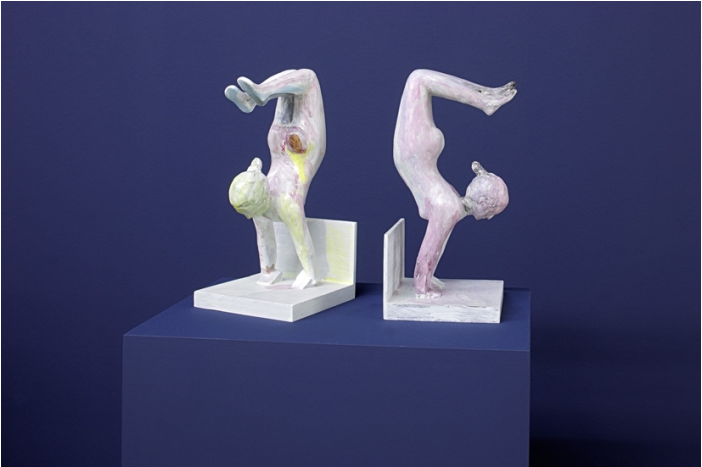
Gerda Scheepers. Taras Bookies, 2009; Installation View at Sprüth Magers Berlin.

Gerda Scheepers. Taras Bookies, 2009; mixed media; installation view at Sprüth Magers Berlin.

“It’s not what you know, it’s who,” the old adage goes. To be honest, I fall victim to this manner of thinking as often as anyone else, even when I’m the one being asked to supply the recommendation. A few months ago, when a colleague asked me to serve as a reference, my initial response was, “Wouldn’t you rather have someone with more clout?” I assumed that she must have far more important people in her corner, and that in the squishy place that we call the “art world”—where social capital outstrips nearly every other cultural marker of success—a tepid reference from a Big Name would count for more than an enthusiastic endorsement from little old me.

As it turns out, I was wrong. I did a lot of research to answer your question, and nearly everyone said  that they’d rather have a strong recommendation from an informed source. My colleague had been right to ask me rather than someone with more name recognition, because she and I went to school together and have conducted studio visits since then, so I’m very familiar with her process and her work ethic. Our long association means that I can speak directly to her growth as an artist, and I can attest to her commitment.

Don’t get tripped up, as I did, by thinking that name recognition is always going to be more meaningful than firsthand knowledge and genuine interest. The Alliance of Artists Communities says, “While some major awards are interested in the who’s-who references, residency programs are interested in your seriousness as an artist, your dedication to a creative practice, and your ability to live in a close-knit community of others. If the program asks for letters of recommendation, ask your references to speak to these points, rather than simply what a wonderful artist […] you are.” Simply put, your recommender should be able to discuss your work performance and speak cogently about your talents and abilities. It’s best if they have a clear understanding of your work and can tell the story of who you are as an artist. Someone who has spent time with you can also talk about your personality and character (your so-called soft skills), which is often important for residency and job applications. Ask for references from the people who can provide an insider’s perspective.

Read More »

Share