Interviews
Talking About 100 Days Action, Part 1
On November 8, 2016, Donald J. Trump reached the nation’s highest political office after a long and brutal election cycle. In response, artists throughout the United States mobilized to resist regressive policy changes that would set progressive efforts back by at least fifty years. Writer and activist Ingrid Rojas Contreras collaborated with numerous Bay Area artists to form 100 Days Action, a creative affiliation described as a “forum for resistance” and “a call to all bodies that stand against bigotry, xenophobia, racism, sexism, and the destruction of our environment to act together.” I spoke with Contreras, Zoë Taleporos, and Dana Hemenway of Oakland’s Royal NoneSuch Gallery about how artist–activist gestures for 100 Days Action are selected, and the role that arts institutions can play in times of political crisis.
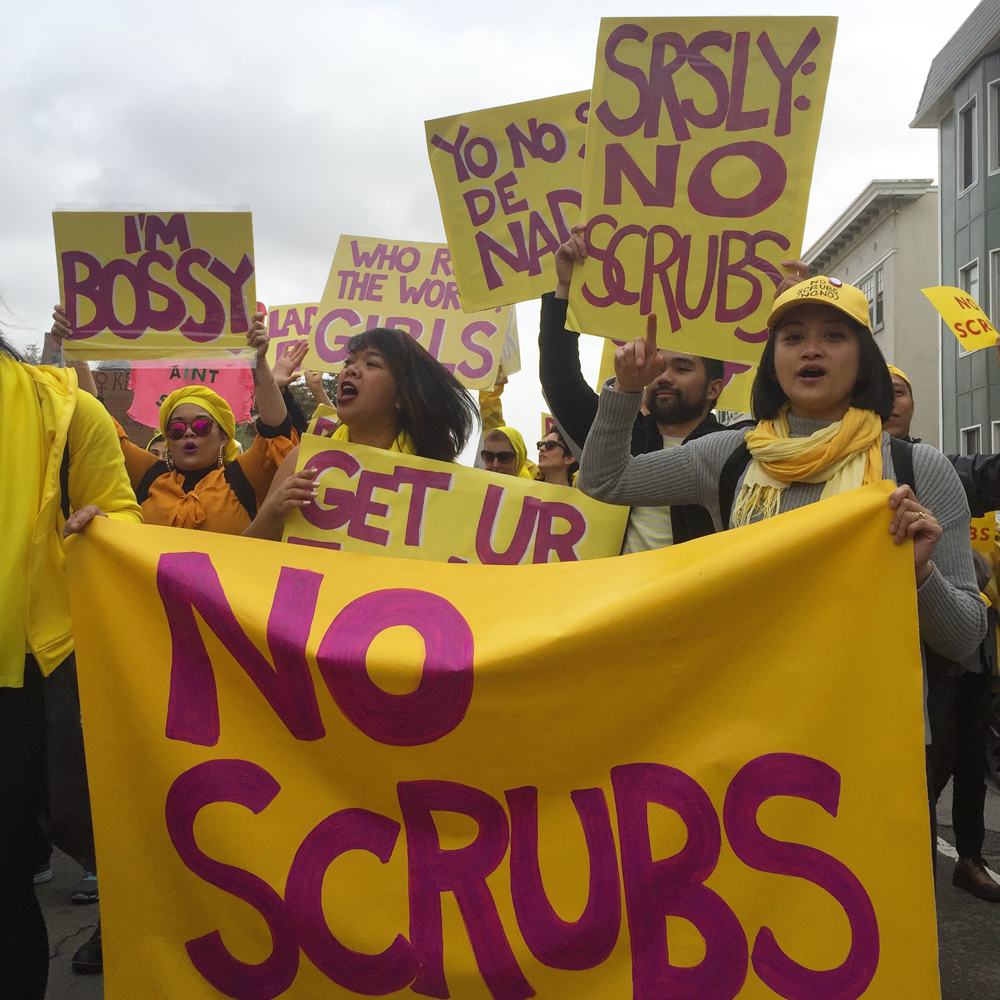
Jenifer K Wofford. No Scrubs, 2017; participatory action, performed on January 21, 2017, at the Women’s Marches in San Francisco and Oakland, as part of 100 Days Action. Courtesy of 100 Days Action.
Roula Seikaly: How are interventions vetted and selected? Have you received proposed gestures that haven’t aligned with the 100 Days Action mission?
Ingrid Rojas Contreras: Our curatorial team sits together in pairs to review each proposal. We look at each gesture and decide if it is within our mission, and if it is, we ask which dates are appropriate or workable, and then situate them within the calendar. We received a proposal that was physically violent, where the gesture crossed a line we don’t want to violate. We’re trying to be inclusive and to reach out, but there have to be hard limits to what we support. We’ve published actions that are edgy, but not too extreme. We don’t want it to go that far. We’ve also received suggestions that we wouldn’t feature in the calendar. For example, people getting together to write postcards and sending them to senators and representatives. Since that isn’t an artistic gesture, we agreed to signal-boost the effort through social media, but not add it to the calendar.
Dana Hemenway: I wanted to add that even though there are some gestures that were not included, the 100 Days Action project is still monumental. It’s a huge undertaking. As anyone who plans events knows, lead time before an event is crucial for preparing and promoting it. There’s something to do every day—from an administrative perspective, it can be overwhelming. That said, it’s also what makes it such a powerful project.
Zoë Taleporos: The organization was built in such a small amount of time. To mobilize that many people and to settle on decision-making modalities and set the mission—Ingrid and company just jumped right into it. I think sometimes a narrow response time can prompt the most creative and organic things.