Posts Tagged ‘Painting’

Jacob Lawrence: Promised Land at the Cantor Arts Center

Jacob Lawrence. Ordeal of Alice, 1963; egg tempera on hardboard; 24 x 20 in. Gift of Dr. Herbert J. Kayden and Family in memory of Dr. Gabrielle H. Reem, 2013.98. © 2015 The Jacob and Gwendolyn Lawrence Foundation, Seattle/Artists Rights Society (ARS), New York. Courtesy of the Cantor Arts Center, Palo Alto.

From our partners at Art Practical, today we bring you Lea Feinstein’s review of Jacob Lawrence: Promised Land at the Cantor Arts Center of Stanford University. Feinstein notes: “In drawing inspiration from iconic works of art history, Lawrence indicated that the stories he painted were part of the larger human context, not just specific to the African American experience.” This article was originally published on May 26, 2015.[…..]
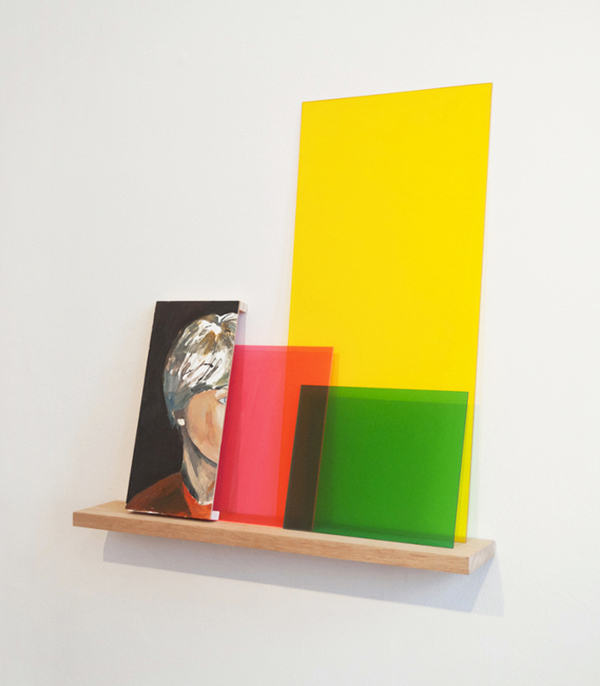
Verónica Bapé and José Porras: Filtros at Diagrama

VeronicaBape

Shotgun Reviews are an open forum where we invite the international art community to contribute timely, short-format responses to an exhibition or event. If you are interested in submitting a Shotgun Review, please click this link for more information. For the next four Sundays, our Shotgun Reviews will come from the finalists for the Daily Serving/Kadist Art Foundation Writing Fellowship in Mexico City. In today’s edition, author Marisol[…..]

Tutti Frutti at Turps Gallery

Carla Busuttil. It Ended in Houghton, 2015; oil on canvas; 40 x 30 cm (15.75 x 11.81 in). Courtesy of the Artist and Turps Gallery, London. Photo: Adam Rompel

Painting is to art as royalty is to democracy; it defensively justifies its own significance while continuing to hold court. There are many reasons why painting continues in this coveted pretense, but perhaps it can be mainly attributed to the limitations of its purpose. Any painter knows that the enchantment of painting lies in its classification. No matter how far the medium is pushed, as[…..]

Amer Kobaslija at Arthur Roger Gallery

Amer Kobaslija. Studio with Chair and Ladder (J. Pollock, E. Hamptons), 2015; Oil on Plexiglas; 12 x 14 ¼ in.

In his 1971 essay “The Function of the Studio,” conceptual artist Daniel Buren defined the artist’s studio as a metadiscourse of “frames, envelopes, and limits” imposed upon the working artist in the age of advanced capitalism.[1] Claiming that this privileged space had become nothing more than an “ossified custom”—a “commercial depot” for curators and dealers to ship works out into the world (and thus detach[…..]

Fan Mail: Jered Sprecher

Jered Sprecher. Water & Logic, 2014; oil on jute; 56 x 46 inches. Courtesy of Gallery 16.

For artist Jered Sprecher, painting is a medium for conveying the tensions between the abstract and the concrete. His works are balanced between the painterly and the conceptual; in the catalog for his 2014 exhibition Stacking Stones at Gallery 16 in San Francisco, Sprecher wrote: “When I work I want to create paintings that surprise, paintings that can hold competing ideas but not contain them.”[…..]

Tom LaDuke: Candles and Lasers at Kohn Gallery

Tom LaDuke. Gloryhole, 2015; acrylic and glitter on canvas over panel; 50 x 42 in. Courtesy the artist and Kohn Gallery, Los Angeles.

Tom LaDuke’s paintings are messy, exuberant, indulgent affairs, cramming multiple techniques and representational modes onto each canvas. These range from total abstraction to meticulous rendering, as paint is smeared, dripped, and airbrushed across the surface, built up into textured accretions, and covered in glitter. Trompe l’oeil competes with pure paint for authenticity. The result is a frenetic, often garish exploration of representation and perception, offering[…..]

Taravat Talepasand: Not an Arab Spring at Beta Pictoris Gallery

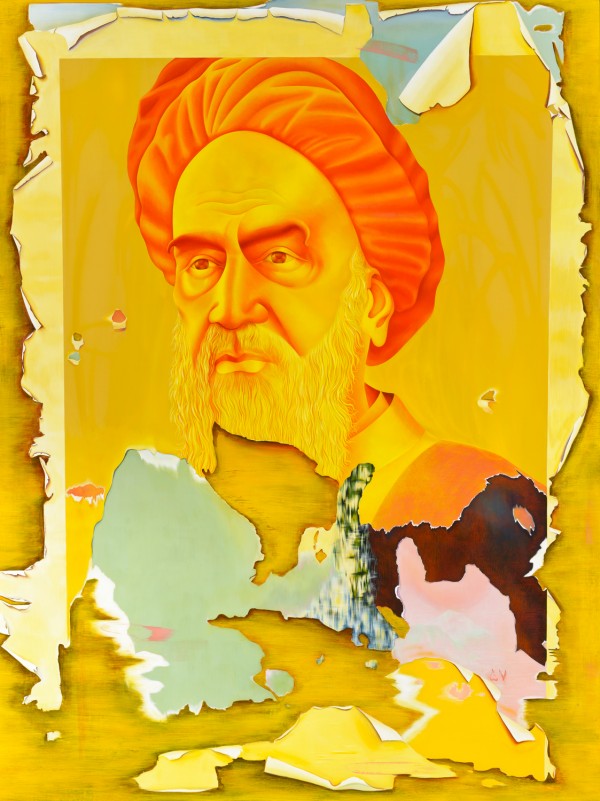
. Taravat Talepasand. Khomeini, 2015; egg tempura on linen; 48 x 36 in.

Taravat Talepasand’s work takes on the representational codes and image systems of the Iranian state: national currency, political propaganda, religious iconography, and gendered forms of identity making. The paintings in Not an Arab Spring open up the ideological assumptions that index Iranian identity, state power, and gender in order to consider how the body (male and female) comes to signify the state as well as[…..]