Summer Reading

Summer Reading – Closed Circuits: A Look Back at LACMA’s First Art and Technology Initiative

From our friends at East of Borneo, today we continue our Summer Reading series with an essay on LACMA’s Art and Technology initiative. Author Catherine Wagley notes: ’[…] the nostalgia for Art and Technology has much to do with the way the report suggests a moment when institutions were less careful about protecting their sponsors, when conflicts of interest could be openly discussed, and when a curator could publish pages and pages detailing how various collaborators did and did not get along.” This article was originally published on May 11, 2015.
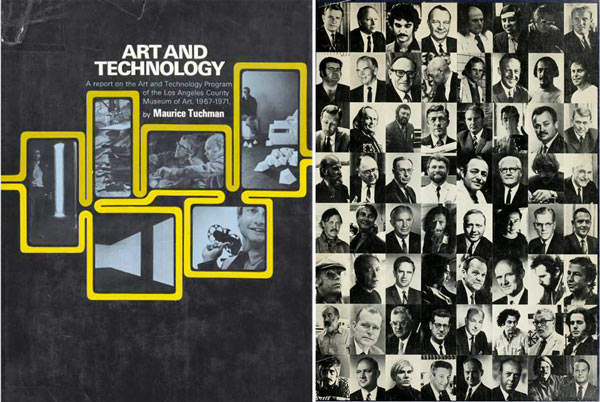
"A Report on the Art and Technology Program of the Los Angeles County Museum of Art, 1967-1971."

“A Report on the Art and Technology Program of the Los Angeles County Museum of Art, 1967-1971.”

It was 1969 when artist John Chamberlain decided to screen his film The Secret Life of Hernando Cortez in the RAND Corporation’s cafeteria. The artist, middle-aged and best known for the smashed-metal monuments he had been sculpting out of discarded car parts, was having a Warholian moment. He had even cast regulars of Andy Warhol’s Factory—scrawny, always smirking Taylor Mead and wispy Ultra Violet—as stars of The Secret Life, which he filmed in Mexico in 1968. Mead plays Mexican conqueror Hernando Cortez and cavorts, making treaties and wreaking havoc. Ultra Violet, taller than Mead and far more conventionally attractive, plays his mistress, urging him to privilege sex and vanity over duties such as fighting for his people’s freedom. At one point, a mountain lion eats an antelope onscreen.

The film ran once a day for three days. Then all screenings were canceled. “Word must have gotten to Washington, D.C., that RAND was showing dirty flicks on lunch hour,” Chamberlain wrote in a memo to curators at the Los Angeles County Museum of Art, though it seems staff complaints, not politicians, were to blame.

Read the full article here.

Share

New Orleans

From the Archives: Prospect.3 New Orleans

As President Obama visits New Orleans this week on the ten year anniversary of Hurricane Katrina, we bring you a look back at last year’s Prospect.3 New Orleans. Tori Bush contextualizes her review of the rocky history of this biennial in a city “suspended in time in space.” This article was originally published on November 11, 2014.

Camille Henrot. Grosse Fatigue, 2013 (film still). Video installation (color, sound) Courtesy of the artist, Silex Films and kamel mennour, Paris.

Camille Henrot. Grosse Fatigue, 2013 (video still); video installation (color, sound). Courtesy of the Artist, Silex Films, and kamel mennour, Paris.

Honoré de Balzac wrote: “Ideas are a complete system within us, resembling a natural kingdom, a sort of flora, of which the iconography will one day be outlined by some man who will perhaps be accounted a madman.” This passage was included in Camille Henrot’s writings about her video Grosse Fatigue (2014), now on view in Prospect.3, a sprawling biennial in both geographic and thematic terms. The “madman” in this quote might be Franklin Sirmans, the artistic director of Prospect.3; Sirmans attempts to create a cohesive exhibition in a city that is perpetually unhappy with easy definitions and straightforward thought. However, Prospect.3 has some stunning and kindhearted works that try very hard to carve clear connections to a place that is a constantly shifting landscape of one part earth and two parts water.

Prospect New Orleans has had an awkward childhood. Prospect.1, founded by Dan Cameron, opened in October 2008 with eighty-one artists from thirty-four countries in about thirty locations. Artistically, the biennial was a smashing success, drawing comments such as, “Prospect.1 takes the reprobate scallywag nihilists of the contemporary avant-garde and converts them … into goody-two-shoes bleeding-heart believers in the nobility of humankind.”[1] Unfortunately, Prospect.1 ended over a million dollars in debt, defaulting on the public’s trust. Then, unable to meet funding expectations, Prospect returned in 2010 with something called Prospect1.5, a mostly local affair that was as awkward as the first iteration was ballsy. Prospect.2 opened the next year in 2011, with a graceful mix of international and local artists, but was still significantly less exciting that the first iteration. Prospect.3 now has grown into early adulthood and has regained some of the energy that made Prospect.1 so great. This year’s iteration opened on October 25 with fifty-eight artists spread around eighteen locations.

Read More »

Share

Summer Reading

Summer Reading – MN Original: Mohamud Mumin

Today we’re taking a break from the “reading” portion of our Summer Reading series to bring you a video produced by our friends at MN Original. Artist Mohamud Mumin walks us through his practice in portrait photography:  “[…] It’s not just work to me—it’s stories, it’s lives, it’s trust that I’m given by the subjects. It’s not always, ‘This is a great shot.’ It’s always a great responsibility.” 

Share

Summer Reading

Summer Reading – The Past Is Present: The Curatorial Act of Exhibiting Exhibitions

Today’s selection for our Summer Reading series comes from our friends at un Magazine. Author Pippa Milne examines curatorial reconstruction, noting that it “emphasi[zes] the relevance of the exhibition as a singular, unified cultural and historical phenomenon; an irreducible embodiment of the relationship between curator, artist, and artwork.” This article was originally published in issue 7.2.

Alighiero Boetti with lo che prendo il sole a Torino il 19 gennaio 1969 (Me Sunbathing in Turin, 19 January 1969), 1969, from ‘When Attitudes Become Form’, Kunsthalle Bern, 1969 photograph: Shunk Kender, ©Roy Lichtenstein Foundation

Alighiero Boetti with lo che prendo il sole a Torino il 19 gennaio 1969 (Me Sunbathing in Turin, 19 January 1969), 1969, from ‘When Attitudes Become Form’, Kunsthalle Bern, 1969 photograph: Shunk Kender, ©Roy Lichtenstein Foundation.

It sounds like an art-world joke: What do you get when you pluck a 1969 exhibition from a German Kunsthalle and reconstruct it in an 18th-century Venetian palazzo, forty-four years later? Add some gallery attendants in Prada suits and an audience fresh from Massimiliano Gioni’s 55th Venice Biennale, and you have an answer that, due to the arcane specificity of its starting point, might only be interesting to in-on-the-joke art academics and curators. But to them, it’s an intriguing, extravagant, and ludicrous experiment.

Bear with me a moment. You’re in Venice. You’ve walked into Ca’ Corner della Regina, entering from a back street near San Stae Vaporetto stop rather than via the private jetty. After being greeted by an immaculately dressed attendant from Fondazione Prada with a neutral expression and a lilting accent, you walk through the classical foyer and up the stairs, past a square of wall that has had the plaster removed from it, past several sacks of coal, grains, and beans, and under some black wires. You’re following the vocal intonations of Josef Beuys as he chants “Ja ja ja ja! Nee nee nee nee!” There is a strange sense that this construction is a diorama of a past environment—as though you are standing in front of a group of antelope, set in their painted wilderness in a wing of the Museum of Natural History. The habitat is recreated as succinctly and loyally as possible; the objects of interest have been placed in their most natural positions, as per the investigative research conducted by curators and historians. But it still doesn’t look real. It’s a bit stuffed. There are small gaps between the fresh, constructed walls and the ornate architraves and frescoed panels. The stage set is obstinately obvious, saving it from fetishism. This is not Madame Tussauds. This is a conflation of two spaces, two temporal instances. It’s convincing, but not trickery.

Read the full article here.

Share

Summer Reading

Summer Reading – Juana Berrío on Tacita Dean

Today we continue our Summer Reading series with an essay on Tacita Dean’s film Day for Night. Author Juana Berrío explains, “Day for Night is a term used to describe a cinematographic technique that uses a particular camera lens to turn a scene filmed during daylight into a night-scene. In other words, it’s about capturing an image and re-presenting it under a different ‘light.’ In that same sense, Dean’s film is an act of rereading the life and work of [Giorgio] Morandi.” This article was originally published on SFMOMA’s Open Space on June 1, 2015.

Tacita Dean. Day for Night, 2009; still from video.

Tacita Dean. Day for Night, 2009; video still.

Over the past few years, I have been thinking about Italo Calvino’s short essay “Why Read the Classics?” from the perspective of contemporary art—rather than from its given subject of literature. Instead of providing us with a series of moralizing reasons why we should read the classics, Calvino lists fourteen definitions of what a literary classic might be. What he proposes is that the notion of the classic comes from the very practice of reading and—most importantly—from rereading. For him, the classics are books that resist being framed in a fixed time or intellectual context because they “have never finished saying what they have to say,” and because they “come down to us bearing upon them the traces of readings previous to ours, bringing in their wake the traces they themselves have left on the culture or cultures they have passed through.”

I like thinking about Calvino’s definitions as a means of understanding the way contemporary visual artworks are often also re-engagements with intellectual and aesthetic concerns from previous times and cultural contexts. In my opinion, what makes an artwork contemporary is not its date of production, or its “up-to-date” look, or its direct response to current issues and events. On the contrary, I believe that what makes an artwork contemporary is the way an artist rereads and re-contextualizes previous forms of cultural knowledge and makes them relevant to his or her own time. In this sense, the content and meaning of a classic—whether a book or an artwork—is an ever-growing series of re-readings of questions and observations that are inherent to our most basic human conditions.

For example, it is not uncommon to find contemporary artworks that reread other artworks or are in dialogue with other artists, either recent or ancient. We see this in works that are made after so-and-so, or that use appropriation as a means of aesthetic and intellectual creation, or that are made with the purpose of reinterpretation, opposition, distortion, tribute, or satire. The work I want to talk about is Day for Night (2009), a film by British artist Tacita Dean, which is in dialogue with Italian artist Giorgio Morandi and his lifelong painting practice. In this case, the conversation spans a century, as Morandi was born in 1890 and died in 1964, while Dean was born one year later, in 1965.

Read the full article here.

Share

Summer Reading

Summer Reading – Up in the AIR: How Will Tech Residencies Reshape Bay Area art?

Continuing our Summer Reading series, today we bring you an article on residencies offered by tech companies. Authored by Ceci Moss and originally published on Rhizome on January 20, 2015, the article asks, “If tech is the Bay Area’s main industry and export, with its emphasis on making, creating, and, above all, innovative design, then how can (or should) that translate into the art infrastructure here, and elsewhere?”

Image from Art+Tech: Virtual Reality, November 2014. (Photo: Codame).

Image from Art+Tech: Virtual Reality, November 2014. Photo: CODAME.

Over the past year, San Francisco and the Bay Area have come to be defined in the national sphere by the thinkpiece. In the constant stream of articles about gentrification, the Ellis Act evictions, artist displacement, and arts nonprofits closing left and right in response to the city’s rising population and booming tech industry, it might be surprising to note that a number of tech companies are investing increasingly in artist residency programs. In fact, two of the biggest tech companies in the region—Facebook and Autodesk—maintain active residency programs. For companies without the infrastructure for such endeavors, local art and technology nonprofit CODAME offers to pair tech companies with artists for individual projects through their “Adopt An Artist” program. While there is a lot of conversation (and concern) in the Bay Area regarding the tech industry’s lack of support and philanthropy for the arts, the questions seem skewed towards trying to figure out how to cater to tech wealth, rather than thinking through art’s role in the tech industry itself. This text surveys corporate residency programs in the Bay Area which exemplify how artists engage with this industry, and begins to sketch out possible implications—or potential—for the art infrastructure and its relationship with tech creativity.

Autodesk’s Pier 9 Artist-in-Residence program is housed in the corporation’s immense facility in Pier 9 along the waterfront in downtown San Francisco. Artists apply for four-month residencies at the space, which provides access to their workshop, a stipend, and the ability to work directly with the company’s engineers on their projects. The program maintains a diverse pool of applicants who range from fashion designers to chefs, architects, and technologists as well as fine artists, who have access to Autodesk’s high-end equipment, materials, and software, plus training and skillshare programs. Although it is not an explicit part of the program, the focus on “makers” over “fine artists” benefits Autodesk as well. The company launched Autodesk 123D in 2009 as free 3D modeling software designed for the general consumer, and they acquired the DIY info sharing website Instructables in 2011. The AIR program began at Instructables before their purchase by Autodesk, who developed it into a much larger initiative. All AIR residents are required to post their projects to the website, so there is a direct tie into the site’s content. Envisioning how people create with their tools, or their competitor’s tools, in a variety of scenarios is clearly a valuable asset to the company, especially as the mainstream culture moves into a maker culture.

Read the full article here.

Share

Summer Reading

Summer Reading – Burn the Maps

Today’s article for our Summer Reading series comes from our friends at Mn ArtistsMatthew Fluharty, founder and executive director of Art of the Rural, discusses “the dividing lines between country and city spheres… [and] makes a case for rejecting calcified notions of ‘rural art.’” This article was originally published on July 23, 2015.

Emmet Byrne. Illustration for Mn Artists and Walker Art Center, n.d.

Emmet Byrne. Illustration for Mn Artists and Walker Art Center, n.d.

It is significant that the common image of the country is now an image of the past, and the common image of the city an image of the future. That leaves, if we isolate them, an undefined present. — Raymond Williams, The Country and The City

I think about Theocritus a lot these days. Working from the Library of Alexandria in the third century BCE, this Sicilian-born poet was part of a collective effort to build the largest storehouse of knowledge his civilization had yet known. In the midst of this pre-modern, pre-internet project of information aggregation, Theocritus harnessed those texts towards the creation of an enduring kind of cultural and political ars poetica.

Theocritus sat in the halls of the Library and wrote poems—intricately metrical, densely referential—that utilized everyday dialogue to express a complex, national mythos. The presence of this body of work, alternately referred to as the Bucolics or Idylls, can be felt throughout our contemporary experience. In the arts, we might refer to Theocritus as the father of the pastoral genre; in political and cultural spheres, we could point to him as one of the first to put into critical terms a kind of spatial pathology that has continued to persist for two millennia: the notion of center and periphery.

These Idylls operate as a series of dialogues between paired speakers (goatherds, shepherds, nymphs, Pan, etc.), all of which are set against the backdrop of an idealized rural landscape, Arcadia. The brooks echo with the eloquent speech of these men (always men), and an orderly and peaceful flock organizes around their song. Well-turned verse is likened to sound husbandry, which in turn parallels the ideal and orderly organization of the nation. Pastoral scholar Paul Alpers coined this relationship the “representative anecdote”: how the shepherd stands in for the Greek citizen, how the cultivated landscape spreads out in abundance like a well-ordered nation. The Idylls offered a lush political matrix of anxiety and aspiration, achieved, as William Empson famously wrote, by “putting the complex into the simple.” That received tradition continues even now through a thousand avenues, from national parks to new country, from Marfa to farm-to-table to pancake breakfasts along the campaign trail in Iowa.


Read the full article here.

Share