Atlanta

Sprawl!: Drawing Outside the Lines at the High Museum of Art

Sprawl! Drawing Outside the Lines presents a compelling case for an expanded notion of drawing and draftsmanship in contemporary art. With over 100 drawings culled from artists and creative workers within the sprawling suburban metropolis of Atlanta, it’s a much-anticipated sequel to the 2013 exhibition Drawing Inside the Perimeter, which instigated the museum’s public commitment to acquiring and exhibiting the work of local artists. Sprawl! registers as a strong statement of institutional support and acknowledgement from the High Museum to the diversity of the artistic community working within and just outside the capital city.
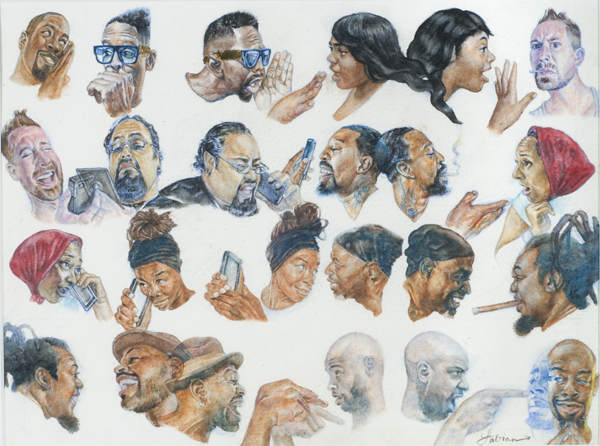
Fabian Williams. Gossip, 2014; watercolor on paper; 8 x 10 in. Courtesy of the High Museum of Art, Atlanta.

Fabian Williams. Gossip, 2014; watercolor on paper; 8 x 10 in. Courtesy of the High Museum of Art, Atlanta.

In regard to urban planning, sprawl—or the unregulated and uncontained expansion of bodies, buildings, industries, and urban traffic—is often used as a pejorative term. Like many cities, Atlanta struggles to form a stable identity in the aftermath of a series of gentrification booms (beginning in the late 1990s) that disturbed the historically dominant African American demographic with an influx of Hispanic, Asian, and white populations to the city. Paving the way for the demolition of public-housing projects and low-income initiatives that supported the residents of the inner city, Atlanta’s association with aggressive forms of urban growth finds a more utopian expression in this exhibition. Framed as a melting pot of ethnic and creative heterogeneity, Sprawl! equates the overwhelming influx of new inhabitants to the area with the sprawling, spreading, expansive processes of drawing itself.

This sense of connection and community is powerfully explored in Fabian Williams’ tenderly executed work Gossip, an appropriation of Normal Rockwell’s The Gossips (1948), both of which depict a taxonomy of social types or “characters” laughing, talking, and gesticulating. While the figures exude a sense of energy and liveliness that overwhelms the spaces of the other figures, the exaggerated expressions and movements rub uncomfortably against a form of a biting sarcasm that accompanies the history of pencil drawing and caricature. Reminiscent of the sketchbooks of the 18th-century British social satirist and artist William Hogarth, Williams’ work is as joyful as it is disturbing in its exploration of issues of social class, ethnicity, cultural stereotypes, mass technology, and 21st-century life in Atlanta.

Read More »

Share

Shotgun Reviews

Clare Rojas: New Work at Anglim Gilbert Gallery

Shotgun Reviews are an open forum where we invite the international art community to contribute timely, short-format responses to an exhibition or event. If you are interested in submitting a Shotgun Review, please click this link for more information. In this Shotgun Review, Hana Metzger reviews Clare Rojas: New Work at Anglim Gilbert Gallery in San Francisco.

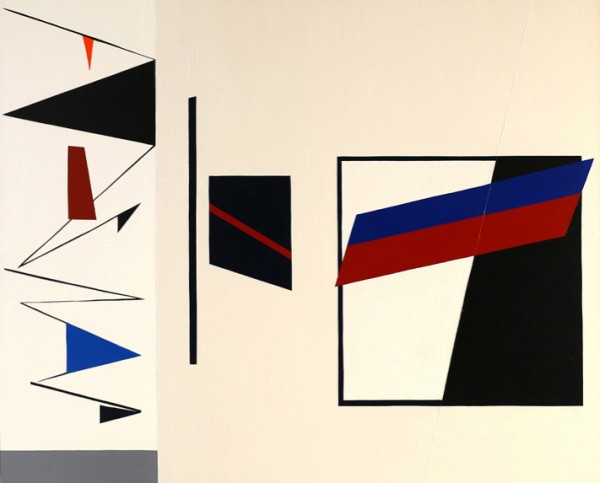
Clare Rojas. Untitled (CR15014), 2015; 48 in. x 60 in. Courtesy of the Artist. and Anglim Gilbert Gallery.

Clare Rojas. Untitled (CR15014), 2015; 48 x 60 in. Courtesy of the Artist. and Anglim Gilbert Gallery.

New paintings by Clare Rojas at Anglim Gilbert Gallery give the greatest pleasure when viewed twice—first from a distance of about ten feet, and then from much closer, just a foot or two away.

These are large paintings, and from afar they reveal a surprising dynamism, all the more impressive because each piece seems so simple. Rojas has painted flat, geometric shapes, primarily quadrangles and triangles, using only a few dense colors (black, deep red, dark blue, ochre) against an off-white background. Occasionally some thinner black lines connect the shapes. The effect should be almost aggressively two-dimensional and linear, blocky even, but instead, the density and positioning of the shapes brings them to life. The eye moves between the lines, shapes, and negative space in a way that seems lively and playful.

Read More »

Share

San Francisco

Juan Carlos Quintana: Retrospectives at Jack Fischer Gallery

From our partners at Art Practical, today we bring you a review of Juan Carlos Quintana: Retrospectives at Jack Fischer Gallery in San Francisco. Author Maria Porges quotes the artist at the end of the review: “And who is to say what is failure and what is success? As an artist you just need to trust and listen to yourself and keep moving forward.” This article was originally published on September 16, 2015.

Juan Carlos Quintana. Reflections on Exile Part I (Entering the Forest), 2014-15; oil and acrylic on canvas; 84 x 192 in. Courtesy of the Artist and Jack Fischer Gallery, San Francisco.

Juan Carlos Quintana. Reflections on Exile Part I (Entering the Forest), 201415; oil and acrylic on canvas; 84 x 192 in. Courtesy of the Artist and Jack Fischer Gallery, San Francisco.


The elegant, perfectly paced installation of Retrospectives—just the right number of paintings and objects—evokes the hushed adoration that the title invokes. Yet many things about Juan Carlos Quintana’s beautiful yet unsettling paintings make one reconsider just what the artist might really intend. The clusters of cartoony, faintly alarming figures that people Quintana’s canvases suggest a combination of Belgian painter James Ensor’s crowd scenes, Philip Guston’s goofy hooded Klansmen, and the denizens of ’70s “Bad Painting.” Looking closely at these crowds of “barflies, wanna-be-revolutionaries, lackeys, clowns, hobos, hillbillies, zealots, opportunists, and zombies” (the artist’s description), it is clear that we, the art-world audience, are also part of this mob.

Quintana, who has described his work as a “pre-post-anti-pro revolutionary gumbo/ajiaco potpourri of image-making that navigates between narratives and abstractions,” is a veritable poster boy for cultural hybridity, having been raised by Cuban exile parents in New Orleans’ mix of African, European, and Native American cultures. The dense, palimpsest-littered surfaces of his paintings suggest the presence of these multiple voices; images added and subtracted, improvised and erased seem to be part of an affectionate, labor-intensive relationship with each canvas, renewed on a daily basis for months before final completion. Titles are sharply humorous references to political (in)correctness of all kinds. Some are about the Cold War; others—Revolutions Are Made to Liberate the Painter from the Humdrum Circumstances of the Canvas (2015), for instance—evoke Communist rhetoric, or, like Soiree for the Nouveau Riche to Show Off Their New Art Collection (2015), or Art Collectors Descending on Unsuspecting Emerging Economies (2015), make fun of the burgeoning Late Capitalism of the present-day art world.

Read the full article here.

Share

Fan Mail

Fan Mail: Tavis Lochhead

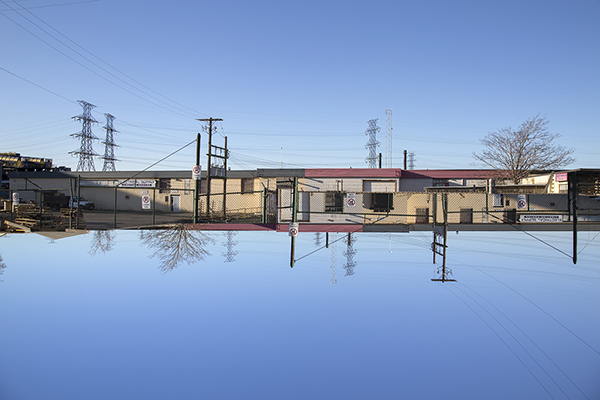
Toronto-based artist Tavis Lochhead has a knack for the surreal. In his photo collage series Habitat, large sections of industrial sites are digitally manipulated into semi-abstract compositions that disrupt the mundane aesthetics of manufacturing zones. In each work, the central figure—what the artist describes as “a sculptural element floating in space”—is an assemblage produced by an elaborate process of merging, mirroring, and stitching.

Tavis Lochhead. Habitat 1, 2015; digital image. Courtesy of Tavis Lochhead.

Tavis Lochhead. Habitat 1, 2015; digital image. Courtesy of the Artist.

Initially trained in architecture, Lochhead describes his interest in reimagining industrial landscapes as an exploration of perspectives that emerges from playing with the laws of physics. What would nondescript structures look like if they were turned upside down? What happens when the elements of everyday life are subjected to new parameters that serve to accentuate their normally muted presence? In Habitat 1 (2015), the boxy quality of the building is contrasted by a series of perpendicular protrusions both artificial and natural. Between electric towers, telephone poles, and barren trees (upright and inverted), the composition offers a glimpse into an alternative realm of vantage points and perspectives that defy logic and create a compelling space for experimenting with the mundane. The particular construction of this image lends itself to a subtle enunciation of the various lines and planes that exist in overlooked environments, ranging from the multicolored corrugated rooftops to the diagonal wiring that breaks the symmetry of the scene.

Read More »

Share

Beijing

Taca Sui: Steles – Huang Yi Project at Chambers Fine Art Beijing

Taca Sui’s photographs in Steles – Huang Yi Project at Chambers Fine Art Beijing capture images that cut across time: transcendent tombs and temples, primordial rock formations, and ephemeral waves. Sui’s black-and-white prints are a culmination of his research on Huang Yi, a celebrated 19th-century Chinese artist and archaeologist. Sui immersed himself in Huang’s writings, using Huang’s diaries as a guide to plan a photographic expedition. Huang was deeply concerned with the preservation of China’s steles—ancient vertical slabs of stone bearing commemorative inscriptions—and Sui photographed many steles that Huang discovered or described during his trip. But Sui’s works do not attempt to document Huang’s travels; rather, the artist’s familiarity with Huang’s records allows him to view his own travels through two lenses: those of a 19th-century cultural preservationist and of a 21st-century formalist photographer.

1.Taca Sui, Tomb of Prince Lu #1 (2015). Silver on baryta paper. 53 x 80 cm. Courtesy of Chambers Fine Art.

Taca Sui. Tomb of Prince Lu #1, 2015; silver on baryta paper; 53 x 80 cm. Courtesy of Chambers Fine Art.

Sui’s richly articulated photograph of Prince Lu’s tomb—a tunnel cut by hand into the side of a mountain—honors the awe-inspiring feat of workers who centuries ago carved this enduring structure. As with Sui’s Dragon Cave, which depicts the interior of a Buddhist temple, the detailed image of the tomb’s luminous rock surfaces captures the powerful presence of mystery and history within. Simultaneously intimate and vast, Sui’s images are as much portraits of these pregnant spaces as they are landscapes of historically significant sites.

Read More »

Share

New York

Zoe Beloff: A World Redrawn at the James Gallery, CUNY

It is a strange fact that Theodor Adorno, Max Horkheimer, Arnold Schoenberg, Thomas Mann, and Bertolt Brecht all resided in Los Angeles, California, in the 1940s. Unsurprisingly, few of them found their wartime haven a particularly sympathetic milieu. Brecht’s stay was especially ill-fated, ending with his interrogation by the House Un-American Activities Committee (HUAC) and consequent return to Berlin. A decade earlier, the Latvia-born film director Sergei Eisenstein had found himself similarly blacklisted by the Hollywood establishment and left North America without having realized the major film that Paramount Pictures had contracted him to execute.

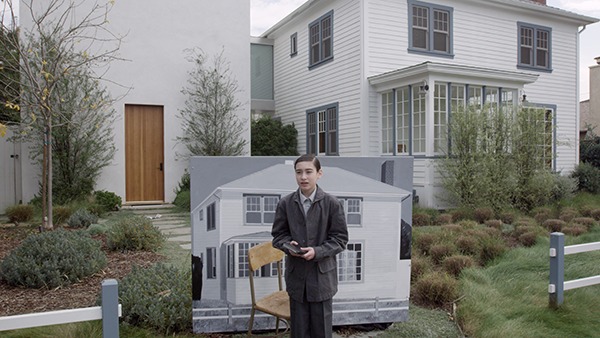
Zoe Beloff. Two Marxists in Hollywood, 2015 (film still). Courtesy of the James Gallery, Graduate Center, CUNY.

Zoe Beloff. Two Marxists in Hollywood, 2015 (film still). Courtesy of the James Gallery, Graduate Center, CUNY.

Zoe Beloff’s current exhibition at the James Gallery of the Graduate Center, City University of New York (CUNY), A World Redrawn: Eisenstein and Brecht in Hollywood, assembles materials from the Russian State Archive of Literature and Art and the Bertolt Brecht Archive in Berlin to explore Brecht’s and Eisenstein’s exceptionally unproductive years in the City of Angels and the embittered flights of fancy to which they gave rise. Specifically, Beloff takes up two unrealized projects, Brecht’s sketch for a film called A Model Family in a Model Home and Eisenstein’s idea for a film called The Glass House, both thinly veiled allegorical attacks on the state of American culture, set in a rapidly changing domestic sphere.

Read More »

Share

Los Angeles

Noah Davis: Imitation of Wealth at MOCA Storefront

For the next three years, the estimable Underground Museum, co-founded by husband and wife Noah and Karon Davis, will bring artworks from Museum of Contemporary Art’s (MOCA) permanent collection to its unassuming storefront in the largely black and Latino working-class neighborhoods of West Adams and Crenshaw. Reciprocally, MOCA presents Noah Davis’ Imitation of Wealth, which was first exhibited at the Underground Museum, in its new storefront exhibition space located on Grand Avenue in Downtown Los Angeles.

Noah Davis. Imitation of Wealth, 2015; installation view, MOCA: storefront. Courtesy of the Artist and the Museum of Contemporary Art, Los Angeles. Photo: Cameron Crone and Carter Seddon.

Noah Davis. Imitation of Wealth, 2015; installation view, MOCA Storefront. Courtesy of the Artist and the Museum of Contemporary Art, Los Angeles. Photo: Cameron Crone and Carter Seddon.

In Imitation of Wealth, Davis stations a vintage Hoover vacuum cleaner (bought via Craigslist) atop a vitrine filled with fluorescent lights, making an identical Jeff Koons. He replicates a Robert Smithson in the corner of the room, with three square mirrors embracing a pile of sand. The iconic works of Marcel Duchamp, On Kawara, and Dan Flavin are also re-created. In an interview with Art in America, Davis explains his initial interest in showing the works at the Underground Museum, which formerly housed a pupuseria: “I like the idea of bringing a high-end gallery into a place that has no cultural outlets within walking distance.” Now relocated to MOCA’s storefront, Davis’ copies of these iconic works are glassed in by floor-to-ceiling windows. The room is inaccessible; its front door is locked. Visitors can only view Davis’ works from the exterior, by squinting through the reflections in the windows, and are disconnected—kept out—from the works inside.

According to MOCA, Imitation of Wealth masquerades famous works of art in an attempt “to break down the traditional class and ethnic barriers to high culture.” MOCA, however, makes the assumption that the original pieces by Koons, Flavin, and Smithson are worthy of emulation—Davis’ emulation—and appreciation by all Los Angeles communities, even those without a stake in the art world.

Read More »

Share