Help Desk

From the Archive – Help Desk: Giving Up?

As our intrepid columnist finishes settling into her new digs in Warsaw, today we bring you a look back at some advice that still holds true. If you have a question about making, exhibiting, finding, marketing, buying, selling—or any other activity related to contemporary art—you can submit your questions anonymously here. All submissions become the property of Daily Serving.

I have been a semi-successful studio artist for almost 30 years. For about the last ten of these I have been able to support myself financially with my work. I consider this a fortunate situation, but recently I have had to admit to myself that I’m getting tired and that the satisfaction of being an artist no longer seems worth the hustle of maintaining a viable studio practice. However, I am still an ambitious person (possibly out of habit) and I feel very acutely the pressure to produce work in a certain quantity. Being an artist has been the central part of my identity for so long, and I still romanticize it but I’m just not sure I can do it any longer. If I did stop making my work, I think there’s plenty I could do to make a living in the city where I live, but the thought of giving up a national reputation is frightening. Not that I think that there’s an adoring public who would be devastated but I can’t deny that my studio practice is externally motivated at this point. Is there a way to gracefully wrap up an art career without dying? Is there a way to turn down opportunities and quell the beast of the “artist’s ego” in order to lead a more sane and relaxing existence?

Thomas Demand. Copyshop, 1999; C-print; 72 1/4 x 118 1/4 in.

Of the many possible dilemmas to have, let’s admit that this one is rather attractive. Selling work steadily enough to provide a livable income is something that many artists yearn for, a marker of capital-S Success—at least on the commercial market. And for the past ten years you’ve had it, but now it has lost its luster.

Certainly, you could start bowing out. A regular job worked forty hours a week would surely make you too busy (and definitely too tired) to meet your current production demands. If this is what you really want, you need to have some honest conversations with your gallerists and dealers. Tell them that you need some space to pursue other goals right now and will be slowing down your studio work. It will be a hard conversation to have, but if you’re going to go down this path you need to be candid with the people who have helped support your career.

But before you initiate those conversations, you need to have one with yourself first. Clichéd though it may be, it’s absolutely true that age has a way of putting things into perspective and it might be that you’ve matured and grown distant from your current life. Before you lock the door to your studio and throw away the key, let’s try to figure out how you got here in the first place. To put it bluntly, let’s make sure that this is a well-considered course of action and not just a mid-life-crisis maneuver that ends in remorse.

Read More »

Share

San Francisco

Davina Semo: APPROACH OR ENTER at CAPITAL

Shotgun Reviews are an open forum where we invite the international art community to contribute timely, short-format responses to an exhibition or event. If you are interested in submitting a Shotgun Review, please click this link for more information. In this Shotgun Review, Colin Fernandes reviews Davina Semo: APPROACH OR ENTER at CAPITAL in San Francisco.

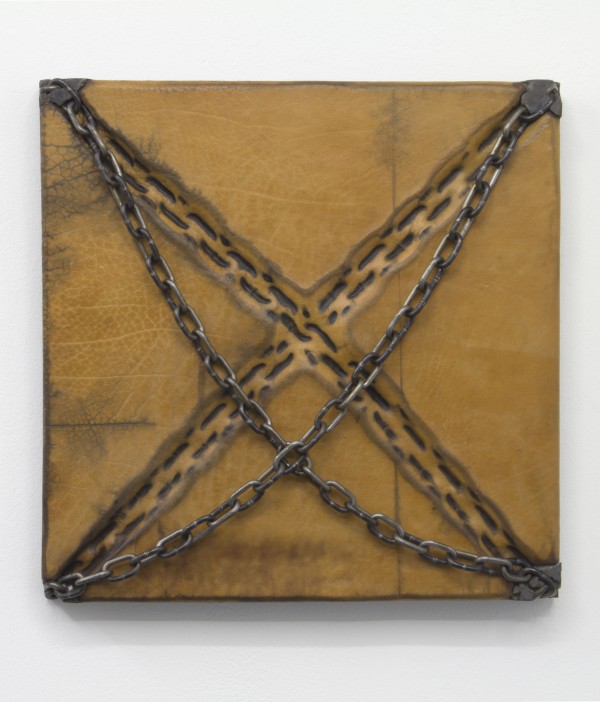
Davina Semo. SHE FOUGHT WITH THE KID WHO THREW ROCKS AT HER DOG, 2015; leather, pigmented reinforced concrete, waxed steel chain; 18 x 18 x 2 1/2 in. Courtesy of the Artist and CAPITAL, San Francisco.

Davina Semo. SHE FOUGHT WITH THE KID WHO THREW ROCKS AT HER DOG, 2015; leather, pigmented reinforced concrete, waxed steel chain; 18 x 18 x 2 1/2 in. Courtesy of the Artist and CAPITAL, San Francisco.

APPROACH OR ENTER, the title of Davina Semo’s solo show at Capital Gallery, is both a taunt and a caution. Five Brutalist sculptures rendered in industrial materials compose the show. Their hard, sharp surfaces evince a sinister feel.

At seven feet tall, the largest sculpture is a concrete slab propped up against the wall. Brightly colored glass spikes puncture its surface, creating the appearance of a “bed of nails,” albeit one with the sharp points oriented away from the viewer. A smaller slab with spikes rests on the gallery floor. A pair of sizable concrete-and-leather squares are hung at about torso height; both incorporate waxed steel chains arranged in a cruciform manner to form harnesses of sorts. The final piece is a sliver of blackened cast bronze, 21 by 1/2 by 1 and 1/8 inches in dimension. I could imagine its use as a striking weapon, or as a “sound” with which to examine a bodily orifice.

Read More »

Share

San Francisco

Alejandro Almanza Pereda

From our friends at Kadist Art Foundation in San Francisco, today we bring you a video of Alejandro Almanza Pereda’s installation at San Francisco Art Institute, which is installed in front of Diego Rivera’s famous mural The Making of a Fresco Showing the Building of a City (1930–1931). Almanza Pereda says, “We were thinking about how to re-think Diego’s piece, and question it a little bit, and question where this city is going, and what is progress.” This video was originally published on August 17, 2015.

Share

San Francisco

Chris Fraser: Animated at Gallery Wendi Norris

In addition to their current special issue on the legacy of punk rock, our partners at Art Practical are also blasting into the new season with their annual Shotgun series—ten short reviews by regular contributors that cover the Bay Area art scene. This review, by Danica Willard Sachs, investigates the works of artist Chris Fraser, currently on view at Gallery Wendi Norris. This article was originally published on September 24, 2015.

Chris Fraser. Mobile | 0˚, 90˚, 90˚ | Argon and Neon, 2015; powder-coated steel, gas discharge tubes, transformer, argon, and neon; 42 x 21 x 12 in. Courtesy of the Artist and Gallery Wendi Norris, San Francisco.

Chris Fraser. Mobile | 0˚, 90˚, 90˚ | Argon and Neon, 2015; powder-coated steel, gas discharge tubes, transformer, argon, and neon; 42 x 21 x 12 in. Courtesy of the Artist and Gallery Wendi Norris, San Francisco.

Chris Fraser is an artist cum magician, employing the physics of light to create magical objects that interrogate perception. In Animated, on view at Gallery Wendi Norris, Fraser debuts two complementary bodies of work that extend his consideration of optics and perception: sculptures activated by both light and the viewer’s movement, and photograms that still the action in the sculptures.

Fraser’s sculptures mark the high point of the exhibition. Mobile | 0˚, 90˚, 90˚ | Argon and Neon (2015) is one of three similar sculptures, each approximately the size of a mirror, mounted in a row on one of the walls in the gallery. Inside a black metal frame Fraser has carefully layered perforated sheets of black metal, creating subtle, shifting kaleidoscope-like patterns in the overlap as the viewer passes by the sculpture. Each black box is flanked by pastel-hued tubes of light, variously containing compressed noble gases that emit different colors with the addition of an electrical current: Neon becomes red, argon blue, helium peach, krypton white, and xenon purple. In the case of Mobile, Fraser chooses neon and argon. These glaring red and blue tubes transform into a subtle gradient, meeting in the center as violet, seen through the shifting image created by the perforated metal. Recalling Bruce Nauman’s Neon Templates of the Left Half of My Body Taken at Ten Inch Intervals(1966) or Dan Flavin’s iconic fluorescent light sculptures, Fraser’s sculptures similarly rely on the viewer’s interaction to complete the work. As the pulsating, tinted glow of the noble gases reflects on our faces, and the image in the black boxes shifts before our eyes, we as viewers are made aware of the limits of our vision.

Read the full article here.

Share

New York

Drawing Sound Part II: Alvin Lucier at the Drawing Center

To enter the main gallery at the Drawing Center for a recent performance, we couldn’t use its front doors. Instead, we had to descend the stairs near the lobby, walk along the lower-level corridor from the front to the back of the building, ascend the rear stairs, and pass through the smaller gallery called the Drawing Room. There, the walls were adorned with several wooden beams with quivering strings. The installation, Echoic Memory (2015) by the sound artist and composer Spencer Topel, consisted of a series of wood pieces hung vertically, each fitted with a single magnetically resonating string that reproduced delayed sounds from the adjacent main gallery throughout three days of performances, the second installment of the Drawing Center’s series Drawing Sound. On September 11, 2015, the main gallery housed a performance of three compositions by the renowned sound artist Alvin Lucier: Music for Snare Drum, Pure Wave Oscillator, and One or More Reflective Surfaces (1990), Tapper (2002), and Bird and Person Dyning (1975).

2.Alvin Lucier. Bird and Person Dyning, 1975 (performance still); Drawing Center, New York; September 11, 2015; Alvin Lucier, performer. Courtesy of the Drawing Center. Photo: Chris Bradley.

Alvin Lucier. Bird and Person Dyning, 1975 (performance still); Drawing Center, New York; September 11, 2015; Alvin Lucier, performer. Courtesy of the Drawing Center. Photo: Craig Howarth.

Our detour through the building’s underbelly forced us to pass through several architectural environments before reaching our final destination upstairs. The journey was one of cumulative perception, as opposed to the immediacy of directly crossing a threshold between two spaces. As a result, aspects of the Drawing Center’s interior became elements of the evening’s sound performances. The disruption of the expected gallery visit nudged us out of perfunctory interaction; we began the evening in a state of heightened awareness.

One of Lucier’s greatest skills as an artist is his ability to reveal the preternatural qualities of sound that go largely unnoticed in everyday life. He does this not through elaborate manipulation but through immersion and simple repetition. In No Ideas But In Things: The Composer Alvin Lucier (2012), a documentary by Viola Rusche and Hauke Harder, Lucier explains: “When you let something happen and don’t make big changes, you start to hear the acoustic phenomena.” Tapper, written for and performed by the violinist Conrad Harris, embodies the descriptive potential of a prolonged perception of acoustic events. In the performance, Harris repeatedly tapped the violin body with the butt end of the bow. This banal act was transformed into a complex articulation of the instrument’s structure, the room’s architecture, and our bodies within it. The first thing I heard was the attack of the bow’s metal screw against the violin’s lower bout, which made an unsurprising metal-on-wood sound. A revelation occurred after a few minutes, when I began to distinguish the nuanced reverberations and sonic reflections that fluctuated as Harris slowly turned 180 degrees: Suddenly, high-pitched pings were added to the mix of oscillating echoes. After about fifteen minutes, the repeated sounds became disconnected from the corresponding actions; my understanding of what it means to strike one object with another lost its significance, and instead I perceived the sonic mapping of the space through the sounds reflecting from bodies, objects, and walls.

Read More »

Share

San Francisco

Mechanized Bodies: Anxiety and Healing in a Global Economy

Today from our partners at Art Practical, we bring you an essay on art, manufacturing, and workers’ bodies. Author Genevieve Quick explains, “Whether in the U.S., Mexico, or India, workers endure the same cycle: becoming part of a larger network of production that can be disassembled and relocated, rendering them redundant. Assembly-line production has taken its toll on workers’ bodies since the beginning of industrialization, and its absence is also felt as a traumatic experience.” This article was originally published on August 18, 2015.

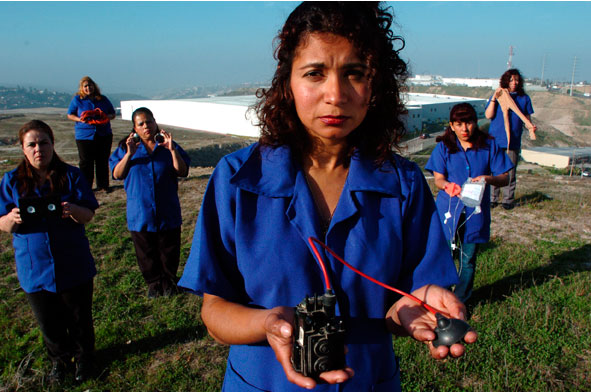
Vicky Funari and Sergio De La Torre. Maquilapolis (City of Factories) (still by David Maung), 2006; film; 68:00. Courtesy of the Artists.

Vicky Funari and Sergio De La Torre. Maquilapolis (City of Factories) (still by David Maung), 2006; film; 68:00. Courtesy of the Artists.

We tend to consider how technology and machines alter our bodies from the consumer’s end, as with our daily use of wearable or smart devices (watches, fitness trackers, phones, and more) and the more fantastic, cutting-edge neuroprosthetics and artificial organs. Our products and technologies, however, are made by individuals on assembly lines whose bodies are also imprinted by the manufacturing process. During the rise of industrialization in the U.S., Charlie Chaplin’s Modern Times (1936) presciently satirized the way in which assembly-line work automates the body, such that the body is disoriented when removed from work. As our economies globalize, manufacturing not only expands to different regions, but also migrates from one region to another. When manufacturing exits an area, it leaves its trace on workers’ bodies. Jesse Sugarmann’s We Build Excitement (2013) and Vicky Funari and Sergio De La Torre’s Maquilapolis (City of Factories) (2006) explore the plight of unemployed American autoworkers and struggling Mexican factory workers. As their video and film projects feature collaborators miming their assembly-line jobs, they reveal the automation of the body and the void left in the global migration of manufacturing. While Surabhi Saraf’s Remedies: Capsules and Remedies: Tablets (both 2014) also use the physical gesture of assembly-line production, she transforms the manufacturing process into a ritual process of healing.

Read the full article here.

Share

Seattle

Martin Creed: Work No. 360 at the Henry Art Gallery

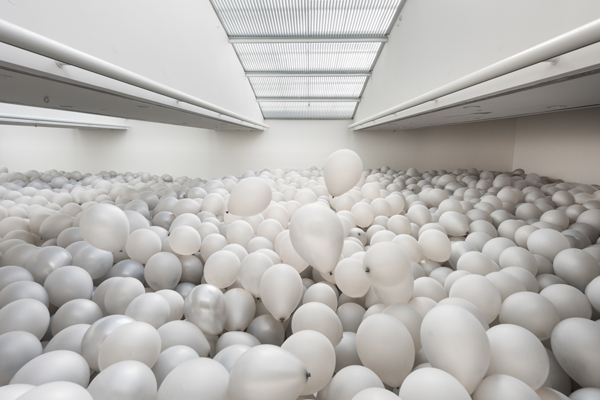
Let’s just state the obvious: Martin Creed’s Work No. 360: Half the Air in a Given Space, on view at Henry Art Gallery, is insanely fun to experience. Pushing your way through a space filled (true to the installation’s title, only halfway) with over 37,000 pearly gray balloons is like being in a mosh pit, surrounded by marshmallows. It’s a ridiculous image, to be sure, but one that gets at how exhilarating, disorienting, and at times suffocating the piece feels on the inside.

Martin Creed. <i>Work No. 360: Half the air in a given space</i>, 2015. Installation view. Courtesy of the Henry Art Gallery, University of Washington, Seattle, Washington. Photo: RJ Sánchez, Solstream Studios.

Martin Creed. Work No. 360: Half the Air in a Given Space, 2015; installation view. Courtesy of Henry Art Gallery, University of Washington, Seattle, Washington. Photo: RJ Sánchez, Solstream Studios.

Over the past decade, Creed has made about a dozen pieces involving colored latex balloons of various dimensions. The exact number of balloons for each installation is calculated via a mathematical calculation; the volume of the gallery is halved and then divided by the equivalent volume of a sixteen-inch balloon in cubic feet. Work No. 360 turns the Henry’s lower-level gallery into a space of play that simultaneously, thanks to the sheer density of the balloons, makes one self-conscious of the volume that one’s body takes up while masking the true dimensions of the surrounding white cube.

Read More »

Share