Beijing

New Directions: Tao Hui at Ullens Center for Contemporary Art

Young Chinese artist Tao Hui is a teller of absurd and disturbing tales; he is a fabulist and a social critic. Born in 1987, his childhood exposed him to the hardships of rural life and to Chinese folk traditions. After graduating from the Sichuan Fine Arts Institute with a BFA in oil painting, he turned to new media to represent the bizarre realities of life in modern China. His theatrical video installations juxtapose the everyday and the bizarre, creating surreal scenarios that defy expectations, refusing viewers the comfort of familiar narrative conventions.

TaoHuiinstallation5

New Directions: Tao Hui at UCCA Beijing; installation view. Courtesy of Ullens Center for Contemporary Art. Photo: Eric Powell.

The moving image was a Western import into China in the 19th century, and it was seized with enthusiasm and an entrepreneurial spirit. By the 1930s, Shanghai was the center of a thriving film industry, with glamorous movie stars rivaling those in Hollywood. After the establishment of the People’s Republic in 1949, film, like photography, became a vital instrument for Maoist propaganda. After Mao’s death, the reform and opening policies of Deng Xiaoping provided new influences, and in the mid-1980s, simultaneous with the rise of the ’85 “New Wave” artists, a group of idealistic filmmakers graduated from the Beijing Film Academy. Video in an art context was pioneered by artists such as Wang Jianwei, Hu Jieming, and Zhang Peili. An explosive mix of new technical knowledge, the discovery of Western artists (including Nam June Paik, Bill Viola, and Bruce Nauman), and the influx of popular culture from diverse sources provided an experimental laboratory for the Chinese avant-garde. Tao Hui is of a new generation for whom the language of video is entirely unremarkable, allowing him to explore the emotive possibilities of sound and create immersive experiences for audiences.

Read More »

Share

Shotgun Reviews

Richard Colman: Faces, Figures, Places, and Things at Chandran Gallery

Shotgun Reviews are an open forum where we invite the international art community to contribute timely, short-format responses to an exhibition or event. If you are interested in submitting a Shotgun Review, please click this link for more information. In this Shotgun Review, Laura Jaye Cramer reviews Richard Colman: Faces, Figures, Places, and Things at Chandran Gallery in San Francisco.

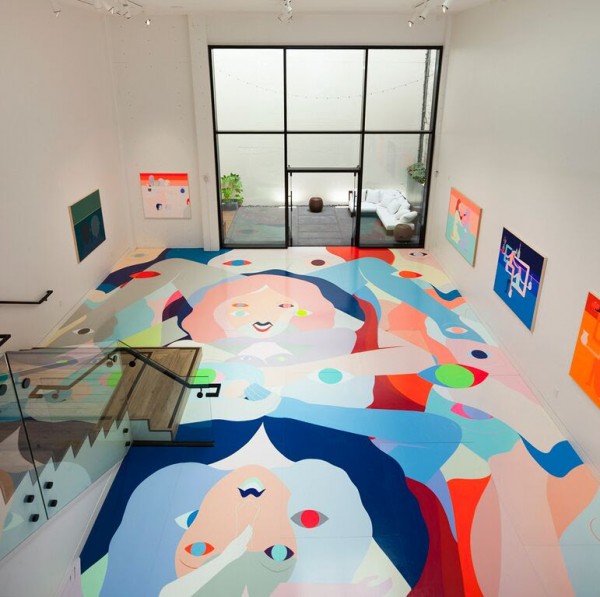
Richard Colman. Faces, Figures, Places and Things, 2015; installation view. Courtesy of the Artist and Chandran Gallery, San Francisco.

Richard Colman. Faces, Figures, Places and Things, 2015; installation view. Courtesy of the Artist and Chandran Gallery, San Francisco.

In Richard Colman’s solo show, Faces, Figures, Places, and Things, currently at the Tenderloin’s new Chandran Gallery, relationships take precedence over anything else. With little more than the human form, Colman creates a world of figures that aren’t muted. They’re stately. They’re uncompromising. They’re anything but shy.

Whether they hold dismembered human heads, kneel as couples, or are stacked in impossible cunnilingus pyramids, each figure is boiled down to its most basic form: expressive, streamlined shapes of flat color. Colman’s bold subject matter is portrayed on correspondingly oversized acrylic paintings, resulting in a combination that seems like a nod to the ancient world. The flattened and linear subjects possess textual qualities that communicate stories of human interaction, sexuality, and social stratification—not unlike what you might find on the wall of a prehistoric cave or an archaic tomb.

Read More »

Share

San Francisco

Radical Presence, Absence, A Body Without Politics

Today from our partners at Art Practical, we bring you Anna Martine Whitehead’s latest installation of “Endurance Tests,” a column “on current explorations of representation, the ethereal, and compulsiveness by black artists working in the field of performance.” The author notes, “[…] there is no accounting for blackness. It is too vast—it is everything—and can look any way it wants to. Or it can not look at all.” This article was originally published on September 29, 2015.

Girl [Chitra Ganesh + Simone Leigh]. My dreams, my works must wait till after hell... (still), 2011; Digital video, color, sound; 7:14 minutes. Courtesy of the Artists.

Girl [Chitra Ganesh + Simone Leigh]. My Dreams, My Works Must Wait Till After Hell… (video still), 2011; digital video, color, sound; 7:14. Courtesy of the Artists.

Perhaps it is fitting that the final program for Radical Presence: Black Performance in Contemporary Art at Yerba Buena Center for the Arts is Xaviera Simmons’ Continent: Dark Sound Blue. The artist is a social practitioner in the truest sense, frequently making work that resists commodification and even documentation, to the extent that it troubles the very notion of what an “art work” is. This is precisely the kind of question one should ask when walking through Radical Presence: How can we understand this as art? How can we understand it as work? How can we reckon with these remnants as anything other than traces of blackness after the historical fact of the performance?

There are several vantages from which to consider Radical Presence, curated by Contemporary Arts Museum Houston’s Valerie Cassel Oliver. One viewpoint is to understand the art world itself as a performance of globalized capitalism with performance art as its undercommons, in which black artists participate in dialogues of resistance. Another is to approach it from within the fugitive place of blackness, a perpetually redefined and transmutable no-place of rugged reinvention and hyper-sociality. From this latter standpoint, the art world is not as interesting a subject of interrogation as the question of how blackness iterates itself through performance practices and radical aesthetics.

Read the full article here.

Share

Atlanta

Aleksandra Domanović: Turbo Sculpture at Atlanta Contemporary

Aleksandra Domanović’s multidisciplinary work has captured the attention of critics and curators across the globe for its striking account of the aesthetic and political changes at work in the Balkan region, specifically the former Yugoslavia. Born in Novi Sad in 1981—a territory that belonged to the Federal Republic of Yugoslavia before being dissolved in 2003—Domanović’s work in sculpture, film, and video installation addresses the social, political, economic, and psychological hauntings of the region’s Soviet past. In a powerful deployment of the personal and the political, Domanović animates the fraught history of memorials as empty gestures of recovery and forgetting that are financed by the State. The work explores the deep conflicts inherent in the region’s quick assimilation into the markets and meanings of global capitalism and neoliberalism and the unresolved experiences of those who live in the midst of decisions made at the hands of the State power.

Aleksandra Domanović. Film Still from Turbo Sculpture. 2010-2013. HD video, color, sound. 20 minutes. Edition of 5 + 2 AP. Image courtesy of the Artist and Tanya Leighten, Berlin.

Aleksandra Domanović. Turbo Sculpture, 2010-2013 (video still); HD video, color, sound; 20:00; edition of 5 + 2 AP. Courtesy of the Artist and Tanya Leighten, Berlin.

Domanović’s current installation, Turbo Sculpture (2010–2013) at Atlanta Contemporary, is a twenty-minute crashing of high-definition images and sounds. It examines the recent commission of monumental public sculpture that appears in major public crossways and tourist locales across the former Yugoslavia: Hollywood stars and popular musicians such as Johnny Depp and Bob Marley, fictional film characters such as Rocky Balboa and Donald Duck, and even former President George W. Bush. Garish, expensive, and extremely popular among citizens and tourists alike, these new shrines to popular commodities in American culture refuse the traditional subjects and themes of public monuments (such as national heroes, political leaders, or representations connected to the collective history of a nation) and instead grotesquely literalize the country’s swift embrace and belief in the “cultural logic of late capitalism.”[1] At once extremely jarring, ridiculous, tasteless, and thoughtful in its carefully constructed collusions of site-specific imagery and digital detritus of internet-age image culture, Turbo Sculpture is more than a subversive engagement with the implications of aesthetic failure or neoliberal kitsch. Similar to the dark humor of political philosopher and cultural critic Slavoj Žižek, Domanović brushes against these tasteless sites by forcing the viewer to linger at the fault line between the ridiculous and the serious within the political landscape of former Yugoslavia.

Read More »

Share

Seattle

Genius/21 Century/Seattle at the Frye Art Museum

For the last thirteen years, Seattle has cheekily retorted the MacArthur Foundation’s annual announcement of “Genius Grant” winners by presenting a roster of its own local “geniuses” through the Stranger Genius Award. The Stranger, which is the city’s weekly alternative news and entertainment paper, selects and awards five individuals each year, from the fields of art, performance, literature, film, and music, with $5,000 of unrestricted funds to produce creative work. As described by visual arts editor Jen Graves, recipients of the award have “[ranged] from drag queens to jazz trumpeters”—a diverse group of brilliant and charismatic oddballs, to say the least.

C. Davida Ingram. Avatar: Fanon & Decca, 2015 (video still); single-channel digital video with audio. Courtesy of the Artist.

C. Davida Ingram. Avatar: Fanon & Decca, 2015 (video still); single-channel digital video with audio. Courtesy of the Artist.

This year, the Frye Art Museum hosts and curates a large-scale exhibition, Genius/21 Century/Seattle, to celebrate the many artists and collectives who have previously received the Stranger Genius Award. The exhibition, which opened during the last week of September, will continue to unfold over the course of sixteen weeks with more than forty performances, screenings, readings, and other events taking place throughout its duration. Considering that most of the works are from fields outside of the visual arts, Genius is an ambitious endeavor that extends far beyond the scope of a traditional museum project.

To integrate the works seamlessly, the Frye’s galleries have been transformed into a series of stages, facilitating encounters between the material and ephemeral—between white cube and black box. zoe | juniper’s We were. (2015) is an immersive installation and ongoing durational performance designed and choreographed by collaborators Zoe Scofield and Juniper Shuey. Cylinders of white string hang from the ceiling to the floor, perforating the dark gallery with illuminated columns of light. Projections of dancers ripple across the surface of the threads, creating a compelling vision that is ghostly and undulates as if projected onto the surface of rain. Ephemerality is inherent in the piece—the residual memories of an embodied, physical experience are retained as short-lived sensorial frissons.

Read More »

Share

San Francisco

Jay DeFeo/Alter Ego at Hosfelt Gallery

Today from our partners at Art Practical, we bring you a review of Jay DeFeo/Alter Ego at Hosfelt Gallery in San Francisco. Author Anton Stuebner notes, “In reconceptualizing the forms of her everyday life, DeFeo’s work suggests the importance of embracing the imaginary and the real as necessary complements.” This article was originally published on October 1, 2015.

 Jay DeFeo, Untitled, 1973; gelatin silver print, 7 3/4 x 9 9/16 in., Estate no. P0778A. May not be reproduced in any form without permission of The Jay DeFeo Trust, © 2015 The Jay DeFeo Trust/Artists Rights Society (ARS), New York.

Jay DeFeo, Untitled, 1973; gelatin silver print, 7 3/4 x 9 9/16 in., Estate no. P0778A. May not be reproduced in any form without permission of The Jay DeFeo Trust, © 2015 The Jay DeFeo Trust/Artists Rights Society (ARS), New York.

Shadows suffuse Jay DeFeo’s work. In her gelatin silver prints, familiar objects suddenly become insidious, the high-contrast black-and-white exposures revealing breaks and fissures in what we might otherwise regard as impervious surfaces. The amorphous graphite and charcoal fields in her works on paper, conversely, suggest vortices of depth and motion, and are both unsettling and exhilarating in their free-form abstraction. Her photo and ink collages are densely layered, bordering on the monstrous, their shapes reminiscent of wings and body parts. And her massive grayscale canvases depict violently jutting shapes suspended against unplumbed backdrops of black paint, evoking flight and, inevitably, descent.

Throughout her career, DeFeo (1929–1989) experimented with form, perspective, and light in order to explore the undersides of things, the unseen. Although she took primary inspiration from everyday objects—a shoe, a protractor, a potted plant—these things functioned as points of departure for much stranger and darker imaginings. The fifty-five works included in Jay DeFeo/Alter Ego, now on view at Hosfelt Gallery, offer compelling insights into DeFeo’s multidisciplinary practice, which encompassed painting, photography, drawing, collage, and assemblage. But if the breadth of works on display suggests the expansiveness of her art, it is also indicative of DeFeo’s tireless intellect and her myriad attempts to represent the instability of the material world around her.

Read the full article here.

Share

Mexico City

Lorena Wolffer – Expuestas: Registros Públicos at the Museum of Modern Art in Mexico City

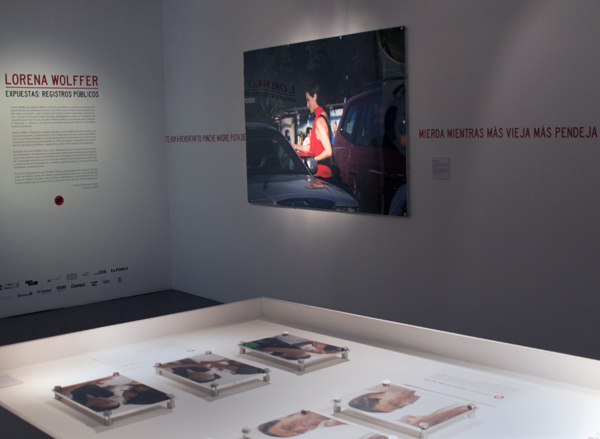
Walking into Lorena Wolffer’s Registros Públicos at the Museum of Modern Art in Mexico City is a deeply unsettling experience. The space is tiny, just a few meters across, and the ceiling height is far closer to a bedroom than a gallery. Written in large red letters along the walls are a series of insults and threats from husbands and lovers to their partners–although using that word in this context seems obscene. The text begins with: Te voy a reventar tu pinche madre puta… (roughly: “I am going to beat your fucking head, slut…”). The intimacy of these words reinforces the intimacy of the gallery space; this kind of violence takes place in the bedroom, and the feeling of disquietude stems not only from these worst aspects of masculinity, but from encountering them in such a public way. Wolffer’s work focuses on politicizing these intimate and hidden forms of violence by making them provocatively public.

Lorena Wolffer. Lorena Wolffer Expuestas: registros públicos, 9/29/2015; installation view, Museo de Arte Moderno, Mexico D.F.. Courtesy of Lorena Wolffer and Museo de Arte Moderno. Photo: Jorge Gomez del Campo.

Lorena Wolffer. Lorena Wolffer Expuestas: Registros Públicos, 2015; installation view, Museo de Arte Moderno, Mexico D.F.. Courtesy of Lorena Wolffer and Museo de Arte Moderno. Photo: Jorge Gomez del Campo.

Documentation of several of the artist’s actions and performances make up the majority of the exhibition, which includes documentation of four pieces in particular. The red text along the wall is from an installation titled Acta Testimonial (2009), in which the artist wrote the insults directed at clients of a woman’s shelter on the walls of a gallery, while the clients’ own recorded voices described their experiences.

A large photograph of the artist handing out chocolates to passing motorists, and a plastic tube filled with those chocolates, documents 14 de Febrero (2008). In this piece the artist handed out chocolates with wrappers containing written accounts of the experiences of a woman named Mari who was forced, along with her four children, to sell chocolates on the busy streets of Mexico City. If Mari failed to sell enough, she was beaten and abused by her husband.

On a table in the center of the space, photographs and texts document Antimemorias: Enmiendas Públicas (2011), in which Wolffer invited passersby to interact with her body in such a way that it came to represent the wounds that the individual women had suffered. These interactions included actions such as washing Wolffer’s skin, or placing bandages on the artist’s body at the locations where the victims had been injured.

Read More »

Share