Los Angeles

Elad Lassry at David Kordansky Gallery

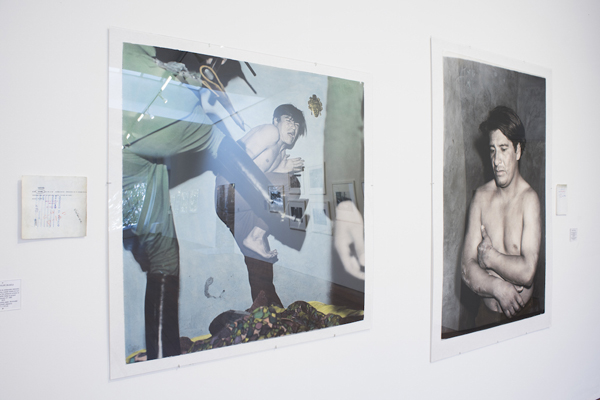
Elad Lassry’s latest exhibition at David Kordansky commingles two groups of seemingly disparate works: highly wrought wooden sculptures, carved from single slabs of dark walnut, and dated commercial photographs, which have been intervened upon with materials such as acrylic paint, colored wires, and beads. The show attempts to bridge the gap between the two bodies of works by engaging the issue of pictorial representation as an abstraction of depicted objects—a far-reaching pursuit for compositions and techniques that seem fairly simple and straightforward on the surface.

Elad Lassry, 2015; installation view. Courtesy of David Kordansky Gallery. Photo: Fredrik Nilsen.

Elad Lassry, 2015; installation view. Courtesy of David Kordansky Gallery. Photo: Fredrik Nilsen.

The black-and-white images found in Lassry’s series of sculptural photographs are taken from commercial photo shoots. The context of each photograph is deliberately withheld, with ranging subjects that include black fashion models, as depicted in Untitled (Woman B) (2015); a set of water glasses on a tray, and industrial parts, in Untitled (Engine 2) (2015), and scientific studies, as in Untitled (Rattlesnake A) (2015). The works center on a dual and seemingly contradictory assertion that “pictures do not exist until the information within them is framed, captured, and introduced into a new, separate system,” as the exhibition’s printed statement puts it—a claim to an image’s lack of an autonomous ability to convey meaning that Lassry’s addition of color and objects is oxymoronically meant to disrupt.

Read More »

Share

From the Archives

From the Archives: “Hello, all-but-forgotten piece of 1970s feminist Earth Art, have you ever seen a transsexual before?”

This week, inundated with news of artists to watch at the Frieze Art Fair, we bring you Jaqueline Clay’s assessment of a group show at the now-closed MacArthur B Arthur Gallery in Oakland, one that included the work of Shana Moulton. Moulton’s work at Frieze this year includes video and sculpture, and her recent exhibitions include Picture Pattern Puzzle Door at the Yerba Buena Center for the Arts, curated by Ceci Moss. This review was originally published on February 14, 2012.

Show card for “Hybrid Narrative” at MacArthur B Arthur, in Oakland, California, 2012.

Sight, acknowledgment, and shared experience all figure prominently in Hybrid Narrative: Video Mediations of Self and the Imagined Self, currently at Mac Arthur B Arthur in Oakland, CA. Artists Liz Rosenfeld, Chris E. Vargas, Sofia Cordova and Shana Moulton make themselves “seen” though video, film transfer, installation and performance.

Read More »

Share

San Francisco

Fourth World: Current Photography from Colombia at SF Camerawork

From our partners at Art Practical, today we bring you John Zarobell’s review of Fourth World: Current Photography from Colombia at SF Camerawork. Zarobell notes that Fourth World follows a survey of contemporary photography from Mexico: “Taken together, these exhibitions make SF Camerawork preeminent in presenting contemporary Latin American photography in the Bay Area. Such a program […] suggests other avenues that SF Camerawork could explore in order to continue to diversify the offerings of global contemporary art in the Bay Area.” This article was originally published on May 26, 2015.

Andres Felipe Orjuela. Luis Aldana Uno de los Antisociales Detenidos en la Mañana de Hoy Cuando Trataba de Huir (Luis Aldana One of the Antisocial Arrested in the Morning While Trying to Escape), 2014; photograph on cotton paper, illuminated with Marshall's pigments. Courtesy of the Artist and SF Camerawork.

Andres Felipe Orjuela. Luis Aldana Uno de los Antisociales Detenidos en la Mañana de Hoy Cuando Trataba de Huir (Luis Aldana One of the Antisocial Arrested in the Morning While Trying to Escape), 2014; photograph on cotton paper, illuminated with Marshall’s pigments. Courtesy of the Artist and SF Camerawork.

SF Camerawork’s current exhibition of contemporary Colombian photography was curated by a pair of Colombian curators, Carolina de Ponce de León (former executive director of Galería de la Raza) and Santiago Rudea Fajardo, an independent curator and critic. Though the exhibition features only four artists, it successfully captures a wide range of topics and approaches in the photographic medium.

Zoraida Diaz and Luz Elena Castro are primarily photojournalists whose straight photography captures the political context of Colombia in the 1980s, as well as more recent images from political protests in Baltimore this spring produced by Diaz. Diaz has a fantastic eye for human expression, unearthing a deeper truth behind protests and political events. Castro is subtler, and her array of images covering revolutionary violence and peace negotiations say much more about the exercise of power than any protest slogan could. Her empathy for her subjects is nowhere sharper than in La Moda Nace Aqui [Fashion is Born Here] (1993), a portrait of a young girl selling toy cars on the street in Leticia, Bogotá in front of a closed boutique with a painted mural on the front of its security shutter. The child is dressed in her Sunday best and she just beams in front of a shabby, awkward mural of a fashionably dressed woman. Her pride makes the viewer forget that this is an image of child labor.

Read the full article here.

Share

Fan Mail

Fan Mail: Victor Solomon

For a year, Victor Solomon apprenticed with stained-glass masters who taught him everything he needed to know about this oft-forgotten craft. Solomon is not a stained-glass artist, and though he doesn’t particularly aspire to be one, an idea took a hold of him and compelled him to take up this traditional medium. Literally Balling is an ongoing project in which the San Francisco-based artist explores the parallels between the world of sports and the world of art, with a subtle side commentary on religious history.

Victor Solomon. We Skrong Then, 2015; glass, mirror, lead, 24K gold-plated high polish steel, wood, Swarovski crystal; 44 in x 40 in x 20 in. Courtesy of the Artist.

Victor Solomon. We Skrong Then, 2015; glass, mirror, lead, 24K gold-plated high-polish steel, wood, Swarovski crystal; 44 x 40 x 20 in. Courtesy of the Artist.

Using the well-known symbol of the basketball hoop and backboard as the centerpiece of this series, Solomon’s interest in stained glass speaks to notions of practical finesse, technical rigor, and excessive opulence. In relocating basketball into the space of contemporary art, the artist seeks to highlight the intense level of discipline required of both players and artists in pursuit of their practice. Within this spectrum of similarities, however, there is also an implicit critique of the extravagance that comes with celebrity culture in both realms, as exemplified by the use of an ostentatious medium such as stained glass.

Read More »

Share

Los Angeles

Michael Waugh: Boom at Von Lintel Gallery

Michael Waugh’s first solo exhibition in Los Angeles, Boom, is currently on view at Von Lintel Gallery. Using ink on Mylar, Waugh reimagines an assortment of 19th-century tableaux, depicting quaint scenes of countryside estates and horse stables, as well as turn-of-the-century buildings on New York City streets. These representational drawings consist wholly of handwritten text: Scribbled sentences produce the contour lines of buildings as they crumble to the ground, while epistolary markings provide contrast to form the underside of a horse. Letters and numbers further constitute the hands and faces of male figures. Waugh has painstakingly scrawled and layered words and sentences across the sheets of Mylar to construct the entirety of every image, spending three to four thousand hours to produce each piece. The amount of labor alone puts Waugh’s drawings on par with the historical legacies of endurance works.

Michael Waugh. Les règles de l’art, 2015; ink on Mylar; four panels, 102 x 42 in. each; Courtesy of the Artist and Von Lintel Gallery.

Michael Waugh. Les Règles de l’Art, 2015; ink on Mylar; four panels, 102 x 42 in. each. Courtesy of the Artist and Von Lintel Gallery.

The incongruous titles of the drawings, such as Unfettered Markets (FCIR, part 4) (2015), hint at the content of the words and sentences used to create them. Waugh uses the Congressional Financial Crisis Inquiry Report to form the images of stately manors and equestrians. In Derivative (FCIR, part 5) (2015), the phrase “too big to fail” delineates the horse’s genitals. For the largest piece in the show—a four-panel work depicting a crowd watching a building collapse—Waugh plums Les Règles de l’Art (The Rules of Art) written by the philosopher Pierre Bourdieu. Like a gunshot, the stupendous amount of time and labor put into Les Règles de l’Art (2015) is immediate and breathtakingly obvious.

Read More »

Share

San Francisco

Printed Matters: An Old American Problem

Today from our partners at Art Practical, we bring you Amelia Rina’s review of the photography books A New American Picture by Doug Rickard (Aperture, 2012) and A New American Dream by Coll.eo (Concrete Press, 2014). This article was originally published on September 15, 2015.

Doug Rickard. #96.749058, Dallas, TX (2008), 2010; from A New American Picture (Aperture 2012). © Doug Rickard. Courtesy of Yossi Milo Gallery, New York, and Stephen Wirtz Gallery, San Francisco

Doug Rickard. #96.749058, Dallas, TX (2008), 2010; from A New American Picture (Aperture, 2012). © Doug Rickard. Courtesy of Yossi Milo Gallery, New York, and Stephen Wirtz Gallery, San Francisco.

Today, with the ever-expanding visibility of public space facilitated by online image databases such as Google Street View and Google Images, it is now possible to “be” almost anywhere, all from the comfort of your home, favorite café, or anywhere with a decent internet connection. As a readily accessible research tool, the images recorded by Google’s cameras and archived in their search engines allow users to become world travelers for nothing more than the cost of a Wi-Fi password. This new privilege inspires wanderlust-inducing listicles such as, “16 Amazing Places to Visit Via Google Street View,” which links readers to everywhere from the Adélie Penguin Rookery in Antarctica to Times Square in New York City. However, with our unprecedented connectivity comes a simple, all-too-common oversight of the plugged-in public: Not everyone enjoys the same access, and not every place has the same visibility. What are the implications of people, places, and things we can view online, and what meaning can we find in the gaps?

When Doug Rickard went on a virtual photographic road trip using Google Street View, his aim was to expose what he considered to be the forgotten or ignored parts of the United States—places that highlight the inequality and poverty he was shocked to discover while studying U.S. history in college. Through his project A New American Picture (2008–2012), Rickard endeavored to “shine a spotlight on specific parts of our country that need to be seen.” Starting in Detroit, which for him epitomizes the collapsed American dream, Rickard traveled across the country with the click of his mouse, visiting impoverished areas and photographing the scenes on his computer screen. “I was surprised at the level to which what I was seeing was so different from how America likes to see itself,” he explains in an interview. The resulting images demonstrate Rickard’s masterful eye for composition and image making, as well as his naïve exploitation and sensationalizing of poverty and its effects.

Read the full article here.

Share

Nashville

Vesna Pavlović: LOST ART at Zeitgeist Gallery

Oscillating between archival research, anthropological studies, conceptual photography, and documentary film, Lost ArtZeitgeist Gallery’s current exhibition of the work of Vesna Pavlović—examines the artist’s deep engagement with institutional resources, specifically slides and photographic ephemera culled from university libraries and the Museum of Yugoslav History in Belgrade, Serbia. Founded in 1996, the museum is the result of the integration of two other institutions: the Museum of the Revolutions of Yugoslav Nations and Ethnic Minorities, and the vast Josep Broz Tito Memorial Center—a repository of historical, photographic, and personal materials that document the life and career of President Tito. Despite Tito’s successful resistance to European Fascism during World War II, Tito’s strict policies of anti-alignment with Stalinist Moscow and the mandates of Western capitalism during and after the Cold War, Tito’s reign is blackened by some of the darkest human-rights violations of the post-Soviet era—an issue that animates his historical legacy with tremendous ambiguity, unresolved conflict, and controversy.

Vesna Pavlović. Installation shot of Elements of the Choreography. 2013. Two fabric flags, 27 x 156 inches each. Image courtesy of the artist and Zeitgeist Gallery (Nashville, Tennessee).

Vesna Pavlović. Installation view of Elements of the Choreography, 2013; Two fabric flags; each 27 x 156 in. Courtesy of the Artist and Zeitgeist Gallery, Nashville.

The unsettled nature of her country’s past can be felt in Pavlović’s images of warped canisters and dusty reels located in the depths of these institutions. Years of War, Decades of Piece (2013) frames the act of remembering through the aged ephemera and the slippery slope of Tito’s rule that remains broken and uncohesive for former Yugoslavians. Known as a great socialist revolutionary as well as a “benevolent” dictator, Tito does not rest easy in the hearts and minds of those who thrived and suffered under his rule. Pavlović had firsthand experience in the late trajectory of the Tito administration—which shifted from pomp and circumstance, love and adoration, to the horrors of the civil wars in the 1990s—and she seizes on the complicated emotional and political contexts of the Yugoslavian socialist era by mapping the individual within a realm of “lost” images and ideologies.

Read More »

Share