From the Archives

From the Archives – Help Desk: Friends in High(er) Places

Today from our archives we bring you an age-old question about how to respond to friends and acquaintances who ask for (un)professional favors. Help Desk is an arts-advice column that demystifies practices for artists, writers, curators, collectors, patrons, and the general public. Submit your questions anonymously here. All submissions become the property of Daily Serving. This column was originally published on May 12, 2014.

Heidi Bucher. Hautraum (Ahnenhaus), 1980-82; Courtesy Freymond-Guth Fine Arts, Zürich

Heidi Bucher. Hautraum (Ahnenhaus), 1980-82. Courtesy of Freymond-Guth Fine Arts, Zürich.

I work at a museum, but not as a curator or any similar position that might have influence over content. I am sometimes approached by artists (friends, associates, acquaintances, strangers at parties) who want to know how to get their art into a museum. Specifically my museum. What’s the curator’s phone number? Can they drop off a packet? Will I put it on someone’s desk? The way to a museum show is convoluted and not the same for every artist. I’m an artist too, and while I sympathize, I am sure my “help” wouldn’t help them and would jeopardize my professional relationships at work. But I would like to have something to tell people.

You have my sympathies. It must be annoying and kind of frightening to have friends, colleagues, and strangers alike envisioning your job as their fast track to being shown or collected by the museum. I mean, there you are, minding your own business like a cartoon pig out for a sunny walk, while behind every tree lurks a wolf who imagines you as a delicious Sunday ham served up on a fine china platter. Okay, no more similies. You get the idea.

Responding to strangers is easy, because all you have to do with any unknown person who asks you for an inappropriate and presumptuous career favor—one that might induce your colleagues to loathe you—is to just stare at her in silence. The longer the silence, the better, so practice this on your significant other or on the cat. If the stranger doesn’t then fall all over herself to backpedal (“Just kidding! Ha ha! I hate museums!”), then maintain your dead-face and say, “I regret that I’m not able to help you.” You can go to confession later for fibbing about the “regret” part.

Read More »

Share

From the Archives

From the Archives– #Hashtags: Institutionalized Critique

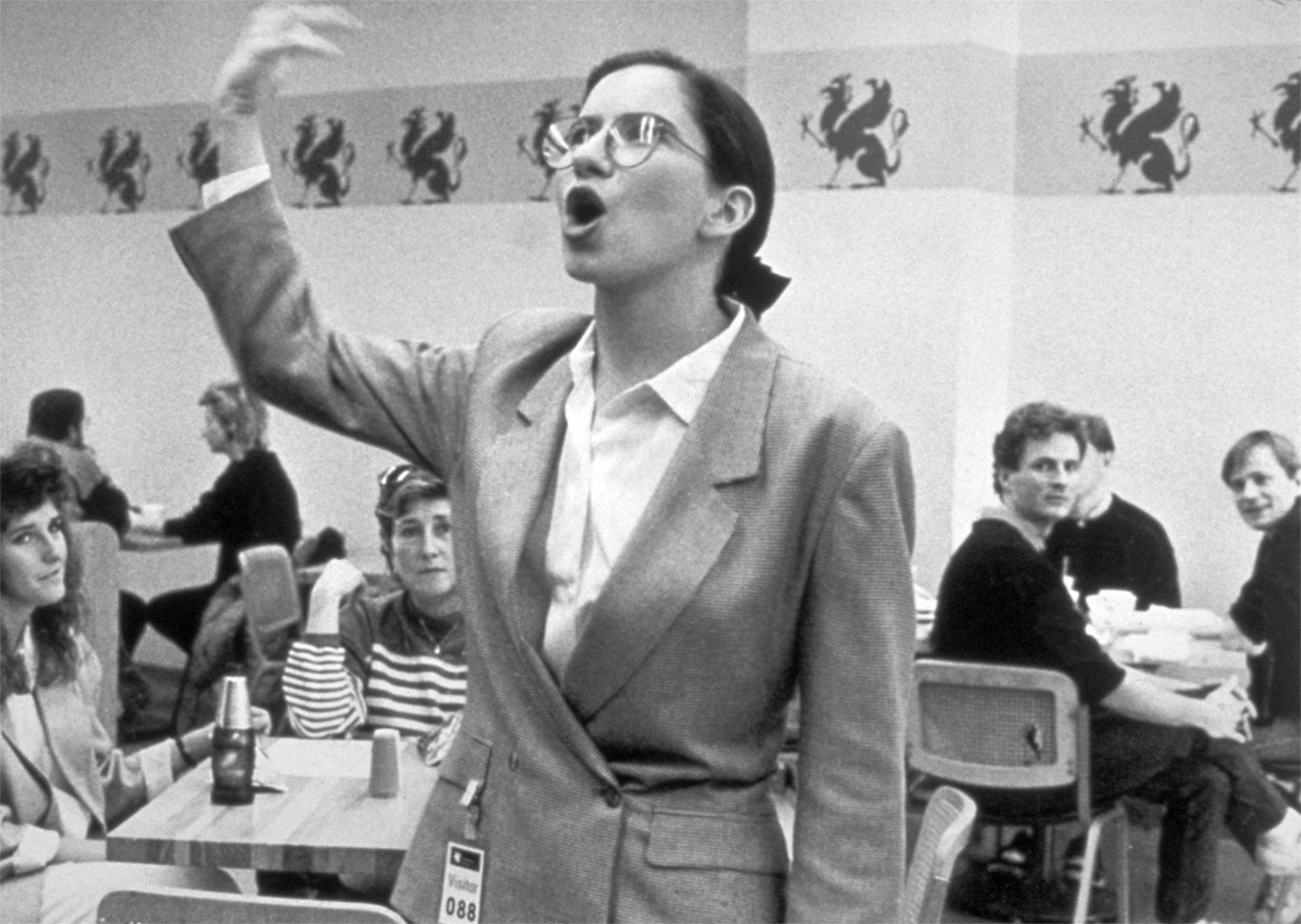
Here at Daily Serving, we’re excited that Andrea Fraser is the focus of a year-long series of events (and a published text) at the Wattis. Today from the archives we bring you Anuradha Vikram’s review of the Hammer Museum’s 2014 show Take It or Leave It: Institution, Image, Ideology, which includes an extended reflection on Fraser’s noteworthy early performance Museum Highlights: A Gallery Talk and how Fraser’s career has “paralleled that of institutional critique as a discipline.” This review was originally published on April 7, 2014. 

Andrea Fraser. Museum Highlights: A Gallery Talk, 1989. Single-channel video (Betacam SP NTSC), color, sound. 30:00 min. Courtesy of the artist.

Andrea Fraser. Museum Highlights: A Gallery Talk, 1989; single-channel video (Betacam SP NTSC), color, sound; 30:00. Courtesy of the Artist.

#museums #historicity #institutional critique #detournement #appropriation

The exhibition Take It or Leave It: Institution, Image, Ideology at UCLA’s Hammer Museum is an effort to comprehensively document the artistic modes of appropriation and institutional critique that emerged in American contemporary art of the 1970s–1990s. While related, these are two distinct forms—appropriation being the art of repurposing images and forms from an established, original context to a new, transformative one, while institutional critique is generally defined by installation-based art practices that appropriate and détourne forms and images from within institutional contexts such as museums and academia. Artists associated with institutional critique include Andrea Fraser, Fred Wilson, Renée Green, Martha Rosler, and Adrian Piper, all of whose work is included at the Hammer. Within the period of the exhibition’s scope, these artists had practices that were boundary-pushing and provocative. Nonetheless, that era is more than twenty years in the past, and the edginess and discomfort associated with these artists has largely given way to sanctification. As the critique generation enters the canon, it’s appropriate to ask whether the form of institutional critique can evolve to remain relevant and keep pressure on institutions that remain problematic and change-averse.

Read More »

Share

Philadelphia

Reformation: Public Art and the Philadelphia School Closures

Today from our friends at Pelican Bomb, we bring you Meredith Sellers’ article examining reForm, Pepón Osorio’s installation project at Temple University’s Tyler School of Art. Sellers discusses reForm critically in the larger political context of Philadelphia school closures. She states, “The reForm project […] aims to create much-needed public discussion around the fate of the Philadelphia school system and to be a potential catalyst for change. But a classroom, tucked down a labyrinthian hall, inside a building on a university campus hardly feels public.” This article was originally published on October 2nd, 2015.

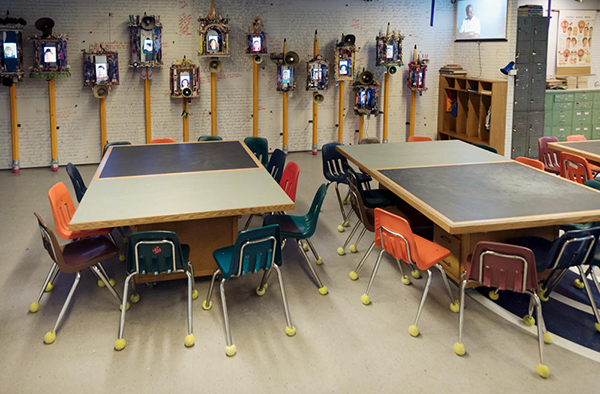
Pepón Osorio. reForm, 2015; installation view, Temple University's Tyler School of Art. Photo: Constance Mensh.

Pepón Osorio. reForm, 2015; installation view, Temple University’s Tyler School of Art. Photo: Constance Mensh.

After about ten minutes of wandering around Temple University’s Tyler School of Art, I saw students emerging from a hallway. No one had been able to tell me the room number or exact location of the classroom where reForm, artist Pepón Osorio’s newest installation project for Temple Contemporary, was located. I slipped past a pair of double doors and had started walking down the hall when I realized I was already inside the work. Brightly colored backpacks hang from a row of wooden cubbies with sneakers, jackets, and stuffed animals stashed inside them. Photos of empty hallways, scattered file folders, and a recent student reunion party are embedded within clunky frames into a false cinderblock wall behind the cubbies. A sullen looking taxidermied bobcat is perched on a massive pile of books inside an antique vitrine.

I turned the corner and entered a classroom. The main exhibition takes place in one of Tyler’s art history rooms, which, the wall text informed me, will continue to be used through the duration of the exhibition. Over a chorus of children’s recorded voices the gallery attendant asked me to sign in the guestbook. The children are speaking about their now-closed school, Fairhill Elementary, from video screens attached onto oversized pencils decorated with chock-a-block assemblages of mirrors, tchotchkes, and loudspeakers. The assemblages are peppered with plastic figurines holding miniature protest signs saying “The Kids,” “SOS,” and “Fight Hite!” The ten young people on the video screens, mostly graduates of Fairhill, form what the project calls the Bobcats Collective, after their former school’s mascot. The students chant lines from a poem one of them wrote, “This time when we speak, you listen,” and, “Jail or dead, dead or jail.”

The students’ concerns are real, yet the classroom installation is filled with cloying surrealistic interventions, like a fake tree sprouting out of a sink and backpacks suspended from the wildly patterned ceiling. There are random assortments of artifacts salvaged from the school—piles of books stacked haphazardly against a wall, teacher’s mailboxes, and a nurse’s vinyl couch that stands in front of a wall with a chalk rendering of Superintendent William Hite’s letter informing parents of Fairhill’s closure. The walls of the room are lined with blown-up prints of essays the students wrote about their feelings on the school’s closure, marked with paternalistic red ink corrections. After a couple minutes the children’s protestations loop and repeat, and by the time I’m leaving the installation, they’ve started to grate.

Read the full article here.

Share

Washington, D.C.

Black Box: Sergio Caballero at the Hirshhorn Museum

Sergio Caballero combines grotesque materials, low-budget techniques, and a healthy dose of dark humor in his film Ancha La Castilla or N’importe Quoi (2014). Ancha La Castilla is the latest iteration of Black Box, a series dedicated to moving-image works at the Hirshhorn Museum in Washington, D.C. The twenty-five-minute film tells the tale of a young girl named Alegría as she becomes possessed and thus in need of an exorcism. With its main characters appearing both as puppets and as costumed actors, the film is emblematic of Caballero’s experimental yet playful style.

Sergio Caballero. Ancha La Castilla or N’importe quoi, 2014 (video still); digital video, 24:00. Courtesy of the artist and Smithsonian's Hirshhorn Museum and Sculpture Garden.

Sergio Caballero. Ancha La Castilla or N’importe quoi, 2014 (video still); digital video; 24:00. Courtesy of the Artist and Smithsonian’s Hirshhorn Museum and Sculpture Garden.

Ancha La Castilla begins with a scene that perfectly characterizes the filmmaker’s absurdist style and wry humor. Seen as a live actor in a large, potato-like papier-mâché costume, Alegría’s mother laboriously pours green goo (coffee) from a moka pot into a cardboard carafe, only to haphazardly spill much of it on the floor. Bringing what dregs of coffee made it into her carafe, the mother—now appearing as a gnarly puppet consisting of an actual potato—remarks to her child, “It’s a harmonious day without limits,” and “The petunias sing of love.” This grating optimism contrasts with the grotesque appearance of the characters, assembled with blobs of plaster, hair, and other materials, and the bleak setting of their desolate, poorly lit abode, strewn with trash.

Following her mother’s cheery remarks, Alegría is promptly possessed in a chaotic, strobe-lit scene. Johann Sebastian Bach’s Jesu, Joy of Man’s Desiring plays gleefully in the background, clashing with the distinct barking of a demonic voice. Such jarring sonic contrasts recur throughout the film, often with airy melodies such as Edvard Grieg’s Morning Mood alternating with furiously pulsating synths by electronic duo EVOL.

Read More »

Share

Singapore

Tomás Saraceno: Arachnid Orchestra. Jam Sessions at NTU Centre for Contemporary Art Singapore

The gallery hums with screechy sounds resembling acoustic feedback, punctuated by random bursts of bass and cartoonish sound effects. The soundscape is queasily amorphous and disorienting, built on dissonance and the chaotic rhythms resonating from a handful of arachnids that have woven fine, thick webs around delicate wire frames. Featuring a plethora of spiderweb sound installations, Tomás Saraceno’s latest show Arachnid Orchestra. Jam Sessions is an experimental drive to amplify and record the vibrations created when spiders communicate, and using special sensory devices, like transducers and laser Dopplers, that map their movements. When made perceivable to human ears, these vibrations—spontaneously produced in a freewheeling environment—enable jam sessions to become integral part of the show, where musicians have been invited to respond to the arachnids’ vibrational signals in a bid for interspecies mingling.

Tomás Saraceno, Omega Centauri 1 Nephila Kenianensis 4 Cyrtophora citricola, 2014; Spidersilk, carbon fibre, light, Tripod. Courtesy of the artist and Esther Schipper Gallery, Berlin.

Tomás Saraceno. Omega Centauri 1 Nephila Kenianensis 4 Cyrtophora Citricola, 2014; spidersilk, carbon fiber, light, tripod. Courtesy of the Artist and Esther Schipper Gallery, Berlin.

In spite of what the name of the exhibition suggests, the curatorial framework of the show is given vague, but stylish parameters that situate Saraceno’s oeuvre on the crossroads of art, architecture, and science. To term Saraceno’s show as “sound art” or “sound installation,” would be an underestimation of the multivalent nature of an artistic practice that prizes interaction, interconnectedness, and a kind of new order that can only form out of an established network of chaos.

Read More »

Share

San Francisco

Gail Wight: Windswept

From our partners at Art Practical, today we bring you Gail Wight’s meditation on wind. Wight writes: “I began to understand that the color and texture, the hue and saturation of the sky—or of the ocean swell, the arching trees, the rippling seaweed—are constructed largely by the presence, or absence, of the otherwise invisible wind.” This article was originally published in Issue 7.2, Art, Science, and Wonder, on October 29, 2015.

Gail Wight. Homage to the Wind (video still), 2012; HD video; 16:09. Courtesy of Gail Wight.

Gail Wight. Homage to the Wind (video still), 2012; HD video; 16:09. Courtesy of Gail Wight.

On my bookshelf is a dog-eared and ragged copy of Josef Albers’ Interaction of Color, the “revised pocket edition” from Yale University Press. I picked up this small paperback at a second-hand store in Boston in 1986. It came with a tiny packet of colored paper chips and a few loose leaves for comparing colors. I’ve always loved this little treasure.

The original version was published in 1963 as a glorious set of one hundred fifty silk-screens, with die-cut overlaid pages and accompanying text, all within a slipcase. Yale describes it as “a masterwork in art education.” It’s been in print ever since, and celebrated its fiftieth anniversary in 2013 with a beautiful, clothbound, two-volume edition.

Read the full article here.

Share

Taos

Ken Price: Death Shrine I at the Harwood Museum of Art

Ken Price is best known for his psychedelic ceramic sculptures: abstractions layered in paint and sanded to pristine finishes. His piece Death Shrine I (1972–1976), permanently installed at the Harwood Museum of Art in Taos, New Mexico, is an unexpected departure from this canon. The shrine is a facet of Price’s Happy’s Curios project, and is one of three such installations inspired by the iconography of Día de Muertos. Death Shrine I, the only piece from the series currently on public view, is part of a contemporary collection at the Harwood, donated in 2013 by artist and collector Gus Foster. The collection crystallizes the relationship between Taos and Los Angeles within a museum honoring northern New Mexico’s long history as an artist colony.[1] In the early 1970s, Price semi-permanently moved from his hometown Los Angeles to the ambient Taos. He was the first among his cohorts; Foster, Larry Bell, Ron Cooper, Ron Davis, Lee Mullican, and others soon followed.

Ken Price. Death Shrine I, 1972-76; dimensions variable. Courtesy of Ken Price Studio.

Ken Price. Death Shrine I, 1972-76; dimensions variable. Courtesy of Ken Price Studio.

In Taos, Price embarked on his six-year-long project Happy’s Curios, which pays homage to Mexican folk pottery through the process of rigorous replication. His spirited pieces, handmade ceramic cups, plates, and servingware, were thoughtfully displayed in custom-built wood cabinets. Through Happy’s Curios, Price genuinely sought to represent the thoughtful yet nonchalant craftsmanship of the pottery he admired. It was one of the first projects in which qualities of the Southwest were interpreted in his work. Later, his drawings and watercolors were hallucinatory takes on the landscape. Even when the connection is less direct, as with his ceramic abstractions, Price’s organic shapes and color palette seem inspired by the exaggerated topography and intense sunsets of northern New Mexico. Taos, where the Rocky Mountains collide with canyonland, drew artists like Ansel Adams and Georgia O’Keefe.

Read More »

Share