Interviews

In the Dressing Room with Coco Fusco, August 19, 2015

Today from our partners at Art Practical, we bring you In the Dressing Room with Coco Fusco by Patricia Maloney and Moira Roth. In it, Coco Fusco takes us behind the scenes of her performance as Dr. Zira, the animal psychologist from Planet of the Apes, at Yerba Buena’s Radical Presence exhibition. As she removes her monkey costume backstage, Fusco opens up about performance and uniforms, economic violence, and humor. This article was originally published on October 13, 2015.

Coco Fusco. Observations of Predation in Humans: A Lecture by Dr. Zira, Animal Psychologist, 2013 (still); performance. Courtesy of Walker Art Center. Photo: Gene Pittman.

Coco Fusco. Observations of Predation in Humans: A Lecture by Dr. Zira, Animal Psychologist, 2013 (still); performance. Courtesy of Walker Art Center. Photo: Gene Pittman.

Even when you are naked in a performance, you are in costume. Everything counts about how you look, because you are the instrument, whether it’s your body or your voice. Of course I am masquerading, but I am not acting in a traditional sense. I am not thinking about masquerade; I am thinking about making a performance and what I have to do.

There was a Brazilian filmmaker, Wagner Morales, who made a documentary titled I Like Girls in Uniform (2006) about my work for the 2005 Videobrasil International Electronic Art Festival. He was looking at my performance Bare Life Study #1, in which the performers are all dressed in orange prison jumpsuits and I’m in fatigues. I’ve done a lot of pieces in which I am in uniform, such as for example a maquiladora worker’s uniform, because a lot of women go to work wearing uniforms. I’ve done many pieces about the kinds of work that women do.

This performance came about because I was using these films in an undergraduate class on Afrofuturism at Parsons School of Design in New York. I had students who had never heard of this stuff before. It’s not like I said, “Planet of the Apes!” and they were like, “Yeah!” They were really taken with the films, though, and that was a good sign.

Read the full article here.

Share

Los Angeles

Pope.L: Desert at Steve Turner and Pope.L: Forest at Susanne Vielmetter Los Angeles Projects

Pope.L returns to Los Angeles, after his MOCA exhibition William Pope.L: Trinket this past summer, with a two-part, two-gallery, map-sprawling, time-spanning show—Desert at Steve Turner in Hollywood and Forest at Susanne Vielmetter Los Angeles Projects in Culver City—connected by a downloadable GPS driving tour. Samuel Beckett, whose influence appeared in Trinket, returns again in the GPS guide’s insistently jolted repetitive language, “this thing this thing this thing you are are are listening to is your conscience.”

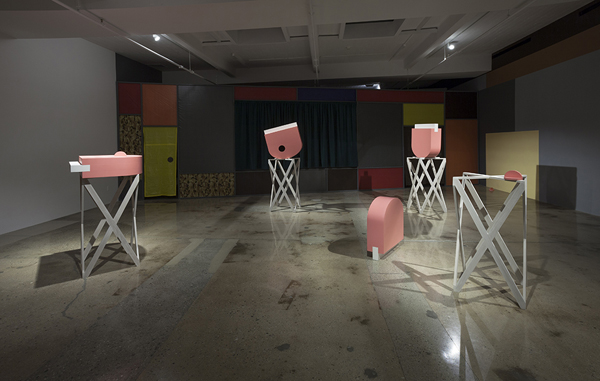
Pope.L. Desert, installation view, Steve Turner Contemporary, 2015. Courtesy of the artist. © Pope.L

Pope.L. Desert; installation view, Steve Turner, 2015. Courtesy of the Artist. © Pope.L.

History, trapped, bubbles up in each site and in the space and time between them. Do you know how forests became deserts? The driving tour answers, but only after a voice warns that while there aren’t any tricks in the physical artwork, the audio portion of this exhibition might have some. Continuing on S. Cochran Ave, the guide finally divulges, “Forest is just oil in another lifetime … a forest will become a desert and.” The audio stops mid-clause.

Pope.L twists gaps and opens up fissures. Sentences stop mid-meaning. Logographic texts, such as “& – ,, +,” line the walls of Desert at Steve Turner as isolated interpolators of written language. Words are pushed in and out of near-identity—destiny becomes “dustiny” becomes destiny—simultaneously signaling a boundary and a connection. There is total removal: an erasure haunted by another erasure, a package never opened. Desert is populated by Pope.L’s pristine sculptures of eraser heads, pink and propped up on stands or tilted on the floor, punctured with holes. Nigger Eraser (1998–2002), a deodorant container, modified with marker, chocolate, and cellophane tape, is the oldest piece of Pope.L’s work shown in Desert.

Read More »

Share

Help Desk

Help Desk: The Snarky Remarker

Help Desk is an arts-advice column that demystifies practices for artists, writers, curators, collectors, patrons, and the general public. Submit your questions anonymously here. All submissions become the property of Daily Serving.

I’m an artist and I live and work in [a small city]. There’s a woman who is relatively new to our small scene, and she doesn’t seem to like me, but I don’t know what I might have done to get on her bad side because most people I know enjoy her company. When I run into her at openings and parties, she makes snarky remarks that seem aimed at me. In the few times that we’ve been alone together, she’s made some subtle put-downs and backhanded compliments. Under other circumstances I’d just cross her off, but she’s friends with lots of my friends and she’s gotten herself into a position of power, curating exhibitions and jurying grants. I want to stick up for myself, but making her an outright enemy isn’t going to help my career. Can you help?

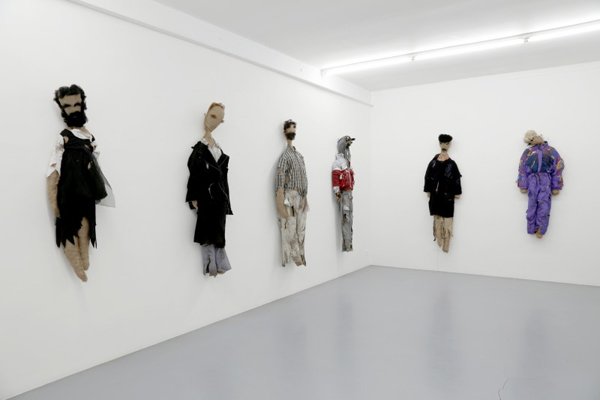
Jos de Gruyter and Harald Thys. Die schmutzigen Puppen von Pommern, 2014; installation view, Micheline Szwajcer Gallery, Antwerp.

Jos de Gruyter and Harald Thys. Die Schmutzigen Puppen von Pommern, 2014; installation view, Micheline Szwajcer Gallery, Antwerp.

Certainly I can help, though my advice might have you gritting your teeth a little. There are a few maneuvers you can try, and in truth, I don’t guarantee any of them because it’s possible that you’ve contracted a case of mean girl, for which there is no permanent cure. But before we discuss a few schemes, can you find out through those mutual friends why she doesn’t like you? I’m not suggesting that you start some kind of gossip campaign—it’s more that I hope you have at least one trusted confidant to whom you might say, “Madame X doesn’t seem to like me very much, and I often wonder why.” It’s a vulnerable position to put yourself in, but it might be the most expedient route to finding a cause and planning a treatment.

In the case that your ally does not know the reason behind this woman’s antipathy, you still need to try to rehabilitate the situation. A good way to start is to “kill with kindness” (this is the gritting your teeth part). Let’s give her the benefit of the doubt. Is it possible that she might have misinterpreted some gesture early on in your relationship? Could she have somehow gotten the impression that you don’t like her? If that’s conceivable, then this method gives you both a chance to change your perceptions of each other. Next time you see her, find something to compliment (note that you must be sincere). Show some mild admiration, like, “That’s a great dress,” “This is a really thoughtful lineup for the exhibition,” or “I was glad to hear you picked so-and-so for a grant, she deserves it.” Surely there is something you can find to like about her, and I want you to try it on a minimum of five different occasions—demonstrate that you’re serious and give her a few opportunities to respond properly. Bonus points for following your compliment with a question that shows interest in conversing with her (“Where did you get it?” “Did you start with the artists or a general concept?” “Do you know what she’s planning to do with the money?”) Even if you don’t end up best pals, maybe she’ll see you in a new light and the two of you can move forward with equanimity.

Read More »

Share

Baltimore

Interview with Sterling Wells

From our friends at BmoreArt, today we bring you an interview with artist Sterling Wells. Although the exhibition discussed took place in July at Metropolitan Structures, author Jan Razauskas notes “…the ideas within the work, as well as the new existence of the gallery, are relevant and worthy of consideration.” This article was originally published on October 17, 2015.

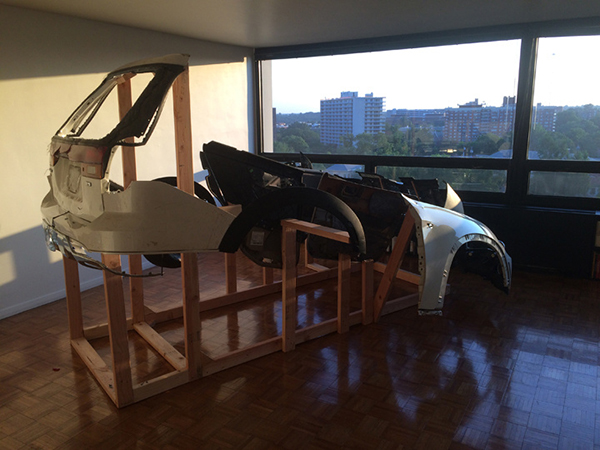
Sterling Wells. Broken Window, 2015; installation view, Metropolitan Structures, Baltimore, MD.

Sterling Wells. Broken Window, 2015; installation view, Metropolitan Structures, Baltimore, MD.

Well above the tree line, inside a snug, modernist apartment, Sterling Wells’s “Broken Window” installation occupies the empty living room space. The work is composed of reclaimed auto-body parts mounted on a wooden armature, to the approximate scale of an automobile. “Broken Window” is set on the diagonal against a row of picture windows, with the car front facing the view and tilting downward. Except for a few shards of glass and debris on the floor, the work is a self-contained unit poised between assembly and unmaking, a cataloging of parts and relics held in suspended motion. I talked with artist Sterling Wells about his process and the impetus behind the project.

Jan Razauskas: Much of your work comes out of interactions with the natural environment, in pieces that position nature and the built environment within the same framework. How did this work evolve out of that interest?

Sterling Wells: Yes, the work evolved out of my interest in framing nature. The aim was to use the car to forge a link between the apartment and the landscape beyond. The apartment is dominated by two enormous picture windows that frame the landscape. Instead of viewing the landscape through two rectangles, I wanted viewers to see the landscape through the glass-shard perimeter of a broken car window. 

Read the full article here.


Share

San Francisco

Paul Graham: The Whiteness of the Whale

From our partners at Art Practical, today we bring you a review of  Paul Graham: The Whiteness of the Whale at Pier 24 Photography. Author Forrest McGarvey states, “Graham uses the controlled process of photography, from aiming through the viewfinder to the adjustment of color on the final prints, to depict his vision of American life.” This article was originally published on November 19, 2015.

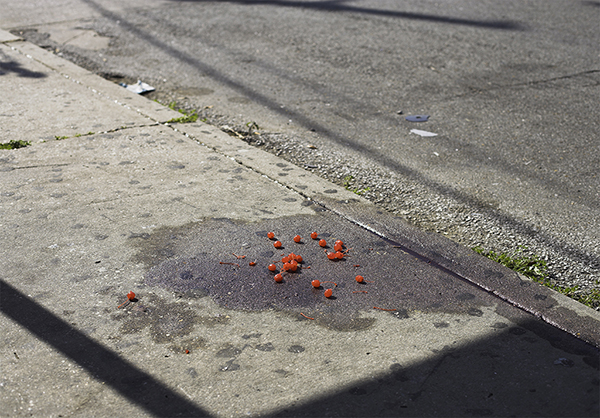
Paul Graham. New Orleans (Cherries), 2005. Courtesy of the Artist and Pier 24 Photography, San Francisco.

Paul Graham. New Orleans (Cherries), 2005. Courtesy of the Artist and Pier 24 Photography, San Francisco.

With almost sixty works from three series spanning thirteen years, Paul Graham: The Whiteness of the Whale is the first single-artist show installed at Pier 24 Photography. In the work, British artist Paul Graham has taken America as his subject of interest, traveling to various states and documenting people, places, and objects. American Night (1998–2002) presents large 4-by-5 prints of waiting, wandering, and isolated subjects overexposed into obscurity along with dense, colorful prints of large California houses decorated with candy-red cars and pristine blue skies. In The Present (2009–2011), Graham took to the streets of New York, producing sequential street photography–style shots that play with senses of space and time. The last series installed, A Shimmer of Possibility (2004–2006), fragments the silence and stillness found in American Night into multiple perspectives in collections of images of parked cars, empty lots, and sunsets.

As a viewer moves through the massive show, Graham’s strategies for selecting his subjects and manipulating the formal qualities of the images become more apparent, resulting in a romanticized spectacle that leaves the viewer feeling ambivalent and unfulfilled. Graham uses the controlled process of photography, from aiming through the viewfinder to the adjustment of color on the final prints, to depict his vision of American life. The combination of banal, conventional subject matter and striking visual techniques ultimately reduces the work to its formal qualities. In American Night, Graham manipulates light to build contrasts between works with nearly invisible content and others saturated with intense color. But the differences between overgrown back roads in Louisiana and opulent homes in California are obvious, and the sense of drama depends on tired tropes of the empty plasticity of wealth and the transient non-places of poverty. By further playing up these perspectives through the massive scale of the photographs, Graham leaves a viewer feeling uncomfortable about accepting these imposing yet generic visualizations of economic standing.

Read the full article here.

Share

Portland

Leif Anderson: TATTARRATTAT at Melanie Flood Projects

The word “Tattarrattat” was first birthed in James Joyce’s 1922 novel, Ulysses. It’s the longest palindromic word in English literature and an unmistakable onomatopoeia that takes inalienable form only in a moment we can collectively imagine: a furious rapping at the door. Such phrases within Joyce’s Ulysses and Finnegans Wake make him a legend amongst Modernist writers who are trepidatious about inventing words where none that was fitting existed.

Leif Anderson. Window, 2015; installation view, TATTARRATTAT, 2015. Courtesy of the artist and Melanie Flood Projects. Photo: Worksighted.

Leif Anderson. Window, 2015; installation view, TATTARRATTAT, 2015. Courtesy of the artist and Melanie Flood Projects. Photo: Worksighted.

Inspired by the cursory notion that the word embodies, Portland-based artist Leif Anderson presents work that considers the incongruous decisions that are made based on short-term needs. In particular, TATTARRATTAT, on view at Melanie Flood Projects, is a keen examination of provisional architecture. Anderson bends and creases photographic prints in the spaces between doors and windows, affecting them to near personification. The works scale the tops of demising walls and protrude from heights that liken them to furniture. The end result is an embarrassment of observational dexterity.

Anderson spent weeks in Flood’s empty gallery space—a third-floor walkup in downtown Portland—mapping and photographing architectural details that had uncertain practical value. The building, with its many charms, is a veritable labyrinth of poorly backfilled passageways and doors that no longer open. Window (2015) is a crisp photograph of one such detail—an architectural opening, now sealed with drywall, though fooling no one as to its previous state. Anderson’s version is installed near its reference, sandwiched between a door and doorframe that would open were it not for the need to house its copycat. The proximity is mocking, and the work is better for it.

Read More »

Share

St. Louis

Steven and William Ladd: Scouts or Sports? at St. Louis Art Museum

Currents 111: Steven and William Ladd: Scouts or Sports? at the St. Louis Art Museum features intricately crafted objects made by the two brothers from which the exhibition gets its name. They often work serially and use the grid as a means of organization; process and formalism appear paramount concerns as they experiment with a variety of materials and methods that include drawing, assemblage, sculpture, and installation. While taking influence from geometric abstraction and minimalism, the artists also impart a personal narrative, often through titles. Though they now live and work in New York, the Ladds grew up in St. Louis, and in this exhibit they offer commentaries on these childhood experiences—specifically their participation in after-school activities such as Cub Scouts and sports, hence the title. The works are playful and depict an unaffected and innocent view of St. Louis as seen through the rose-tinted glasses of children’s eyes. Unfortunately, this perspective is limited, and the Ladds’ interpretation of the city, at times, lacks depth—mentioning St. Louis organizations and locations without offering further explanations other than wistful reminiscence.

Steven and William Ladd. Cardinal Nation, 2015; paper, glue, wheat starch, metal beads, metal trinkets, glass beads, crystal beads, pins, screws, dye, mesh, staples, and wood; 59 1/2 x 39 1/2 x 1 in. Photo courtesy of the artists.© Steven and William Ladd, All rights Reserved, 2015.

Steven and William Ladd. Cardinal Nation, 2015; paper, glue, wheat starch, metal beads, metal trinkets, glass beads, crystal beads, pins, screws, dye, mesh, staples, and wood; 59 1/2 x 39 1/2 x 1 in. Courtesy of the Artists. © Steven and William Ladd, all rights reserved, 2015.


On one wall, works on paper are hung in two separate gridded arrangements, with twelve in each group. In the drawing Injury 1, a freehand grid is sketched with pencil, and in each unit of this framework, short, perpendicular strokes of magenta, cerulean, and black ink alternate, creating an intricate weave-like pattern that fills the page. A transparent wash of violet creates a rectangle on top of this ground and floats in the middle of the composition. Within this shape and slightly off-center, irregular patches are left unpainted, and the rectangle looks like a pane of glass with a shattered opening that exposes the layer beneath. All the drawings from this series, Injury 1–12, are nearly identical except for being distinct in color.

Read More »

Share