Atlanta

Joel Holmberg: You’ll Never Know If You Don’t Ask Yourself at Atlanta Contemporary

Joel Holmberg’s newest installation, You’ll Never Know If You Don’t Ask Yourself, expands our understanding of what it means to watch, witness, and experience information through the infinite cyclical stream of live media coverage within the institutional parameters of the art gallery. Currently on view at the Atlanta Contemporary, Holmberg’s display is simple and striking, consisting of six videos that emanate short clips culled from CNN broadcasts, which are interrupted by the artist’s own brief filmic clusters.

Joel Holmberg. Installation view, <i>You’ll Never Know If You Don’t Ask Yourself</i>, 2015. Courtesy of the artist and the Atlanta Contemporary Art Center.

Joel Holmberg. You’ll Never Know If You Don’t Ask Yourself, 2015; installation view. Courtesy of the Artist and the Atlanta Contemporary Art Center.

Holmberg’s television installation of collated newsbytes, ripped from the unstoppable stream of American televisual experience, reminds us just how even and formulaic the rhythms of media news items are. Short, awkward cuts of eyewitness accounts and interviews—ranging from the horrific (the aftermath of a local murder) to the mundane (a rescue mission for a sandwich)—turn the formulaic scripts of news stories into a disturbing meditation on the ways in which we as a technologically advanced society absorb information. Holmberg’s precise employment of sharp edits and cuts disrupts the durational flow of the projected content—testimony is cut off abruptly, leaving the viewer with a collections of words that reveal the surreal, violent, sensationalist nature of news programming.

By refusing to sustain the camera’s collected data, Holmberg forces us to recognize the underlying tempo of traditional media coverage as a current of constant information that never resolves, concludes, or coheres. The experience is both frustrating and fascinating; the eye and ear struggle to pin down the language and scenes while the experience covers over the gaps that viewers may seek to reify. Standing in front of Holmberg’s work is akin to watching a beautifully choreographed seizure in real time.

Read More »

Share

Los Angeles

Jennifer Moon, Jemima Wyman, and Robby Herbst at Commonwealth & Council

As contemporary art seems to be increasingly the province of the 1%, with continual record-breaking auctions, it may be difficult to appreciate the revolutionary origins of modernism. Early 20th-century art movements like Constructivism, Futurism, and Dada sought an aesthetic, social, and political break with the past, often with utopian goals for the future. A trio of solo shows at Commonwealth & Council aim to reinvigorate contemporary art with this revolutionary zeal.

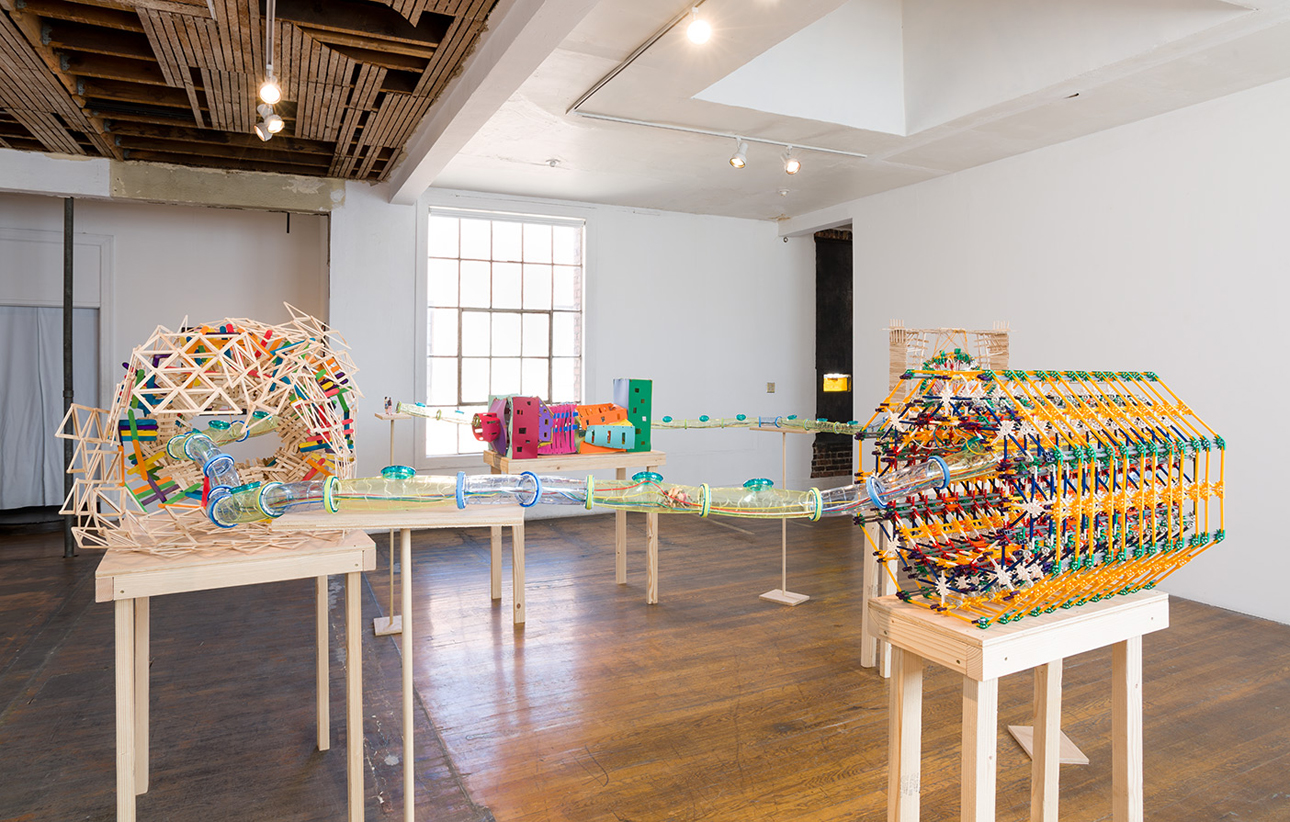
Jennifer Moon. JLS (Jennifer laub Smasher), 2015; K’NEX, Habitrail tubes, popsicle sticks, foam sheets, ceramic 3D print figurines, electrical wire, electrical tape, dental floss, hemp, duck tape, wood, inkjet prints, cardboard, construction paper, foamcore, fabric, folding table; 2 parts: Approx. 68 ½ x 156 x 152 in.; 77 x 48 x 24 in. Courtesy the artist and Commonwealth & Council, Los Angeles.

Jennifer Moon. JLS (Jennifer Laub Smasher), 2015; K’NEX, Habitrail tubes, Popsicle sticks, foam sheets, ceramic 3D print figurines, electrical wire, electrical tape, dental floss, hemp, duct tape, wood, inkjet prints, cardboard, construction paper, foamcore, fabric, folding table; 2 parts: approx. 68 ½ x 156 x 152 in.; 77 x 48 x 24 in. Courtesy of the Artist and Commonwealth & Council, Los Angeles.

With her Phoenix Rising series, Jennifer Moon explores the revolutionary potential of love, with ample doses of candor and humor. One particularly memorable image from Phoenix Rising, Part 2 features Moon seated in a “Black Panther”-style wicker chair, with her Pomeranian at her feet, both of them wearing matching red berets. For Moon, the personal is indeed political. A far cry from Kazimir Malevich’s severe, stark black square, Moon’s work is idiosyncratic and playful, though her aims are no less radical. Phoenix Rising, Part 3: Laub, Me, and The Revolution (The Theory of Everything) resembles a junior-high-school science fair exhibit that provides a blueprint for revolution on both a macro and micro scale. The centerpiece is JLS (Jennifer Laub Smasher) (2015), a model made of Popsicle sticks and construction toys that snakes through the gallery. It resembles a DIY version of the Large Hadron Collider, only instead of smashing protons together, it will send Moon and her partner Laub hurtling toward one another at the speed of light. Instead of the Higgs boson particle, they are searching for a new form of love free from “hierarchies, binaries, and capital,” as an explanatory panel states. 3D-printed figures of the pair stand at the entry point, ready to embark on their experiment. It is a charming and whimsical riff on quantum theory.

Read More »

Share

Los Angeles

Random International: Rain Room at LACMA

It’s not too often that whatever MoMA-inspired freak-outs occurring in New York reverberate out to the West Coast. Recently, New Yorkers and Californians alike displayed the kind of commotion around procuring Kraftwerk tickets that a child normally reserves for their first trip to Disneyland. Rain Room and its hype, which had its moment at MoMA, has now also found its way to the West Coast, where it is currently on view at LACMA.

(left) Random International. Rain Room, 2015; installation view, LACMA, Los Angeles, CA. Courtesy of the artist and LACMA. (right) Le Corbusier. Ville Radieuse (Radiant City), 1925. Courtesy of Foundation Le Corbusier.

(left) Random International. Rain Room, 2015; installation view, LACMA, Los Angeles, CA. Courtesy of the Artist and LACMA. (right) Le Corbusier. Ville Radieuse (Radiant City), 1925. Courtesy of Foundation Le Corbusier.

The hype is only a forewarning. The real concern for alarm is that not a single curator at LACMA has attached their name to the installation and its associated Art + Technology initiative—and for good reason. The whiz-bang Rain Room has all the uncomplicated, vanilla pizzazz of an airport-terminal public art installation. And yet it holds a larger, sadder significance, paralleling much of the economic changes and atomization occurring within California and the U.S.

The installation consists of a large, darkened room with a high-tech drop-down ceiling that pours water onto the grated floor twenty feet below. Using cameras, algorithms turn off only those valves directly above each viewer, creating a dry halo that follows them, as torrents of “rain” come down everywhere else. (Did someone forget to mention there’s a drought in California?) A single white floodlight inundates the space like an oncoming headlight, creating silhouettes of everyone in the room.

Read More »

Share

Shotgun Reviews

Bechdel Test Movie Night: Foxy Brown

Shotgun Reviews are an open forum where we invite the international art community to contribute timely, short-format responses to an exhibition or event. If you are interested in submitting a Shotgun Review, please click this link for more information. In this Shotgun Review, Tanya Gayer reviews Bechdel Test Movie Night: Foxy Brown  at New Parkway Theater in Oakland.

Alison Bechdel. Bechdel Test, c. 1985; Dykes to Watch Out For. Courtesy of the Artist.

Alison Bechdel. Bechdel Test, c. 1985; comic strip from Dykes to Watch Out For. Courtesy of the Artist.

Foxy Brown (1974) is widely described as a blaxploitation film—a genre that filmmaker and educator Cheryl Dunye asserts are films that profit from making a spectacle out of lead black characters, but at the same time promote the voice of the black community in pop culture. On November 8 the New Parkway Theater screened this film as part of a series hosted by Dunye. The series features films that pass the Bechdel test.[1] This seemingly easy requirement is surprisingly difficult for most films to achieve. Each of the films featured in the series are followed by an audience discussion moderated by Dunye.

Read More »

Share

Interviews

Interview with Adriana Lara

Today from our friends at Kadist, we present a video interview with Adriana Lara. In it, Michele Fiedler talks with Lara about her relationship to the readymade, the exhibition, and the wearable. This video was originally published October 6, 2015.

Share

Fan Mail

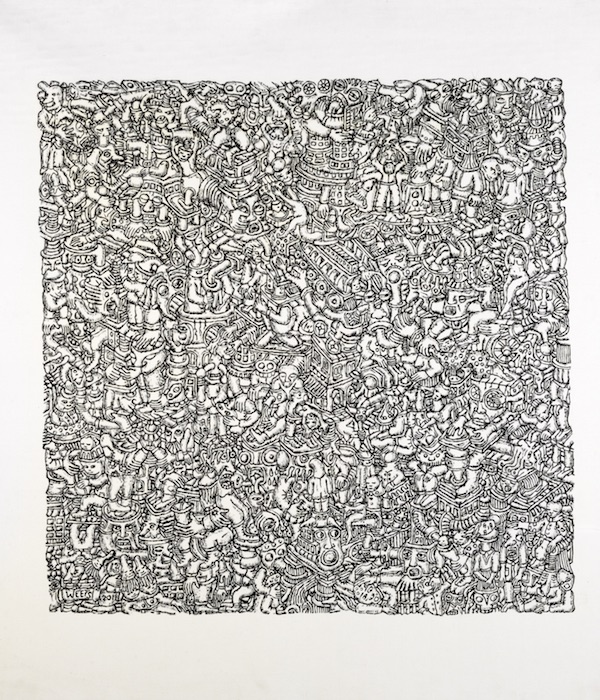
Fan Mail: Eric G. C. Weets

For Eric G. C. Weets, size does matter. Since 2007 he has been creating sprawling canvases of intertwined line drawings in his studio in Pune, India, where the Belgian artist has lived for the past twenty-three years. In searching for a means to document human experience through form, Weets discovered in scale a conceptual and practical mechanism that served his desire for an expansive, albeit laborious, mode of expression. With the help of his partner and representative, Filomina Pawar, who is instrumental in the production and management of Weets’ work, the artist has created a series of large-scale paintings that explore expressions of human civilization across time.

Eric G. C. Weets. The Journey I, 2011; oil on canvas; 30 x 30 in. Courtesy of the Artist.

Eric G. C. Weets. The Journey I, 2011; oil on canvas; 30 x 30 in. Courtesy of the Artist.

Weets describes his first visit to a South Indian Hindu temple in Madras in 1987 as having had a lasting impact on his work almost three decades on. On the large, looming walls covered in countless sculptures and figures depicting stories of gods from thousands of years past, Weets confronted the passage of time. Experiencing this in a single physical space intended to house humankind’s journey became an idea that Weets struggled to encapsulate in his own work. As a self-taught artist who experiments with multimedia projects ranging from sculpture to electronic music, Weets’ first engagement with the type of freestyle painting that is now a focus of his practice emerged from his desire to express the subconscious. The artist speaks of an obsession to develop a mechanism that would enable him to create work uninterrupted by thought. As a strategy, he devoted himself to penning whatever crossed his mind upon contact with the canvas and slowly building on the lines that emerged without a set plan or preconceived vision. Weets also never erases or attempts to “fix” any of the constellations that unfold. In this process, Weets sought and found unrestrained creative freedom.

Read More »

Share

Happy Thanksgiving!

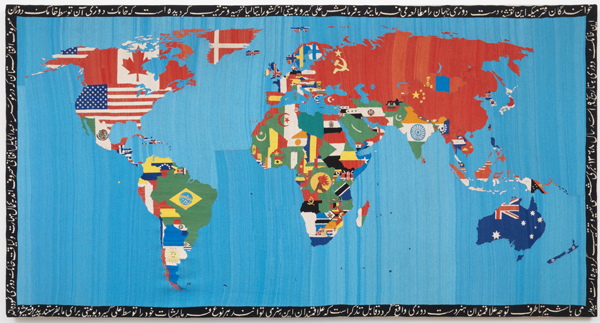
Here at Daily Serving, we’re thankful for you—our fantastic community of writers, editors, and readers—and for the labor of arts workers around the world who enrich our lives every day. And while we celebrate, we’ll also be thinking of the arbitrariness of national borders, and of people who move toward a better life and are greeted with compassion and hospitality.

Alighiero Boetti. Mappa, 1989; Embroidery on wool; 116 x 220 cm. Photo: Jens Ziehe.

Alighiero Boetti. Mappa, 1989; Embroidery on wool; 116 x 220 cm. Photo: Jens Ziehe.

Share