Mexico City

La Polis Imagi-nada at El Quinto Piso

What is a city? How can it be conceptualized? How does one create oneself within that geographic and symbolic space? These questions frame the most recent show at El Quinto Piso, La Polis Imagi-nada. The curatorial statement talks about the polis and civic participation in theoretical terms, but the exhibit situates these concepts firmly within the symbolic and geographic realities of Mexico City. El Quinto Piso is a vast gallery space located on the top floor of a parking structure in the historic downtown. It is raw and unfinished, with exposed wires and very little light. It feels impermanent, as if it could be closed down at any moment, and many of the works in this show feel improvisational, perhaps even unfinished. But this is an appropriate response to the social and political concerns of contemporary life in Mexico City.

Cecilia Barreto. http//www.möbius.10, 2015 (detail); mixed media on canvas; 140 x 200 cm. Courtesy of the artist and El Quinto Piso, Mexico D.F. Photo: Jorge Gomez del Campo.

Cecilia Barreto. http//www.möbius.10, 2015 (detail); mixed media on canvas; 140 x 200 cm. Courtesy of the Artist and El Quinto Piso, Mexico D.F. Photo: Jorge Gomez del Campo.

Several of the works address the current climate of political and structural violence. Cecilia Barreto’s painting, http//www.möbius.10 (2015), shows the city as a mediated battleground. The painting is composed of dozens of black silhouettes of activists, riot police, and police dogs against a mostly red background. Texts and icons, like a prominent Facebook thumbs-up, situate these scenes on social media. All of this is rendered with painterly marks on a medium-size canvas.

Simulacro (2015) by David Camargo also situates political violence as a mediated spectacle. However, in this case the artist creates a video-game caricature. Onto a geometrically simple 3D model of a soldier’s head, the artist video-maps scenes of fire, computer glitches, and a skull. The work suggests a relationship between the commonplace political violence in Mexico City and virtual realities. If Barreto’s work emphasizes political struggle as Facebook activism, Camargo places it firmly in the world of the video game.

Read More »

Share

Los Angeles

Lawren Harris: The Idea of North at the Hammer Museum

“You need to understand, Patricia, that every Canadian recognizes these paintings,” so explained my friend and guide, a native Torontonian, as we walked through The Idea of North: The Paintings of Lawren Harris at the Hammer Museum. “Canadians who have no other art-historical point of reference know who the Group of Seven are.” This school of early 20th-century Canadian landscape painters occupies the periphery of my knowledge, and Harris’s paintings were previously entirely unknown to me. The pull they have on the collective imagination of the Canadian populace, their representation of Canadian identity, was therefore inscrutable. I found these highly stylized landscapes absent of any weight that nationalism projects on or from them. And yet I was fascinated by that absence, by their abstraction from actual place and site of belonging.

Lawren Harris. Mt. Lefroy, 1930; oil on canvas. 52.5 x 60.4 in. Courtesy of the McMichael Canadian Art Collection. Purchased 1975. ©Family of Lawren S. Harris.

Lawren Harris. Mt. Lefroy, 1930; oil on canvas; 52.5 x 60.4 in. Courtesy of the McMichael Canadian Art Collection. Purchased 1975. © Family of Lawren S. Harris.

The exhibition focuses on three groups of paintings that Harris made roughly between 1922 and 1930 (with one later work from 1934–1940) of the geographic locales for which the artist is most well known: Lake Superior, the Arctic, and the Rockies. The artist traveled only once to the Arctic, in 1930 on a research and supply expedition, but made repeated trips to the other sites. Harris, along with the other members of the Group of Seven, possessed an ambition at this time to create a national art of Canada through depictions of its landscape, “to articulate a sense of belonging in a particular place, imbued with the essential characteristics of a distinct terrain.”[1] Harris additionally sought to render the mysteries that connect humanity with the divine—theosophical leanings that would later pull him away from this nationalistic aim.

The paintings in The Idea of North are fluid, frictionless semblances of place, composed of rhythmic forms that fold and undulate. They are ideas instead of sites. Each group shares the distinctive traits that signal the artist’s style during this period: centrally composed landscapes with slaking light and scant vegetation. Trees are bare or dead. The time of day is indistinguishable. Mountains and clouds predominate, homologously shaped by the same forces: wind, water, snow. Architecture is almost entirely absent—the notable exception being the Inuit structure in Eskimo Tent, Pangnirtung Baffin Island (1930) whose facets and form are barely distinguishable, except in color, from the glacial field in which it resides. Harris’s landscapes are unpopulated, and we are situated at their edge, peering in, as if not to sully them.

Read More »

Share

Help Desk

Help Desk: Culture and Compensation

Help Desk is an arts-advice column that demystifies practices for artists, writers, curators, collectors, patrons, and the general public—and today we’re celebrating our 100th installment! Submit your questions anonymously here. All submissions become the property of Daily Serving.

The problem: sincere offers, from sweet, well-intended people, to show my work without compensation. The result: My polite refusal is taken as a slight and I’m sometimes thought of as ungrateful. These people often think they are doing me a favor and are confused when their request is turned down. What I’d like to have access to: an article written for the layperson that elucidates the situation. Ideally it’s a New Yorker-style article that my mom will understand and talk about with her friends. The next time she is sitting on a board or organizing an event and “art for exposure” is mentioned, she’ll pipe up and say, “Let’s put an honorarium in the budget, and here’s why…” The reason I want this article to exist and point people to it is, 1) I’m not very eloquent, 2) the subject is too close to me, and 3) I’m tired of repeating myself.

As far as advice columns go, I’m not sure how customary it is to request that someone write an article for you, but I’m happy to compose this editorial on the condition that you concede that yours is a position of privilege; many artists do not feel empowered to turn down opportunities, and certainly most don’t have a family connection that could influence the policy of an institution. I want to make it clear that I’m not writing this article solely for you, and you’re going to agree to not just hand it off to your mom to bypass the tedium of repetition. What we’re doing—together—is using our relative positions of power to advocate for economic parity.

Now cut on the dotted line and hand this to your mother. Good luck!

…………………………………………………………………………………….

In October, the Creative Capital blog published an article titled “4 Myths about Artists’ Finances” and the first two read, “Artists are bad with money” and “I am lucky to be an artist and thus don’t need to be paid well for my work.” Winkingly, we might acknowledge that somewhere in the stereotype of the creative character there may be a grain of truth about being mathematically challenged, but without a doubt the second assertion is a tiresome old chestnut of the artist-as-toiler who sacrifices her own well being for a higher purpose, willingly nailed to the laissez faire cross of the art world. The article goes on to refute these fictions, stating, “Most artists are incredibly adept at managing their revenue, they just don’t have enough of it. […] Artists imagine a thing that doesn’t yet exist, develop a plan to bring it into existence, implement that plan and deliver it to the world, on time.” They go so far as to call this labor “the executive-level work of the art world.”

However, the case isn’t just that most artists aren’t paid well for their work, it’s that they aren’t paid at all. The majority of exhibiting artists self-fund the creation of their work and then loan it for free to contemporary art centers and museums. Everyone else, from the director to the curator to the coat-check staffer, receives a paycheck, but the artist—the person who makes the thing for which these careers exist—often goes without compensation for her time and materials.

Read More »

Share

Shotgun Reviews

An Evening Redness in the West at the Museum of Contemporary Native Arts

Shotgun Reviews are an open forum where we invite the international art community to contribute timely, short-format responses to an exhibition or event. If you are interested in submitting a Shotgun Review, please click this link for more information. In this Shotgun Review, Alicia Guzmán reviews An Evening Redness in the West at the Museum of Contemporary Native Arts in Santa Fe, NM.

Andrea Carlson. Ink Babel, 2014; ink and oil on paper; 115 x 183 in. Courtesy of the Artist and Bockley Gallery.

Andrea Carlson. Ink Babel, 2014; ink and oil on paper; 115 x 183 in. Courtesy of the Artist and Bockley Gallery.

When viewers enter An Evening Redness in the West, curated by Candice Hopkins for the Museum of Contemporary Native Arts in Santa Fe, they are surrounded by the constant clicking of a Geiger counter. As if measuring radioactivity within the space itself, the Geiger counter’s din can be heard throughout the exhibition, which unfolds over two rooms.

The exhibition includes eleven Native American and First Nations artists all offering visions of life in a postapocalyptic future. The title of the exhibition cites Cormac McCarthy’s Blood Meridian (1985), a fiction account of raucous scalp hunters set in the borderlands of the Southwest, itself a novel of apocalyptic proportion. The Geiger emanates from Cart (2015), Death Convention Singer’s mixed-media sculpture of a cart loaded with detritus such as empty water bottles. A grim-reaper-like figure composed of VHS tape looms overhead, a citation no doubt of the “death cart” motif common to New Mexico. Even more poignant than Cart is Death Convention Singer’s inclusion of a vessel holding the murky brown water of the Animas River, titled Water from the Polluted Animas River as It Flowed Through the San Juan River (2015). The river now flows with nearly 3 million gallons of toxins, a result of the Environmental Protection Agency’s perforation of a defunct gold mine in Colorado.

Read More »

Share

Boston

Nicole Cherubini: Golden Specific at Samson Projects

From our friends at Big Red & Shiny, today we present a review of Nicole Cherubini’s exhibition Golden Specific. Author Zach Horn notes, “The sculptures in Golden Specific are emphatically contemporary but with significant history, like the punky offspring of a storied dynasty.” This article was originally published on November 23, 2015.

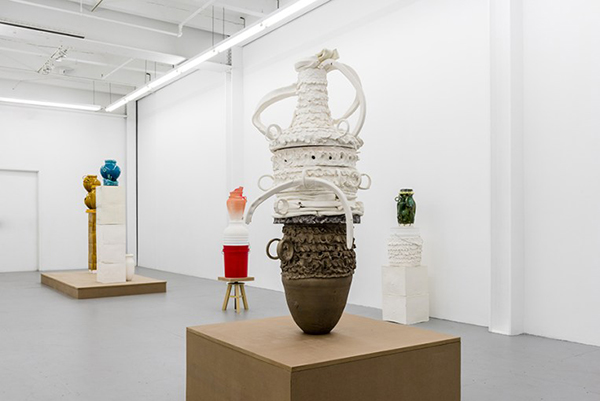
Nicole Cherubini. Golden Specific, 2015; installation view, Samson Projects, Boston.

Nicole Cherubini. Golden Specific, 2015; installation view, Samson Projects, Boston.

Golden Specific, Nicole Cherubini’s exhibition at Samson Projects, is meditative. The gallery’s white box is punctuated with caramel, turquoise, and terre verte glazes, peach spray paint, and a red plastic bucket. Cherubini’s sculptures color the room. The show includes six amphora-like constructions on pedestals. These urns feel important, like reliquaries for the phalanges of some saint. In Way of the White Clouds (White Structure with Blue), a luminous aquamarine pot floats on an earthenware pedestal, while another matte white jug lurks around its base. Way of the White Clouds has narrative but no closure. The relationship between the two vases is hierarchical, but the implications of that distinction are satisfyingly unclear. Golden Specific offers the chance to muse over Cherubini’s enigmatic forms; it should be viewed slowly.

Read the full article here.

Share

Interviews

Interview with Nick Cave

Shreveport is a border town at the crossroads of Arkansas, Louisiana, and Texas. The city is known for its musical history—the term “Elvis has left the building” was coined there. But Shreveport also suffers from crippling issues of injustice. Shreveport prosecutors use peremptory challenges to bar people of color from juries, and juries in Caddo Parish “now sentence more people to death per capita than juries in any other county in America.” Beyond disparities in the justice system, Shreveport has the fourth-highest rate of persons living with HIV in Louisiana. In 2013, 22.8% of the residents lived below the poverty line. Poverty, health, and the justice system are all intertwined here, and this year visual artist Nick Cave is in residence at these crossroads, participating in a residency with the Shreveport Regional Arts Council. How does a visual artist address these problems? From October 2015 to March 2016, Cave is working on a multi-dimensional project that attempts to speak to the disparate realities of the citizenry.

Nick Cave, Soundsuit, 2015; Mixed media. Courtesy of Shreveport Regional Arts Council. Photo: Casey Jones.

Nick Cave. Soundsuit, 2015; mixed media. Courtesy of Shreveport Regional Arts Council. Photo: Casey Jones.

Tori Bush: What led you to create this project in Shreveport? How does the history and context of each place inform your projects?

Nick Cave: The Shreveport Regional Arts Council contacted me when I was working in Detroit on a project titled Hear Here. They were interested in working with visual artists who practice within a social spectrum as well. And I was very interested in the project, to work with social organizations, which for me was a different outreach than I was familiar with. And I was even more interested in the fact that SRAC was using art as a kind of healing device. I was very interested in that, and really that is why I came on board with the project. It allowed me to go even further into the fieldwork.

This project is the way I’m interested in working right now. I come to a city with an idea, and the city builds the project. And the thing that’s so fascinating here is that this is really Shreveport’s project. I’m acting as the director.

I said from the start, this project is not going to be a wow-wow, bang-bang performance, where everyone is going to have a good time. We are working with social-services organizations that aid citizens who are trying to reenter society. We are dealing with serious issues. How can I come to this project with compassion? How can I create a work that is reflective of the voices of the community? How can I leave with an imprint so that it is moving, and not just fluff? It’s allowing me to rethink the role of my work and the purpose of this project, and take myself out of the center of it.

Read More »

Share

San Francisco

Julian Hoeber: The Inward Turn at Jessica Silverman Gallery

Today from our partners at Art Practical, we bring you a review of Julian Hoeber’s solo exhibition The Inward Turn. Author Amanda N. Simons says of the paintings in the exhibition, “Lining the walls of the gallery, the surreal architecture of Hoeber’s paintings offers a conceptual meditation on the infinite that is unbound by the physics that governs three-dimensional work.” This article was originally published on December 1, 2015.

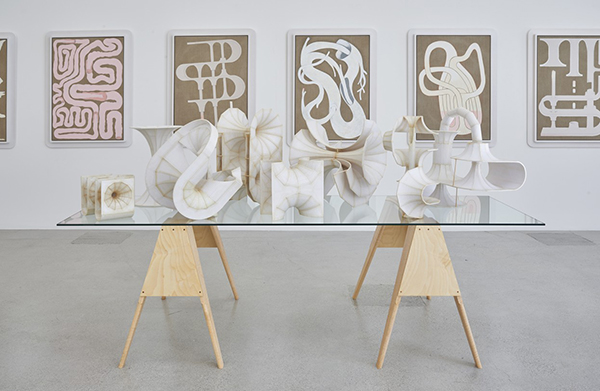
Julian Hoeber. The Inward Turn; installation view. Courtesy of the Artist and Jessica Silverman Gallery, San Francisco.

Julian Hoeber. The Inward Turn; installation view. Courtesy of the Artist and Jessica Silverman Gallery, San Francisco.

Imagine departing on a journey in which your destination is simply a return to the same place of origin. Upon your return, you find yourself unchanged. Intact. Undigested. Whole. And exactly where you started. The Inward Turn, Julian Hoeber’s solo exhibition at Jessica Silverman Gallery, offers such a proposal.

In all of its twists and turns and deviations, the exhibition’s paintings, sculptures, and works on paper always turn the viewer inward. And yet, in this closed, infinite system, there is more to ponder than the paradoxical experience of such a visual journey. The texture, imperfections, and meandering tangents of the system itself offer reprieve from the loop, and a space to meditate upon the causal binary relationships of loop and looped, of mold and cast, and of viewer and visual artifact.

Read the full article here.

Share