New Orleans

A Shared Space: KAWS, Karl Wirsum, and Tomoo Gokita at Newcomb Art Museum

The history of the artist-as-collector is as long as the history of art itself. From Rembrandt to Damien Hirst, artists have amassed collections in order to satisfy a range of interests and obsessions. A Shared Space: KAWS, Karl Wirsum, and Tomoo Gokita, at Tulane University’s Newcomb Art Museum, consists of artworks culled from the Brooklyn-based artist, designer, animator, and commercial guru KAWS’s private collection, allowing the viewer a rare insight into the artist’s preferences as both a producer and consumer of works of art. Unlike more recent attempts to frame the personal collecting habits of an artist as a manic embodiment of commodity fetishism in the era of high capitalism, this exhibition asks viewers to reflect upon the correspondences between artist and acquisition and the complicated relationship that contemporary art exposes between taste, influence, and popular culture.

KAWS. Flight Time. 2015. Acrylic on canvas. 84 x 72 inches. Image courtesy of the artist and the Newcomb Art Museum.

KAWS. Flight Time, 2015; acrylic on canvas; 84 x 72 in. Courtesy of the Artist and the Newcomb Art Museum.

Even across the diverse styles and interests of these three artists, linkages between content and craft are revealed. Weaving through the galleries, the succession of images feels like a series of slaps to the face as colors are taken to their saturation points and figures are monumentalized in scale and proportion. The dialogues composed by the careful placement of works provide the most powerful moments in the exhibition. KAWS’ deep black Michelin-like figure CHUM (2009) stands determinedly next to graphic paintings by Gokita, offering his protection to the naked and faceless vulnerables posed in the images, while ACCOMPLICE (2010)—a matte black toy bunny sculpture with large Xs covering his eyes—stands hunched in defeat across the room, out of sync with the bright canvases that surround him. Using the well-worn ethics of Pop Art to tease out the dark structures of commodity forms, KAWS’s sculptures allow these humorously irreverent figures to fester in their slick, expensive aura of pomposity and compelling iconicity.

Read More »

Share

Mexico City

Como fantasmas que vienen de las sombras… y en las sombras, se van at Espacio de Arte Contemporáneo

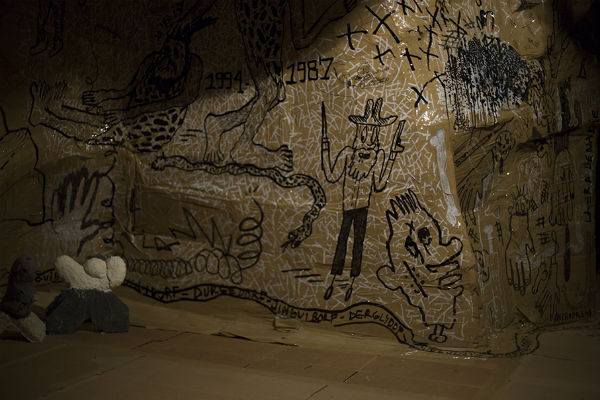
Like with mazes and haunted houses, there’s a magnetic appeal in unraveling the mysteries that fictitious places offer. We enjoy undefined atmospheres where a strange comfort assures the encounter with the unknown and is met with the thrill of discovery. Because our sense of control struggles with the powerful forces of uncertainty, we are challenged by our own idea of self-representation, despite being aware that the simulated experience will eventually end. That ambivalence is present at Espacio de Arte Contemporáneo (ESPAC) in its current exhibition Como fantasmas que vienen de las sombras… y en las sombras, se van [Like ghosts that come from the shadows… and in the shadows, they leave].

Jazael Olguín. Paisaje molar, 2015; black marker and three paintings. Courtesy of ESPAC.

Jazael Olguín. Paisaje molar, 2015; black marker and three paintings. Courtesy of ESPAC.

Curated by artists Juan Caloca and Andrés Villalobos, the exhibition features works by seventeen artists, situated within an immersive installation, Grutas [Grottos] (2015), built by Villalobos and Jonathan Miralda. Installed in a 600-square-meter room, the cave—made of cardboard boxes, wood, and brown tape—works as a physical and semantic frame for the other pieces, erasing their boundaries and enabling new meanings in this context.

Since there are no wall labels, visitors must suspend the rules of behavior in a white cube and transit at their own pace. The way they choose to walk around redefines the installation and creates multiple narratives. This scavenger hunt is both filled with moments of recognition and complete strangeness toward grasping the meaning of its discourse. In the darkness of Grutas [Grottos], perception, identities, and corporealities are put at stake alongside the relations we establish with technologies. Limits vanish, and visitors are dragged to question the dichotomies of presence–absence and visible–invisible, ultimately accepting a phantasmagoric status. Artificial light emerges from electronic devices, as if the cave was a self-sufficient being with the ability to produce its own living conditions.

Read More »

Share

Hashtags

#Hashtags: Dominion

#museums #empathy #posthuman #Anthropocene #environment

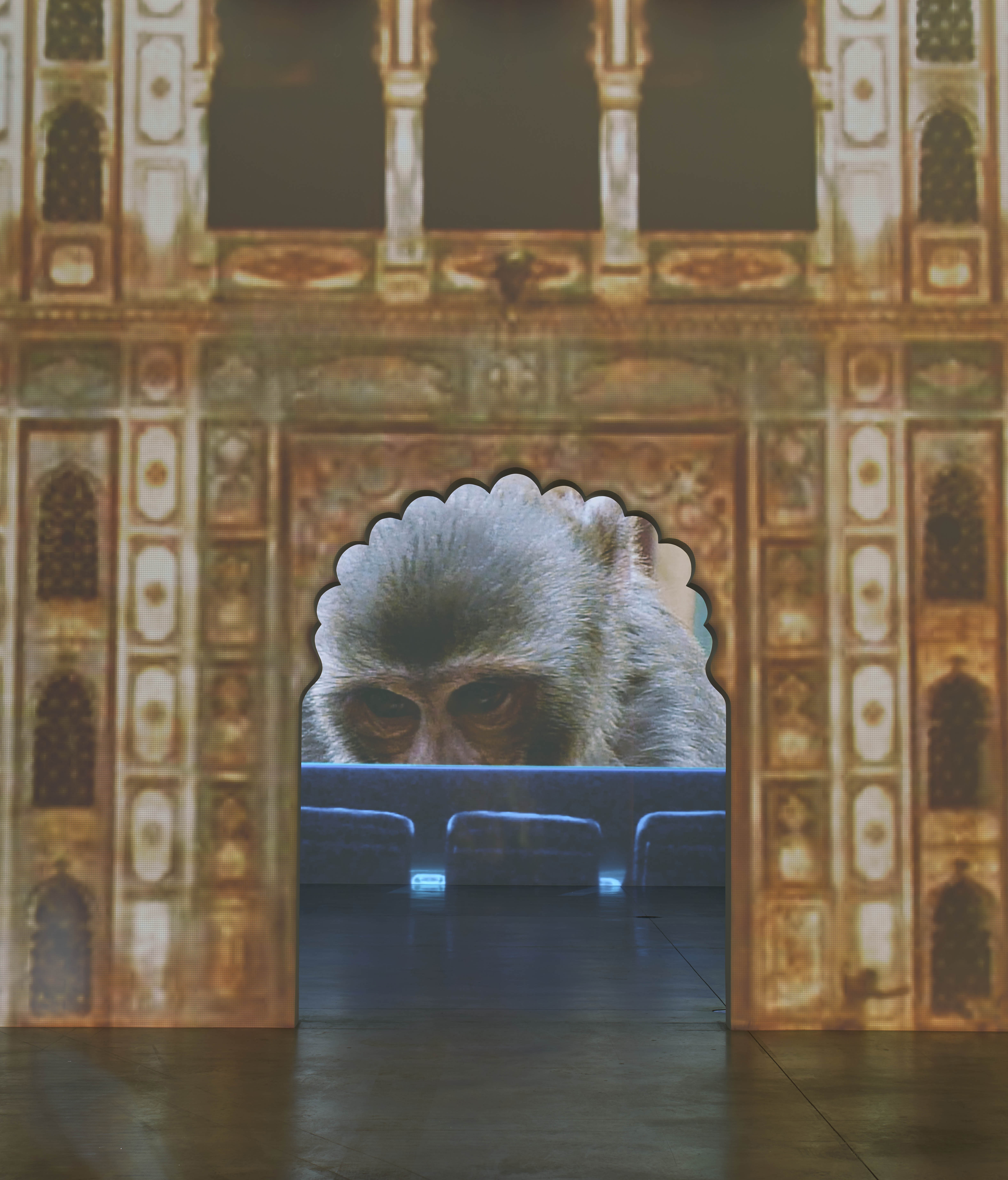
Recent headlines demonstrate that human beings are consistently terrible to one another, and it can be tempting to reject the human altogether. Drained by a year of public and private deaths, numb with exhaustion after having a child and returning to work, I entered Diana Thater’s mid-career retrospective at LACMA and found that those worldly concerns quickly fell away. Thater’s lush visuals and tranquil tone are a balm for shattered nerves, evocative of minimalist light sculptors like James Turrell and Anthony McCall, but rich with representational, political content. Thater’s work with animals suggests that what is universal about human beings is best understood by looking at the other creatures with whom we share the planet. For Thater, it is not enough to promote a caretaking vision of the planet, which would preserve the place of the human as the owner of all living things. In her work with animals and insects (including monkeys, dolphins, bees, and butterflies), she attempts to renegotiate the relationship between observer and observed. The human is present but not the priority when she is filming the works, and the presentation seems at times intended to introduce gallery visitors to the animals’ points of view. This work anticipates a posthuman future, in which we still exist but our dominance over other living creatures is no longer assumed.

Diana Thater. Life is a Time-Based Medium, 2015. Three video projectors, three lenses, player and Watchout system; dimensions variable. Installation view at Hauser & Wirth, London, 2015. ©Diana Thater; photo by Alex Delfanne, courtesy Hauser & Wirth.

Diana Thater. Life Is a Time-Based Medium, 2015; three video projectors, three lenses, player, and Watchout system; dimensions variable; installation view, Hauser & Wirth, London, 2015. © Diana Thater. Courtesy of Hauser & Wirth. Photo: Alex Delfanne.

One of the core beliefs held by all Abrahamic religions is that the creator specifically chose human beings to be the wardens of the Earth and all of its abundant life. Some interpret these doctrines as advocating a caretaking role toward the environment, while others have taken them as permission to consume natural resources with abandon. Different belief systems give representatives of the natural world equal stature to anthropomorphic deities, but Abrahamic faiths situate man at the pinnacle of a hierarchy that includes women, animals, insects, and plants. Maria Sibylla Merian and Rosa Bonheur, among others, used this myth of women’s closeness to nature to develop careers as artists on the basis of their depictions of plants and animals, at a time when other women were not permitted to pursue artistic practice professionally. Thater’s work resonates with this historical context, being both informed by and disinterested in the fact of her gender.

Read More »

Share

Shotgun Reviews

Cold Storage: James Cordas and Rhonda Holberton

Shotgun Reviews are an open forum where we invite the international art community to contribute timely, short-format responses to an exhibition or event. If you are interested in submitting a Shotgun Review, please click this link for more information. In this Shotgun Review, Elena Gross reviews Cold Storage: James Cordas and Rhonda Holberton at City Limits Gallery in Oakland.

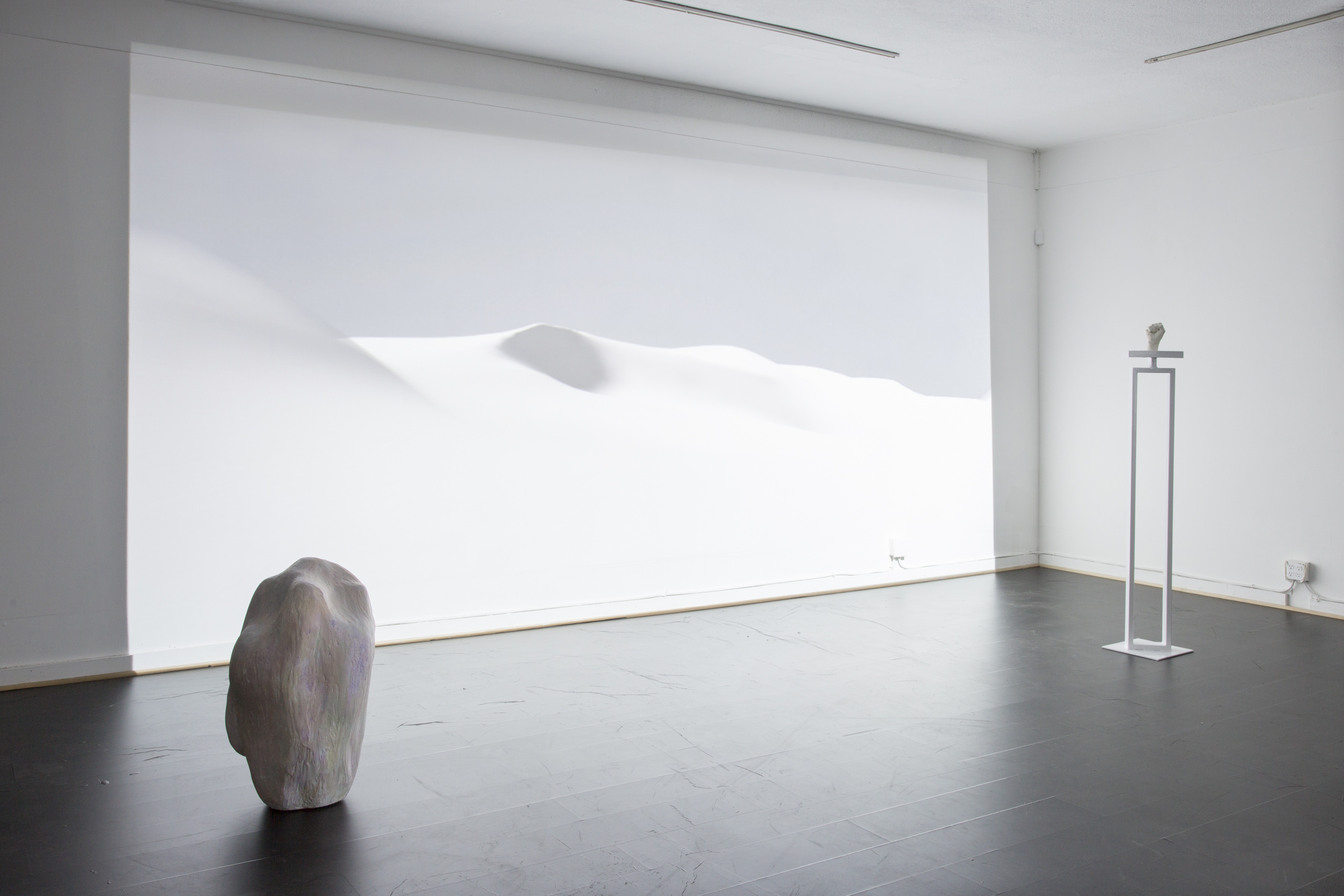
Rhonda Holberton, Knights of the Sky, Digital video projection, 3:24 (looping), Edition 1/1, 2015. Courtesy of City Limits Gallery.

Rhonda Holberton. Knights of the Sky (2015); digital video projection; 3:24. Courtesy of City Limits Gallery.

A chilly, overcast afternoon seemed like the perfect conditions for experiencing Cold Storage, the dual exhibitions of artists James Cordas and Rhonda Holberton. The gallery resonates with stillness as the slow, measured pace of the video projections and an even-toned white noise settle over the room. The sobriety of the atmosphere, however, masks the underlying tensions in the exhibition’s design.

With Holberton occupying the back wall with the hypnotic three-minute video projection Knights of the Sky (2015), and Cordas on the perimeter, a tug-of-war for the gallery’s limited floor space ensues. Sharing a space the size of City Limits would be a challenge to anyone, but Cordas and Holberton make unlikely bedfellows and feel somewhat disconnected. Though both artists’ showings are strong and compelling in their own right, it is not immediately obvious how they are meant to fit together—or if they even are. For example, the press release for Cold Storage features a short statement about the show written collaboratively between “the artists.” However, the artists referred to here are not Cordas and Holberton, but Cordas and the poet James Gendron, a collaborative partner of Cordas’s for one of the works in the show, Sexual Boat (Sex Boats). While the poem/artist statement allows for a subtler and more complex read of the collaboration between Cordas and Holberton, it also runs the risk of obscuring a definitive thread that holds the show together.

Read More »

Share

Interviews

Interview with Angelica Mesiti

From our friends at Guernica, today we present an interview with Australian video and performance artist Angelica Mesiti. Author Naomi Riddle notes, “In Mesiti’s work, verbal language is decidedly absent. The artist is preoccupied with actions and movement—with the communicative potential of sound and the body, the significance of an upturned hand.” This article was originally published on November 2, 2015.

Artist Angelica Mesiti.

Artist Angelica Mesiti.

I stood watching Australian artist Angelica Mesiti’s Nakh Removed (2015) at Carriageworks, Sydney, in the middle of winter. A silent single-channel video installation, the film is made up of nine looping minutes in which four Parisian women of Algerian, Moroccan, and Tunisian heritage perform the nakh, a “hair dance” originating from the Algerian-Tunisian border. Traditionally danced by women at weddings and during periods of fertility, it consists of a kind of swaying movement, the women flicking their hair up and over their heads, back and forth, again and again.

Mesiti presented Nakh Removed on an imposingly large screen. She chose to show the dance in slow motion, which meant that my attention was drawn to every soft, arching coil and tendril of hair. It’s said that the performers of the nakh enter into a trance-like state through the rhythm of the movement, which seems to transport them elsewhere. Mesiti has often spoken about the hypnotic pull of bodily motion, and it became hard to watch the work without swaying in time. But beyond the transcendent allure of the performance, Mesiti is interested in the ways in which tradition and the present overlap but also remain separate. The film is indeed of a dance removed, highlighting the somewhat jarring contrast between a historical-cultural gesture and modern women dancing in plain black clothes in a Parisian studio.

Read the full article here.

Share

Fan Mail

Fan Mail: Jonas Holmer

A computer programmer by day and an artist and musician by night, Jonas Holmer has created a body of work shaped by multiple frames of reference and methodologies. The Stockholm-based artist produces digital and installation works that explore the play between technology, music, and aesthetics.

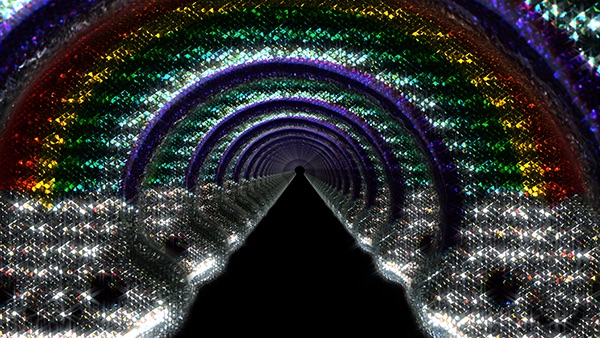
Jonas Holmer. Endless Rainbows (video still), 2012; looping video installation. Courtesy of the Artist.

Jonas Holmer. Endless Rainbows, 2012 (video still); looping video installation. Courtesy of the Artist.

Holmer has an eye for creating illusions of depth. Endless Rainbows (2012) is one example of how the artist utilizes graphic and installation techniques aimed at engaging viewers in an immersive sensory experience. In one iteration, the looping video was installed in a small room with a sloping ceiling. To enter, visitors had to crawl through an entrance a little more than three feet high, and sit in a space illuminated only by the spiraling rainbow before their eyes. The recurring circular motion and reverberating sound create an entrancing atmosphere, drawing viewers into a space of contemplation.

Read More »

Share

San Francisco

Chris Johanson: Equations at Altman Siegel

Today from our partners at Art Practical, we bring you Brian Karl’s review of Equations at Altman Siegel Gallery in San Francisco. The author notes, “Johanson eschews in this set of paintings the strategy of inserting text directly into the worlds he creates. The titles of the pieces do some of that work.” This article was originally published on November 30, 2015.

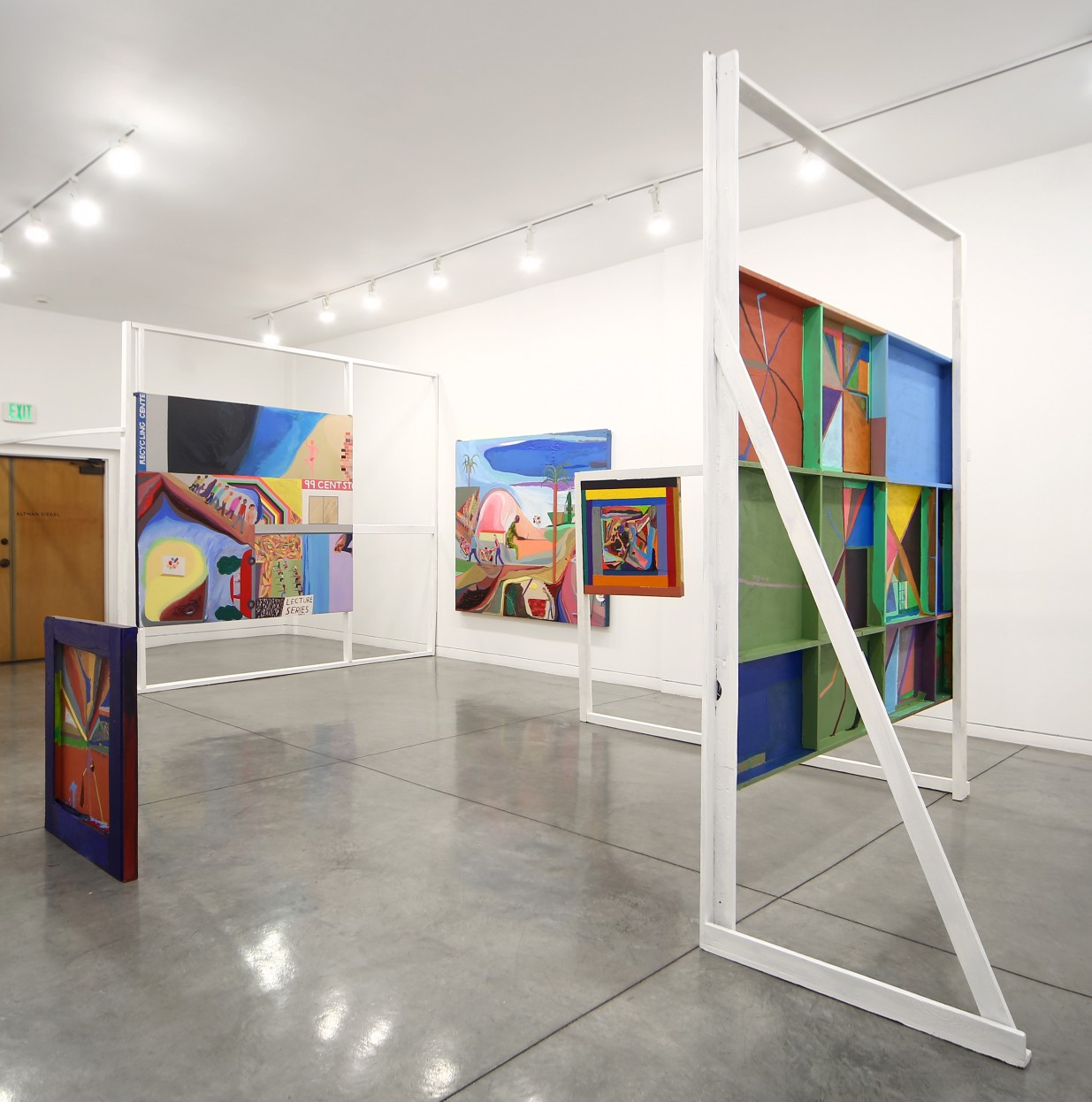
Given the cartoonlike basis of most of his portrayals, the slackerly compositions, and the seeming arbitrariness of the surface textures of the paint he uses so dynamically as a set of color choices (seemingly clumsy elements that have often been similarly deployed by other artists who might pass as “outsider,” however relative that term might be), the question arises as to why Johanson chooses to so often paint rather than draw. In these pieces Johanson doubles down on painting in several ways: first, through the large scale of several of the scenes, as with Lecture Series/Abstract Mass, and the bleak consumer composite suburbia of Los Angeles with Pills. Johanson paints on repurposed wood panels and displays most of his work in awkward, large, built wooden armatures to show off both fronts and backs equally (as he has done even more elaborately in installations elsewhere). This prominently shows off the wooden buttressing behind the panels, which he also highlights with “secondary” paintings on the reverse. These include what look like a series of painted geometric doodles mosaic’d on the back of one larger composition, a simple set of color fields of darker and lighter brown parceled out by the different wood elements themselves, and what looks like a beginning painted sketch of an abstract landscape not so dissimilar to what might show up elsewhere as just one among many background components in a “primary” or finished painting by Johanson on the front of one of his panels.

Chris Johanson. Equations; installation view, 2015. Courtesy of the Artist and Altman Siegel.

In this exhibition of ten new works (all 2015) of varying dimensions painted in acrylic on found wood, Chris Johanson represents a series of scenes imbued with psychologically charged if ambiguous atmospheres that depict alienation—with more than a few signs of human yearning—mostly in a small range of contemporary settings. Never showing as a technically “fine” painter, Johanson continues a sketchy pursuit of different genres that include abstraction, as with Reimagining the Square Trying to Make it Round Like a Circle; landscapes of sorts, as in I Am in My Body Again, an exterior view of a suburban ranch home, with gold clouds thickly painted above; interiors, both inside and outside in Infinity; and unrealistically rendered human figures, usually abject in posture or attitude and dwarfed by their surrounding milieu, populating the majority of the pieces here. Though set in apparently sunny climes, and moving through a shared landscape, these figures ultimately all seem to struggle—sometimes bowed singly, others marching in imprecise file—in conditions of great anomie if not outright isolation. Technology features in more than one of these paintings, but mostly as a tantalizing, failed possibility, or, worse, a breeder of even greater awareness of isolation.

Given the cartoonlike basis of most of his portrayals, the slackerly compositions, and the seeming arbitrariness of the surface textures of the paint he uses so dynamically as a set of color choices (seemingly clumsy elements that have often been similarly deployed by other artists who might pass as “outsider,” however relative that term might be), the question arises as to why Johanson chooses to so often paint rather than draw. In these pieces Johanson doubles down on painting in several ways: first, through the large scale of several of the scenes, as with Lecture Series/Abstract Mass, and the bleak consumer composite suburbia of Los Angeles with Pills. Johanson paints on repurposed wood panels and displays most of his work in awkward, large, built wooden armatures to show off both fronts and backs equally (as he has done even more elaborately in installations elsewhere). This prominently shows off the wooden buttressing behind the panels, which he also highlights with “secondary” paintings on the reverse. These include what look like a series of painted geometric doodles mosaic’d on the back of one larger composition, a simple set of color fields of darker and lighter brown parceled out by the different wood elements themselves, and what looks like a beginning painted sketch of an abstract landscape not so dissimilar to what might show up elsewhere as just one among many background components in a “primary” or finished painting by Johanson on the front of one of his panels.

Read the full article here.

Share