San Francisco

Locating Technology: Raiders and Empires

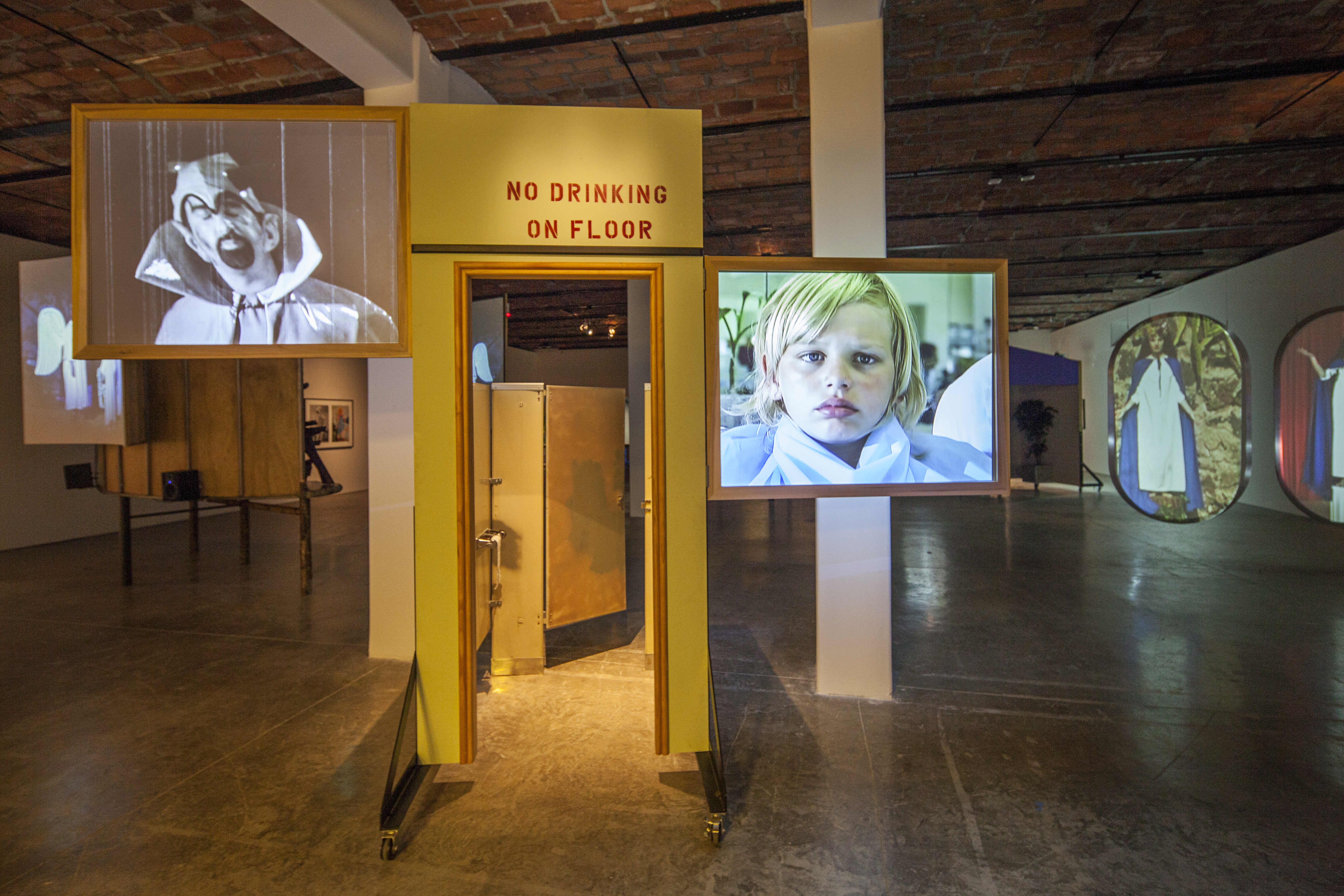
From our partners at Art Practical, today we bring you Genevieve Quick’s most recent “Locating Technology” column, a consideration of artist Stephanie Syjuco’s process and practice: “[Syjuco] prompts viewers to consider more broadly the legality and ethics of museums’ collections, and suggests that museums are institutions of cultural appropriation.” This article was originally published on October 27, 2015.
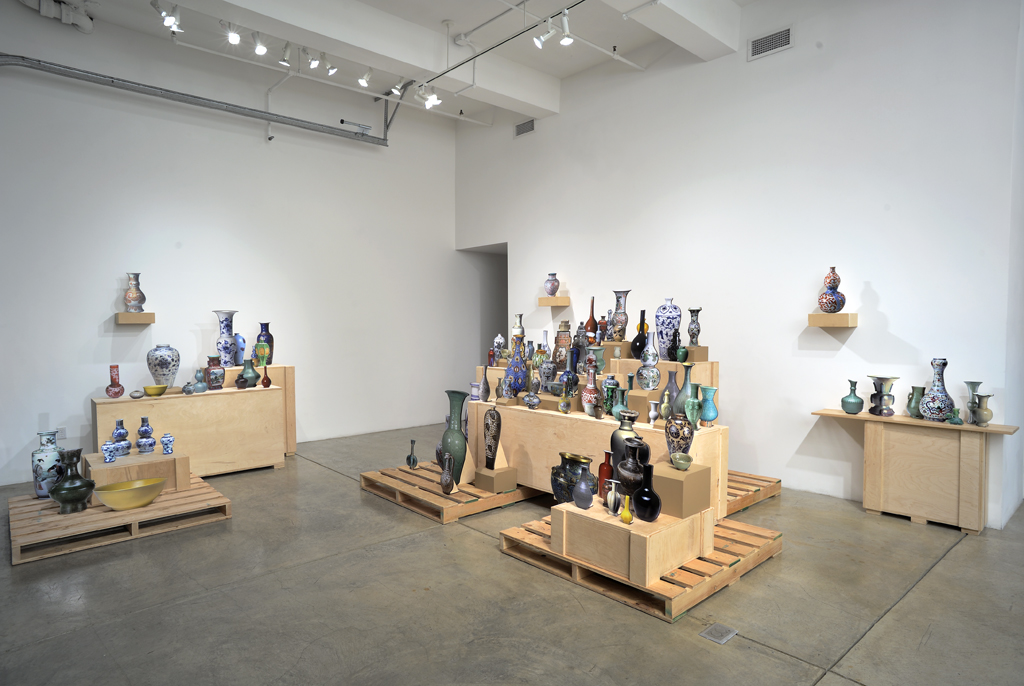
Stephanie Syjuco. RAIDERS: International Booty, Bountiful Harvest (Selections from the Collection of the A____ A__ M_____) (installation view), 2011; digital archival photo prints mounted onto laser-cut wood, hardware, crates; dimensions variable. Courtesy of the Artist and Catharine Clark, San Francisco.

Stephanie Syjuco. RAIDERS: International Booty, Bountiful Harvest (Selections from the Collection of the A____ A__ M_____) (installation view), 2011; digital archival photo prints mounted onto laser-cut wood, hardware, crates; dimensions variable. Courtesy of the Artist and Catharine Clark, San Francisco.

Much of the history of museum collections is related to the concentration of wealth and power of empires, and more recently corporate monopolies. While museums take great care in contextualizing the aesthetic, cultural, and historical significance of their artworks, they often omit most of their object’s acquisition histories. These backgrounds, extending from antiquity to present, would most likely include emperors and profiteers, along with their contemporary counterparts: the business tycoons that museums name as donors. InRAIDERS: International Booty, Bountiful Harvest (Selections from the Collection of the A____ A__ M_____) (2011) and Empire/Other (2013–ongoing), Stephanie Syjuco alludes to the questionable acquisition of museum artifacts. In these projects Syjuco harnesses technologies of distribution and reproduction—the web, photography, and 3D scanning and printing—to create objects that reveal the tangled history of colonization and cultural hybridization. Syjuco’s web-sourced imagery and 3D manipulations create imperfect objects that declare their simulation while entering into the same economic exchange system as the artifacts that they reference.

Read the full article here.

Share

Los Angeles

New Objectivity: Modern German Art in the Weimar Republic, 1919–33, at LACMA

Following World War I and the humiliating terms of the Treaty of Versailles, the Weimar Constitution was ratified, establishing Germany’s first democracy. It ushered in a thriving cultural climate: Expressionism came to an end, the Dadaists engaged in anti-art activities, the Bauhaus school was established, and in particular, Neue Sachlichkeit, or “New Objectivity,” emerged. The movement was an alternative realism, endemic to post–WWI Germany, and is the subject in LACMA’s latest exhibition, New Objectivity: Modern German Art in the Weimar Republic, 1919–33. The exhibition contains five haunting sections that explore democratic life in the aftermath of war through the tensions between urban and rural environments, industrial modernization, commodities and everyday objects, portraiture, and identity.

August Sander. Painter’s Wife [Helene Abelen], 1926; gelatin silver print; 10 3/16 x 7 3/8 in. Courtesy of LACMA.

August Sander. Painter’s Wife [Helene Abelen], 1926; gelatin silver print; 10 3/16 x 7 3/8 in. Courtesy of LACMA.

Rabble-rousing comparisons between present-day America and post–World War I Germany have recently shown up in many prominent news outlets, perhaps because the comparisons feel so easy. We have our own gaudy, racist buffoon who has recently entered politics by describing an enemy from within. Economic crises and inflation left the German economy in shambles; our own financial calamity nearly left ours in disrepair.

Just as in Germany at the time, new understandings of sexual difference and gender ambiguity currently reverberate in popular culture, like in the TV series Transparent, which even includes a prominent subplot that takes place in Germany’s Weimar Republic. A renewed awareness and aversion to the human cost of war characterizes both Otto Dix’s The War prints from 1924 as well as the controversial scenes of torture in Zero Dark Thirty, 24, and Homeland. The movie Her is analogous to Fritz Lang’s masterwork Metropolis, in which fascination with the future of technological progress is tinged with skepticism and fear. The depiction by painters such as Rudolph Schlichter of lustmord (or “sex murder”) and other violence toward women permeated German art in the 1910s and early 1920s, just as it does now in Jessica Jones, Game of Thrones, The Fall, and Unbreakable Kimmy Schmidt. We even have our own version of August Sander à la Humans of New York.

Read More »

Share

Interviews

From the Archives: Interview with Judith Bernstein

Today from our archives we bring you Elspeth Walker’s refreshingly blunt interview with painter Judith Bernstein. As we begin the new year and consider our plans for the next twelve months, it’s important to recall Bernstein’s philosophy: “[I]t’s important to be true to what you want to say and how you want to handle that. You have to keep moving forward. You can’t just stay where you are. You really have to constantly keep moving in terms of what you want to say, how you are saying it, and reevaluating it. It’s a very tough road.” This interview was originally published on June 4, 2015.

Judith Bernstein. Voyeur, 2015; installation view, Mary Boone Gallery, New York. Courtesy of the Artist. Photo: John Reynolds. 

Judith Bernstein. Voyeur, 2015; installation view, Mary Boone Gallery, New York. Courtesy of the Artist. Photo: John Reynolds.

Since 1967, Judith Bernstein has provided a swift undercurrent to painting in New York. Until recently, despite her storied history in the scene, the grit, tenacity, and technically precise rebel yell of Bernstein’s work has largely gone under-recognized. On the occasion of her current show at Mary Boone Gallery, I sat down with the artist to discuss her newest work, the fantastic threat of the looming vagina, feminist recourse to power, and perseverance.

Elspeth Walker: When I first saw your actual paintings, I realized that I hope they upset men.

Judith Bernstein: Well, I do the work that I have to do. If the men are upset, if they’re not upset, if they love it, if they don’t love it—whatever. I don’t think about the reactions of other people. I am on my own trajectory. There are a lot of very angry women, but my work is about the continually changing dialogue between men and women and about women being much stronger, now.

EW: I feel the abrasiveness of your work is welcome and necessary.

JB: I think one has to be very direct, in all kinds of ways—in my case, genitalia and everything right in your face. I’ve found that directness is a metaphor for my life. My background was quite dysfunctional; I had to scream and yell to be heard. And for a long time I was not heard; I was not given a show in the New York gallery system for many years. I’m thrilled that now I can talk about what I want to say. In the past, the rawness was not accepted within an art context, but now it is. I sense the zeitgeist at this time, and it’s extraordinary. I was in a lot of women’s groups, like A.I.R. (the first feminist gallery), Guerrilla Girls, and Fight Censorship. I saw how enraged women were. They were angry because they didn’t get what they wanted.  My mother didn’t know what she wanted, but she didn’t like the life she had. I saw all that rage and anger. Many artists have used female genitalia in a very romanticized way. That’s fine for them but not for me. I have anger, too.

Read More »

Share

From the Archives

From the Archives – #Hashtags: Whose Museum Is It Anyway?

Here at Daily Serving, we keep an eye on the ways an exhibition’s impact changes depending on geographical location. With a recent editorial on what 30 Americans means in Detroit and December’s protest of omitting artists of color in Art AIDS America at the Tacoma Art Museum in mind, today we bring you Anuradha Vikram’s observations on shifting context, intended audiences, and racialized access to and exclusion from museums. This article was originally published on January 13, 2014.

Installation view of Mike Kelley at MoMA PS1, 2013. Photo: Matthew Septimus.

Installation view of Mike Kelley at MoMA PS1, 2013. Photo: Matthew Septimus.

#access #institutions #race #class #performance #intersectionality

Two major New York exhibitions this winter have raised the question of access to contemporary art and museums in important and divergent ways. Radical Presence: Black Performance in Contemporary Art at the Studio Museum in Harlem continues reframing the historical narrative to include African Americans, as begun in Part 1 at NYU’s Grey Art Gallery. Mike Kelley’s sprawling retrospective at MOMA/PS1 (originated at Stedelijk Museum, Amsterdam; traveling to MOCA, Los Angeles) similarly engages questions of identity and inclusion within the context of a white American artist’s experience of the world.

In my review of Radical Presence at Grey Art Gallery, I identified the absence of a cohesive vision of “black performance” that diverged substantively from the larger framework of post-conceptual performance art in terms of form rather than culturally specific content.  This line of inquiry was inspired by the exhibition’s wall text, which asserted that, “Black performance has generally been associated with music, theater, dance, and popular culture,” and proposed to re-situate these practices within the visual-arts genre of performance. Why, I wondered, did curator Valerie Cassel Oliver not frame the show more forcefully as a reconsideration of performance-art histories that have tended to omit the contributions of black artists? Why did she locate the radical shift within the black community’s traditional framework for performance rather than use it to lay claim to the white-dominated narratives of conceptual and action-based art? At the time, it seemed unlikely to me that a significant number of black visitors unfamiliar with late twentieth-century performance art would be attending the exhibition in lower Manhattan. I assumed that audiences of any color would be contemporary art audiences experienced in the conventions of live art. Having now experienced the second part of the exhibition at the Studio Museum, I perceive that the question of what makes “black performance” black has taken a backseat to the question of what has historically rendered modern and contemporary art venues “white,” and that Cassel Oliver may have been trying to establish a point of entry to those who could be most likely to exclude themselves from the intended audience for her show.

Read More »

Share

Interviews

Vicious Circles

From our friends at REORIENT, today we bring you “Vicious Circles.” In this piece, author Samannaz Kourang Pishdadi talks with Moroccan artist Mounir Fatmi about growing up in Tangier, the inspiration of the Beat movement, and his interdisciplinary career. Fatmi says of his work, “At the beginning, I think I was very naïve thinking my work could change things. Eventually, I realised that the most important [thing] is to make works that make me change. The most important [thing] is to try to create another reality than the one imposed on us.” This article was originally published on December 14, 2015.


Mounir Fatmi. Casablanca Circles, 2012 (detail); Print on baryte paper; 35 2/5 × 47 1/5 in. Courtesy the artist and a private collection.

Mounir Fatmi. Casablanca Circles, 2012 (detail); print on baryte paper; 35 2/5 × 47 1/5 in. Courtesy of the Artist and a private collection.

History is typed. Love is geometrised. Religion is sewn. Iconoclasts dream. Saw blades chisel Arab fantasies. Springs collapse, and tape twin towers are rebuilt.

The winner of prestigious awards including those of the Dakar and Cairo biennials (2006 and 2010, respectively) has starred on the mercurial stage of the contemporary art world for the past decade; yet, Mounir Fatmi’s first bona-fide encounter with fine art, as he recalls, was as a child, when he witnessed an upside-down poster of the Mona Lisa being devoured by a sheep in a local flea market in his hometown of Tangier in Morocco. Growing up in a religious society provided his childhood days with little artistic exposure. At home, there were works of calligraphy, the image of the king (which he thought belonged to his family, until later), and a volume of the Koran that he was forbidden to touch, as it was believed his hands would sully the book.

“Growing up in Casabarata in Tangier, I was surrounded by flea-market stands full of old cameras, objects, records, clothes, antennas, cables—everything,” he recalls. “I was constantly looking at all these discarded objects having their third, fourth, or maybe [even] tenth life being resold.” According to the artist, he “loved looking through all these things, discarded stuff, and thinking about a new life for them.”

Read the full article here.

Share

Fan Mail

Fan Mail: Karen Ostrom

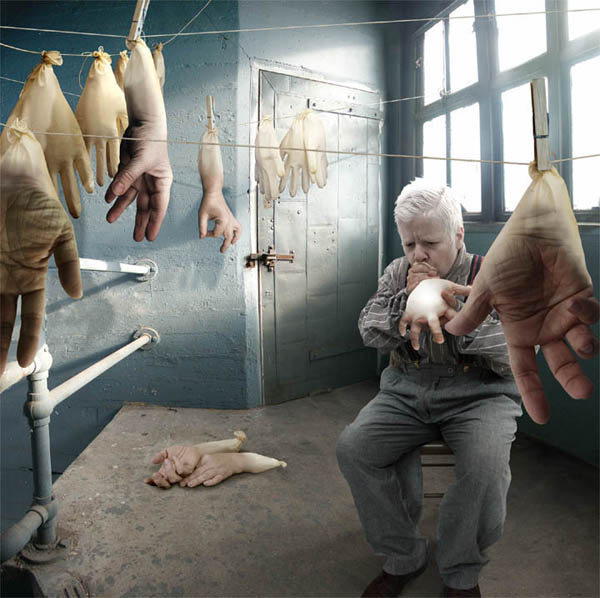
Holiday in Hope is the name of the fictional fishing village created by Brooklyn-based, Canadian-born artist Karen Ostrom. Conceived in 2001 in the form of photographic tableaus, the village primarily exists through the depiction of various characters that inhabit it. Holiday in Hope is manifested in threads and series; it’s an implied space that harbors references to communities transformed by industrialization, the erosion of traditional craft-based roles, and historical images of violence.

Karen Ostrom. Glovemaker, 2005; chromogenic print; 40 x 30 in. Courtesy of the Artist.

Karen Ostrom. Glovemaker, 2005; chromogenic print; 40 x 30 in. Courtesy of the Artist.

This ongoing project echoes Ostrom’s biography without becoming a strict interpretation of her life. Hailing from a family of Swedish immigrants who flocked to the northwest coast in the early 20th century, Ostrom imagined Holiday in Hope as a reference to the utopian dream many of the Scandinavian immigrants held in their quest for a new home. These immigrants, in search of idyllic landscapes in which to build new and experimental communities, are in some ways the forefathers of the residents of Holiday in Hope.

Read More »

Share

New York

Art Brut in America: The Incursion of Jean Dubuffet at the American Folk Art Museum

Art Brut in America: The Incursion of Jean Dubuffet, currently on view at the American Folk Art Museum in New York, focuses on two events seminal to the introduction of art brut to an American audience. The first was a 1951 speech given by the French artist Jean Dubuffet to the Arts Club of Chicago entitled “Anticultural Positions.” Displayed in full at the museum, the speech is a kind of manifesto for the creative field Dubuffet had been constructing since 1945, arguing the superior authenticity and raw creativity of works made by children, psychiatric patients, so-called primitive artists, and other anonymous individuals who were “uncontaminated by artistic culture.” The second event was the loan of some 1,200 art brut works from Dubuffet’s collection to his friend Alfonso Ossorio in 1952, who displayed them in his East Hampton mansion, The Creeks, for the next decade. Ossorio was a wealthy artist and collector in his own right, and The Creeks was a New York art-world hotspot in the 1950s and ’60s, frequented by influential figures such as Clement Greenberg, Jackson Pollock, Lee Krasner, Marcel Duchamp, Barnett Newman, Harold Rosenberg, Elaine and Willem de Kooning, and Mark Rothko, to name just a few. In addition to the nearly 200 works of art, most of which were part of the original loan, Dubuffet’s letters to Ossorio and photographs of the art brut works hung in Ossorio’s home are also on view in the exhibition.

Adolf Wolfli. Untitled (Saint Adolph Bitten in the Leg by the Snake), 1921; colored pencil and pencil on paper;
 26-3/4 x 20-1/8 in.; Waldau Clinic, Bern, Switzerland. Collection de l’Art Brut, Lausanne, Switzerland. Photo: Marie Humair.

Adolf Wolfli. Untitled (Saint Adolph Bitten in the Leg by the Snake), 1921; colored pencil and pencil on paper;
 26-3/4 x 20-1/8 in.; Waldau Clinic, Bern, Switzerland. Collection de l’Art Brut, Lausanne, Switzerland. Photo: Marie Humair.

The importance of this documentation is hard to overestimate. In addition to providing insight into Dubuffet’s early process and philosophy in formulating art brut as a new aesthetic paradigm, it also chronicles the moment when the seeds for what would later become outsider art were first planted in the United States. Many of the artists included in Art Brut in America, like Aloise Corbaz, Augustin Lesage, and Adolf Wolfli, are now well known to American audiences through the robust and active network of outsider-art galleries, fairs, and publications. Through revisiting and partially re-creating art brut’s American debut, the exhibition also inevitably tells outsider art’s genesis story. While it is undeniable that the outsider-art genre was built from art brut’s blueprints, and inherited the slippery criteria for inclusion and false dichotomies that plagued its predecessor, it is crucial to remember the differences between the two fields, in particular the historical context that informed Dubuffet’s motives for collecting in the first place.

Read More »

Share