Interviews

Made in Iran, Born in America

Today, from our friends at REORIENT, we bring you Joobin Bekhrad’s interview with artist Taravat Talepasand, aka TVAT. They discuss Talepasand’s recent show at San Franciscos Guerrero Gallery, Made in Iran, Born in America, the use of drugs in her work, and her love of Iran. The artist says, “Take your definition of ‘Orientalism’, which I find offensive, and see if you can create art that is as conceptually profound and technically on-point as mine. I am here to make Iran in vogue, and I think I have, along with you, Joobin, and Hushidar Mortezaie.” This article was originally published on May 2, 2017.

Taravat Talepasand. Iran, Iran, Iran, Iran (detail); 2017. Metal, rope, denim, pigment, hand match patches, assorted pins, iPhone 7 plus. Collaboration with Laura Rokas.

Taravat Talepasand and Laura Rokas. Iran, Iran, Iran, Iran (detail); 2017; metal, rope, denim, pigment, hand match patches, assorted pins, iPhone 7 plus.

JB: “Made in Iran, born in America”—that’s been your motto for quite some time now. How has Iran made you, despite having lived almost all of your life in the States?

TT: I have been harassed almost all of my life for not being Iranian, as I wasn’t born in Iran. This surprised me, since as a child I had resented being Iranian only because I was growing up in a predominantly white, Republican, suburban, racist town in Portland. Never did I think I wasn’t Iranian; when you stepped inside my house, there was a constant smell of sabzi and fresh tea (smuggled from Esfahan) that was always brewing, and the sounds of Googoosh and Ebi.

Iran has shaped who I am, as a human being and particularly as a woman, since I did not want to live in post-Revolution Iran, just like my mother and other female relatives didn’t. Literally, I was made in Iran, as I was conceived in Esfahan, and was born in America in 1979, the year that marked the formation of the Islamic Republic. My parents and family in Esfahan have shaped me, but it was my own decision to embrace my heritage and give respect to a country that is full of the most inspirational art, culture, food, music, and language, which have all informed my work and allowed me to embrace the outer skin and inner fire defining me as an Iranian-American.

Read the full article here.

Share

Shotgun Reviews

James Franco & Kalup Linzy: Collaborations at Bob Rauschenberg Gallery

Shotgun Reviews are an open forum where we invite the international art community to contribute timely, short-format responses to an exhibition or event. If you are interested in submitting a Shotgun Review, please click this link for more information. In this Shotgun Review, Danny Olda reviews James Franco & Kalup Linzy: Collaborations at Bob Rauschenberg Gallery in Fort Meyers.

ozara-and-katessa-high-res-no-borderj

James Franco and Kalup Linzy. Courtesy of the Bob Rauschenberg Gallery.

Since General Hospital brought the two together in 2010, James Franco and Kalup Linzy’s collaborative work has been rooted in a shared sense of camp, performance, and a fusion of art and show business. However, as is clear in James Franco & Kalup Linzy: Collaborations at Fort Myers’s Bob Rauschenberg Gallery, on view through June 3, Franco and Linzy arrive at and move beyond their collaborative work in tellingly different ways.

The exhibition is structured, physically and thematically, around Ozara and Katessa (2017), a new ten-part video installed in a structure resembling a TV production set. A wooden cube built for the series fills nearly a quarter of the large gallery. The structure’s impromptu character adds to the artifice. At the center of the series are its namesake characters: Ozara (Franco), a theatre director with aspirations to “cross over” into film by way of her latest project, and Katessa (Linzy), an actress dedicated to her craft, and the star of Ozara’s new project. Like many of Franco and Linzy’s past collaborations, Ozara and Katessa draws heavily on the narrative conventions and melodramatic stylings of soap operas set against dialogue voicing that is digitally altered and overdubbed.

Read More »

Share

Berlin

Adrian Piper at Hamburger Bahnhof

Upon entering the grand central hall within Berlin’s Hamburger Bahnhof museum, the visitor views Adrian Piper’s exhibition from a distance. From this vantage point, The Probable Trust Registry: The Rules of the Game #1–3, an installation and performance piece, resembles the sparsely furnished lobby of a prosperous but unidentifiable corporate institution. Deceptively simple at first glance, The Probable Trust Registry is in fact a total mind-bender.

Adrian Piper. The Probable Trust Registry: The Rules of the Game #1–3, 2013–17 (exhibition view); installation and performance (3 grey walls reaching from floor to the ceiling, 3 golden circular desks, golden embossed letters, 3 standing desks, 3 lean stools, computer system, 3 receptionists); dimensions variable. Courtesy of Staatliche Museen zu Berlin, Nationalgalerie. Photo: David von Becker.

Adrian Piper. The Probable Trust Registry: The Rules of the Game #1–3, 2013–17 (exhibition view); installation and performance (3 gray walls reaching from floor to the ceiling, 3 golden circular desks, golden embossed letters, 3 standing desks, 3 lean stools, computer system, 3 receptionists); dimensions variable. Courtesy of Staatliche Museen zu Berlin, Nationalgalerie. Photo: David von Becker.

From a distance, visitors can see that the installation consists of three circular, golden reception desks in front of three ceiling-high gray-colored walls staggered along the hall. Behind each desk is an attendant dressed head to toe in black. Upon each desk rests a computer monitor that faces the visitor. After one approaches the desks, it becomes apparent that the walls are adorned with golden, uppercase embossed letters that form declarative statements, the eponymous Rules of the Game:

  • I will always be too expensive to buy.
  • I will always mean what I say.
  • I will always do what I say I am going to do.

Read More »

Share

New Orleans

Beyond the Canvas: Contemporary Art from Puerto Rico at Newcomb Museum

Ni de aqui, ni de alla—neither from here or there. This is something you might hear on the streets of Puerto Rico as people consider what it means to be both citizens of the United States and colonized subjects of an antiquated political system. This year, Puerto Rico had the largest bankruptcy case in the history of the American market. The island’s total debt, according to the control board appointed by the U.S. Congress (and ironically named PROMESA), is $123 billion.[1] Beyond the Canvas: Contemporary Art from Puerto Rico, at the Newcomb Art Museum in New Orleans, coincides with the 100th anniversary of Puerto Ricans’ U.S. citizenship, and also acts as a stark reminder of the current crisis in Puerto Rico.

Zilia Sánchez, Amazonas, 1993; acrylic on stretched canvas, 52.5 × 42 × 11 inches. Courtesy of Newcomb Museum.

Zilia Sánchez. Amazonas, 1993; acrylic on stretched canvas, 52.5 × 42 × 11 in. Courtesy of Newcomb Museum.

It is increasingly clear that the current U.S. Congress will not inject public dollars into the largest overseas territory still under the sovereign control of the U.S. Instead, massive cuts to education, healthcare, and retirement pensions will eke out less than a quarter of what is owed over the next ten years. Puerto Rico’s debt to Wall Street will be paid by teachers, students, and retirees of the island. Zilia Sánchez fits into many of these categories. One of the island’s most venerable artists, at age ninety-one Sánchez has taught at the Escuela de Artes Plásticas for decades. Sánchez’s work is a reminder of the tension inherent in canvas. Her technique of stretching canvas over molded wooden armatures creates a thin, porous, skin-like feeling. In Amazonas (1993), a quartet of powder-blue waveforms cover the canvas. The apex of each wave has a white nipple, as if two women’s bodies were floating just beneath the water, with only their breasts visible to the onlooker. Sánchez’s work combines the fluidity of the natural landscape with female objectification in a seamless manner, suggesting a connection between the colonization of the island and the body.

Read More »

Share

LOUISVILLE

Southern Accent: Seeking the American South in Contemporary Art

In her 1960 essay “Some Aspects of the Grotesque in Southern Fiction,” writer Flannery O’Connor states, “Anything that comes out of the South is going to be called grotesque by the northern reader, unless it is grotesque, in which case it is going to be called realistic.”[1] Aware of the deeply moralizing labels and qualifiers imposed upon her work and career-long subject of the South, O’Connor underscores a deep-seated awareness and frustration with the silly romanticizations, disturbing realities, and geographical divides that continue to dominate ideologies and interpretations of America below the Mason-Dixon line. The Speed Art Museum’s current exhibition, Southern Accent: Seeking the American South in Contemporary Art, takes up the complicated collisions between history and reality at work in Southern culture and national politics. A collaborative institutional effort between Miranda Lash of the Speed Art Museum and Trevor Schoonmaker of the Nasher Museum of Art at Duke University, this unprecedented exhibition presents a dynamic, heterogeneous landscape of artists who depict, refer to, or acknowledge the South within their practice and subsequently change or complicate the fantasies, myths, stereotypes, legacies, and contradictions that structure our understanding of the region today.

Barkley L. Hendricks. Down Home Taste, 1971; oil and linen on acrylic; 48 x 48 in. Courtesy of the Artist and the Office of the Dean of Students, Cornell University (Ithaca, NY).

Barkley L. Hendricks. Down Home Taste, 1971; oil and linen on acrylic; 48 x 48 in. Courtesy of the Artist and the Office of the Dean of Students, Cornell University (Ithaca, NY).

Caricatures of the South as backwards, unsophisticated, and inherently conservative are dismantled and put to rest by the vast richness and diversity of work on display, with the list of included artists forming a “who’s who” of American contemporary art—from Kara Walker and Amy Sherald to Theaster Gates and Kerry James Marshall. Southern Accent avoids many of the tired and problematic themes that tend to romanticize the South and dilute the heterogeneity of its citizens by including works that expand our visual field of who, what, and where the South actually is.[2] Barkley L. Hendricks’s life-size portrait Down Home Taste (1971)—a confident celebration of the Black urban experience, style, and everyday life—affirms a more fluid, expansive understanding of Southern-ness. Hendricks’s paintings (including this one) are often portraits of the friends and strangers who populated his life in various cities across the 1960s and ’70s. Down Home Taste presents a fashionable man lighting a cigarette with matches from R.J. Reynolds Tobacco Company, the North Carolina corporation of Winston-Salem fame. Taste—whether sensory, aesthetic, or nostalgic—is something that defies and crosses borders, mixing and marking people, places, and their histories in overt and subtle ways.

The exhibition does not shy away from the legacies of slavery, segregation, and racism in the South, and their impact on regional and national politics and culture. Commissioned for the bicentennial commemoration of the Louisiana Purchase, Carrie Mae Weems’s photographic series The Louisiana Project (2003) provides a powerful account of the ways in which slavery and racism continue to hide in plain sight across the South, like so many ruins. Clad in a softly patterned white dress, Weems bears witness to the spaces and sites where Black people were made to work, suffer, live, and die—sites that now act as monuments, cleansed of their dark histories, for tourist consumption and pleasure. The image of the cemetery emphasizes this liminal space, where the past, present, and future of racial politics and history live above and below the surface of everyday life.

Read More »

Share

Odd Jobs

Odd Jobs: Neha Choksi

Welcome back to Odd Jobs, an exploration of artists’ varied and untraditional career arcs. For this edition, I spoke with Neha Choksi in the Otis College of Art and Design cafeteria. Choksi was born in 1973 in Belleville, New Jersey, raised in Bombay, and currently lives and works in Los Angeles and Bombay. She employs sculpture, video, photography, sound, painting, and performance in her work, which was recently exhibited at Hayward Gallery Project Space in London. Her work has also been shown at the Office of Contemporary Art Norway, the Spencer Museum, Whitechapel Gallery, and the Shanghai Biennale. She is on the editorial board of X-TRA, a quarterly art journal. This coming year she will serve as the Regional Representative for the Annual CAA Conference Committee. Her work is represented by Project 88.

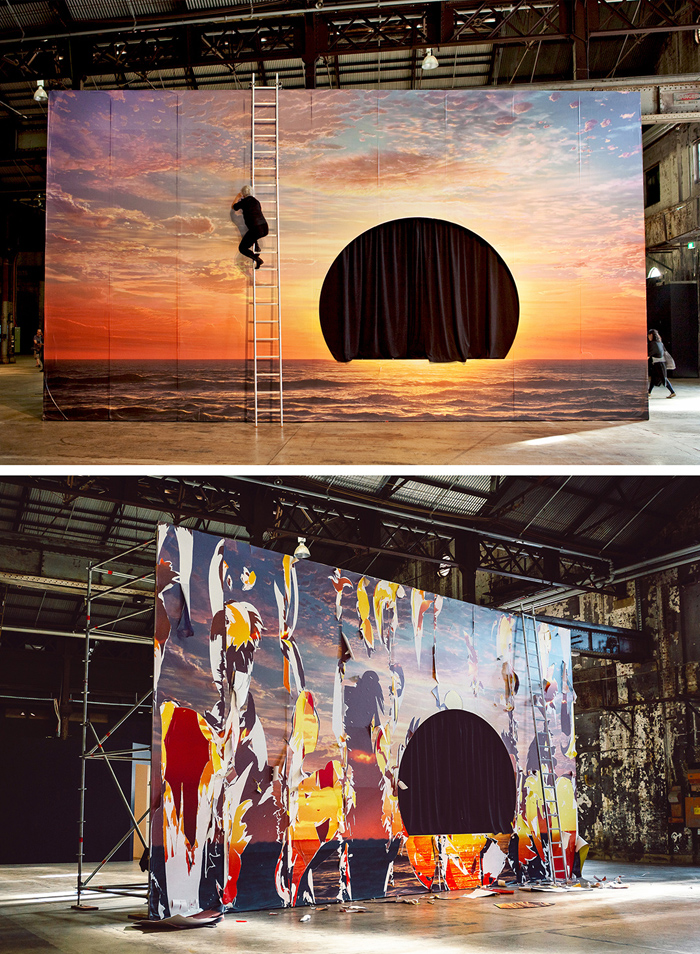
Neha Choksi. The Sun’s Rehearsal, 2016; performance still and installation view (2016) at Carriageworks for the 20th Biennale of Sydney. Courtesy of the artist and Project 88, Mumbai. Photo: Neha Choksi.

Neha Choksi. The Sun’s Rehearsal, 2016; performance still and installation view at Carriageworks for the 20th Biennale of Sydney, 2016. Courtesy of the Artist and Project 88, Mumbai. Photo: Neha Choksi.

Neha Choksi: I guess this is an odd job right now: Otis [Otis College of Art and Design]. I’m an adjunct.

Calder Yates: What do you teach here?

NC: I teach video and I do senior studios. So, odd jobs. After I graduated from undergrad, I had a job at an accounting firm, filing and answering the phones. But I didn’t last very long. I left to go to India for a year. I was wandering with mendicant nuns and staying with my parents.

CY: Mendicant nuns?

NH: People who beg for their food. Within my family’s religion, which is Jainism, mendicant nuns are an order of female ascetics. Also I was DJing and hanging out with a lot of music people.

Read More »

Share

To All the Futures We Can Imagine

Today, from our sister publication Art Practical, we bring you Jen Delos Reyes’s article from issue 8.3: Art can’t do anything if we don’t. Delos Reyes ruminates on the power of letter writing and the role letters have played in her personal and professional life. She ends this piece with the letter she would have sent to incoming art students, stating, “We need artists to understand social systems, political and legislative structures, to be skilled in non-violent protest and demonstration, and to understand how to organize creatively in their communities.” This article was originally published March 23, 2017.

jendelosreyes

I have been spending time recently reading the letters of influential Southern writer and activist Lillian Smith. I am working on a lecture for an upcoming symposium on arts and social change organized in her honor. Smith’s life work was dedicated to ending social and racial injustice. She did not see a division between art and politics and in her own life did not see the role of artist and activist as separate. Most people, she felt, are too quick to separate means and ends. In a letter that she wrote to an editor at the New York Herald Tribune, Lewis Gannett, she reflected on what the role of artists should be in a politically tumultuous, strained, and divisive America. “But of course there are times when we can take no more. We must have something to cheer us, to divert, amuse. But we should not ask our serious artists and novelists to be ‘good therapy’ for us; nor should we ask them to show us the ‘best America’—whatever that is. It isn’t fair to ask an artist to do anything but reveal to us human experience as he knows it; as he has felt it, dreamed it, experienced it.” Smith believed in the power of letters to affect change, and letter writing was part of her activism. Post-election, many of us have also been writing letters, mostly to our local representatives.

In 2015 I attended one of Fred Moten’s lectures at which he read several gorgeous, rich, and vulnerable emails he had written to his friends and colleagues. His words reminded me of how I want to communicate and how I want to reflect on what I encounter in my life. Inspired by his talk, I began a mostly weekly practice of writing letters to beloved friends scattered across the world. Letter writing is a form that I have come to embrace and use often for communication; the form lends itself to intimacy, to a kind of address that feels deep and direct.

From one of Moten’s poems:

the absence of your letter

shines in absent distance.

Read the full article here.

Share