Los Angeles

Kota Ezawa: Gardner Museum Revisited at Christopher Grimes Gallery

In 2013, Kota Ezawa once gave a presentation at the California College of the Arts about a man in Japan. As he explained it, Ezawa saw a man talking on CNN, with the name of “Kota Ezawa” printed in the bumper graphic at the bottom of the screen. This onscreen Ezawa was a scientist, and as Ezawa watched the interview, he became intrigued. The name Kota Ezawa is so uncommon that after the interview, the artist decided to travel halfway across the world to meet this other Ezawa, living somewhere in Japan, to investigate their intriguingly dissimilar paths of life. Ezawa’s investigation of his namesake mirrors his artistic process: He isolates and studies discreet visual units—in this case, his name—so that the larger significance of each individual element can emerge.
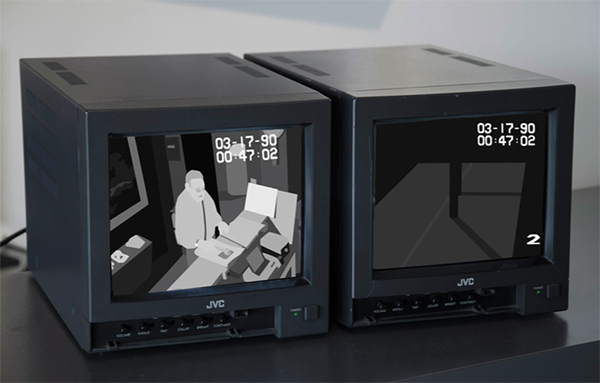
Kota Ezawa. Double Tape, 2015; two-channel video, black and white, silent; 5;41. Courtesy of the artist and Christopher Grimes Gallery.

Kota Ezawa. Double Tape, 2015; two-channel black-and-white video, silent; 05:41. Courtesy of the Artist and Christopher Grimes Gallery.

In his new body of work, Gardner Museum Revisited, now on display at Christopher Grimes Gallery, Ezawa focuses on the largest property crime in U.S. history: the theft of thirteen works of art from the Isabella Stewart Gardner Museum in Boston. On March 18, 1990, two men dressed as police officers entered the Gardner Museum. They gagged and tied up the security guards on duty, and stole sculptures, sketches, and paintings by Rembrandt and Degas among others, taking with them one of the only thirty-six Vermeer paintings in existence. The robbers and their half-billion dollars’ worth of loot were never found.

Ezawa uses his characteristic style—digital animation and illustration—in his presentation of the theft. Upon entering the exhibition, two small TV monitors show a digitally animated version of the Gardner Museum’s closed-circuit video on loop. In the piece, titled Double Tape (2015), one animation shows a museum guard peacefully meandering around his desk, thumbing through a newspaper, while the other shows a car pulling up into a dark alleyway.

Read More »

Share

New York

Setting Out at Apexart

In Setting Out (an exhibition selected as part of apexart’s Unsolicited Proposal Program), the guest curators Shona Kitchen, Aly Ogasian, and Jennifer Dalton Vincent showcase works that reframe or enact the vocabularies, tools, and approaches of explorers and scientists. With many intriguing works on display, the most interesting render the Earth strange by observing it with fresh eyes, analogous to the wonder of seeing distant planets and places. As the artists fuse the structure and utility of science with their imaginative objectives and tools, they probe the way we understand place.

Claudia O’Steen. Arc of Visibility, 2015; video, binocular/projector stands, Yellowheart, cedar, glass, rocks collected over time from 41°29’40.72”N, 71°8’8.10”W, sandbags containing sand from same coordinates, video projections, stainless steel, glass reflectors, aluminum, mirrored Plexiglas, compass level; dimensions variable. Courtesy of the Artist and apexart, New York.

Claudia O’Steen. Arc of Visibility, 2015; video, binocular/projector stands, Yellowheart, cedar, glass, rocks collected over time from 41°29’40.72”N, 71°8’8.10”W, sandbags containing sand from same coordinates, video projections, stainless steel, glass reflectors, aluminum, mirrored Plexiglas, compass level; dimensions variable. Courtesy of the Artist and apexart, New York.

Claudia O’Steen’s video and sculpture, Arc of Invisibility (2015), sit amid a table filled with the curators’ and exhibition designer’s vinyl text—identifying topics of inquiry like dissemination, evidence, and illusion—and objects related to the artists’ projects, like maps, a stereopticon, and more. O’Steen partially bypasses the table’s clutter by projecting her video on the floor while her homespun, wooden surveyor transit sits on top. Transits, typically consisting of a telescope with a crosshair, measure the relational distance and angle of objects for construction, landscaping, and geography. O’Steen’s transit differs from conventional ones by producing two images that are split along a vertical axis, one of which is upside-down. In O’Steen’s video, shot at South Shore Beach, Rhode Island (indicated as 41˚29’40.72″N, 71˚8’8.10″W), she walks toward the Atlantic Ocean, holding her transit. While the artist attempts to hold it level with the horizon line, her wobbly split-screen and partially upside-down imagery of the ocean are disorienting. Fashioned almost like a twin-lens reflex camera (with two openings, mirrors, and an eyepiece on the top), O’Steen’s transit combines the acts of looking outward toward the horizon and downward to the ground, such that her video shows the ocean along with beach pebbles and occasionally her feet in the background. With her quasi-scientific approach and tool, O’Steen’s project embraces futility and disorientation to envision the way we comprehend place.

Read More »

Share

Queensland

The 8th Asia Pacific Triennial of Contemporary Art

Postcolonial narratives of dispossession, survival, and reclamation dominate the 8th Asia Pacific Triennial of Contemporary Art (APT) at the Queensland Art Gallery/Gallery of Modern Art, making the exhibition part melancholy lament and part anthem of triumph. Works by artists of different traditions speak of cultural practices transformed in response to external forces, yet they preserve important narratives of identity. From the revival of Mongolian zurag painting in Ulaanbaatar to the reinvention of miniature painting in Lahore, to challenges of colonialist narratives in Polynesia and Anida Yoeu Ali’s street performance in Phnom Penh, the works selected for this iteration of the APT ask viewers to reconsider the way in which contemporary art emerges from cultures steeped in tradition.

THOMPSONchristian_Trinity1

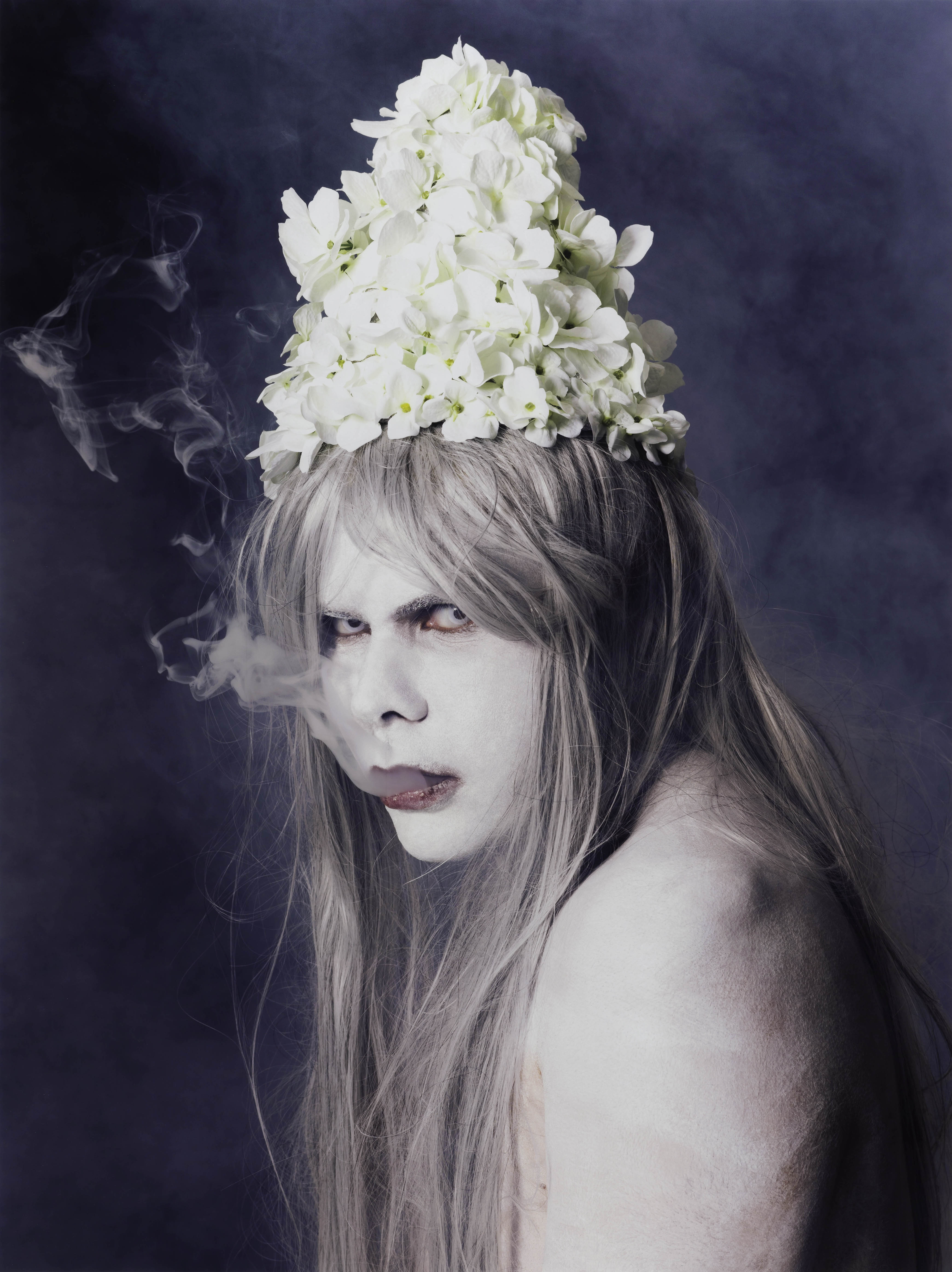
Christian Thompson. Bidjara People, Western Queensland Trinity I (from Polari series), 2014; C-type photograph; 100 x 75 cm. Courtesy of the Queensland Art Gallery|Gallery of Modern Art Foundation.

Showing the work of eighty-three artists from more than thirty countries, the triennial is a barometer of artistic and social change, responding to global forces and the shifting cultural, economic, and political environments of the region. The emphasis of APT 8 is on the performative body: in live actions, immersive installations, video, sculpture, and—a wonderful surprise—the dynamic resurgence of figurative painting. The exhibition reveals boundaries of geography, history, gender, religion, and art practice in constant, fluid motion. Curator Aaron Seeto says, “We understand that while Asia and the Pacific represent quite specific geographies, these terms are also convenient constructions. Within these territories we see great diversity, histories, and attitudes to current global issues.”

The work of indigenous Australian artists speaks of strength and survival in the face of historical oppression and dispossession, and Christian Thompson’s self-portraits are a powerful act of reclamation. Thompson reframes 19th-century ethnographic photographs as symbols of mourning, interwoven with influences from pop culture, cinema, and theater. Gunybi Ganambarr’s distorted burial poles, painted with the intricate cross-hatching of Arnhem Land, are juxtaposed with works in which he used an angle grinder to inscribe traditional patterns into sheets of metal from old water tanks and discarded conveyor belts from the bauxite mines.

Read More »

Share

From the Archives

From the Archives – Art in Limbo

On Tuesday, February 9, Utah’s House of Representatives will vote on whether to make Robert Smithson’s iconic land art, Spiral Jetty (1970), the state’s official work of art. If the legislation passes, Utah will become the first state to have an official work of art. Today we bring you Danielle Sommer’s reaction to the state’s initial acquisition of the work from the Dia Foundation. This article was originally published on July 6, 2011.

Robert Smithson. Spiral Jetty, 1970. Image copyright Danielle Sommer.

It’s true. The state of Utah now owns Spiral Jetty. For the last decade, the Dia Foundation has paid Utah’s Department of Natural Resources $250 a year to maintain the 20-year lease on the land surrounding the earthwork. In February, the Dia received and paid its annual invoice, only to have the payment returned in June with a note that the lease had expired—a fact that had somehow escaped everyone’s attention, including the DNR’s. According to an article by Jennifer Dobner of the Associated Press, the oversight may have occurred due to the fact that the DNR’s Sovereign Lands coordinator, Dave Grierson—the man who should have sent Dia a notice about the lease renewal—passed away last year.  Conspiracy theories about drilling aside, the Dia maintains that it has a “collegial” working relationship with the DNR and that they are in the process of renegotiating the lease.  But for the moment, the Jetty belongs to Utah, a fact that has the art community unsettled.

I first visited Spiral Jetty in August 2007, thirty-seven years after Robert Smithson installed it and thirty-four years after his death. I’d heard that the water level was low enough that the jetty was visible again, so I made a point to visit it on my way from Portland, Oregon, to Chicago, Illinois. I’d seen photographs, as well as the film of the construction that Smithson had made with his wife, Nancy Holt, but the physical experience caught me unprepared. Visiting Spiral Jetty in the flesh provides an experience of time unlike any other. Everything seems to halt, even as it remains in motion.

Read More »

Share

Interviews

Connecting Intentionally: The Beginning of Blights Out

From our friends at Pelican Bomb, today we bring you an interview with Blights Out, a New Orleans project that “prioritizes transparency, interdisciplinary collaboration, community involvement, and creativity.” Blights Out is New York–based artist Lisa Sigal, New Orleans artist Carl Joe Williams, and arts activist Imani Jacqueline Brown. Author Rosemary Reyes says, “Blights Out looks to ignite conversations around the rapid economic development in New Orleans by ‘performing architecture’ and developing strategies to create permanently affordable housing.” This conversation took place in December of 2014, and was originally published on January 13, 2016, “offering a moment to reflect on the ways an organization can develop as its community presence grows.”

Blights out began in 2014 during Prospect.3: Notes for Now with Artist Lisa Sigal’s nstallations on houses in New Oreleans’ mid-city neighborhood. Courtesy of the Artist and Blights Out, New Orleans.

Blights Out began in 2014 during Prospect.3: Notes for Now with Artist Lisa Sigal’s installations on houses in New Orleans’ Mid-City neighborhood. Courtesy of the Artist and Blights Out, New Orleans.

Rosemary Reyes: Lisa, I want to start with you, and talk about how your work has used abandoned spaces all over the world as a canvas, and how those experiences translated into Blights Out.

Lisa Sigal: My work responds to architecture as a code for the laws of a place, which brings racial inequalities and other societal inequities to the forefront. I am concerned with addressing these issues without aestheticizing them, which I feel would be unethical. When I was approached by Prospect to submit a proposal for the 2014 iteration, I came down to New Orleans for a week or two. I went around and painted on my easel in front of various housing projects that were being demolished and I would talk to the people who passed by. It was very performative. As a painter, the question is how to have a painting project that has a social component, which is a challenge—how to have a painting project that isn’t contained within the closed systems of the gallery and the market.

I wrote a Creative Capital grant in 2012 that was about envisioning architecture as silent protest. When I received the grant, Blights Out became a great way to enact those ideas. I was struck with thinking about the idea of a house as a page in a book. I had just read Suzan-Lori Parks’ 365 Days/365 Plays and I saw so many of those plays in the houses. She has this uncanny sense of the absurd as it relates to politics, people, and the cycles of history. I met with Parks and, when I suggested using 365 Days for Blights Out, she said, “Take it, girl.” I considered the range of plays and how they should vary from neighborhood to neighborhood.

Read the full article here.

Share

Fan Mail

Fan Mail: Eva Voutsaki

Mythology, memory, and a fascination with the nocturnal are some of the underlying themes in Eva Voutsaki’s photographs. Originally from Drakona, a small village on the island of Crete in Greece, the artist documents and commemorates the unique way in which she understands her ongoing experience as a “modern immigrant.” Now living in Brighton, UK, Voutsaki grapples with notions of migration and belonging, and the ways in which photography can become a window into a shared, relatable world.

Eva Voutsaki. From the Traces Within series, 2006-2016. Courtesy of the Artist.

Eva Voutsaki. From the Traces Within series, 2006-2016. Courtesy of the Artist.

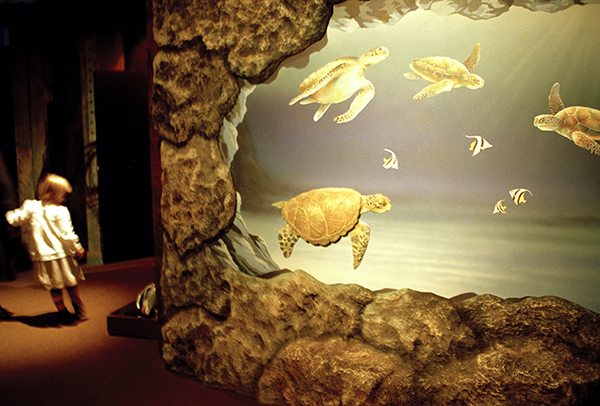
One of Voutsaki’s more autobiographical projects, Traces Within (2006–2016) is an exhibition of an unraveling childhood. In this body of work, a series of thirty photographs embody Voutsaki’s excavation of memories from her distant past. The artist doesn’t plan or construct her photographs—her strategy simply involves walking around with a manual Nikon camera to capture shots on impulse. In one of the images from this series, a child is caught in mid-movement near some swimming turtles. The artist describes the scene of as one that caught her off guard and compelled her to capture the moment. Soon after she developed the film, the reason behind Voutsaki’s compulsion became clear: The image evoked memories of the week she left her village at the age of fifteen, a time that coincided with her grandmother’s and dog’s deaths.

Read More »

Share

New Orleans

James Hoff: Bricking at the Contemporary Arts Center New Orleans

James Hoff: B=R=I=C=K=I=N=G is the first solo museum exhibition of the artist’s “virus paintings”—works shaped and mediated by Hoff’s engagement with digital technology and computer viruses as opposed to brush or paint. Functioning as a series of études to contemporary computer code, these paintings flirt consciously with the provocative gestures and meta-questions of conceptual art and the heavy visual language and history of abstraction. Shaped only by the rabid aggression of the autonomous computer virus, Hoff’s works raise questions about the circulation and reproduction of digital information in a world marked by WikiLeaks, drone warfare, and the threat of cyberterrorism.

Installation view of James Hoff: B=R=I=C=K=I=N=G at the Contemporary Arts Center New Orleans. Image © Traviesa Studio.

James Hoff: B=R=I=C=K=I=N=G, 2015; installation view, Contemporary Arts Center New Orleans. Image © Traviesa Studio.

Bricking is a term that describes the overload of an operating system when infected by malware, a process that renders the system useless, or at least unable to work for its original purpose. Hoff infects JPEGs, PNGs, and TIFFs with specific forms of malware such as Skywiper and Stuxnet—viruses that have become synonymous with international cyberterrorism[1]—and then digitally converts them into image files that can be transferred to canvas or aluminum. The political weight of these viruses rubs against the formally expressive character of the final works, which seem to engage more with the history of abstraction and the cool, detached vocabulary of formalism than the language of computer code. Thin, horizontal striations of vibrant neon colors seem to liquefy and drip, creating an unusual grainy texture across the surface of the aluminum paintings, whose markings bear a kinship to rough textiles such as coarse, unprimed canvas. The cosmic forms, pulsating colors, and abrupt shifts in tone call up the rich history of pure abstraction, from the cosmic utopian canvases of Wassily Kandinsky to the colored depth of a Mark Rothko.

Read More »

Share