Seattle

Salt/Water at the Photographic Center Northwest

Salt and water: an amalgamation of fundamental, life-sustaining compounds that evokes the sea, sweaty human excretions, and the makings of primordial soup. Independently innocuous, it is the combination of salt and water that produces something transformative—a substance potentially electric and corrosive. It is the coming together of salt and water that sparked the concept for Salt/Water, an exhibition of contemporary photography on view at the Photographic Center Northwest in Seattle. Featuring four photographers spanning generations and continents, the exhibition engages salt and water as media to expand the technical and conceptual potential of contemporary photo-based works.

Meghann Riepenhoff. Littoral Drift #270 (Ft. Ward Beach, Bainbridge Island, WA 06.16.15, Tidal Draw, Five Minutes Preceding Low Tide), 2015; cyanotype; 57 x 96 inches. Courtesy of the Artist and Photographic Center Northwest.

Meghann Riepenhoff. Littoral Drift #270 (Ft. Ward Beach, Bainbridge Island, WA 06.16.15, Tidal Draw, Five Minutes Preceding Low Tide), 2015; cyanotype; 57 x 96 in. Courtesy of the Artist and Photographic Center Northwest.

Meghann Riepenhoff and Daniel Hawkins are based in Seattle, a city synonymous with maritime vistas and a perpetually sodden atmosphere. Any Pacific Northwesterner can describe (with gratuitous fervor) their deep appreciation for soggy climbs in the Cascades and chilling paddles in the Sound. Culturally, this profound relationship with the natural world is what defines the Pacific Northwest. Riepenhoff, though new to the region, has fully embraced this prevailing zeitgeist, creating a series of works that have immersed her, both literally and conceptually, in the unpredictable wildness of the Puget Sound.

Littoral Drift is composed of cyanotype prints made without the camera. Part performance and part artifact, Littoral Drift #270 (Ft. Ward Beach, Bainbridge Island, WA 6.16.15, Tidal Draw, Five Minutes Preceding Low Tide) (2015) is a cartographic impression of the continental shelf created by submerging light-sensitive photo paper in the sea. Riepenhoff employs saltwater, sand, and marine flotsam as agents to manipulate cyanotype emulsion, producing monumental tableaus that capture the unruly power of tidal flows. Littoral Drift #270 is a landscape unto itself, an otherworldly topography at once chaotic and controlled. Much like the bioluminescent blooms that are revealed under a full moon, Riepenhoff’s artworks are ephemeral—deliberately unfixed. The pieces continue to transform and evolve through time, harkening to the geologic phenomena they depict.

Read More »

Share

San Francisco

David Ireland at Walter and McBean Galleries

Wry humor, mystery, and entropy: Today from our partners at Art Practical, we bring you Danica Willard Sachs’ review of David Ireland’s work at the Walter and McBean Galleries at the San Francisco Art Institute. The author notes, “Throughout, Ireland draws our attention repeatedly to the material conditions of each object, the where and how of every action, rooting them in real time and space.” This article was originally published on February 11, 2016.

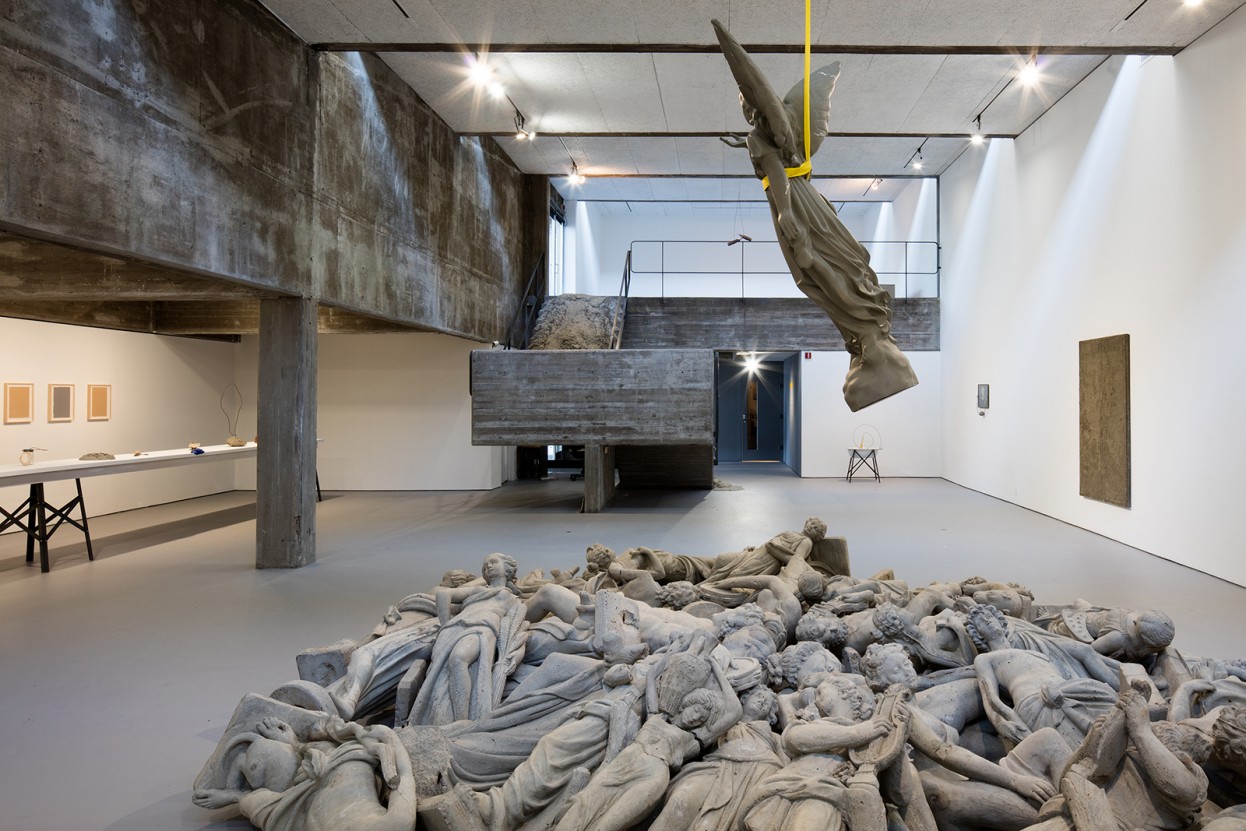
David Ireland. David Ireland, 2016; installation view, Walter and McBean Galleries, San Francisco Art Institute. Courtesy of San Francisco Art Institute. Photo: Gregory Goode.

David Ireland. David Ireland, 2016; installation view, Walter and McBean Galleries, San Francisco Art Institute. Courtesy of San Francisco Art Institute. Photo: Gregory Goode.

Suspended from the ceiling and twirling above a circular pile of kitschy Roman-style garden statuary in the center of SFAI’s Walter Gallery, David Ireland’s Angel-Go-Round (1996) is a mash-up of wit and melancholy typical of the artist. Supported with only a fluorescent yellow strap looped across her gray fiberglass waist, the angel flies precariously through the air. The mechanical groan of the motor propelling her orbit above the heap of concrete bodies reverberates throughout the gallery and lends a haunting quality to this work and the entire exhibition. Coinciding with the reopening of 500 Capp Street, Ireland’s house-turned-artwork, the tightly edited David Ireland shows an artist fluent in the language of conceptual art and grounded in everyday materials like concrete, wood, and metal. Bringing together Angel-Go-Round, along with a range of small sculptures, another large-scale installation, and several small paintings, the exhibition is a carefully selected representation of the varied practices encompassing Ireland’s career. It underscores Ireland’s insistence on an art inflected by place and time, an art that reveals, in the words of fellow conceptual artist Allan Kaprow, “as if for the first time, the world we have always had about us but ignored.”

Read the full article here.

Share

Help Desk

Help Desk: Institutional Bias

Help Desk is where I answer your queries about making, exhibiting, finding, marketing, buying, selling–or any other activity related to contemporary art. Submit your questions anonymously here. All submissions become the property of Daily Serving.

I freelance in a museum in a major metropolitan area with a diverse population, but the racial demographics of the institution’s staffing seem glaringly segregated. The white​-​collar office employees are mostly White, while Black and Brown employees comprise almost all of the security department. Within the exhibitions department, where I work, there are a few people of color in leadership positions, but the rest of the staff and freelancers are almost all white. While I haven’t felt any discrimination, the racial dynamics seem obvious and weird to me. What should I do?

Robert Rauschenberg. White Painting [three panel], 1951; latex paint on canvas; 72 x 108 in.

Robert Rauschenberg. White Painting [three panel], 1951; latex paint on canvas; 72 x 108 in.

Thanks for your question. February is Black History Month, so it might seem like this issue is especially well timed; however, this is a problem that extends beyond four weeks, and we’d all do well to consider it during the other eleven months of the year. I reached out to some people who are knowledgeable about these situations, and Roberta Uno, Director of Arts in a Changing America, and Monica Montgomery and Stephanie Cunningham of Museum Hue, have generously provided a wealth of resources that will aid you in thinking about creative solutions. Here’s what Ms. Uno wrote:

The situation the reader describes isn’t an anomaly. When I was the Senior Program Officer for Arts and Culture at the Ford Foundation, diversity reporting was a proposal requirement. Sadly, it was common to see little/no diversity in many large-budget arts institutions’ board and professional staff. Diversity, if any, would be clustered in the support staff line—despite the fact that the organization’s city was usually a majority people of color. Arts organizations that ignore the profound demographic shift that is occurring in this country risk being left behind as the U.S. joins a greater global community. Evolution is essential to remain relevant to current audiences and future donors—and to achieve excellence of ideas and perspectives.

Forward-thinking leaders are offering best practice towards that change. Great resources can be found at Grantmakers in the Arts Racial Equity Forum and Helicon. Innovative field leaders like the National Association of Latino Arts and Culture have developed model leadership institutes. Organizations like the Center for Curatorial Leadership have recognized that diversity in the museum field is critical and are trying to hone new approaches. And convenings of national projects like Arts in a Changing America and Citizens’ University are bringing together artists and idea producers who are at the leading edge of the arts and cultural equity practice. Change occurs along a spectrum—if an organization can make a commitment and strategy, they have only the future to gain.

Read More »

Share

Shotgun Reviews

Terra Incognita at Art@Archer

Shotgun Reviews are an open forum where we invite the international art community to contribute timely, short-format responses to an exhibition or event. If you are interested in submitting a Shotgun Review, please click this link for more information. In this Shotgun Review, Garrett Caples reviews Terra Incognita at Art@Archer in Oakland.

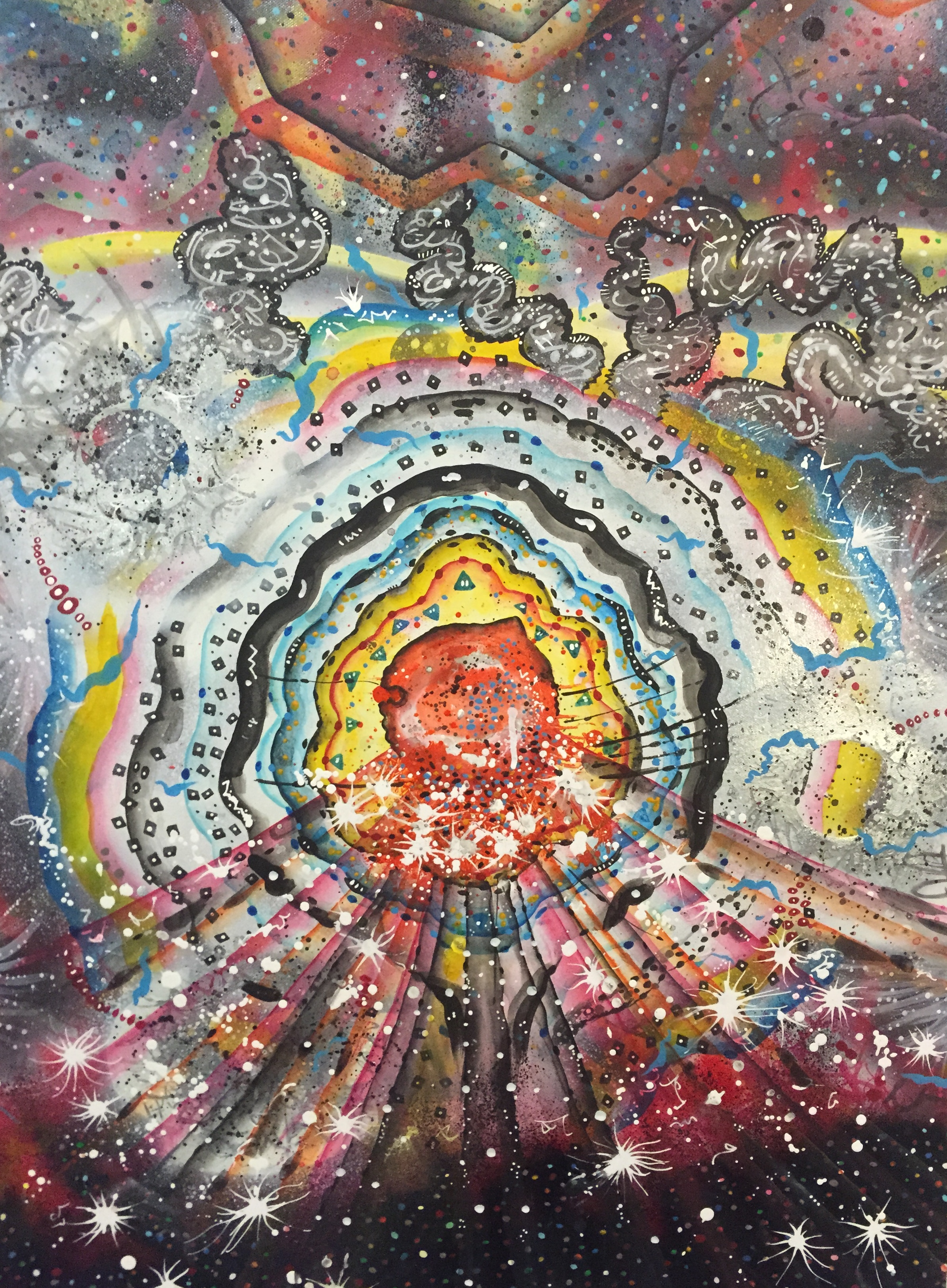
Brian Lucas. Seventh Sense, 2015; mixed media on canvas; 36 x24 in. Courtesy of the Artist and Art@Archer, Oakland. Photo: Garrett Caples.

Brian Lucas. Seventh Sense, 2015; mixed media on canvas; 36 x 24 in. Courtesy of the Artist and Art@Archer, Oakland. Photo: Garrett Caples.

In Terra Incognita at Art@Archer, Derek Fenner, Ava Koohbor, and Brian Lucas—who exhibited together last year at now-defunct Emerald Tablet—reprise their roles as poets equally adept at visual art. Lucas himself will be included in Dark Star: Abstraction and Cosmos, an eight-person exhibition of contemporary and historical visionaries at New York’s Planthouse curated by Hanuman Books guru Raymond Foye. I mention this because all three artists in Terra Incognita participate in a dissident tradition of mystical American art in which direct experience is prized over illusion. Koohbor’s assemblages make this clear; Nocturnal Bike (2015), an abstract arrangement of coiled wire and metal over a slate-like black background, features a real bicycle bell, which several attendees of the opening enjoyed themselves by ringing, though none were sanguine enough to grab the rolled-up dollar bills baiting the adjacent mousetrap of the two-panel Autobiography (2015). In the repurposing of everyday objects in uncanny arrangements—Sun-bent (2014–16) renders a sunflower from a hubcap and flaking rusty metal—her assemblages evoke the black humor of American surrealist sculptor David Hare.

Fenner demonstrates occult leanings via an abstract tarot deck and through a calligraphic technique equally attuned to graffiti and witchcraft. He underlines the poetic influence of the show with an Altar for John Wieners (2015), in which five copies of Jerome Mallmann’s photograph of the poet Wieners are surrounded by a blue box heavily scored by white calligraphy. But his strongest works eschew the calligraphic in favor of a geometric drawing style. Covenant (2015), one of these black-and-white pieces, creates an illusion of three-dimensionality by seeming to build up structures whose stability is undermined by conflicting elements, a continuous shifting of visual organization that immediately folds them back into experience.

Read More »

Share

Interviews

Interview with Barbara Bloom

Today, we bring you a video from our friends at Kadist Art Foundation. In this video, Barbara Bloom (in conversation with Jo-ey Tang), describes the impetus for her installation The Bedroom (1997), her fascination with the utilitarian object and the fictional narrative, and the work’s inception in a flea market gouache painting. 


Share

St. Louis

Know Yourself at the Luminary

Currently at the Luminary, Know Yourself is a group exhibition that features the artists Conrad Bakker, Chris Bradley, Marianne Laury, Eva and Franco Mattes, Edra Soto, and Julia Weist. The exhibition shares its title with a Drake song in which the rapper looks back on his life, claiming his authenticity and lineage among other artists. He expounds, “I’ve always been me, I guess I know myself,” and hopes that the “fakes get exposed.” After its release, Drake was infamously accused of hiring a ghostwriter. Taking inspiration from this ironic scandal, Know Yourself presents a group of artists who explore the instability of authenticity and ownership within the present sphere of economic production and consumption. The works approach the concept of authenticity from multiple points, leveraging commonplace objects to question the authorship of forms and ideas.

Conrad Bakker. The Crystal Land, 2014 (detail); Oil on carved wood panels; 24 ft. x 20 in. Courtesy of The Luminary.

Conrad Bakker. The Crystal Land, 2014 (detail); oil on carved wood panels; 24 ft. x 20 in. Courtesy of the Luminary.

In front, a multitude of postcard-size images cover the gallery windows in an ordered gestalt. This installation, Julia Weist’s Parbunkells Image Archive (Composition for Inside and Outside) (2015–2016), documents a body of work that started when Weist was commissioned to turn a vacant billboard in New York into a public artwork. Her concept was simple: In black Apple Garamond font on a white ground, she presented the 17th-century English term parbunkellsThe billboard looked more like a sleek advertisement for a new product than an archaic, forgotten word (at the time of Weist’s encounter with the term, there were no Google search results for parbunkells). After the unveiling, the word quickly went viral. Its original meaning—“coming together through the binding of two ropes”—shifted as the public began inventing new definitions and merchandising the word, resulting in a massive body of work, not made by the artist, but instigated by Weist through her choice and placement of a word. The images at the Luminary are culled from these appropriations. Occasional photos containing the word, including some of the original billboard, are peppered throughout otherwise unconnected, mundane imagery.

Read More »

Share

Warsaw

Ludmiła Popiel at Fundacja Arton

Curators of contemporary Polish art have a somewhat paradoxical responsibility: to present the most up-to-the-moment work that is in the process of developing a history, while attempting to also excavate and frame the history of artworks produced during the last seventy years. As Poland expands its participation in the global contemporary art scene, it must also find a way to present the critical art-historical lineage that has lead to current developments. Now on view at Fundacja Arton in Warsaw, Ludmiła Popiel is an example of a practice that continues to have an impact on generations of artists.

Ludmiła Popiel, 2015; installation view, Fundacje Arton, warsaw. Courtesy of Fundacja Arton. Photo: Jagna Lewandowska.

Ludmiła Popiel; installation view, Fundacje Arton, Warsaw, 2015. Courtesy of Fundacja Arton. Photo: Jagna Lewandowska.

Popiel first explored movement in flat space, and later took her ideas off of the canvas and into the world. A facile, first-glance categorization of the work presented here is Op Art, and the larger pieces in this exhibition do take their cues from that genre. Six paintings, including diptychs and triptychs, are hung salon-style in the space. Mainly executed in black and off-white, the bold strokes swirl toward the center of each rectangle, defying the eye where the lines meet. Space and flux were especially important to the artist, and she soon began making works that pushed the conceptual boundaries beyond optical illusions. The deceptively simple six-paneled Wykres Linii Horyzontu­ – Pejzaz Obiektywny [Graph Lines Horizon  Objective Landscape] (1973), which unexpectedly provides a pop of color in the gallery, can be seen as the link between Popiel’s two-dimensional considerations of space and her later conceptual works. Created in response to the horizon of a physical landscape, the artist composed it using a string to gauge and then mark the line at which land meets air, filling in the lower segments with bright blue oil paint.

Read More »

Share