Portland

Mike Bray: Light Grammar/Grammar Light at Fourteen30 Contemporary

The mechanics of grammar are the starter set of must-know rules for uniform speaking. They are the basic regulations without which language can be rendered clumsy beyond comprehension. Artist Mike Bray engages with these mechanics through his video, photographic, and sculptural works. At first concerned with the logistics of light and form on a fundamental level, Bray’s works expand to make visible their potential through abstraction. His deconstructed exhibition Light Grammar/Grammar Light at Fourteen30 Contemporary transforms fragmented surfaces into pieces that form a completely new language. This language subverts the hard-and-fast rules for coherency to reveal the beauty in visual stutters and run-on thoughts.

Mike Bray. Day For Night, 2016; light stands, wood, steel and aluminum; 78 x 96 x 78 inches. Courtesy of the Artist and Fourteen30 Contemporary.

Mike Bray. Day For Night, 2016; light stands, wood, steel, aluminum; 78 x 96 x 78 in.; installation view, Light Grammar/Grammar Light, Fourteen30 Contemporary. Courtesy of the Artist and Fourteen30 Contemporary.

In the entirety of the small exhibition, black forms stand against white ground, with a couple of works that incorporate light or reflective elements. The initially simple declaration of aesthetic is cleverly personified and unapologetic for the choice. Day for Night (2016) comprises four lighting stands that support discs of wood, steel, and aluminum. The discs—some of which are no longer full circles—have been cropped and angled as not to reach their complete, traceable circumference. The forms crowd each other, face to face, leaning in close as though engaged in passionate argument. The imposing structure is the mechanical foundation of Bray’s debate with orderly form. The sculpture is equal parts tidy and incidental, animated and still. It emotes in a way that simple and recognizable shapes usually don’t.

Read More »

Share

San Francisco

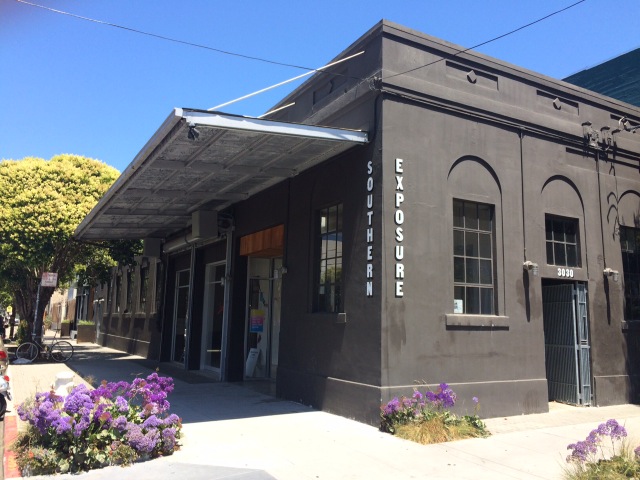
DSAP Executive Director Patricia Maloney to Join Southern Exposure

Hail and farewell! Today we are both pleased and sad to announce that our executive director, Patricia Maloney, will be leaving us to become the new executive director of Southern Exposure in San Francisco. Below is her valediction to our readers. We hope you will join us in thanking her for her years of service to the publication, and in wishing her the best of luck in her new role, effective March 14, 2016.

Southern Exposure in San Francisco, California.

Southern Exposure in San Francisco, California.

Dear friend,

If I address you as such, it is because you have always seemed familiar to me, the person just on the other side of these words. Imagining you there makes it easier to say that this is the last article I will write as executive director for Daily Serving and Art Practical. On March 14 I will assume the role of executive director at Southern Exposure, one of San Francisco’s oldest artist-centered alternative art spaces, and, in my opinion, its most vital.

The implications of this change are still sinking in. It has been almost seven years since I conceived of Art Practical, and it has been nearly three years since I became the publisher of Daily Serving. There will always be more that I wanted to do with these two publications. Even as I write this, my editors are still receiving emails that say, “Keep this in mind…” It is difficult to let go.

But in stepping away, I also grant myself a measure of the success that only comes in the moment of handing something over. It is one thing to bring something into the world, and it is quite another to know that it will go on without you. Whatever reluctance I might feel about leaving, it is a luxurious feeling to have. The DSAP team has often heard me use the word luxurious to describe a problem; we are lucky to be doing what we are doing. The thorny issues that we deal with in running two sites for excellence in ethical, edited art criticism have also given me the greatest sense of gratitude I have experienced in my career to date.

Read More »

Share

Hashtags

Hashtags: The Impossible Dream

#utopia #nostalgia #technology #street art #counterculture

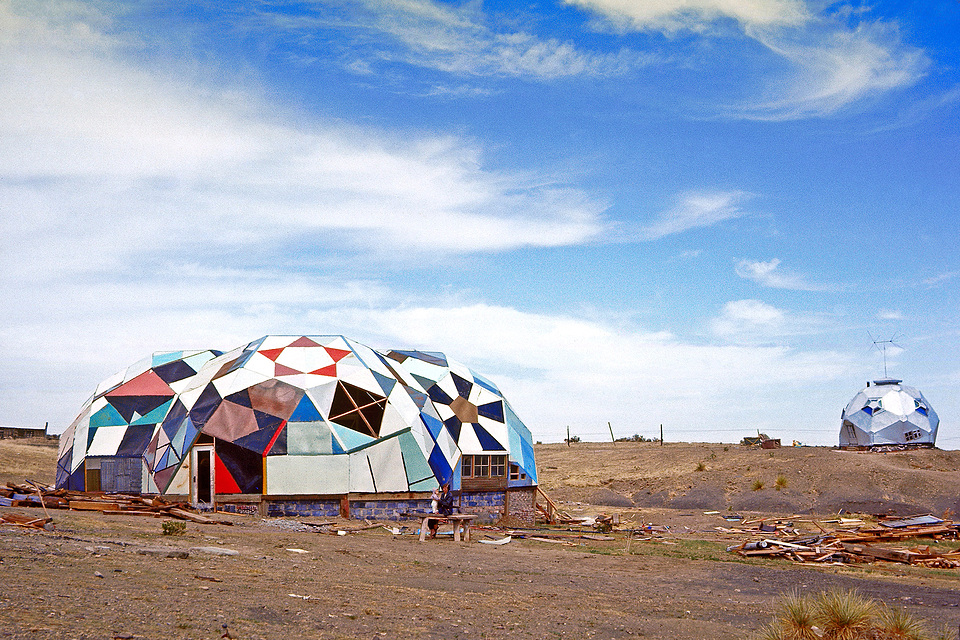
Technology and utopia are united in a certain subset of counterculture in Hippie Modernism: The Struggle for Utopia at the Walker Art Center. The show illustrates the ideals and limitations of the utopian imaginings by artists of the 1960s and early 1970s with early computer graphics imaging, speculative architecture proposals, political posters, and installation art. In contrast to ideal societies, Martin Wong: Human Instamatic at the Bronx Museum of the Arts finds spaces of freedom despite the cascade of social failures that characterized the 1980s.

Clark Richert, view of Drop City, “the Complex,” in El Morro, outside Trinidad, Colorado, circa 1966. Photo: courtesy Drop City Photo Archives

Clark Richert, view of Drop City, “the Complex,” in El Morro, outside Trinidad, Colorado, circa 1966. Courtesy of Drop City Photo Archives.

At the Walker, utopian dreams of peaceful and diverse living are illustrated by Superstudio in a suite of proposals for environments to create better life and death experiences, but they are difficult to realize in practice. Social experiments such as “Drop City,” a landscape of geodesic domes, collapse into entropy almost as quickly as they appear. Citrus trees placed in the galleries by Helen and Newton Harrison wither in the dead of a Minnesota winter, despite the grow lights that require large amounts of power to operate. Read More »

Share

Shotgun Reviews

Noam Rappaport: Dogleg at Ratio 3

Noam Rappaport. Dogleg, 2015; oil, acrylic, high-density foam, paper, canvas; 90 x 55 in. Courtesy of the Artist and Ratio 3, San Francisco.

Noam Rappaport. Dogleg, 2015; oil, acrylic, high-density foam, paper, canvas; 90 x 55 in. Courtesy of the Artist and Ratio 3, San Francisco.

Shotgun Reviews are an open forum where we invite the international art community to contribute timely, short-format responses to an exhibition or event. If you are interested in submitting a Shotgun Review, please click this link for more information. In this Shotgun Review, Justin Mata reviews Noam Rappaport: Dogleg at Ratio 3 in San Francisco.

Noam Rappaport’s artwork exists in a continuum of modernist object-making, a growing history of formal exploration. The works in Dogleg at Ratio 3 fit seamlessly into conversations about minimalism, abstract expressionism, and color field painting, but they are not dated. Any similarities to his aesthetic predecessors are unironic. Rappaport’s work feels soothingly honest because he does not quote giants of art history but instead investigates specific forms and colors to construct a highly distinctive visual vocabulary.

Rappaport’s roughly seven-foot paintings feature shaped canvases on which rectilinear forms intersect with and overlap each other. The works have intensely saturated layers with loosely brushed washes or, occasionally, heavy slathering of paint and medium. Stick-like pieces of painted wood appear in some, adding elements of line to the composition. Light washes of sky and aqua blues produce fields of shimmering color and a sense of ephemerality or movement, a possible nod to Richard Diebenkorn’s Ocean Park series (1967–1988) with his wash-like compartmentalization of color. In contrast, the thicker impasto areas of blacks, brick reds, and vegetal greens immediately ground some paintings, laying claim to the wall. In Dogleg (2015) these techniques play off one another, fighting for space in a canvas that looks like two elongated rectangles colliding. These shaped canvases rely on the gallery wall as a compositional element of the work in a way that recalls the late Ellsworth Kelly’s shaped paintings. Both artists’ works become almost graphic elements of the total architecture of the gallery.

Read More »

Share

Interviews

Female Gazing: Interview with Ana Álvarez-Errecalde

Today from our friends at Guernica, we present an interview with Argentinian artist Ana Álvarez-Errecalde. Author Bryony Angell talks with the artist about challenging the conventional portrayal of motherhood, her early career as a documentary filmmaker, and primal super identities. This article was originally published on February 1, 2016.

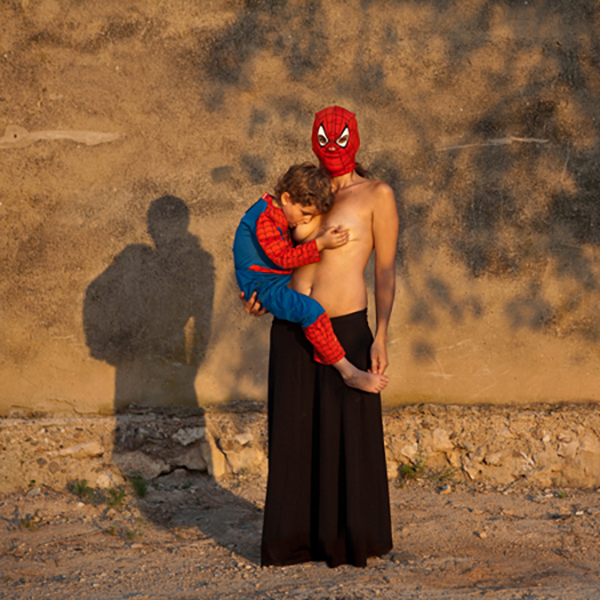
Ana Álvarez-Errecalde. The Four Seasons Series: Symbiosis, 2013-2014. © Ana Álvarez-Errecalde.

Ana Álvarez-Errecalde. The Four Seasons Series: Symbiosis, 2013-2014. © Ana Álvarez-Errecalde.

Through the eyes of women artists, motherhood is increasingly a subject of contemporary art. For the Argentine-born artist Ana Álvarez-Errecalde, motherhood was the very impetus for becoming a contemporary artist. Álvarez-Errecalde’s searing photographs depict experiences like home birth, breastfeeding, care for a special-needs child, and gestational loss. Drawing on the traditional trope of classic portraiture, and often taken outdoors or against a white backdrop, her staged images balance the wild and unknown—the blood and pain of bodily cycles—with the sensitivity and tenderness of human connection. Straightforward, tender, and often messy, her work is a response to popular media depictions of motherhood as immaculate or sexy.

Álvarez-Errecalde’s self-directed images of motherhood present a counter-archetype of the mother: a woman in control and unapologetic about the gore, discomfort, and trauma involved in bringing a new life into the world. In an interview with Flic Magazine, Álvarez-Errecalde said, “I don’t think we have to get rid of one thing for the other. The problem that I see is that we only have this singular story being told and I think we have to be as plural as possible. Most of the popular imagery that we see of women comes from a male, heterosexual, occidental, and patriarchal perspective.”

Read the full article here.

Share

Fan Mail

Fan Mail: Fanny Allié

For Brooklyn-based artist Fanny Allié, the human figure is a source of intrigue. In thinking about the body and how it moves through and inhabits space, the artist explores what she describes as the “ephemeral existence” of the human experience. Whether migrants fleeing trauma or the homeless seeking shelter, the notion of bodies in flux forms the crux of Allié’s practice. Initially trained in photography and video art, her medium of choice shifted upon her move to New York from France a decade ago, when she found herself gravitating toward materials that are temporal and prone to decay.

Fanny Allié. Man-Mass (The Carriers series), 2014-15; plastic bag sewn onto fabric; 14 x 19 in. Courtesy of the Artist.

Fanny Allié. Man-Mass (The Carriers series), 2014-15; plastic bag sewn onto fabric; 14 x 19 in. Courtesy of the Artist.

The series The Carriers (2014–15) examines images of those who live on the periphery of urban life. Using footage found online or photos she has taken of people on the street, Allié sculpts black plastic bags into the outlines of figures. Playing on both the materiality and title of the series, The Carriers echoes the invisible members of society who carry their belongings from one temporary shelter to another. The silhouettes are an embodiment of the kind of tangible and intangible weight that comes with displacement and destitution. The scale of the works in The Carriers varies between small portraits and life-size installations—the latter being a more effective way of making each “carrier” relatable to onlookers.

Read More »

Share

Los Angeles

John Outterbridge: Rag Man at Art + Practice

In the South Central Los Angeles neighborhood of Leimert Park, an art and social movement is gaining steam. Art + Practice is a community outreach and education center as well as a gallery in partnership with UCLA’s Hammer Museum. Founded by artist Mark Bradford, philanthropist Eileen Harris Norton, and social activist Allan Di Castro, Art + Practice aims to educate and prepare disadvantaged foster youth for the workforce and a self-sufficient future. As an important part of this outreach, the campus, which spans nearly two blocks of downtown Leimert Park, is building a community of artists and activists through exhibitions, artist talks, panels, performances, and film screenings.

John Outterbridge. Case in Point, c. 1970 (from the Rag Man Series); mixed media; 12 x 12 x 24 inches. Collection of the Hammer Museum. Photo: Andrew Zermeño.

John Outterbridge. Case in Point, c. 1970 (from the Rag Man Series); mixed media; 12 x 12 x 24 in. Collection of the Hammer Museum. Photo: Andrew Zermeño.

Currently on view at Art + Practice, Rag Man features the work of veteran artist John Outterbridge (b. 1933, Greenville, NC). Outterbridge is no stranger to this kind of community activism through art, having been the director of the Watts Towers Art Center from 1975 to 1992. He is also no stranger to the oft-ignored art scene located “south of the 10” (or south of Interstate 10, as non-Angelenos would say). In fact, the Brockman Gallery, which housed the Black Artists Association and represented artists such as Betye Saar, Noah Purifoy, Kerry James Marshall, David Hammons, and Outterbridge himself, once sat in the same square in Leimert Park. Started by Alonzo and Dale Davis in the 1960s, the gallery sought to showcase underrepresented artists of color, who were otherwise disregarded.

When LA Times art critic William Wilson said that he had not attended the Brockman Gallery because he was not interested in writing about group shows (a statement easily refuted), John Outterbridge responded by saying, “Mr. Wilson, why don’t you honestly tell everyone that you have not come to Brockman Gallery simply because you don’t come on that side of town? … The people that you write about are the people that you drink wine with, and we’re not those people. So just be honest and say that you have not come to the gallery because you are uncomfortable in coming into the realm of what the gallery represents.”[1]

Read More »

Share