San Francisco

Printed Matters – Daniel Coburn: The Hereditary Estate

Today from our partners at Art Practical, we bring you Larissa Archer’s review of the photography book The Hereditary Estate by Daniel Coburn. The author writes, “It’s the eyes of Coburn’s subjects that will haunt you. The elders seem to have seen everything, leaving them with marked brows and broken hearts. The younger adults seem by turns thoughtsick and mistrustful to downright hardboiled and malicious. The children, however, close their eyes and, as if willing themselves to rise up from the shadows, turn their faces toward the light.” This article was originally published on February 25, 2016.
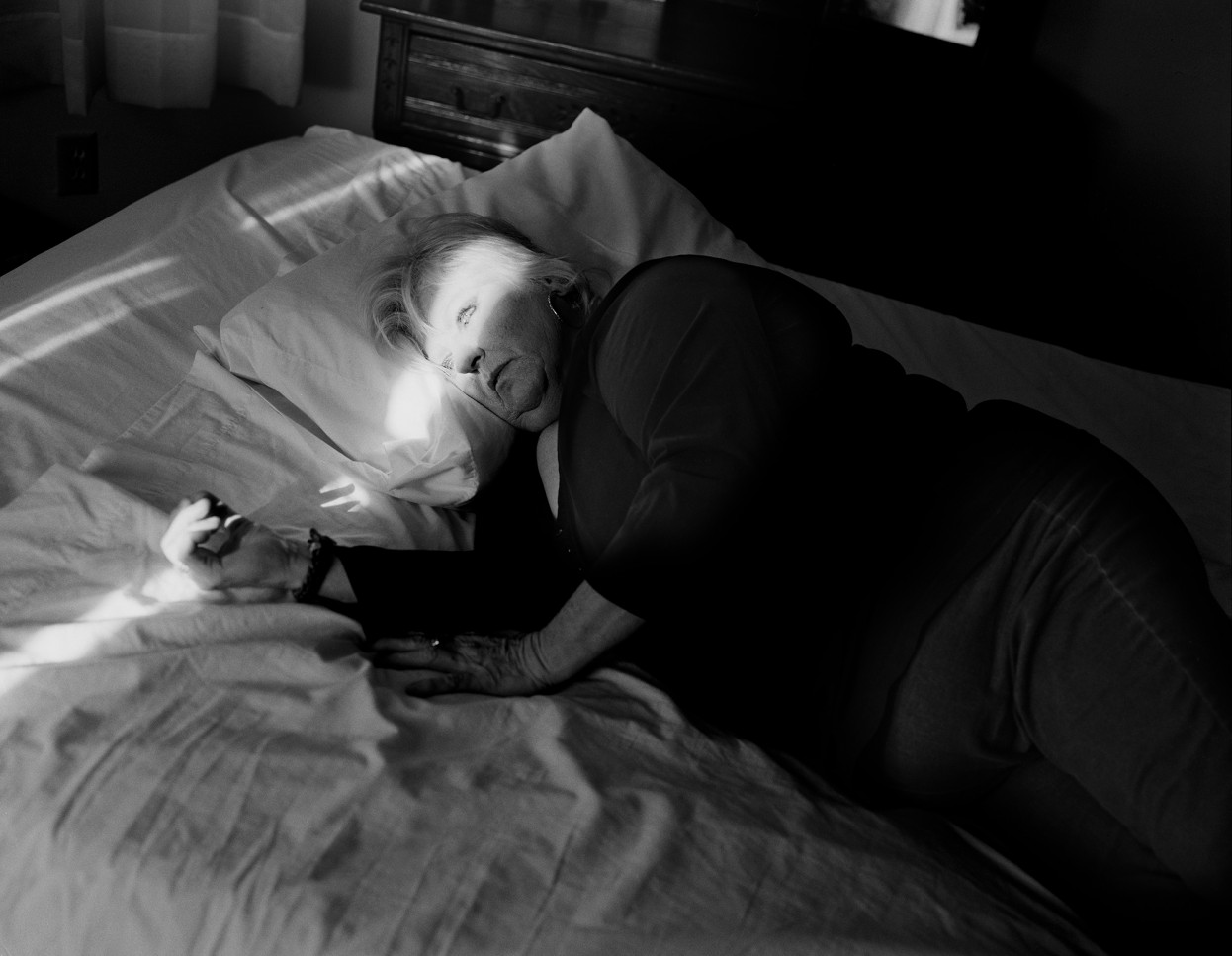
Daniel Coburn. The Matriarch, from The Hereditary Estate, Kehrer Verlag, 2014.

Daniel Coburn. The Matriarch, from The Hereditary Estate, Kehrer Verlag, 2014.

Light plays a complex and outsized role in The Hereditary Estate (Kehrer Verlag, 2014), photographer Daniel Coburn’s “broken family album,” to borrow a phrase of the photographer. Light not only illuminates the vivid Southern gothic panache of Coburn’s subjects—his extended family in and around Topeka, Kansas—but also seemingly seizes and manipulates their actions, leaving them stunned and confounded. Take two contrasting photographs of Coburn’s mother, for example. In The Matriarch, a slab of harsh white light has fallen across her face as if with the force of a poleax. She lies on her side, arms stiff, mascaraed eyes staring blankly, looking as if she was felled rather than simply resting. In Divine Light, she stands backlit like a movie star against a backdrop of trees and a picket fence as a benign sun hovers beyond the branches over her head and radiates light through the fence posts. That glowing orb and its slanting beams seem to nudge her forward toward the viewer, and she stands with one foot primed as if ready to walk out of the frame.

The image is just this side of sentimental; the flattering soft light, pyramidal composition, and quaint setting almost produce the effect of a sugary religious tableau. But there’s something hard, pragmatic, and fully terrestrial in her eyes. While in the previous image his mother appears as the passive object of a malevolent light’s violence, in Divine Light she and the light appear to work in conspiracy with one another. Fluorescent flames in the image of a brush fire on the adjacent page lick across the grass, as if summoned by her from across the gutter to the other side of the book.

Share

Mexico City

Mónica Mayer: Si Tiene Dudas… Pregunte at Museo Universitario de Arte Contemporáneo

Si Tiene Dudas… Pregunte [When in Doubt… Ask] at the Museo Universitario de Arte Contemporáneo (MUAC) is a retrocollective of works by feminist art pioneer Mónica Mayer (b. Mexico City, 1954). “Retrocollective” isn’t a very well-known term[1] and certainly not one that many artists would choose to designate their career retrospective, but Mónica Mayer isn’t like other artists. Since the late ’70s, Mayer has been discussing, rethinking, and refuting issues that are fundamental to the Mexican sociocultural environment: gender, equality, violence, age, body, memory, intimacy, labor, social policies, representation, and all of their possible combinations.

Polvo de gallina negra (Maris Bustamante and Mónica Mayer), ca. 1983; photograph.  Courtesy of the Artist and Museo Universitario Arte Contemporáneo.

Polvo de Gallina Negra (Mónica Mayer and Maris Bustamante), ca. 1983; photograph. Courtesy of the Artist and Museo Universitario Arte Contemporáneo.

Mayer’s artistic strength lies in the solid community she has formed around her activities, where friendship, empathy, and complicity play a pivotal role. As the exhibition title emphasizes, constant dialogue is her best weapon. It is indeed a Mónica Mayer show, but with a horizontal and collaborative discourse, which curator Karen Cordero Reiman successfully achieves. The exhibition stands as a recognition to the many contributors that have shaped these projects throughout the years. Their joint and fearless efforts have made visible what was previously disregarded from the canonical and patriarchal perspective.

When in Doubt… Ask follows a chronological order that highlights Mayer’s professional path. The body of works displayed in the exhibition cover a wide variety of mediums—from painting, print, collage, and photography to performance, video, TV appearances, mail art, actions, publications, and archives. The issues explored in her pieces more than thirty years ago still resonate today. Mayer’s acute awareness is the reason why the same questions are posed over and over again, though not without bitter taste.

Read More »

Share

Help Desk

Help Desk: Critic or Collector?

Help Desk is where I answer your queries about making, exhibiting, finding, marketing, buying, selling–or any other activity related to contemporary art. Submit your questions anonymously here. All submissions become the property of Daily Serving.

What are the ethics around a critic collecting art? I want to write a review of a dazzling painting show. While I can’t afford one of the paintings, I would like to buy one of the artist’s works on paper. Is there an ethical problem of covering this show and buying a piece not in the show—as long as I don’t write about the artist in the future? 

On Kawara. Paris–New York Drawing no. 144, 1964; Graphite and colored pencil on paper, perforated top edge, 4 9/16 x 18 1/16 in. Photo: David Zwirner, New York/London.

On Kawara. Paris–New York Drawing No. 144, 1964; graphite and colored pencil on paper, perforated top edge, 4 9/16 x 18 1/16 in. Photo: David Zwirner, New York/London.

I once walked into an exhibition and fell in love. The artist had restaged her childhood photographs with her adult body; the two images were framed side-by-side and titled with the hand-written captions from the original photo’s verso. At the time, I was examining my own identity and progress through life, and these images resonated on that same wavelength. They were priced at $600, which was the outer limit of what I could afford, and I made a quick calculation: I could buy one, or I could write a review. The former would give me a single possession that I might enjoy for my whole life; the latter would allow me to consider the entire suite of works and support the artist in a different (but no less tangible) way. In the end, I chose to review the show.

Undoubtedly there is a range of opinions on this subject; the field of art often appears to be a mucky marsh of ethical gray area. But to me, reviewing an artist when you own a piece of their work is unethical, even if that particular work is not in the show that you’re writing about. Exhibition reviews have the power to raise the social and economic value of an artist’s oeuvre, and if you own work by that artist you are—even inadvertently—raising the value of your own collection.

As usual, I asked around to see what others thought. Jen Graves, the visual arts writer at The Stranger, immediately sprang to mind; in 2007 she published an article that indicted critic Matthew Kangas for impropriety and conflict of interest. In that article, she wrote, “The emphasis on reporting instead of criticism, or in addition to criticism, has dragged critics into the same spotlight reporters work under, where lapses of judgment are firing offenses. Today, being embedded is looked at with suspicion, and being detached is more in vogue. Each position certainly has its merits. But the industry is still struggling to combine the two approaches in a way that keeps critics passionate, engaged, and knowledgeable, without allowing their biases to be, or to appear to be, personal or financial.”

Read More »

Share

Shotgun Reviews

Ellen Berkenblit at Susanne Vielmetter Los Angeles Projects

Shotgun Reviews are an open forum where we invite the international art community to contribute timely, short-format responses to an exhibition or event. If you are interested in submitting a Shotgun Review, please click this link for more information. In this Shotgun Review, Claire Colette reviews Ellen Berkenblit at Susanne Vielmetter Los Angeles Projects, Los Angeles.

Ellen Berkenblit. Pantherella Fine English Socks, 2015; oil, charcoal and paint stick on linen; 92 x 76 in. Courtesy of the Artist, Anton Kern, and Susanne Vielmetter Los Angeles Projects, Los Angeles. Photo: Adam Reich.

Ellen Berkenblit. Pantherella Fine English Socks, 2015; oil, charcoal and paint stick on linen; 92 x 76 in. Courtesy of the Artist, Anton Kern, and Susanne Vielmetter Los Angeles Projects, Los Angeles. Photo: Adam Reich.

On view now at Susanne Vielmetter Los Angeles Projects, Ellen Berkenblit’s new paintings are enigmatic, lively things. For her first solo show with the gallery, Berkenblit introduces fresh characters with her deft painting style—large works in oil and paint stick, featuring bold colors amid abstract shapes on a dark black background. An orange tiger is a repeat player, as well as a girl with a pointed nose and long eyelashes drawn in a fashion reminiscent of Pink Panther cartoons from the 1960s. The girl has starred in Berkenblit’s paintings for years, morphing from a sweet, round-nosed form to her current more elegant state. Since this metamorphosis several years ago, the artist’s paintings have become progressively reductive. Highlighting the action, her latest paintings are boiled down and stark—and increasingly powerful.

Berkenblit has stated in the past that her figures are merely an organizing device—vehicles to “carry the line that I wish to draw.” [1]  A narrative, if you see one, is unintentional and of your own making. Indeed, the relationship between Berkenblit’s characters seems tenuous. They float at random among abstract shapes in haphazard combinations, creating a dark, jungle-like feeling. The orientation of the elements changes quickly between paintings in assorted variations, with a dizzying effect. The tiger hangs upside down from the top of one painting, and crawls in from the bottom of another, mouth gaping open.

Read More »

Share

Baltimore

Whose Culture Is Not Your Friend?

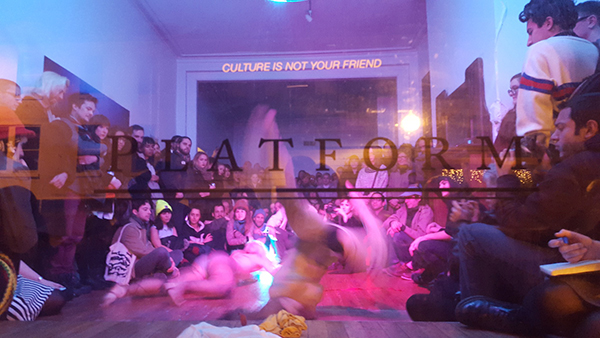
Today from our friends at BmoreArt, we bring you Angela N. Carroll’s reflections on FlucT’s performance Culture Is Not Your Friend at Platform Gallery in Baltimore, MD. Carroll says of the performance, “Much of what I experienced was performative in the most mundane and expected ways: a critique of sexuality by embodying overtly sexed archetypes. But maybe that’s the point.” This article was originally published on February 12, 2016.

Photo: Kristen McWharter

Photo: Kristen McWharter.

Platform Gallery, a small commercial gallery space in the Platform Arts Center on Mulberry Street, was filled to capacity with students and curious art patrons waiting to experience FlucT, the performance duo made up of Sigrid Lauren and Monica Mirabile. Culture Is Not Your Friend, an original piece performed by Lauren and Mirabile, employs repetition, movie scores, and choreography familiarized by popular culture to offer a generalized critique and analysis of the ways in which culture informs identity.

I was one of the masses squeezed against PAC’s walls in anticipation of the show. Before the hoards arrived, the sparse gallery space allowed voyeurs access to an installation of videos, photographs from past performances, and a framed image of two soiled pairs of underwear. FlucT experiments are jarring, sharp movements occasionally segued by narratives ripped from classic films and hyper-dub/futurist or hip-hop scores. FlucT works activate archetypes and formulas of popular culture, and their live and documented performances are becoming increasingly popular in performance art spaces.

Read the full article here.

Share

New Orleans

John Isiah Walton: Rodeo at The Front

At first glance, John Isiah Walton’s exhibition Rodeo, now on view at The Front in New Orleans, seems innocuous, even playful, with paintings of bulls diving through Pepto-Bismol pink skies toward men, frozen in space. But after a closer look, a smiling cynicism arises from the works. We, the viewers, are implicated as voyeurs in a decades-old tradition that exploits imprisoned men for entertainment: the Angola Prison Rodeo, “the Wildest Show in the South.”

John Isiah Walton. Rodeo, 2016; installation view. Courtesy of the Artist and The Front. Photo: John Isiah Walton.

John Isiah Walton. Rodeo, 2016; installation view. Courtesy of the Artist and The Front. Photo: John Isiah Walton.

Walton’s series of paintings and drawings depicts the rodeo at the Angola State Penitentiary, an 18,000-acre former slave plantation.[1] The Angola Rodeo is the longest running rodeo held within prison walls in the nation. Each April and October, as many as 10,000 people fill the stadium to watch prisoners ride bucking bulls, catch wild horses, and most notoriously, try to be the last one seated at a poker table while a bull stampedes toward them. Walton’s paintings are a sly nod to the voyeurism of this ludicrous tradition. In White Bull (2016), a spectrum of pinks in quick, painterly brushstrokes holds the subjects in space. The frenetic, choppy brushwork endows the work with energy and intensity. Other than a small amount of ground rendered at the bottom of the canvas, the subjects in the painting do not inhabit any recognizable world; instead, they seem to orbit in a pink atmosphere. Perhaps this acknowledges the dislocation of men in prison, who no longer live in the outside world. In the painting, a white bull—its face like one of the figures in Picasso’s Les Demoiselles d’Avignon—hovers, its hooves not yet sinking into the man below. There is tension in the depiction of both the man and the bull, rendered as flat shapes against the canvas, with few elements that suggest three dimensions: one leg depicted behind another leg, a hoof with a shadow. The tension of limited depth in the picture plane reminds the viewer that the painted mark is at once a thing in itself and the thing that it describes. We are looking both at the marks of the painting and at a depiction of the prisoners’ rodeo. We are voyeurs of this rodeo.

Read More »

Share

Baton Rouge

The Carnival, The City, and The Sea at Louisiana State University Museum Of Art

Curated by Xavier University professor Dr. Sarah Clunis, The Carnival, The City, And The Sea seeks to introduce the university’s community to the rich history of 20th-century Haitian painting as it evolved within the Centre d’Art of Cap-Haitien in the 1940s and ’50s, and to the eclectic constellation of styles and aesthetic intentions that continue to shape cultural production in the region.[1] Comprising works on loan from the New Orleans Museum of Art—in particular the archival collection of the Christian missionary and Haitian art collector Perry E. H. Smith—the exhibition orders the paintings and painted decorative objects into three themes: works that depict the celebrations and ceremonies of Kanaval, celebrated in the days before Lent; representations of the bustling streets of Haitian cities where commerce, cultures, and urban sprawl collide; and works that mark the Haitian people’s unique relationship with the waterways that flow in and around the nation, specifically the Caribbean Sea and the Atlantic Ocean.[2]

Antoine Obin. Philomé Obin et son Fils, Antoine. 1977. Oil on board. Image courtesy of the New Orleans Museum of Art and the LSU Museum of Art.

Antoine Obin. Philome Obin et son Fils, Antoine, 1977; oil on board. Courtesy of the New Orleans Museum of Art and the LSU Museum of Art.

The selections from the Smith collection are vital examples of the self-conscious representation of Haitian spiritual subject matter through a vernacular, representational, and intentionally simplistic style led by Philomé Obin in the city of Cap-Haitien (eighty-five miles north of the more commercial Centre d’Art in Port-au-Prince). Obin worked to represent the daily life, secular experiences, and religious traditions of Haiti that scrape against the commercial initiatives and explosion of the Haitian art markets during the middle of the 20th century. The stark organization of composition within Obin’s style becomes more embellished in the hands of the second generation of artists at the Centre d’Art in Port-au-Prince, who experiment with the flattened figures, great exaggerations of scale, and a shared desire to represent the more isolated northern city. Works play with Western traditions of perspective; Volvick Almonor’s Le Bal (1976) constructs a scene that dramatizes encounters between dancing couples and destabilizes the physical and spatio-temporal boundaries between inside/outside, public/private, culture/nature that often structure non-Western cultures with strong connections of ancient forms of worship and ritual practice, specifically Haitian Voudou. These traits are further expanded in Préfète Duffaut’s extraordinary work Imaginary Landscape (1979), a painted box of lush, melting vegetation and picturesque views of sea and Haitian countryside, in perfect harmony with humankind, spread in infinite continuity across the surface: an imagined utopia far from the real conditions of Haiti.

Read More »

Share