Stamford

Cut-Up at Franklin Street Works

“Everything in the world began with a yes. One molecule said yes to another molecule and life was born,” professes Clarice Lispector in the first lines of her 1977 novel, The Hour of the Star. Like the universe, art also begins with a yes. Some yeses are small: get out of bed today, put this image next to that one. Other yeses are bigger: continue affirming the validity of my presence, let go of assumed truths and embrace the miraculous unknown. The most productive yeses often occur when we welcome the primordial chaos of incomplete ideas and allow new meaning to grow out of incongruities. In Cut-Up: Contemporary Collage and Cut-Up Histories through a Feminist Lens, curated by the artist Katie Vida at Franklin Street Works in Stamford, Connecticut, the works of twenty-two artists demonstrate the potential of jumbling discordant materials and ideas.

Phyllis Baldino. The Unknown Series, 1994–96 (detail); mixed media. Courtesy of the Artist.

Phyllis Baldino. The Unknown Series, 1994–96 (detail); mixed media. Courtesy of the Artist. Photo: Matt Grubb.

In the exhibition’s newsprint handout, Franklin Street Works’s creative director Terri C. Smith writes about two divergent connotations of the term cut-up: it implies both works of art made by extracting and reconfiguring source materials to produce something new as well as a mischievous prankster that disrupts order, promoting confusion by upsetting social hierarchies. While each of the works on view exhibits these qualities to varying degrees, the Brooklyn-based artist Phyllis Baldino is a cut-up par excellence. In her video piece, The Unknown Series (1994–96), Baldino implicates a medley of mundane objects in a wry investigation of their possible uses and uselessness. “Americans will sell you anything, even if they do not know what it is,” explains Baldino of the thrift-store trinkets she bought and then redefined through her interventions.[1] The Unknown Series features thirty objects, each filmed for no more than sixty seconds, during which time Baldino de- and re-constructs each with the utmost intentionality. The resulting objects, given descriptive titles such as Shaving Cream Thing, Straw Thing, Mayo Thing, and Green Velour Pads Thing, embody puckish mutations of their original functions.

Read More »

Share

Mexico City

Andrew Birk: Callejero at Anonymous Gallery

Andrew Birk is a gringo. I don’t mention this as an insult—I’m one too, after all—but to give some context to his work. The Portland, Oregon, native has lived in Mexico City since 2011 and has a clear affinity for the cacophony and vibrancy of this dense, sprawling metropolis. It is with the fresh eyes of an outsider that Birk is able to translate the street life around him in his solo show Callejero at Anonymous Gallery.

Andrew Birk. Callejero, 2016; installation view, Anonymous Gallery, Mexico City. Courtesy the artist and Anonymous Gallery, Mexico City.

Andrew Birk. Callejero, 2016; installation view, Anonymous Gallery, Mexico City. Courtesy of the Artist and Anonymous Gallery, Mexico City.

In Spanish, callejero translates to an adjective form of “street,” indicating something as being of or from the street. It also connotes a wanderer, similar to the European flâneur, who traverses the city without purpose, absorbing a constant stream of urban sights, sounds, and smells. Birk does more than simply depict la calle (the street). He has created an evocative environment that is street-like. As curator Daniel Garza Usabiaga notes in an essay, “Birk’s work transcends the simple domain of representation, in the manner of a stage… Callejero does not aspire to realism.” Through an immersive installation that incorporates paintings, sculpture, light, and sound, he channels the myriad sensations of the world outside the gallery. In other hands, this endeavor might have been doomed to misguided essentialism, but Birk’s enthusiasm, sincerity, and keen eye make for a captivating experience.

Upon entering the gallery, visitors encounter a large piece of twisted aluminum that rises up from the ground to form a peaked arch, supported in the middle by a thin pole. Flyers advertising wares for sale are affixed to the structure, and packs of cigarettes dangle from a strap, similar to the ones displayed by vendors selling loosies on seemingly every other corner. Birk told me that the sculpture, El Caminero (2016), is based on a similar object he encountered on a grassy median near Cuernavaca. It seemed like it might just be a piece of urban detritus, but the fact that it was supported by a pole gave him the impression that someone had created it as a piece of DIY street art. It stood there for months without anyone carting it off as garbage or laying claim to it as artwork, occupying a liminal space between accident and intention that so often characterizes the city.

Read More »

Share

Savannah

State of the Art: Discovering American Art Now at the Jepson Center

The contemporary-art business is frequently portrayed as a cosmopolitan endeavor. The centers of the art world typically are cities where people buy expensive art, and easily consumable forms—like oil-on-canvas paintings—are usually favored by collectors and dealers. The exhibition State of the Art: Discovering American Art Now, presented by the Jepson Center at the Telfair Museums in Savannah, Georgia, explores artistic activity throughout the country; with a handful of exceptions, most of the represented artists work largely outside of major art centers. Organized by the Crystal Bridges Museum of American Art, the show attempts to find commonalities in the work of a broad group of artists.

Sheila Gallagher. Plastic Lila, 2013; melted plastic on armature; 81 × 64 1/2 in. Courtesy of Crystal Bridges Museum of American Art, Bentonville, Arkansas. Photo: Stewart Clements Photography.

Sheila Gallagher. Plastic Lila, 2013; melted plastic on armature; 81 × 64 1/2 in. Courtesy of Crystal Bridges Museum of American Art, Bentonville, Arkansas. Photo: Stewart Clements Photography.

While State of the Art presents a diverse group of artists, certain aspects of the exhibition reinforce stereotypes of regional art. A number of works in the show eschew traditional media, with several using typical craft materials, like yarn, children’s toys, and fake foliage. While such materials have certainly been seen in mainstream contemporary art over the past several decades, commercial art centers and art fairs tend to feature accustomed media, like oil or acrylic on canvas, that appear sparingly in this show.

This focus on unconventional media is one of the show’s central conceits, and it becomes one of its strengths. Shelia Gallagher’s Plastic Lila (2013) embodies this embrace. Appearing at first as a large, brightly colored abstract painting, the work is revealed by closer inspection to consist solely of melted plastic items, created in sections using a typical barbeque grill. Similar to Marcel Duchamp’s declaration that the tube of paint is a readymade—meaning that paintings are indeed “readymades aided,” in his words—Gallagher’s painting explores the concept of what makes a painting by using found objects in the place of paint.[1] The wonderfully surreal sculptures of Jeila Gueramian are composed with crocheted quilts and other textiles, materials tritely connected to craft though increasingly appearing in mainstream art. Works that show the persistent experimentation with materials include the large, geometric-painting-like End of the Spectrum (2011) by Ghost of a Dream, which consists of a vivid array of hundreds of used lottery tickets.

Read More »

Share

Shotgun Reviews

LOVE IV: Cold Shower at the Schinkel Pavillon

Shotgun Reviews are an open forum where we invite the international art community to contribute timely, short-format responses to an exhibition or event. If you are interested in submitting a Shotgun Review, please click this link for more information. In this Shotgun Review, Amanda Ribas Tugwell reviews LOVE IV: Cold Shower at the Schinkel Pavillon in Berlin.

Anthea Hamilton and Nicholas Byrne. LOVE IV: Cold Shower, 2016; installation view, the Schinkel Pavillon, Berlin. Courtesy of the Artists and the Schinkel Pavillon.

Anthea Hamilton and Nicholas Byrne. LOVE IV: Cold Shower, 2016; installation view, the Schinkel Pavillon, Berlin. Courtesy of the Artists and the Schinkel Pavillon.

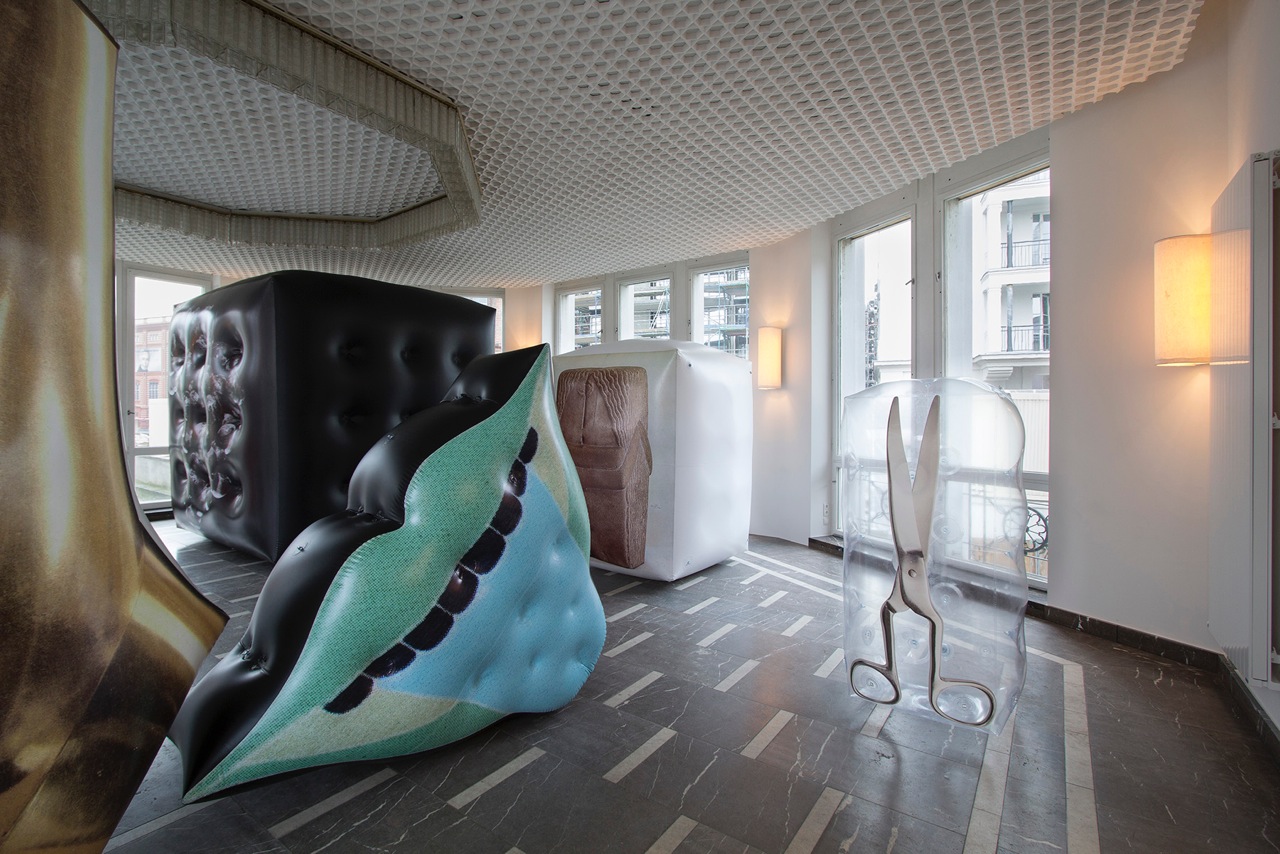
The fourth iteration of Anthea Hamilton and Nicholas Byrne’s LOVE series, Cold Shower packs large-scale inflatables—some old and some new—into the Schinkel Pavillon, a GDR building now surrounded on all sides by construction sites. The large windows that arc around the octagonal room offer up a swathe of gray sky, barren trees, and cranes, and are now half-obstructed by voluptuous vinyl shapes. Whether opaque or transparent, their surfaces sport images of everything from a pair of scissors, to a wide-smiling emoticon mouth, to a stock image of Turkish delight.

Three pieces stand out at the entrance, all of which feature images of modernist sculptures by Constantin Brâncuși, including the stone-carved The Kiss (1913) and brass Male Torso (1917). The latter appears twice, once large and once as an almost child-sized copy. In 3D form, the two formally perfect phallic bodies, along with all of the once-flat image surfaces, are now dimpled with belly buttons, fleshy bulges, and wrinkles.

Read More »

Share

Interviews

Unbreakable: Interview with Larissa Sansour

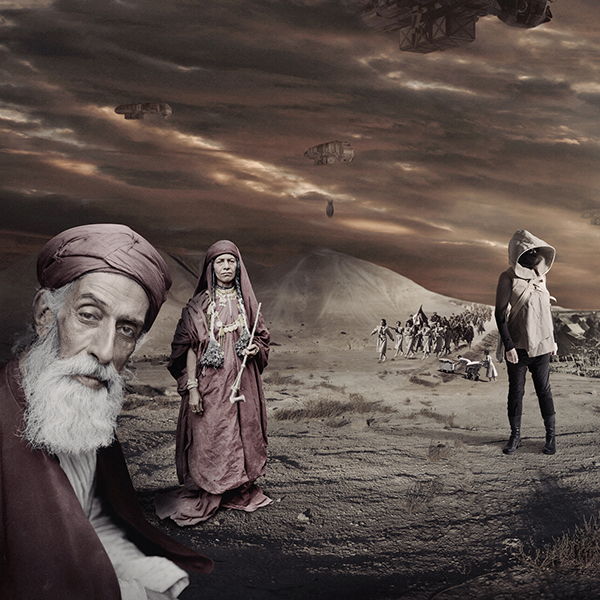
From our friends at REORIENT, today we bring you an interview with Palestinian video artist Larissa Sansour. Author Abdellatif R. Abdeljawad talks with Sansour about rewriting histories, science fiction as a vehicle to explore the Palestinian condition, and the inherent political nature of art. Abdeljawad says of Sansour’s most recent work, In the Future, They Ate from the Finest Porcelain, on view at Lawrie Shabibi in Dubai through March 3: “Sansour’s film (made in collaboration with Søren Lind) blurs the lines between fiction and documentary, and myth and reality, championing Palestinian identity in the depths of time and space.” This article was originally published on February 16, 2016.

Larissa Sansour and Søren Lind. In The Future, They Ate from the Finest Porcelain, 2015 (film still). Courtesy the Artists and Lawrie Shabibi.

Larissa Sansour and Søren Lind. In The Future, They Ate from the Finest Porcelain, 2015 (film still). Courtesy of the Artists and Lawrie Shabibi.

Abdellatif R. Abdeljawad: Do you eat yourself from the finest porcelain?

Larissa Sansour: Well, I guess the whole premise of the film is that this rebel leader narrator is setting up an elaborate operation in order for the future generations of Palestinians to obtain the basic privileges that history has so far denied them; so, it is basically a revisionist historical comment. Am I eating from the finest porcelain? Right now, maybe in my mind … but not according to the rest of the world. I want the rest of the world to see me as a person who is doing so.

This work is very much about who tells history, and how much myth and fiction are really a part of writing history. If the world does not realize that we exist, we might as well just bury some porcelain DNA for future archaeologists to find, as a stick in the wheel on currently accepted versions of history. Maybe the revisions that this porcelain will cause will tilt the balance in favor of the Palestinians at some point in the future. The film is also a commentary on how Israel uses archaeology as headline news, and how it has been instrumentalized, rather than been seen as a scientific method … Israelis wants to prove something, and therefore they dig to find evidence supporting a fiction already having taken the form of fact; they use archaeology towards their own political ends, and it is becoming a means by which to prove a continued historical presence entitling them to territories currently belonging to others.

Read the full article here.

Share

From the Archives

From the Archives – Fan Mail: Wendy Given

Today we’re looking back at our Fan Mail series to reconsider the work of artist Wendy Given, who “uses the component parts of a visual language used for telling folkloric tales that are, as the artist says, ‘inspired by narrative literature from all over the world.’” Given recently had work in an exhibition at the Autzen Gallery at Portland State University, and in April 2016 will be part of the two-person exhibition Nocturne (with Ryan Pierce) at Whitespace in Atlanta, Georgia. This article was originally published on March 14, 2014.

Wendy Given. On Myth and magic No. 14: Chrysalis, 2010: C-print; 40” x 60” inches. Photo courtesy of the artist.

Wendy Given. On Myth and Magic No. 14: Chrysalis, 2010; C-print; 40 x 60 in. Courtesy of the Artist.

Mythos: fantasy, fiction, legend, saga, parable, fable, narrative, invention, fabrication, yarn. The conceptual distance between myth and the concrete manifestations of mythology is a potentially endless—yet meaningfully orderable—list of synonyms. But with each word the gap shrinks, as mental images of processes and then objects emerge, even if just as puns. Wendy Given is bridging the gaps between the abstract idea of a mythos and its textural and visual components—the story.

Given’s work includes photography, sculpture, and installation, often combining all three to create imagery for mythologies and stories. These stories simultaneously capture and unite the literal and abstract components of the processes of mythmaking. She pays particular attention to the natural world and provides placeholders for the components of stories—characters, settings, objects, rituals—and in so doing constructs nearly identifiable narratives. It’s important to note that Given is neither illustrating existing stories nor inventing new ones—her practice does something in between. Her works are not quite archetypal, but they hold just enough familiarity to stimulate the imagination.

Read More »

Share

Mexico City

The End at Estudio 71

The two-year residency program of Estudio 71, organized by the artist Berta Kolteniuk in collaboration with Sinagoga Histórica, culminates in the exhibition The End. A show like this one, based on the work resulting from several artist residencies, runs the risk of lacking curatorial direction, and indeed the work on display does not immediately convey any aesthetic or conceptual unity. It includes everything from representational paintings and drawings to installations and sound art. Likewise, none of the individual artists’ themes cohere around any one idea; the works address everything from violence to landscapes. But it does not feel haphazard, but rather vibrant and exciting. As the viewer moves through the show, it becomes clear that this success hinges on the relationship between the building and the artists.

Victor del Moral. (d) Es: truccion, tructura, critura (fragmento 5), 2015; installation. Variable dimensions. Courtesy of the artist and Estudio 71, Mexico City. Photo: Jorge Gomez del Campo.

Víctor del Moral. (d) Es: truccion, tructura, critura (fragmento 5), 2015; installation; dimensions variable. Courtesy of the Artist and Estudio 71, Mexico City. Photo: Jorge Gomez del Campo.

The studio and exhibition program have revitalized an abandoned historic building in downtown Mexico City, but the organizers have left the structure minimally restored. Large and small holes pepper the ceilings, and aged paint and plaster chip off of the walls. Some of the works play literally with this relationship. The installation (d) Es: trucción, tructura, critura (fragmento 5) (2015) by Víctor del Moral intervenes directly on the cracked and stained surfaces of the gallery’s two floors. Part of it uses a material that looks similar to the vinyl lettering used in trade shows. Despite the dramatic physical difference between the artist’s marks and the worn surfaces, the artist manages to blend his work with the building. Similarly, in other fragments of the installation, the artist places subtly modified sheet-metal wall studs throughout. These barely altered construction supplies blend with the rough and crumbling old building, and appear like leftovers of an abandoned remodel. Del Moral emphasizes that the work of art always exists in relation to its context.

Read More »

Share