San Francisco

Bring It Home: (Re)Locating Cultural Legacy Through the Body at San Francisco Arts Commission Gallery

Today from our partners at Art Practical, we bring you an excerpt from Brian Karl’s review of Bring It Home: (Re)Locating Cultural Legacy Through the Body at the newly reopened San Francisco Arts Commission Gallery. The author notes, “Given the particularly intense struggles in the Bay Area today, where citizens are denied access to civil rights and basic resources by the structural discriminations of racialist and upward-funneling economic policies, the SFAC Gallery can perform a greater social role by further addressing these pressing issues in the cultural realm.” This article was originally published on March 17, 2016.
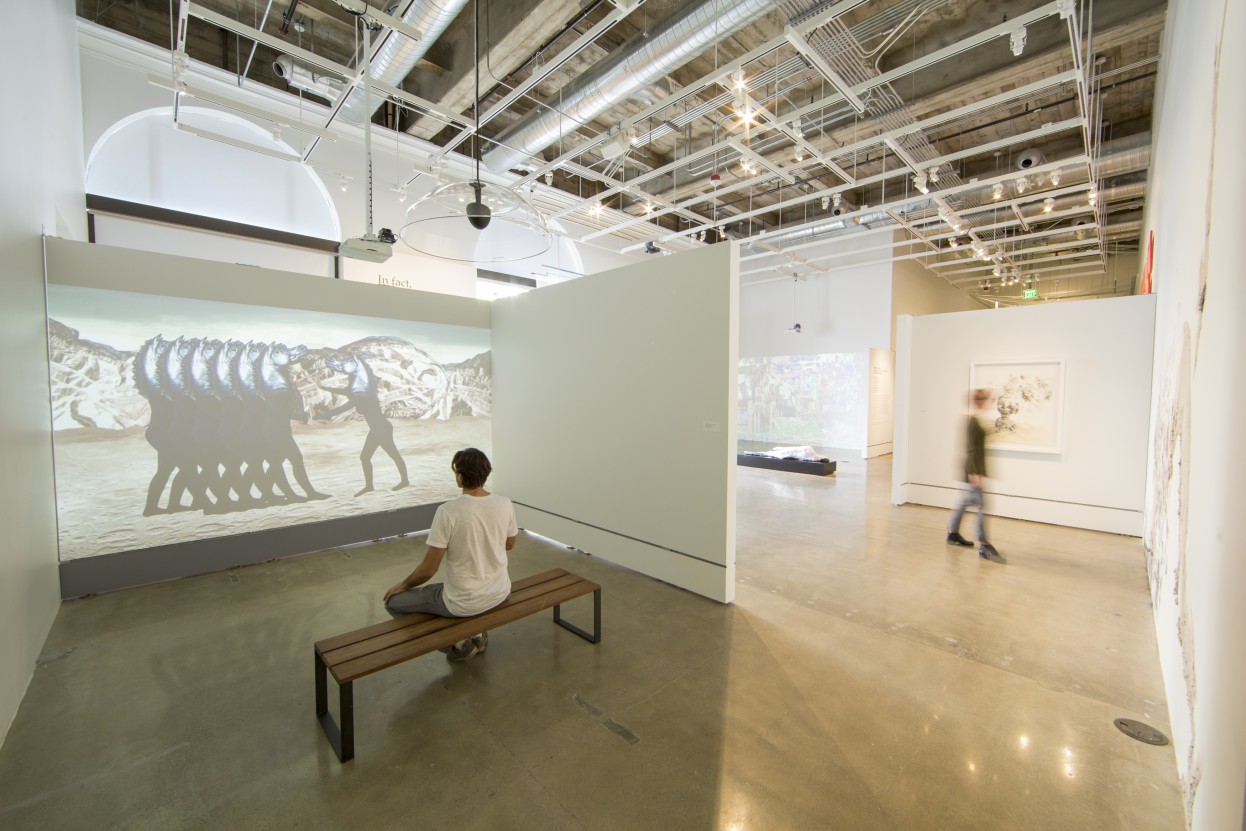
Zeina Barakeh. Homeland Insecurity, 2015; single channel animated video, 6:00. Courtesy of the Artist. Photo: Scott Chernis.

Zeina Barakeh. Homeland Insecurity, 2015; single-channel animated video; 6:00. Courtesy of the Artist. Photo: Scott Chernis.

Bring It Home consolidates several generations of self-consciously multiculturalist impulses in contemporary U.S. art practices. Layered on top of an even-handedness toward gender and some range of age representation, the attention to artist demographics in this show is evident, touching on cultural antecedents originating in far-flung points on the globe, from Asia to the Middle East to south of the U.S. border.

Noticeably balanced, for instance, are neighboring installations by Zeina Barakeh and Dana Harel. Barakeh is a Lebanese-born Palestinian video artist whose project manages to animate, at once playfully and seriously, a wordless narrative of power. Harel is an Israeli artist whose flowing pencil strokes and overlapping stucco relief form the image of a single human body intertwined with a vine-y plant onto a blank gallery wall. The other pieces in the exhibition are diversely arrayed in their placement, media, and materials as well. The insistently vertical physical presence of Ramekon O’Arwisters’s highly textural knitted sculptures evokes the artist and his grandmother as abstract statues of sorts, and are counterpoised to the smooth, low, horizontal pool of Jeremiah Barber’s dark, body-sized platform for a single human body to be laid out and/or performed upon. A text-based wall piece by Guillermo Gómez-Peña, the detailed collage works of Carolyn Janssen and Tsherin Sherpa pointing toward and complicating spirituality for individuals, the more evanescent projections of layered family figures by Summer Mei Ling Lee, and the shifting layers of postcolonial place by Ranu Mukherjee occupy different niches in other reaches of the space.

Read the full article here.

Share

Los Angeles

Revolution in the Making: Abstract Sculpture by Women, 1947–2016, at Hauser Wirth & Schimmel

With galleries in Zurich, London, Somerset, and New York, the Hauser & Wirth enterprise has inaugurated their newest outpost in Los Angeles, Hauser Wirth & Schimmel, with the exhibition Revolution in the Making: Abstract Sculpture by Women, 1947–2016. Curated by Jenni Sorkin and Paul Schimmel, the show sprints through seventy years of art history with nearly one hundred works by thirty-four women. Sorkin and Schimmel take a nervy stand, making a convincing case of women artists as the progenitors of contemporary abstract sculpture. But is this what revolution looks like?

Magdalena Abakanowicz. Wheel with Rope, 1973; installation view, Revolution in the Making: Abstract Sculpture by Women, 1947-2016. Courtesy of the artist and Hauser Wirth & Schimmel, Los Angeles, CA.

Magdalena Abakanowicz. Wheel with Rope, 1973; installation view, Revolution in the Making: Abstract Sculpture by Women, 1947-2016. Courtesy of the Artist and Hauser Wirth & Schimmel, Los Angeles, CA.

The exhibition is almost thorough enough to counter the significance of Unmonumental, the New Museum’s 2008 blockbuster proposition that sculptural assemblage, with its low-tech modesty, exploration of contingency, and embrace of unstructured play, was somehow novel. Revolution in the Making uses materiality, tactility, and the autonomous labor of the artist in her studio as its lynchpin, which allows for a sweeping breadth of work. The show ricochets from the formal investigations of Ruth Asawa to the psychologically loaded works of Isa Genzken, and from the blowsy assertiveness of Magdalena Abakanowicz’s Wheel with Rope (1973) to the fugitive wire constructions by Gego that are as ephemeral as a syllable blown into the air. The artists’ improvisational uses of found material and embrace of unpredictable forms dramatically break open the category of sculpture.

In her tour, Sorkin pointed to the Smith-Hughes Act of 1917, which institutionalized in American society the schoolboy’s place in shop class and the schoolgirl’s place in home economics. The compelling moments in the exhibition occur when realizing that most of these women worked—and continue to work—with materials and processes in defiance of a world formed by the Smith-Hughes Act. They occupied a space in direct opposition to the dominant norms: their studios. When they didn’t have traditional studio spaces, some of these women found a way to make work in their kitchens, their boyfriends’ studios, or in their children’s rooms, showing just how powerful the margins can be.

Read More »

Share

Hashtags

Hashtags: Crossing the Lines

#capitalism #markets #institutions #gentrification #innovation

Two recent unconventional gallery openings on the West Coast have upended expectations about how the commercial and nonprofit sectors of the art world correspond to and interact with one another. Hauser Wirth & Schimmel’s seven-building complex in Los Angeles’ downtown arts district is a commercial gallery with institutional ambitions, promising thematic exhibitions, high-profile loans, publishing, and scholarship. Minnesota Street Project, located at 1275 Minnesota St. in the Dogpatch neighborhood of San Francisco, is uniting ten different galleries in a cooperative setup that includes shared exhibition space and joint events. While both entities are for profit, they’ve adopted nonprofit conventions that speak to the art market’s shift away from exhibitions and toward art fairs, which reduces the value of the monthly rotating shows that are standard in the majority of commercial galleries.

Exterior view, Hauser Wirth & Schimmel, 2016. Image courtesy Hauser & Wirth. Photo: Joshua Targownik / targophoto.com

Exterior view, Hauser Wirth & Schimmel, 2016. Courtesy of Hauser & Wirth. Photo: Joshua Targownik/targophoto.com.

A comparison of these two new spaces is fruitful; they are as different from one another as they are from the average gallery. Hauser Wirth & Schimmel is a partnership between one of Europe’s most esteemed blue-chip galleries and Paul Schimmel, the former MOCA chief curator whom many credit with putting Los Angeles artists from the 1990s on the map. Fueled by cash and name recognition, HW&S continues the established Hauser & Wirth model of developing exhibitions that go beyond the traditional gallery functions of representation and sales. The motivation is not necessarily philanthropic, although the new HW&S does appear to have, if not a public mission, a strategy for public engagement that emphasizes accessibility as well as scholarship. The education program, headed by former MOCA public programs curator Aandrea Stang, will bring leading intellectuals to give public lectures and offer tours of the exhibition to schoolchildren and the public, free of charge. These museum-like activities make the gallery into a destination, one that incentivizes visits by collectors who favor the biennial and museum circuit, and who are increasingly unlikely to make the trip to a gallery just to buy art.

Read More »

Share

Shotgun Reviews

Radiohalo at Blain|Southern

Shotgun Reviews are an open forum where we invite the international art community to contribute timely, short-format responses to an exhibition or event. If you are interested in submitting a Shotgun Review, please click this link for more information. In this Shotgun Review, Adam Monohon reviews Michael Joo’s Radiohalo at Blain|Southern in London.

Michael Joo. Radiohalo, 2016; installation view. Courtesy of the Artist and Blain|Southern, London. Photo: Peter Mallet.

Michael Joo. Radiohalo, 2016; installation view. Courtesy of the Artist and Blain|Southern, London. Photo: Peter Mallet.

At the center of debate between creationists and the scientific community over the origin of Earth are microscopic areas of discoloration found within certain rocks: radiohalos. These spherical discolorations are traces of radioactive energy; each attests to the presence of radioactive particles trapped within rock as it formed. Once a geological curiosity, radiohalos have become crucial to arguments for a Young Earth since, according to creationist scientist Robert V. Gentry,[1] they should not exist at all if the Earth truly took millennia to fully form.

Michael Joo’s current exhibition at Blain|Southern, titled Radiohalo, is composed of works deeply concerned with similar themes. The works contemplate and record traces of energy, subtly questioning the relationship between nature and humanity as mediated by science.

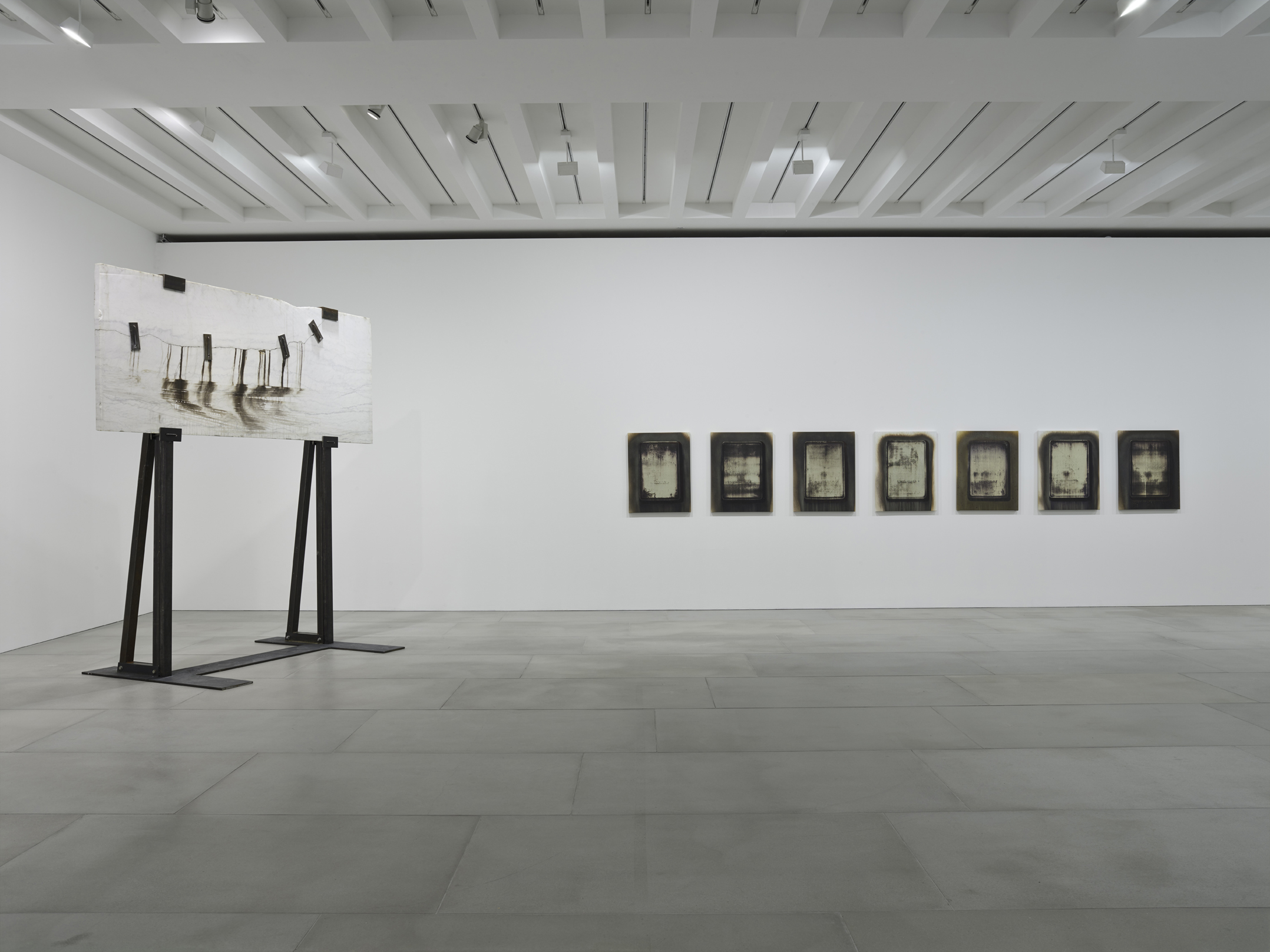
At the center of Radiohalo is a new series, Caloric Paintings (2015–2016). Faintly visible in each work is a series of digits attesting to the amount of energy necessary to conduct a specific physical task, explained in each title—such as Untitled (Take) (2016) and Untitled, To (Drive) (2015–2016). Each work bears an exceptionally specific number, one that projects a sense of scientific precision, alluding to the intricacy of even the most mundane task. However, the very ambiguity of these titles leaves the accuracy of his methodology questionable, reminding viewers that the seeming exactness of products of the scientific process can belie shaky foundations.

Read More »

Share

Interviews

Interview with Mariah Garnett

Today from our friends at BOMB Magazine, we bring you an interview with Mariah Garnett. Author Risa Puleo speaks with Garnett about her time in Belfast, the making of the film/exhibition Other & Father, and the roles of identity and failure in her films. Garnett says, “That was one thing I was interested in for the film: the way identity is constructed and history is performed, passed down, and reenacted—what’s real, what’s not. One of my friends said, ‘Oh there’s always a wee riot somewhere [….]’” This article was originally published on March 3, 2016.

mariah_garnett

Mariah Garnett. Encounters I May Or May Not Have Had With Peter Berlin, 2012 (film still); 16mm film; 14:00. Courtesy of the Artist.

The cinema “teach[es] me to tirelessly touch with my gaze the distance from me at which the other begins.” So wrote the French film critic Serge Daney in 1992, reflecting on a life led looking and thinking about cinema in the months before his death. Mariah Garnett uses the camera to see her subjects from various perspectives to bridge this distance. Aware of the camera’s limitations, she employs various strategies belonging to documentary, narrative, and experimental filmmaking, occasionally reenacting her subjects in attempt to know them further.

The subjects Garnett has engaged with her camera include Catalina de Erauso, the 17th-century Basque nun who lived as a man and a soldier in colonial Latin America, in the 2011 film Picaresques; the sex symbol Peter Berlin, in the 2012 film Encounters I May or May Not Have Had with Peter Berlin; and veterans who place their bodies in extreme circumstances as Hollywood stuntmen, in the 2014 film Full Burn. The subject of Garnett’s most recent film, Other & Father, premiering in Belfast in February and Los Angeles in March, is her father.

Risa Puleo: We’ve been missing each other across Europe and the States since Margaret Haines introduced us in the Spring after she found out I was researching Catalina de Erauso, the subject of your film Picaresques. Why were you interested in Catalina, and how did you find her?

Mariah Garnett: There are so many layers there. The gender stuff, for sure. She’s such an unreliable narrator, because she’s basically pleading for her life, so she’s playing up all these exploits in a performance of masculinity. You never know how she actually feels.

Read the full article here.

Share

Fan Mail

Fan Mail: Taylor Baldwin

Taylor Baldwin’s multidisciplinary practice could be described as an experiment in material and historical mutation. Through a combination of sculptural installations, drawing, and video, the artist investigates the notion of the object as a site of transformation, altered by intangible elements such as the passage of time and death. Though his recent works have been mostly three-dimensional, Baldwin’s entry point into art began with drawing. Some of his early influences include the French cartoonist Mœbius and the American book artist Geoff Darrow, both of whose works possess a level of detail and complexity that Baldwin later echoed in his own drawings.

Taylor Baldwin. ecto 1 (I ain’t afraid of no ghosts drawings), 2009; ink on paper; 8.5 x 14 in. Courtesy of the Artist.

Taylor Baldwin. Ecto 1 (I Ain’t Afraid of No Ghosts series), 2009; ink on paper; 8.5 x 14 in. Courtesy of the Artist.

Baldwin’s intriguing mode of historical reference is illustrated in Ecto 1 (2009), from his I Ain’t Afraid of No Ghosts series. The intricate line drawing shows the vehicle from Ghostbusters (1984), a movie that portrayed New York in a grim, fearmongering light along with a number of other films like The Warriors (1979) and Death Wish (1974). These movies corroborated the myth of a crime-ridden New York, where a car left alone in Coney Island or the Bronx would be stripped down. In Ecto 1, Baldwin heightens the effects of the time and place; there is more symbolism in the work: what appears graffiti-like to the untrained eye is actually an expression in hobo symbols that says, “This is not a safe place, be prepared to defend yourself and get out quick.” The artist is fascinated with recurring patterns of anarchy and survival that weave through history.

Read More »

Share

Portland

The Lasting Concept at Portland Institute for Contemporary Art

The Lasting Concept at Portland Institute for Contemporary Art (PICA) is, by design, chronically unsure of its form. Initially conceptualized as a publication of the same name, the exhibition explores the nagging, process-driven revelation of being unable to excise a particular understanding from one’s thinking. With content that requires a method of digestion similar to reading, the exhibition’s connection to experimental publishing is evident. It’s not enough to flip to only pages with varied images. The works in The Lasting Concept require study—a reading and rereading in hopes of demonstrating the reason for their occupation.

Bill Hayden and Sam Pulitzer. Yet to be Titled, 2016; adhesive vinyl, dimensions variable. Courtesy of the artist and (gallery). Photo: Evan La Londe/WORKSIGHTED

Bill Hayden and Sam Pulitzer. Yet to Be Titled, 2016; adhesive vinyl; dimensions variable. Courtesy of the Artists. Photo: Evan La Londe/WORKSIGHTED.

It’s simpler to recall the exhibition in detail by distinguishing its structure. Akin to a physical manifestation of a memory palace, The Lasting Concept is installed with a subtly repetitive air. The works comprise serial representations of poetry, sculpture, and environmental interventions that extend into PICA’s office. Twenty-four artists created twice as many works, some riffing off of their previous iterations in other spatial compartments of the gallery.

Bill Hayden and Sam Pulitzer’s site intervention, Yet to Be Titled (2016), occupies the width of PICA’s third-story windows. The adhesive vinyl lettering simultaneously greets and heckles viewers passing from the street, reading, “What’s Up, Civilians?” The piece appears to question the mental state and intentions of the non-militarized masses—those who are not a member of America’s institutionalized protective forces. It’s difficult to assess whether the tone is accusatory. After all, these forces (though often steeped in controversy and antagonism) are extensions of the society that we, as civilians, have excused. The answer to Hayden and Pulitzer’s question isn’t reflexive—it’s meditative, as is the intention of The Lasting Concept as a whole.

Read More »

Share