Dhaka

Five Emerging Artists from Bangladesh

In Bangladesh, the 2016 Samdani Art Award exhibition (one of seven shows that was part of the Dhaka Art Summit) provided a survey of some of the most engaging young artists working there. Daniel Baumann, director of Kunsthalle Zürich, selected thirteen artists from over 300 applicants. In his introduction to the show, Baumann wrote that he had the sense that “something was going on there” when he visited to meet the short-listed artists and curate the final exhibition. Looking at a handful of these artists will elaborate just what that “something” might be.
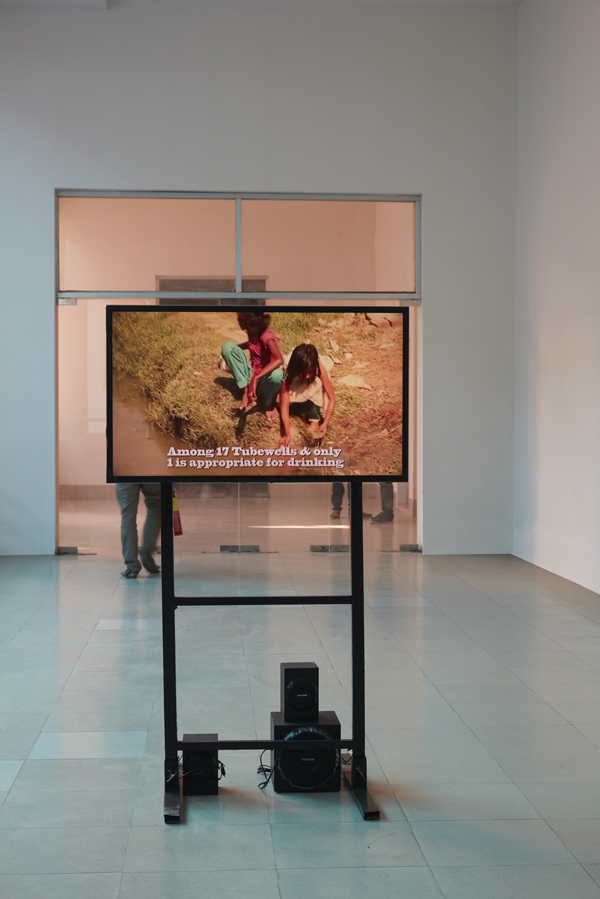
Zihan Karim and Chang Wan Wee. Habitat, 2013. Courtesy of the Artist, Dhaka Art Summit, and Samdani Art Foundation. Photo: Jenni Carter.

Zihan Karim and Chang Wan Wee. Habitat, 2013; installation view. Courtesy of the Artist, Dhaka Art Summit, and Samdani Art Foundation. Photo: Jenni Carter.

Even before entering the exhibition gallery, viewers are confronted with a video work by Zahin Karim and Chang Wan Wee on a large flat screen. Habitat (2013) has a Beatles soundtrack, and as viewers listen to the refrains of Sgt. Pepper’s Lonely Heart’s Club Band, they watch images of children living in the squatter settlements of Chittagong, Bangladesh’s second-largest city. The project was made in response to the destruction of a previous settlement, which was bulldozed to make room for an airport. A text included in the video explains that the new settlement is on public land that might be developed in the future, so these inhabitants are living with no money and very little security. Bangladesh, the birthplace of microfinance, is a poor country, yet Habitat is not a form of poverty sensationalism, but a moving treatment of its citizens’ lives, and was created by Bangladeshi and Korean artists. It was difficult to tell if the soundtrack was chosen as a feel-good lure to make people watch, or if it was meant to elaborate the excitement felt by the children, who did not despair but in fact enjoyed mugging for the camera and showing off their village.

Read More »

Share

Atlanta

Invisible Presence: Bling Memories at the Atlanta Contemporary Art Center

On May 8, 2001, the funeral of William Moore, aka Willie Haggart, was a raucous affair. Abandoning the somber mood of a typical funeral, the ceremony was a giant party at the National Arena in Kingston, Jamaica. Labeling it a “celebrity event,” Donna P. Hope writes that the style of Haggart’s funeral “ruptured the sobriety and mourning associated with traditional funeral rites.”[1] With this, the term bling funeral entered the mainstream, and such ceremonies—and the ruptures they instigate—are the subject of Ebony G. Patterson’s exhibition, Invisible Presence: Bling Memories, at the Atlanta Contemporary Art Center.

Ebony G. Patterson. Invisible Presence: Bling Memories, 2014; installation view, Atlanta Contemporary Art Center, Atlanta, Georgia. Courtesy of the Artist and Atlanta Contemporary Art Center.

Ebony G. Patterson. Invisible Presence: Bling Memories, 2014; installation view, Atlanta Contemporary Art Center, Atlanta, Georgia. Courtesy of the Artist and Atlanta Contemporary Art Center.

The exhibition consists of twenty elaborately decorated coffins mounted on tall wooden poles, objects that originated from a performance conceived by Patterson for the 2014 Carnival in Kingston, Jamaica.[2] On April 27 of that year, Patterson carried fifty ostentatious coffins on poles with the help of local Jamaicans; accompanying them were several dancers and a drum line from the St. Michael’s Steppers community marching band. Evoking a bling funeral, the procession matched the boisterous and celebratory tone of Carnival.

Patterson’s decision to stage the performance during Carnival is a comment on the deep divide between social classes in Jamaica, as the Carnival celebrations are designed for the island’s upper and middle classes. The performance attempts to provide the working poor not only access to the ceremonies but also an unmistakable presence by using the spectacle of bling funerals. In such celebrations, closely linked to the underclass, the dead are remembered through raucous dancing parties featuring erotic costumes and dancehall music.

Read More »

Share

Help Desk

Help Desk: Why Your Show Wasn’t Reviewed

Help Desk is where I answer your queries about making, exhibiting, finding, marketing, buying, selling–or any other activity related to contemporary art. Submit your questions anonymously here. All submissions become the property of Daily Serving.

None of my shows have ever been reviewed, even though I’ve been exhibiting my work in solo and group shows for almost six years. Press releases, personal emails, and newsletters have been sent from me and from the galleries. The galleries aren’t blue-chip, but they’re decent, and there’s an audience. Why can’t I get a review?

John Divola. As Far As I Could Get (R02F09), 10 Seconds, 1996-7; pigment print; 60 x 40 in.

John Divola. As Far As I Could Get (R02F09), 10 Seconds, 1996-7; pigment print; 60 x 40 in.

There’s a strong possibility that in the same moment you submitted your question, I was standing in an exhibition space and wondering if I would or could write anything interesting about the work in front of me. Not every critic has the same constraints as I do, so I’m going to answer your query from my perspective alone; below are all the reasons that (to date) I have not written a review of an exhibition.

Before I give you my list, let’s agree that writing about art isn’t easy. The reason we make representational images and abstracted forms is because the ideas and feelings behind them are slippery and changeable, reshaping themselves from moment to moment. Meanwhile, a word is a fence—it codifies and concretizes, thus a review is an attempt at the interpretation of something whose function is to defy a final analysis. Further, the words a critic ends up using depend a lot on her race, class, gender, and education. An exhibition review can tell you more about the critic than it does about the art, and in the same way that artists sometimes feel tremulous about presenting their work to the world, the critic can feel equally wobbly because her interpretation of this ever-vacillating thing comes with the possibility that art historians, editors, fellow critics, curators, or the artist herself will say, “You’re wrong.” Taking a position and substantiating one’s claims is challenging and sometimes laborious.

Now to our list: If I like your work, there still might be a host of practical reasons why I’m not able to write about it. Please know that a lack of reviews doesn’t mean that your work doesn’t have merit. For example, sometimes I learn about exhibitions too late. Here at Daily Serving, our editorial calendar is made a month in advance, and we only publish “live” reviews for shows that are still open. If one of our critics does see your show and loves it, we won’t be able to review it unless we have a free slot before the show closes.

Read More »

Share

Shotgun Reviews

William Koone: 10:10 at City Limits

Shotgun Reviews are an open forum where we invite the international art community to contribute timely, short-format responses to an exhibition or event. If you are interested in submitting a Shotgun Review, please click this link for more information. In this Shotgun Review, Colin L. Fernandes reviews William Koone’s solo exhibition 10:10 at City Limits gallery in Oakland, California.

William Koone. 10:10, 2016; installation view, City Limits, Oakland. Courtesy of the Artist and City Limits. Photo: Kristine Eudey

William Koone. 10:10, 2016; installation view, City Limits, Oakland. Courtesy of the Artist and City Limits. Photo: Kristine Eudey.

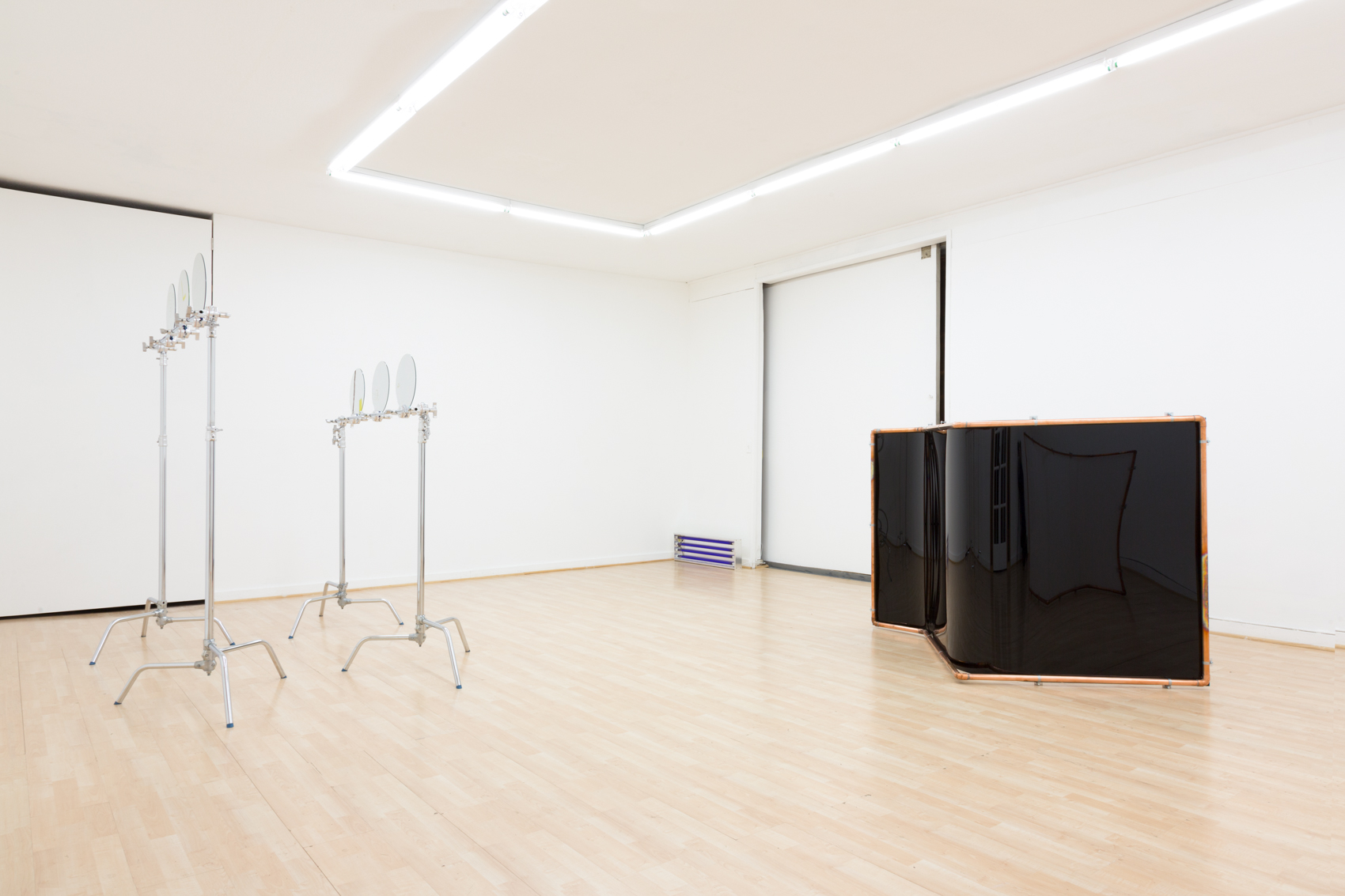
For his exhibition at City Limits gallery, William Koone ensnares the viewer in a game of deception. The show is titled after the practice in commercial photography of depicting watches fixed at 10:10, the symmetrical hands creating the illusion of a smiling timepiece. Six sculptural works are included; all make sly reference to a photographer’s studio and the capacity of photography to mislead.

The first piece encountered is a knife impaled dart-like in the gallery door frame, its blade inscribed “PENTAX.” Around the corner, two playing cards are affixed to the wall with a nail; one bears the Canon logo. A pair of sizable floor-based works is positioned across from this piece. Each consists of an S-curved copper frame onto which is clamped a sheet of Plexiglas—one white, the other black. These pieces approximate “product scoops,” devices used to photograph objects against a backdrop of infinite whiteness or blackness. Stenciling on the copper trusses alludes to popular camera brands and slogans from dated camera ads. Diametrically across, a set of C-stands supports six circular mirrors, forming a silvery two-tiered sculpture almost eight feet tall. Four stacked “blacklight blue” tube lights in the corner are the final work in the show.

I found this exhibition to be insidiously unsettling. The art beguiled me with its beautiful strangeness, yet the longer I looked, the more my perceptions became distorted. This was especially true for the curvilinear black Plexiglas piece, which dominates the gallery with a portentous presence. Its obsidian-like surface, at once dense and reflective, unhinged my grasp of depth and space. The fractured, mercurial reflections in the C-stands and mirrors heightened this disorientation. Even the seemingly innocuous tube lights manipulated my vision with their cobalt fluorescence. In hindsight, I should have seen it coming—Koone had signaled his sinister intent at the gallery threshold with the knife.

Read More »

Share

Interviews

Interview with Beatriz Santiago Muñoz

Today, from our friends at Kadist, we bring you the first video in a two-part interview with Beatriz Santiago Muñoz. Michele Fiedler talks with Muñoz about Ojos Para Mis Enemigos, a piece done in collaboration with Pedro Ortiz exploring an abandoned military base in Puerto Rico, the displacement of families as a result of the base’s construction, and her project Prisoner’s Cinema. Watch the second part of this interview here. This video was originally published on March 18, 2016.

Share

San Francisco

Anthony Discenza Presents A Novel: An Exhibition by Anthony Discenza at Catharine Clark Gallery

Today from our partners at Art Practical, we bring you Maria Porges’ review of Anthony Discenza Presents A Novel: An Exhibition by Anthony Discenza at Catharine Clark Gallery in San Francisco. The author notes, “Achieving a successful understanding of the many layers [of the exhibition] yields a devious satisfaction.” This article was originally published on March 22, 2016.

Anthony Discenza.

Anthony Discenza Presents A Novel: An Exhibition by Anthony Discenza, 2016; installation view. Courtesy of Catharine Clark Gallery.

When or why does art become the idea of art: a representation or simulacra of it, rather than the thing itself? In a constellation of objects and images, Bay Area artist Anthony Discenza tackles this question, among several others, through a deftly ironic manipulation of the visual languages of Minimalism and Conceptualism—tropes that, many decades after their first incarnations, continue to be recycled ad nauseam in galleries and museums worldwide. The works presented here are meant to be seen as enclosed in a veritable cloud of quotation marks, as a kind of performance of these too-familiar ideas, experienced through the filter of Discenza’s own writing in the form of a longish essay available as a newsprint takeaway from stacks in the gallery. Prefacing Discenza’s text, quotes from Jorge Luis Borges and Joanna Russ muse on the idea that there are not only multiple universes in which we live out one thread of possible choices, but that we consist of multiple selves. The exhibition is based on this conceit: Anthony Discenza, friend (or doppelgänger?) of “Anthony Discenza,” has put this show together from notes and materials abandoned by the other. By stepping outside of himself in this way, the essay’s author can describe and evaluate his own gifts as well as his shortcomings with a charming wryness, talking about the work of “Anthony” as if it is not his own. “Anthony,” we learn, had planned to make this show by using, as a point of departure, the 1969 art-world novel The Disappointments by Lane Hobbs, an artist and critic who (of course) died prematurely in 1974, having produced only this satire of the late 1960s scene in New York. That this novel does not actually exist should go without saying, but I am going to say it anyway; as indicated by the essay’s title, “Considering A Novel: An Exhibition in the Subjunctive,” the book’s existence is fictional, like the concept of the two Anthonys. The Disappointments serves as a vehicle for the ultimate subject here: the artist’s struggle to make art, to put forward work and be confident in its clarity, originality, and importance, but ultimately, by some important inward measure, to fail.

Read the full article here.

Share

St. Louis

Drew Heitzler at Parapet Real Humans

A small crowd gathered within the intimate space of Parapet Real Humans, in St. Louis, waiting to hear the California-based artist Drew Heitzler deliver his artist talk on the opening night of his solo exhibition. Projected onto one of the gallery’s white paint-covered windows was a stop-motion video of the green-clay humanoid Gumby, pawing at a piano with fingerless hands. The appropriated footage had been edited and synced to a medley of atonal music. To the left of the projection, a baseball cap and pair of plastic-rimmed glasses—signature elements of Heitzler’s wardrobe—were placed upon a small stage. The hat was a reissue, featuring the vintage logo of St. Louis’ former and Los Angeles’ current football team, the Rams—a sly nod that paralleled Heitzler’s brief stint in St. Louis before traveling back to California. Small paintings depicting covers of Thomas Pynchon’s most celebrated novel, Gravity’s Rainbow, were dispersed throughout the space; the one exception portrayed a later novel, Inherent Vice. Most of the paintings rested upon door and window frames, and one hung on the wall at a similar height as the others, well above eye level. Almost beyond notice because of their discreet scale and placement, the works nearly disappeared within the gallery.

Drew Heitzler. Drew Heitzler, 2016; installation view, Parapet Real Humans, St. Louis, Courtesy of Parapet Real Humans.

Drew Heitzler. Drew Heitzler, 2016; installation view, Parapet Real Humans, St. Louis. Courtesy of Parapet Real Humans.

The paintings were secondary to the talk/performance that transpired. While the audience settled and conversed quietly, Heitzler slipped to the back of the gallery as Ann Marie Mohr, a local performer and the artistic director of OnSite Theatre in St. Louis, made her way up to the front, purposefully donned the glasses and hat, mounted the stage, and began reciting a monologue prepared by Heitzler entitled, “How to Disappear In(to) California.” Reading from a stack of papers, Mohr projected her voice, detailing how the jury for the Pulitzer Prize in fiction unanimously recommended Gravity’s Rainbow for the award in 1974, but the prize board refused the panel’s advice; consequently, the prize was awarded to no one that year. After this anecdote, Mohr digressed into a lengthy speech loosely centered on California, mentioning a disparate range of cultural figures and ideas that included Franz Kafka, Sigmund Freud, adolescence, the culture industry, sadomasochism, music, William S. Burroughs, Walter Benjamin, Mickey Mouse, National Socialism, occultism, imposture, and narcissism—to name a few. She concluded the speech with another reference to Pynchon, this time about Inherent Vice, bookending an impenetrable rigmarole with allusions to the reclusive author.

Read More »

Share