Washington, D.C.

Robert Irwin: All the Rules Will Change at the Hirshhorn Museum

Robert Irwin has had a number of distinct careers as an artist, each with a distinct group of peers and beliefs. All the Rules Will Change presents the best known but least seen of these careers: the studio painter of the 1960s, who began the decade as a conventional Abstract Expressionist, and ended it by closing his studio and abandoning a practice of painting that had, he claimed, become too familiar.
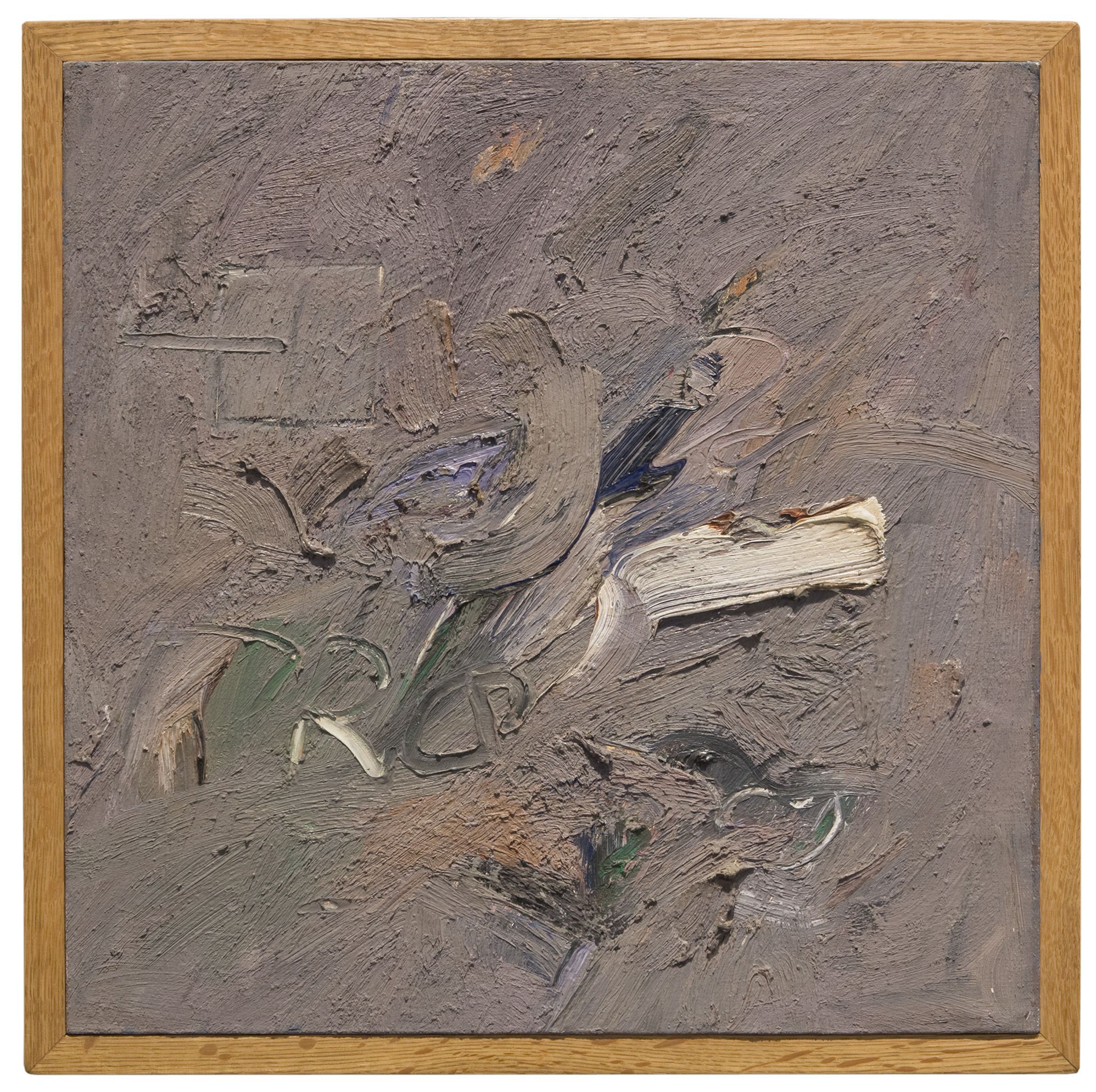
Robert Irwin. Untitled, 1959–60; ©2016 Robert Irwin / Artists Rights Society (ARS), New York. Photo © 2007 Philipp Scholz Rittermann.

Robert Irwin. Untitled, 1959–60. © 2016 Robert Irwin/Artists Rights Society (ARS), New York. Photo: © 2007 Philipp Scholz Rittermann.

Of this transformation, Irwin has said, “From about 1960 to 1970 [… ] I used my painting as a step-by-step process, each new series of works acting in direct response to those questions raised by the previous series. I first questioned the mark (the image) as meaning and then even as focus; I then questioned the frame as containment, the edge as the beginning and end of what I see. In this way I slowly dismantled the act of painting to consider the possibility that nothing ever really transcends its immediate environment.” [1]

Each step in the process yielded a new body of work, and the Hirshhorn presents these bodies in sequence. First, one encounters the Handhelds, austere miniature AbEx paintings set into heavy, crafted panels, each roughly the size of a laptop computer. Both their scale and name suggest a cargo-cult appropriation of digital tech, despite having been made at a time when computers were still room-sized and programmed with punch cards.

Read More »

Share

Vancouver

“The Accursed Share” at Artspeak

The first thing I encounter upon entering “The Accursed Share” at Artspeak is a scent. “A fancy grandma’s house,” my gallery companion assesses. The scent emits from Aleesa Cohene’s You, Dear (2014), in which a large bunch of faux grapes is placed on the floor. Upon closer inspection, the decorative fruit is something much more elegant—in fact, it’s opulent.

Aleesa Cohene. You, Dear, 2014; onyx, galvanized wire, thread, diffused scent. Courtesy of Artspeak. Photo: Blaine Campbell

Aleesa Cohene. You, Dear, 2014; onyx, galvanized wire, thread, diffused scent. Courtesy of Artspeak. Photo: Blaine Campbell.

Each grape is made from the semi-precious stone onyx—and more likely to be a jewel on the neckline of that fancy grandma. Together, the bunches form a palette of milk, pale green, and bands of auburn that obscure a device diffusing the indistinct scent. As a talisman, onyx is considered a protective stone that absorbs and transforms negative energy (specifically, melancholy) to preserve your personal energy, providing both stability and security. Given grapes, we are presented with a symbol of antiquated hedonism—a theatrical form of relaxation or indulgence. Instead of a soft bulb, the hardened onyx begs to be swallowed to metabolize negativity. Fancy grandma is now New Age grandma; either way, they’re both wealthy and need the stones to sustain their passions.

Deborah Edmeades’ curriculum of invented mysticism contains titles that sound right out of the esoterica section of a used bookstore. Divination, Chance & Character: Tools for the Extension of Sensibility (Index) (2016) is a series of works on paper that includes eight illustrations against soft pink blobs. The composition is divided into panels like a set of arcane motivational posters. Depicting epistemic subjects like books, color wheels (one drawn in the place of Duchamp’s Bicycle Wheel), an artist, and spiritual teacher, each illustration is accompanied by a cryptic phrase like, “THE FOUNTAIN/GOD IS WET/(OH MY GOD!)” and “YEARNING/MEDIEVALISMS, LANDSCAPE/FOLKLORE & PROPAGANDA.”

Read More »

Share

Help Desk

Help Desk: Getting Paid for Curatorial Work

Help Desk is where I answer your queries about making, exhibiting, finding, marketing, buying, selling–or any other activity related to contemporary art. Submit your questions anonymously here. All submissions become the property of Daily Serving.

I’m a professional curator with over a decade of experience, mostly as a salaried professional. I’d like to be doing more freelance curatorial work, but curators seem to either get paid nothing, absurdly little, or astronomical sums. How can I actually get paid for the work I do?

Kerry James Marshall. Portrait of a Curator (In Memory of Beryl Wright), 2009; acrylic on PVC, 30 7/8 x 24 7/8 x 1 7/8 in.

Kerry James Marshall. Portrait of a Curator (In Memory of Beryl Wright), 2009; acrylic on PVC; 30 7/8 x 24 7/8 x 1 7/8 in.

Whether you’re a curator, an artist, or a critic, there’s one thing we can say for certain about the arts: Experience, skills, and hard work don’t necessarily equate to a decent paycheck. Unfortunately, there is no secret that I could whisper in your ear that would guarantee you a fair wage for your labor. Instead, you could consider what it is about curating independently that appeals to you, and ask yourself what kind of bargain you might be willing to strike in order to meet your goals. You could also think about setting a minimum wage for yourself, a baseline amount that you won’t go under no matter what.

I reached out to two independent curators to get their perspective on this issue. Kuba Szreder said, “This is the question that many of us ask ourselves every day. I am afraid that no one has found a silver bullet to resolve this problem. Speaking from a systemic perspective, the art economy is a cruel economy in which the winner takes all. The distribution of resources and prestige is skewed to the top of hierarchy; there are hundreds of people who aspire to be in the spotlight, but only a few will ever find themselves there. From an individual perspective, one might need to ask whether competing in such a market is really desirable.

“There are several advantages to being a freelancer, but stability is not one of them. In fact, the majority of ‘independents’ experience self-precarization and other related professional ills. If one thinks about top curators, they usually have an institutional anchorage that provides a stable basis for ‘independent’ exploits. Some of them had episodes of freelancing, true enough, but these were episodes rather than long-term strategies.

Read More »

Share

From the Archives

From the Archives – Weaving, Not Cloth: Mark Bradford at SFMOMA

We always like to see artist Mark Bradford’s name pop up in the press. Of course, there’s the fantastic news that Bradford will be representing the U.S. in this year’s Venice Biennale, in addition to last week’s cheekily delivered critique of art auctions (while onsite at Christie’s). Today, we’re republishing Bean Gilsdorf’s meditations on the tactility of Bradford’s work in relation to textiles. This article was originally published on March 6, 2012.

Mark Bradford. Potable Water, 2005; billboard paper, photomechanical reproductions, acrylic gel medium, and additional mixed media; 130 x 196 in. Collection of Hunter Gray. © Mark Bradford. Photo: Bruce M. White.

The difficulty in viewing photographs of artwork is that the camera flattens the object in its focus, relinquishing subtleties in order to capture a whole. Because his oeuvre is very subtle indeed, Mark Bradford’s work requires a viewer’s presence to be fully appreciated. Very little of the slender lines of collage, delicate papers built up in thin layers or washes of paint almost completely sanded away is apparent in reproduction. Each of the more than forty of Bradford’s works now on view at SFMOMA calls out to be felt, if not by the hand of the viewer then by the eye. They elicit a state of tactile vision, a reminder that visual perception is also connected to the faculty of touch.

Read More »

Share

Ghazel: Mea Culpa at Carbon 12

Today, from our friends at REORIENT, we bring you a review of Ghazel’s latest solo exhibition, Mea Culpa, on view at Carbon 12 in Dubai through May 9. Author Sayantan Mukhopadhyay says of the artist, “Her interventions—which start with materials and symbols inherently laden with meaning—speak about the itinerant lives in a manner that is refreshing when placed in conversation with the many other contemporaneous works dealing with identity crises posed by global nomadism.”

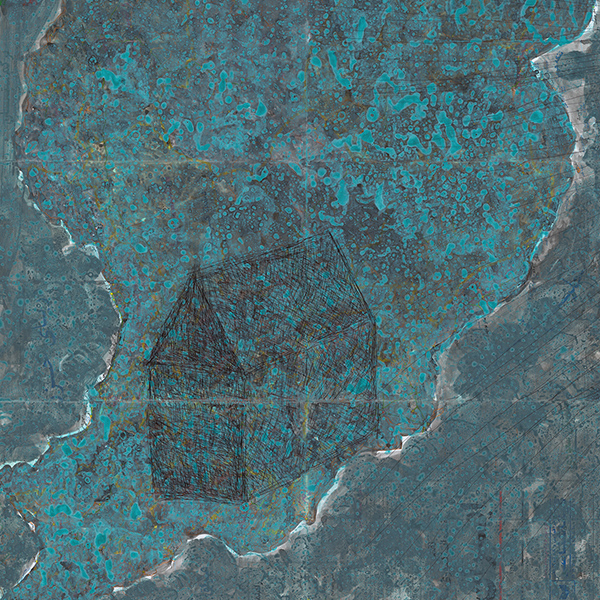
Ghazel. Phoenix IV (detail), 2015; acrylic and Ballpoint pen on 2 printed Maps of Iran; 39 x 55 in.

Ghazel. Phoenix IV (detail), 2015; acrylic and ballpoint pen on two printed maps of Iran; 39 x 55 in.

Walking into a gallery space punctuated with works subject to viewers’ experiences and possessing the ability to be read through those experiences: an exhilarating sensation. “Global contemporary” is a moniker that commonly encompasses a tradition of obscurity for obscurity’s sake, a fearful label that connotes unapproachability for the masses. It speaks to the elitism of a world of characters that effortlessly transmigrate, hopping from one biennial to another, with other art fairs scheduled in between. Ghazel’s work, however, is explicit in democratizing thematic enterprise, and it is this plainspoken and sensitive treatment of diaspora and exile that has made her latest solo exhibition, Mea Culpa (Latin for “my fault”), so successful.

Ghazel, most commonly known by her first name alone, is an Iranian artist who has been living in France since the 1980s. She pursued a formal education in visual art, completing an MFA at the École Supérieure des Beaux-Arts in Nimes. The decades following her departure from her native Iran have been devoted to developing a language that addresses processes of rupture and the growth of a set of peripheral relationships between experiences in Iran and France. Ghazel’s work has largely used performance as a conduit to understand post-revolution Iran as viewed from a distance, although her more recent bodies of work have spanned a broad array of media.

Read the full article here.

Share

Los Angeles

Robert Mapplethorpe: The Perfect Medium at the Getty and LACMA

Robert Mapplethorpe is forever associated with scandals that erupted at the Corcoran Gallery of Art and the Contemporary Art Center Cincinnati, as well as the crippling drawdown of federal funding that rendered the National Endowment for the Arts a casualty of the late-1980s culture wars. More recently, Mapplethorpe, or the foundation that bears his name, made headlines with two significant acquisitions made by the J. Paul Getty Museum and Los Angeles County Museum of Art (LACMA) in 2011. In the twenty-eight years since the artist’s death, Mapplethorpe and his work have been granted the institutional approval he doggedly sought as a young artist. Robert Mapplethorpe: The Perfect Medium, a two-part exhibition on view at the Getty and LACMA, thoroughly maps his creative evolution and contextualizes the artist and his contributions to 20th-century photography beyond the stain of controversy.

Robert Mapplethorpe.  Joe, N.Y.C., 1978 (from The X Portfolio); selenium toned gelatin silver print mounted on black board; image: 7 11/16 × 7 11/16 in. Jointly acquired by the J. Paul Getty Trust and the Los Angeles County Museum of Art; partial gift of The Robert Mapplethorpe Foundation; partial purchase with funds provided by the J. Paul Getty Trust and the David Geffen Foundation, 2011.9.41.6 © Robert Mapplethorpe Foundation

Robert Mapplethorpe. Joe, N.Y.C., 1978 (from The X Portfolio); selenium toned gelatin silver print mounted on black board; 7 11/16 × 7 11/16 in. Jointly acquired by the J. Paul Getty Trust and the Los Angeles County Museum of Art; partial gift of yhe Robert Mapplethorpe Foundation; partial purchase with funds provided by the J. Paul Getty Trust and the David Geffen Foundation, 2011.9.41.6. © Robert Mapplethorpe Foundation.

An exhibition divided between museums is an uncommon practice, and braving Los Angeles traffic between Brentwood and Mid-City on the same day is not for the faint of heart. That said, the split format allows each institution to present Mapplethorpe’s work from a perspective that aligns with each of its institutional identities. Getty curator Paul Martineau describes the divide as Apollonian and Dionysian—an apt assessment given Mapplethorpe’s appreciation of classical sculpture and moments of so-called sexual deviance he captured in equal measure. Martineau organized Mapplethorpe’s work by major categories—Floral Studies, the Sculptural Body, Portraits, Studio Practice—all of which are represented by pieces hung in the introductory gallery. From there, the exhibition flows smoothly and is shaped by striking juxtapositions, including portraits of champion bodybuilder Lisa Lyon and Phillip Prioleau. In isolation, these photographs have achieved iconic status. When viewed within the context of the larger studies to which they belong, the photographs demonstrate the artist’s career-long fascination with the monumental and performative potential of the human form.

Read More »

Share

Chicago

A Feast of Astonishments: Charlotte Moorman and the Avant-Garde, 1960s–1980s at the Block Museum of Art

The Juilliard-trained musician and performance artist Charlotte Moorman, the so-called topless cellist, never shied away from the spotlight. In addition, as a monographic exhibition at Northwestern University’s Mary and Leigh Block Museum of Art demonstrates, Moorman’s work as a cunning and forceful impresario contributed significantly to the international visibility of New York’s burgeoning avant-garde music scene beginning in the ’60s. A Feast of Astonishments: Charlotte Moorman and the Avant-Garde, 1960s–1980s offers visitors a sonically and visually cacophonous encounter with the diversity and tenacity of the artist’s energies and output. Combining an impressive array of ephemera, photographs, film and video footage, props, and artifacts, the show makes a virtue of Moorman’s decades-long disinterest in producing art objects with its informative multimedia cavalcade.

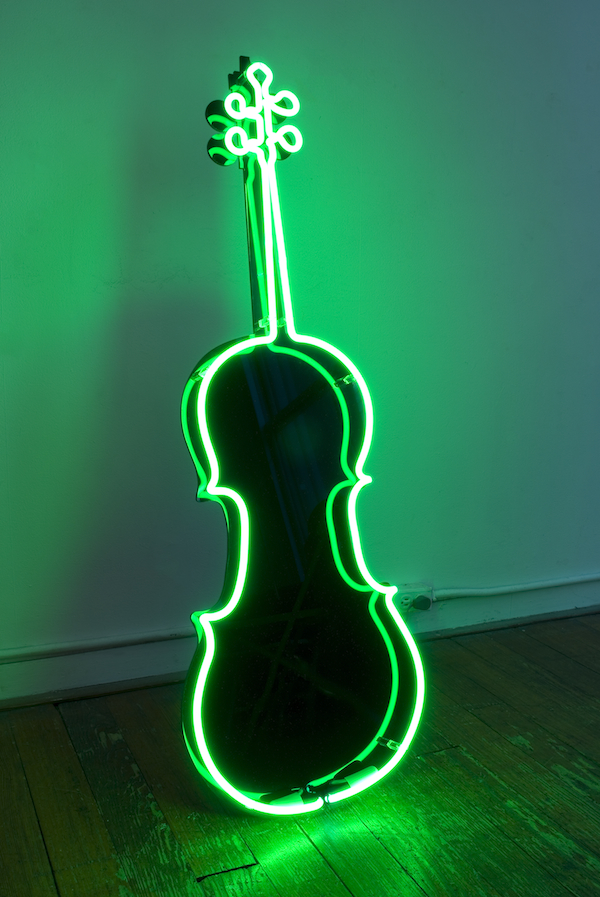
Charlotte Moorman. Neon Cello, ca. 1989; Plexiglas, neon, and electrical parts; 48 1/2 × 16 in. Photo: João Simões. Courtesy of Emily Harvey Foundation.

Charlotte Moorman. Neon Cello, ca. 1989; Plexiglas, neon, and electrical parts; 48 1/2 × 16 in. Courtesy of Emily Harvey Foundation. Photo: João Simões.

The art objects, like Neon Cello (1989), that Moorman did create to finance her performance work are more interesting as documents of the sacrifices she made to support and cultivate a community of creators than as objects of aesthetic interest. A Feast of Astonishments documents Moorman’s considerable bravery and leadership, which at times came at the expense of the artist’s welfare. For instance, the exhibition relates the story of Moorman’s 1967 arrest for indecent exposure during her performance of Opera Sextronique, a work by her longtime collaborator Nam June Paik, which featured the cellist in various states of undress. Through newspaper clippings, photographs, and letters from artists such as Claes Oldenburg calling for her release, the exhibition reiterates the centrality of this “topless cello” moment in the consolidation of Moorman’s artistic persona and her career-long deliberation of her agency as a performer and the history of the female nude in art.

Read More »

Share