Ragnar Kjartansson

Ragnar-Kjartansson-3-18-07.jpg

Icelandic artist Ragnar Kjartansson experiments with visual arts, theater and music to create live performances. Kjartansson’s work often references modes of aggression, masculinity and dominance. In 2003, the artist recreated a scene from a period of Danish colonization in Iceland where a Danish merchant is shown beating a native Icelandic peasant. The image above depicts a knight that is exposed representing sexual power and playing a piano that emits sounds of groaning women. Kjartansson was born in Reykjavik, Iceland (1976), and attended the Icelandic Academy of the Arts painting department (2001) and the Royal Academy in Stockholm, Sweden (2000). Kjartansson exhibited “Colonialization” with the Galleri Kling & Bang and is currently exhibiting “Samviskubit/ Guilt Trip” at Galleri i8 in Reykjavik, Iceland.

Share

Frank Egloff

Frank-Egloff-3-15-07.jpg

The paintings of artist Frank Egloff are created from appropriated imagery found in film and vintage photos. The works are often reconfigured through cutting, copying and projecting source images onto a canvas. The objectivity of the photograph is called into question with this image manipulation. The process of reconfiguration allows the artist to exploit the source material and re-contextualize the image to unveil new formal and conceptual concerns. This Saturday, March 17, Barbara Krakow Gallery in Boston will present “Rethought,” new works by Egloff. The artist has exhibited several times with Brent Sikkema in New York City and with the DeCordova Museum in Lincoln, Mass. Egloff received the Massachusetts Cultural Council Artist Grant in 2002 and 2006.

Share

Nedko Solakov

Nedko-Solakov-3-14-07.jpg
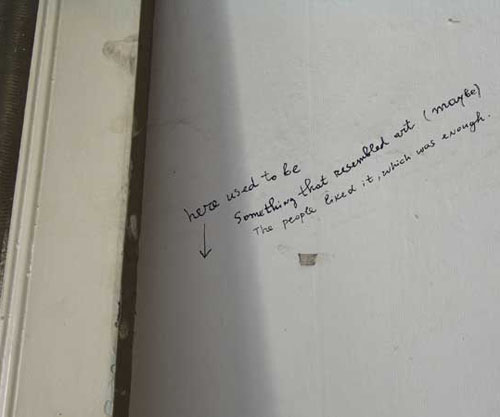
In a piece titled “Art & Life (In My Part of the World),” Nedko Solakov created a piece in a vacant and dilapidated apartment to illustrate a narrative about the distraught life of a piece of art. She, the work of art, felt neglected in this house and thus moved itself into the most well-lit room and on top of several tables. The entire apartment contains text that lets the viewer in on contextual clues that inform of past events. Solakov was born in Bulgaria in 1957 and studied at Hoger Instituut voor Schone Kunsten in Antwerp. While able to take on multiple media, the artist’s work is always centered on a conceptual humor and often stems directly from text. In 2005, Solakov participated in a group show titled “OK:Okay” at the Grey Art Gallery, where the artist used works of de Kooning and Warhol from the Gallery’s collection to create the fictitious hut of an African native who collects Western art. Solakov has received funding from numerous foundations, including the International Studio Program in Sweden (IASPIS), KulturKontakt and the Philip Morris Foundation. Last year, he exhibited with Galerie Arndt & Partner in Berlin and the Museum of Contemporary Art / MNAC in Bucharest.

Share

Yang Fudong

Yang-Fudong-03-13-07.jpg

The videos and photographs of Chinese artist Yang Fudong reflect the human condition in a state of existential uncertainty. The individuals represented in the works are young and disillusioned and seem to struggle with political, social and moral values, while coping with China’s growth as an economic state. Fudong also references specific film genres as the characters attempt to carry out a narrative through multiple perspectives and experiences. Fudong was born in 1971 in Beijing, China, and studied painting at the China Academy of Fine Arts in Hangzhou. This year, the artist will exhibit “No Snow in the Broken Bridge” with Shanghart Gallery in Shanghai, opening March 24, and will be featured in the 52nd Annual Venice Biennale. Fudong has exhibited with countless international galleries and museums, such as the Douglas Hyde Gallery in Dublin, Ireland (2004), Stedelijk Museum in Amsterdam (2005) and Parasol Unit in London (2006). View video from one of Fudong’s installations.

Share

Jon Pylypchuk

Jon-Pylypchuk-3-12-07.jpg

The sculptures and installations of Jon Pylypchuk are constructed with a variety of craft-based materials such as scrap fabric, felt, glue, glitter and fur. The characters that inhabit Pylypchuk’s installations reference the dark side of social psychology as each character interacts without consequence or emotion. In the scene above, the rodent-like creatures spread across the gallery floor in their last moments before they die of poisoning. The artist renders these scenes to convey a pathetic sense of inadequacy and demise. Jon Pylypchuk completed his graduate studies with UCLA (2001) and his undergraduate degree with the University of Manitoba in Canada (1997). This year, the artist will exhibit with Sies & Hoeke in Duesseldorf, Germany. Last year, Pylypchuk exhibited with Tomio Koyama in Tokyo and “you are all too close to dropping off now” with the Alison Jacques Gallery in London. The artist was featured in The New York Times (2003) and in an article with Art in America (2005), both for exhibition with the Friedrich Petzel Gallery in New York City.

Share

Michael J. Schumacher

Michael-J-Schmacher-3-10-07.jpg

Composer Michael J. Schumacher creates electronic sound installations that use multiple speakers to emit sound frequencies. The artist composes for computer-manipulated sound structures and live improvised music. These works are often exhibited in empty galleries or will take place as a live performance. Schumacher was born in Washington, D.C., and studied music at Indiana University and the Juilliard School of Music. The artist has worked with countless composers and musicians and has exhibited with The Kitchen, the Queens Museum and PS1 in New York. He frequently performs at the Diapason Gallery, New York’s only sound art venue. In a recent performance with Diapason, the artist presented “Room Piece” as a multi-channel sound installation that continuously shifts the sounds in the room using the listener as the main axis point.

  • Sound works
  • Video of Michael J. Schumacher and Metamkine
  • Share

    Christopher Wool

    Christopher-Wool-3-10-07.jpg

    The paintings of New York-based Christopher Wool are often reductive by nature and contain a minimal color palette. Wool is best known for his stenciled paintings with large black lettering on a white ground with text that has been drawn from a variety of pop culture sources, including hip-hop lyrics and movie lines. The artist also employs a multitude of painterly techniques in numerous other works using materials such as spraypaint, hand paint and silk-screening. These works make reference to graffiti and further the use of text as the primary structure in the work. Later this year, Christopher Wool will exhibit with Galerie Max Hetzler in Berlin and in a group exhibition titled “For the People of Paris” at Sutton Lane in Paris. Last year, Wool exhibited with the Gagosian Gallery in Los Angeles and had a solo exhibition with the Instituto Valenciano de Arte Moderno, Valencia, which traveled to Musee d’Art Moderne et Contemporain in Strasbourg.

    Share