Summer Session
Summer Session – Material Practices: Stitching, Fabric, and Textiles in the Work of Contemporary Chinese Artists
Continuing our June Summer Session theme of labor, today we bring you this review that deals with gendered, often invisible labor. Author Luise Guest explores the work of several contemporary Chinese artists using embroidery in revolutionary ways. This article was originally published on January 10, 2014.
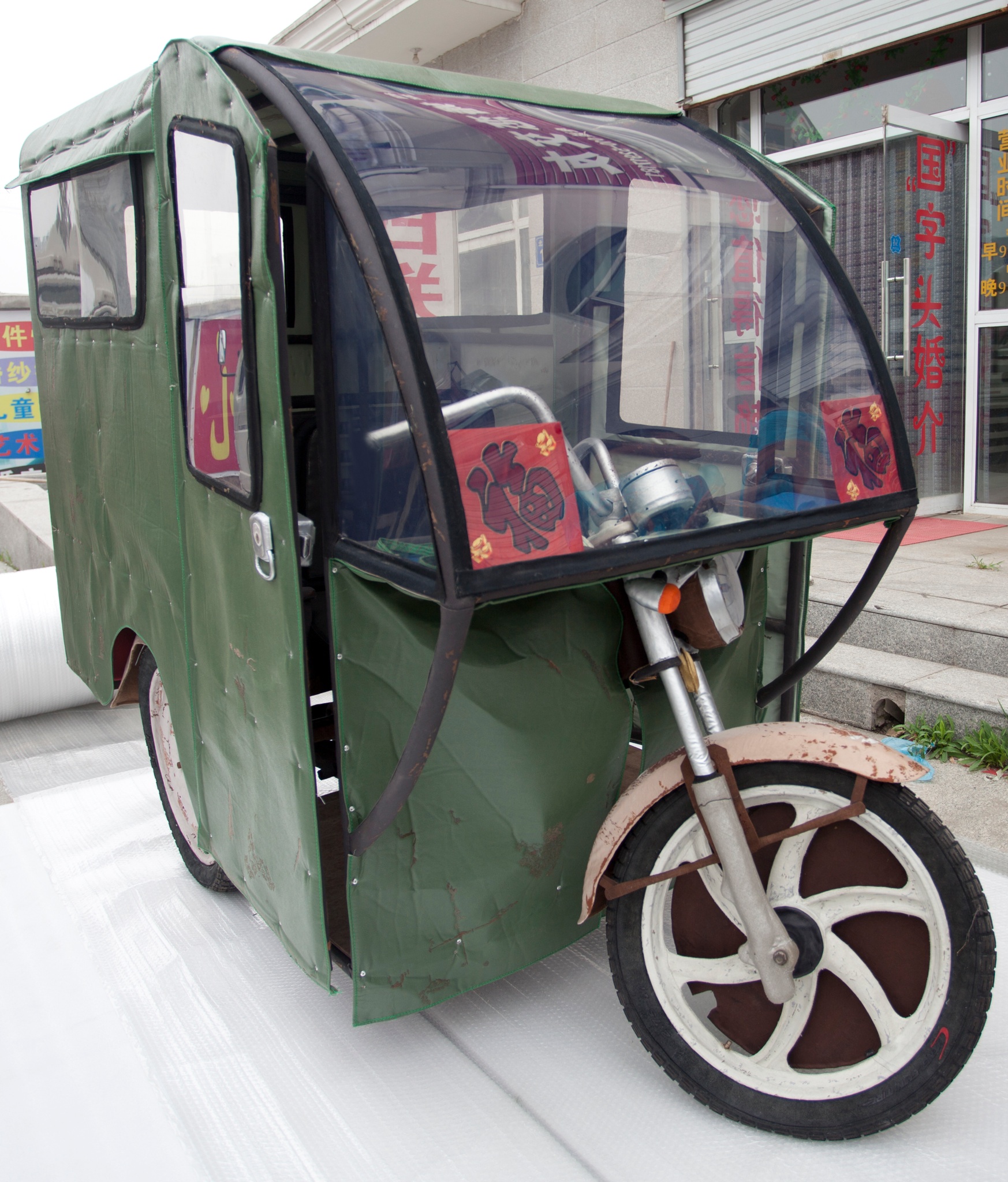
Gao Rong. What Type of Car Can a Motor-Tricycle be Exchanged For?, 2013; embroidery, cloth, wooden board, iron shelf, leather, and plastic; 70 7/8 x 76 3/4 x 37 3/8 in. (180 x 195 x 95 cm). Courtesy of the Artist.
Mao Zedong once said that revolution is not a dinner party. Less famously, he said it is not embroidery, either. Interestingly, however, some female contemporary Chinese artists have chosen to work with thread and textiles—and embroidery—in experimental, maybe even revolutionary ways. From Lin Tianmiao’s overt exploration of sexuality, fecundity, and the aging and decay of the body, to Yin Xiuzhen’s use of the embodied memories in old clothing; from Lin Jingjing’s stitched paintings of the recorded details of many lives, to Gao Rong’s embroidered, padded simulacra of quotidian elements of daily life in Beijing, they variously apply stitching, embroidery, felting, padding, binding, and fabric. Artist/alchemists, they transform the everyday materials of “women’s work,” reflecting personal memories and cultural identities.
As a young girl, Lin Jingjing yearned to discover a world beyond the confines of her neighborhood. She rode her bicycle as far as she could in each direction, a little further each week, measuring the time so that she would be sure to return before dark. This is an apt metaphor for her art practice, which has pushed the boundaries of painting, performance art, and installation. In Public Memories, photographic images of events both public and private are reproduced in bright monochrome colors, with selected areas neatly stitched. Rows of stitches erase and hide parts of the painted image, suggesting the unreliability of memory. Lin’s performance, video, and photographic works—in which barely opened long-stemmed roses are stitched/sutured closed—play with the binaries of beauty and cruelty, wounds and healing.