Summer Session

Summer Session – Vipralambha (Union Through Separation)

This month we’re taking an in-depth look at the nexus of labor and art, and today from our friends at Guernica we bring you an excerpt from an essay by Simon Coates, who discusses a project completed with his collaborator Zahra Jewanjee: “Vipralambha didn’t start life as a paean to the Indo-Pak workforce in Dubai. The stated aim of the piece was to meld sounds from two countries that share a border.” This article was originally published on July 15, 2013.

Zahra-Jewanjee-and-Simon-Coates

The artists Zahra Jewanjee and Simon Coates.

There’s a continuous, all-pervading hum in Dubai. It’s a complex sound made up of industrial chundering, motor engines, water-pumps, and electric crackle. Dubai sounds restless, kind of like an unsleeping giant dogged by insomnia. On top of that, layer sporadic jangles of Hindi and Arabic pop, guffaws, and calls to prayer from minarets. Add engine-revving and mall muzak. Fireworks fizz. This is the sound of Ted Hughes’s Iron Man in a Lamborghini baseball cap, wearing a dishdasha, eyelids heavy, BlackBerry nearby. It’s under this mantle that Zahra Jewanjee and I made our first sound art piece, Vipralambha (Union Through Separation). Vipralambha is a soothing Sanskrit word (uncovered by Zahra) that conveys the sense of unrequited longing that is an exquisite pain. Zahra and I are artists living and working in Dubai. Zahra is from Lahore, I’m from London. Made from a collection of field sound recordings, Vipralambha is our antidote.

While in Lahore, Zahra had made some recordings at the tomb of Sufi Saint Baba Shah Jamal where, once a week, crowds come to watch devotees dance and drum themselves into trance-like states. She had also recorded a Lahore transvestite named Madam singing a popular song called “Shamma Pay Gaiya.” In its original form, “Shamma Pay Gaiya” is mere corny pop. However Madam’s own a capella version imbues the Punjabi lyrics with a true sense of the longing that is central toVipralambha. For myself, I had spent some time in Kerala in South India, returning to Dubai with recordings of the announcer at the Alappuzha railway station, the Kathakali dance school in Fort Kochi, and crows during the monsoon in Kovalam, among others.

Read the full article here.

Share

Summer Session

Summer Session – Amer Kobaslija at Arthur Roger Gallery

For the first part of our Summer Session, we’re thinking about labor, and today we’re considering the traditional site of artistic work: the studio. Author  notes: “If the studio has traditionally been a place of solace from reality’s complications, this exhibition seems to respond with urgent ambiguity by asking important and unresolved questions about the place of artistic practice within today’s society, and the traditions of Western art making that have not (and will not) go away.” This article was originally published on May 19, 2015.

Amer Kobaslija. Sputnik Sweetheart of New Orleans and the End of the World. 2007. Oil on two panels. 85 x 124 ¼ in.

Amer Kobaslija. Sputnik Sweetheart of New Orleans and the End of the World, 2007; oil on two panels; 85 x 124 ¼ in.

In his 1971 essay “The Function of the Studio,” conceptual artist Daniel Buren defined the artist’s studio as a metadiscourse of “frames, envelopes, and limits” imposed upon the working artist in the age of advanced capitalism.[1] Claiming that this privileged space had become nothing more than an “ossified custom”—a “commercial depot” for curators and dealers to ship works out into the world (and thus detach the artwork from the conditions of production and site of creation)—Buren stated that artists could only resist the domestication of their work by preserving it within their studios forever (like Constantin Brancusi) or abandoning the four walls of the studio altogether for a life of art making away from institutional repression and commodification.

Buren’s provocation turns on the idealized notion of the modern atelier, described famously by Honoré de Balzac in his 1831 Romantic tale of artistic failure, “The Unknown Masterpiece.”[2] Setting the story in a cramped, skylit room cluttered with the detritus of an artist’s struggles—the idealized working environment for the solitary male genius of 19th-century literature and art—Balzac dramatized the central dilemma of the studio as both a mental and physical space that encloses the corporeal and psychic “energy essential to art’s existence.”[3] Thus, Buren’s desire to reconnect the studio with social life seems to fall in line with our current era of “post-internet artistry,” where nomadic career paths, collaborative practices, work-from-home jobs, and overnight internet art stars are the norm, and notions of passive aesthetic contemplation and private retreat are interpreted as oppressive and old-fashioned.

A quick trip to any café exposes the ominous cloud that hangs over Buren’s call for a “post-studio” age, as Starbucks and pay-as-you-go office space evolves into the new office for artists, students, and creative professionals clicking away on their laptops. Yet the mythology of the sacred atelier persists in our contemporary culture, as Amer Kobaslija’s current series of paintings at Arthur Roger Gallery in New Orleans indicates. Taking up the weighty legacy of the artist’s studio, Kobaslija’s work explores the studio as a concept, a locus of artistic identity, a space of sociability or private retreat, an alchemical universe of transformation, as well as a psychological construct.

Read More »

Share

Summer Session

Summer Session – Reskill Now!

Today’s installment of our Summer Session considering labor comes from our sister publication Art Practical. Author Celeste Connor contributes an Op-Ed that claims, “To fetishize style trends, as institutions do, as singular models for development of cultural ideas and actions is tragicomically flattening. If we makers are serious about the goal of a growing, inclusive public, reskilling is a crucial antidote.” This article was originally published on June 16, 2015.

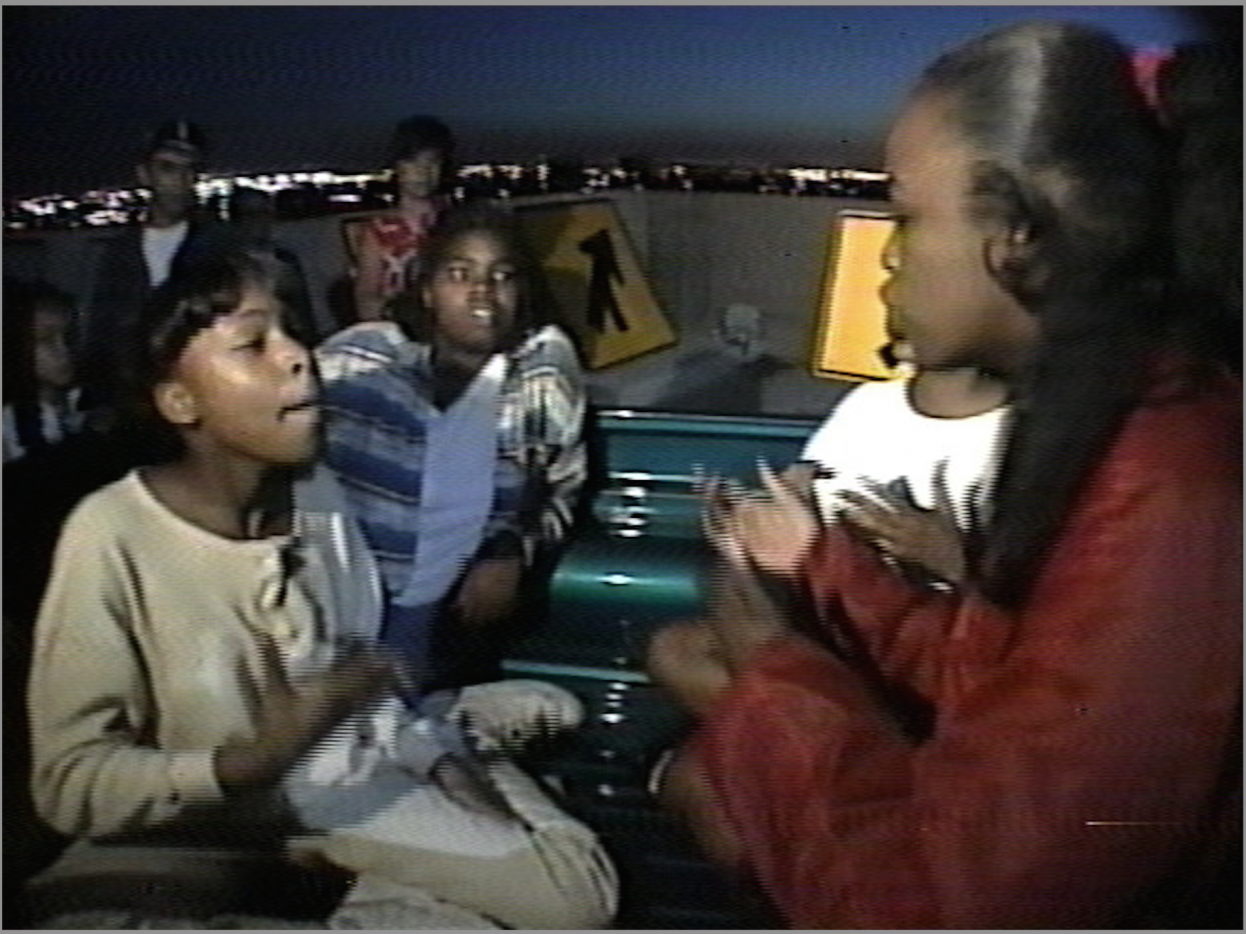
Suzanne Lacy. Still from the making of The Roof Is on Fire, 1992–94. To make this work, a collaborative performance directed by Lacy and documented in photos, videos, and a film, 220 inner-city teens in 100 cars came together on the garage roof of Oakland’s Federal Building to talk openly, with predetermined topics but no script, in front of “eavesdropping” audiences and cameras.

Suzanne Lacy. Still from the making of The Roof Is on Fire, 1992–94. To make this work, a collaborative performance directed by Lacy and documented in photos, videos, and a film, 220 inner-city teens in 100 cars came together on the garage roof of Oakland’s Federal Building to talk openly, with predetermined topics but no script, in front of “eavesdropping” audiences and cameras.

A narrow, forty-five-year-old theory called “deskilling” haunts art education on the West Coast, and Bay Area art schools need to consider its many consequences, especially at the graduate level. Deskilling theory itself, and some theoretical misreadings resulting from it, require reexamination. As predicted by early socialist Arts and Crafts leaders such as the artist–activist William Morris when the first deskilling of art and other markets occurred in England a century and a half ago, the social role and economic status of artists, architects, and designers has indeed diminished as a result.

In 1971, some Los Angeles–based artists, among them John Baldessari, often called the godfather of Conceptual art, who was then and still is on the faculty at California Institute of the Arts, coined the term “post-studio art” to describe work done in one’s head. If an artist has an idea, in other words, the work is as good as carried out. In this view, not only do visual images and objects play a role secondary to concept, but adherents go so far as to claim that text and image are the same; words and pictures are treated as if semantically identical and their important differences are ignored. But what happens when you do not speak the language? Useful analytic language now lags behind making as much as theory lags behind practice. Art language as it has evolved today is hyper-rational, tediously abstract, and known only by an elite.

That mode of analytical language did not enter the picture until a decade after post–studio art’s birth was announced. In 1981, the Australian artist Ian Burn, part of the Art and Language group, used the word “deskilling” to describe the way that vanguard artists of the 1960s divested themselves of the customary obligations of physical production to privilege conception and presentation. The term was subsequently mobilized by others, especially the art historian and October theorist Benjamin H.D. Buchloh, who defined deskilling as the “persistent effort to eliminate artisanal competence and other forms of manual virtuosity from the horizon of both artistic production and aesthetic evaluation.”

Read the full article here.

Share

Summer Session

Summer Session – Audio Guide Stop For Fred Wilson, Guarded View, 1991, at the Whitney

Continuing our labor-themed Summer Session, today we direct you to an excerpt from Fred Wilson’s audio guide to his sculpture Guarded View for the Whitney Museum of American Art. The artist says, “When I was in college, I had been a guard for our college museum. While this was not a major experience, it was something that stayed with me a very long time. And I always thought that I would make an artwork about that experience, and Guarded View turned out to be that artwork.”

Fred Wilson. Guarded View, 1991. Sculpture, dimensions variable.

Fred Wilson. Guarded View, 1991; sculpture; dimensions variable.

“When you’re a guard, you are, kind of, on display like everything else. You’re standing there, you’re silent, people walk by you, but unlike the artwork, you are invisible. And that tension between the two is what really intrigued me and really made me want to make the work. On top of that, this work was really about having been to museums, going to museums for years, and noting that besides myself and the guards, and perhaps, the people in the food service or the maintenance, you know, we were the only African Americans or people of color in the museum. And no one in the professional staff, who decides what gets put on display, how those things get described and discussed, what’s acquired by the museum—to me that was also very much a part of why I did this piece. I’ve had museum guards tell me that the people in the professional staff who worked side-by-side with them for thirty years, would walk in the in morning and not even say hello. And so, this piece was not only to make them visible for the visiting public, but also for the museum professionals as well.”

Listen to the complete audio here.

Share

Summer Session

Summer Session – Appropriate Technologies

From our sister publication Art Practical, today we bring you the next installment of our Summer Session—and this month, we’re considering the idea of labor. Author Abigail Satinsky assesses systems “in which working artists and arts organizations are empowered to devise their own structures for sustainability.” This article was originally published on April 3, 2014.

The Thing Quarterly, John Baldessari edition. Courtesy of The Thing Quarterly. Photo: Michael O'Neal.

The Thing Quarterly, John Baldessari edition. Courtesy of the Thing Quarterly. Photo: Michael O’Neal.

Artists and other creative people who organize their lives around the arts have long dealt with the problem of the lack of money by utilizing the same resourcefulness they apply to making art. They have formed cooperative living and studio arrangements; started their own businesses; become grant-writing virtuosi; begged, stolen, borrowed, and even invented currencies. This situation is nothing new, and yet the conditions of today’s art world have prompted a new existential crisis for artists.

For an aspiring artist, thinking about one’s artistic practice as an entrepreneurial venture to be branded and marketed is becoming the default professional mode. The art market—in which large amounts of capital circulate in the constellation of mega-galleries, swanky art fairs, and high-powered collectors and investors—has grown to an unprecedented degree yet is inaccessible to most artists. There is little public support for governmental (i.e., tax-based) funding for the arts on a mass scale. Individual giving largely happens through websites like Kickstarter or Indiegogo that operate on a transactional basis, in which the projects with the most attractive rewards receive the most funding. While it’s natural for artists to try to figure out how to make a living from their art—which includes turning toward entrepreneurial strategies—it is frustrating that these new professional paradigms are becoming accepted as unquestioned truths, with any alternative deemed unrealistic. The many different kinds of art careers, art worlds, and art lives aren’t being considered, especially as models with which to debate, challenge, and improve the current state of affairs.

As I consider this art-world landscape, I avoid words like precarity or neoliberalism not because they are not useful to describe contemporary conditions, but because their ubiquitous deployment tends to abstract the problem in a way that is not helpful.

Read the full article here.

Share

Summer Session

Summer Session – Ewan Gibbs at SFMOMA

Today from our friends at SFMOMA, we bring you a short video of Ewan Gibbs discussing the concept and labor of the drawings he completed for his 2009 exhibition at the museum. Daily Serving also conducted an interview with the artist that year, and we invite you to read it for a deeper understanding of how the artist came to use these techniques.

Ewan Gibbs, San Francisco, 2009; graphite on paper, 11 11/16 x 8 1/4 in.; Commissioned by SFMOMA; © Ewan Gibbs; photo: courtesy the artist and Timothy Taylor Gallery, London

Ewan Gibbs. San Francisco, 2009; graphite on paper; 11 11/16 x 8 1/4 in. Commissioned by SFMOMA; © Ewan Gibbs. Courtesy of the Artist and Timothy Taylor Gallery, London.

Share

Summer Session

Summer Session – Honor our Wrinkles: Fiber, Women, Dykes and Queers

Continuing our labor-themed Summer Session, today we bring you a thoughtful conversation between the artists L.J. Roberts and Sheila Pepe. Roberts asks, “What does it mean to have men who are making work that pertains to being a man—about men, male desire, and masculinity—appropriating traditional women’s work and theory that is grounded in feminism, without much accountability?” This interview was originally published on our sister site Art Practical on February 26, 2015.

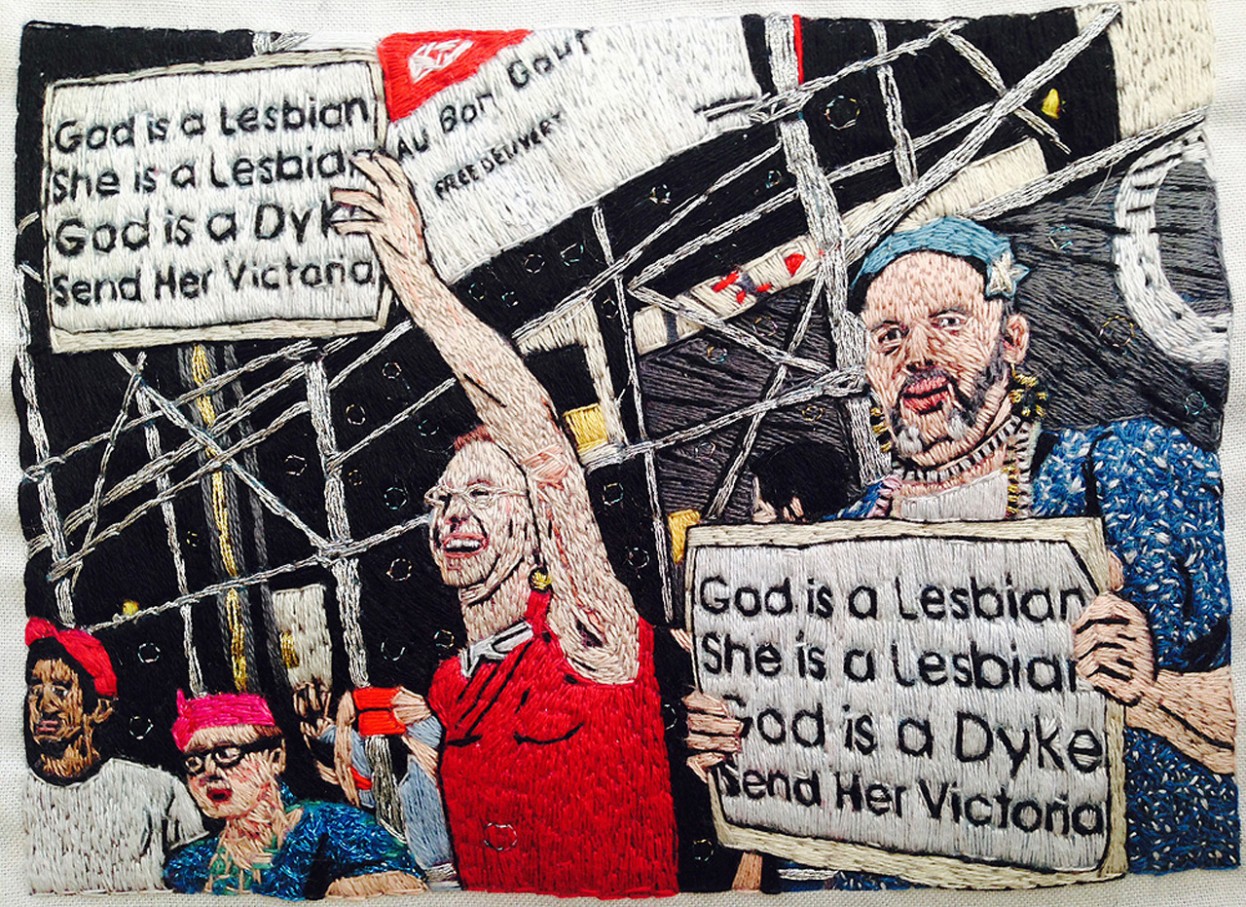
L.J. Roberts. Daniel Rosza Lang/Levitsky Singing at the 2013 NYC Dyke March, 2013; single-strand embroidery on cotton; 4 x 8 in. Courtesy of the Artist.

L.J. Roberts. Daniel Rosza Lang/Levitsky Singing at the 2013 NYC Dyke March, 2013; single-strand embroidery on cotton; 4 x 8 in. Courtesy of the Artist.

L.J. Roberts: Do think your use of abstraction mixed with craft is a strategy that inserts political concerns and agendas into a form that can be accessed by a wider range of people with more avenues for interpretation? If so, my work differs greatly from yours in that way. I thought I worked very literally, but now I’m actually working figuratively, which is not where I saw myself going at all. Perhaps that closes doors on the conversation and creates less of a gateway for multifaceted conversations.

Sheila Pepe: I think we are all working literally, but we are also working to combine layers of literal signs and signals that work as metaphor and analogy. It is what it is—and it points to something else. That’s why I’m thinking again about craft and art. One could say that within the context of art, craft may be queer but only if the latter is understood as a static self-sustaining location, invested in and empowered by its marginality. To this end, there must be an inherent disinterest in becoming part of the larger whole. As a personal quest, this sounds good, but as a political one, it doesn’t: Few people have the luxury of—or interest in—living and/or working in a static state of marginality.

I’m wondering what your political ambitions are for the concepts of queer and craft. What do they look like, in your mind’s eye?

LJR: For me, lately, the politics of craft and queer identity have been revolving around the notions of women and femininity—in terms of concept, visibility, and political gain—academically and even in the market.

In disciplines that have been traditionally practiced by women, like textiles, we’ve seen a group of men—particularly cisgender men—become highly visible, which is quite different than how women working in textiles have been positioned, both historically and contemporarily. Many representations of masculinity in mainstream culture are quite violent, and so to see a man exuding a feminine masculinity—like knitting or crafting, for example—is enticing. Most of these men who position themselves within the realm of queer craft (if we want to use that term) are making work about men, male identity, and male desire (usually toward other men). The valuing of men engaged in textiles is often hyper-gendered and what I call slyly misogynist. For instance, the show Man-Made: Contemporary Male Quilters that recently opened in Los Angeles at the Craft and Folk Art Museum seems to embody a lot of the problems you and I have been talking about, in terms of the intersections of queer identity and craft. It’s a show composed entirely of white cisgender men (queer and straight) who all are making work about being male. It’s convenient to engage in women’s work to accentuate and declare masculinity. I think of these men-who-sew shows as illustrating Sedgwickian Triangles, a dynamic in which men flirt or bond through a woman who acts as a conduit—but in this context, it’s a creative practice that has been historically marginalized that is a catalyst for these homosocial dynamics. These shows have systemic consequences on so many levels, micro and macro.

Read the full interview here.

Share