Michael Salter

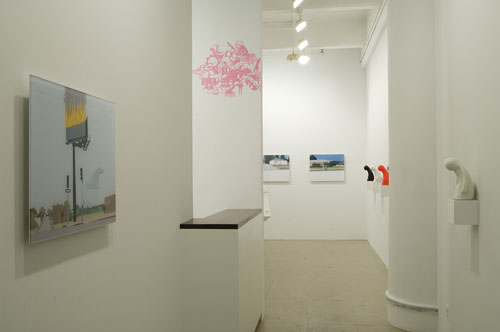
Since 1996, Michael Salter has participated in developing the artist-run space, Lump Gallery in Raleigh, NC and has recently opened the new project space, LumpWest in Eugene, Oregon. He has exhibited nationally and internationally, including his recent show, “Are you sure” at Jeff Bailey Gallery in New York City. Appropriately titled, this exhibition challenges our perceptions of everyday media, merging the vernacular of commercial design with a willful irrationality. While the commercial appeal of Salter’s work attributes to it’s accessibility, the way in which the imagery and surfaces are designated confuses our expectations of both advertising and commodity. Daily Serving recently spoke to Michael Salter about past projects and his most recent solo show in New York City.

Michael-Salter-4-17-08-01.jpg
All Photos Courtesy: Jeff Bailey Gallery and the Artist

Read More »

Share

Ayad Alkadhi

Ayad-Alkadhi-4-25-08.jpg

Iraqi-born artist Ayad Alkadhi uses Arabic calligraphy in the form of calligrams, or figurative imagery composed of interwoven written words, to create narratives within his work concerning the themes of religion, politics, and culture. His recent paintings reflect the war in Iraq and its psychological, emotional, and social ramifications for the modern Iraqi population.

Alkadhi works in series, his latest series being Al-Ghareeb (which translates as “stranger” or “the strange one”) and Father of No One’s Son. Al-Ghareeb explores the complex emotions of fear, loss of control, anger, and rebellion in a war-torn society. Most of the figures used in this series are based on photographs of the artist himself taken by photographer/video artist Scott Gerst, lending an intensely personal aspect to the works while simultaneously drawing attention to the position and problem of the artist surrounded by war. The faces of the figures are obscured by weaponry and masks illustrated using the elegant Arabic script, as seen above in If Words Could Kill II, thus elevating the emotional content of the work by referencing imprisonment and torture.

Alkadhi received a Bachelor’s Degree in Engineering Sciences from the University of Technology in Baghdad. He has exhibited at the Orfally Gallery in Baghdad, but left Iraq at 23 after the first Gulf War. He has had a solo show at the Aeotea Gallery in Auckland, New Zealand before moving to New York in 2000 where he earned a scholarship to the ITP/Tisch School of the Arts graduate program at New York University. Since then, he has shown at the Fire Island Pines Arts Project‘s 9th Biennial, The National Arts Club and Nader Gallery in New York, and Exposure Gallery in Palm Springs, California.


Share

Landon Wiggs

Landon-Wiggs-4-24-08.jpg

Landon Wiggs works with cultural paraphernalia, incorporating signs, text, and flashing lights into new contexts in the form of sculptures and collages. He plays with certain formal characteristics of his media like symmetry and repetition as well as with the semiotics and connotation of words. In each of his works, a sense of the familiar is perceived, but distorted to develop narratives based on each individul’s own cultural associations and understandings.

Landon’s skills in manipulating and repurposing pre-existing everyday imagery can be seen in one of his past public projects. In 2006, he altered the text on an American Apparel bench advertisement (well known for their provocative nature) in front of the Los Angeles County Museum of Art to read “ReAppear in lacmA.” The project remained undisturbed for weeks as cleanup crews removed various stickers and graffiti tags around the bench. American Apparel later removed all bench advertisements in the area, thus ending the subversive public project.

Earlier this year, Landon exhibited with Adrian Paules at Jail Gallery in the show Educated Dreamer. Both artists received their M.F.A.s from Yale University in 2003 and currently share a studio building in Los Angeles. Landon has also been featured online by Beautiful/Decay Magazine.

Share

Cash Brown

Cash-Brown-4-23-08.jpg

Appropriate, a recent collection of works by Sydney artist, Cash Brown is currently on display at Robin Gibson Gallery, Darlinghurst. The exhibition is comprised of various works on canvas which appropriate Gustave Courbet’s infamous vaginal painting Origin of the World, 1866. While utilizing this image as a central source of inspiration, Brown has also incorporated influences from other western artists, painting Courbet’s figure in the style of Tom Wesselmann‘s pop art nudes, integrating fish used in John Currin’s The Moroccan and utilizing geometric Suprematist imagery ala Kazimir Malevich.

Brown received her BFA from National Art School, Sydney and has had her work extensively exhibited on a national scale at institutions including the Museum of Contemporary Art, Sydney, Greenhill Galleries, Adelaide and MOP Projects, Redfern. She is currently the coordinator of Off the Wall, a showcase of works by unrepresented Australian artists, taking place as part of The Weekend Australian Art Sydney, Art Melbourne and Art Brisbane.

Share

Kate Schermerhorn

Kate Schermerhorn-4-22-08.jpg

Kate Schermerhorn was born in 1966 and raised in Malibu, California where she began taking photographs at age six. She studied with Joel Sternfeld at Sarah Lawrence College and graduated in 1989. She has traveled extensively, having lived and worked in New York, Los Angeles, Hong Kong, Florence, and London. However, her work displays distinct West-Coast elements. Schermerhorn incorporates imagery from the entertainment world and desert wildlife, all while playing with the boundaries between real and fantasy. In her photographs, a naturalistic rock is actually a stereo speaker, and an artificial cactus sits on the sand of a real desert.

Her work is the result of critical observation of our contemporary American culture. Her first book, America’s Idea of a Good Time, investigates through a camera lens why we play bingo, hit golf balls, stack Oreo cookies, bungee jump and the like. She is working on a second book that will examine the idiosyncrasies particular to Los Angeles.

Fifty One Fine Art Photography includes Schermerhorn’s work in their current exhibition USA squared, along with the work of Peter Granser. The exhibition captures the stereotypes and absurdities that characterize American life and popular culture. There remains a subtle sense of humor throughout the exhibition, which will be at Fifty One until May 3rd.

Share

Color Chart

The Museum of Modern Art‘s current exhibition is a chromatic extravaganza. Color Chart includes an impressive span of artists, from ready-made deity Marcel Duchamp to young digital artist Cory Arcangel. Ann Temkin, who was appointed Department of Painting and Sculpture Curator at MoMA in 2003, is a curator with a penchant for early appropriation artists and seductive, culturally resonant mark-making. Temkin organized Color Chart, trying to capture the mass-produced, systematic, arbitrary and indulgent role color played in the latter half of the twentieth century.

Duchamp and Warhol set the tone for the exhibition. Both artists took color out of the realm of spirituality and borrowed their hues from consumer culture and mass production. Ellsworth Kelly‘s straightforward color charts give the exhibition its name. Yet, while Color Chart certainly emphasizes the down-to-earth characteristics of color, it doesn’t exclude natural, organic hues. Ed Ruscha‘s stains speak to the arbitrary nature of color – we don’t necessarily have control over the shades of a thumb print or the way coffee yellows the table cloth. John Baldessari‘s Six Colorful Inside Jobs, on the other hand, has everything to do with the ways in which people control color. Carrie Mae Weems, on of the few women in the show, addresses color’s relationship to race and adding a much needed consciousness to and exhibit that spans so many centuries.. The exhibition continues through May 12.

Share

Phantom Sightings

Capistran-Juan-4-20-08.jpg

Phantom Sightings: Art after the Chicano Movement is a breakthrough exhibition for the Los Angeles County Museum of Art. Despite the heavy Latino and Chicano population in Southern California, LACMA has never before featured the Chicano art movement. Organized by filmmaker and curator Rita Gonzales, LACMA’s Contemporary art curator Howard Fox, and LACMA’s adjunct curator of Latino and Chicano Art Chon Noriega, the show attempts to explore the experimental aspects of Chicano Art.

Phantom Sightings includes around 125 works of art, all by contemporary artists. Christina Fernandez, whose photographs were recently displayed in the project space at Pomona College’s Museum of Art, shot the promotional image for the show: a graffiti ridden laundry mat. Mario Ybarra Jr., an artist who likes his work to interact with its surroundings and its audience, recently participated in the Whitney Biennial. Nicola Lopez does free-spirited multi-media projects that probe urban landscapes. Juan Capistrani does it all–installation, sculpture, and drawing. As a whole, the LACMA show gives audiences a comprehensive idea of Chicano art as it stands today, emphasizing the social, environmental, and attitude related issues that young people face and showing how art can grapple with contemporary issues. The exhibition opened on April 8th and will run through September 2008.

Share