Marc de Jong

Marc-De-Jong-6-8-08.jpg

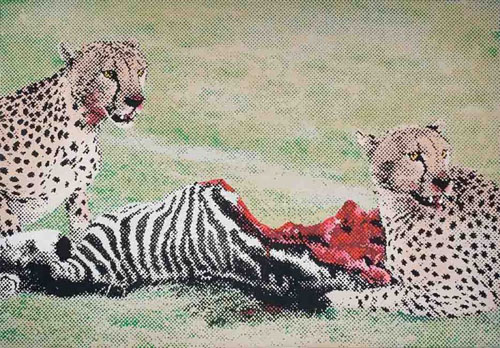
Sullivan+Strumpf Fine Art in Sydney will open an exhibition of recent paintings by Melbourne artist Marc de Jong on June 10th. de Jong gained recognition as a street artist in Melbourne and his work is now held in several collections throughout Australia. He collects the imagery for his paintings from a variety of sources, including the Internet, television, movies, and newspaper. His contemporary scenes include an isolated car crash, an image of Princess Leia, a video still from a gas station hold-up, men huddled on Wall Street, and two cheetahs hovered over the entrails of a zebra. The artist then translates this diverse subject matter onto his canvas by painstakingly painting individual dots, personalizing the wide realm of technological imagery and humanizing the prolific pixel.

There was an eruption of public art in Melbourne between the 1990s and 2004, and de Jong was actively producing during this time. The practice gained institutional respect in 2007 when the National Gallery of Australia purchased its first collection of contemporary street art, which took three years to compile and included 300 stencil designs by 30 artists, including works by Marc de Jong. Melbourne is now an international hotspot for urban art, with world renowned graffiti artist Banksy calling Melbourne’s street art, “..arguably Australia’s most significant contribution to the arts since they stole all the Aborigines’ pencils.”

Marc de Jong’s paintings will be on view at Sullivan+Strumpf in Sydney until June 29th.

Share

Robert Mapplethorpe

Robert-Mapplethorpe-6-7-08.jpg

The Whitney Museum‘s current exhibition offers a telling glimpse into photographer Robert Mapplethorpe’s artistic development. Mapplethorpe, who became controversial because of his S&M inspired photographs in the 80s, helped bring beauty back into the art dialogue. Influenced by Andy Warhol‘s cultural connoisseurship and classical perceptions of beauty, his sleekly formal images were at once traditional and culturally relevant.

When his lover, collector and curator Sam Wagstaff, gave him a Polaroid camera in 1975, Mapplethorpe’s photographic eye began to flourish. The polaroids that Mapplethorpe took in the later 1970s have the haunting, composed quality that came to characterize his work. But they are also clearly experimental. The nearly 100 photographs in the Whitney exhibition represent an array of technical and compositional explorations. Mapplethorpe’s romanticized images of Patti Smith differ from his portraits of celebrities with whom he had a more distant relationship and his own self-portraits experiment with riskier subject-camera relationships.

Mapplethorpe received a BFA from Pratt Institute in the early 1970s and spent most of his career in New York City. In 1987, he established the Robert Mapplethorpe Foundation to help fund photographers and fight aids. He died in 1989, from complications related to AIDS. Mapplethorpe: Polaroids at the Whitney Museum continues through September 7, 2008.

Share

Toby Burrows

Toby-Burrows-6-7-08.jpg

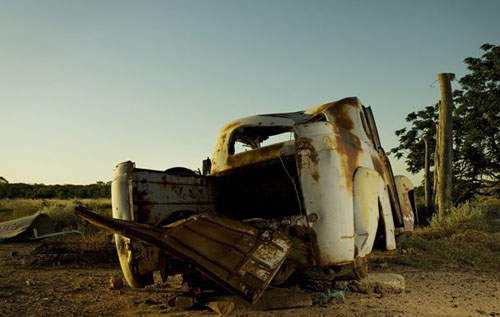
Currently showing at Blender Gallery, Paddington is a recent collection of works by acclaimed photographer, Toby Burrows. Entitled Footprint, the exhibition documents the artist’s journey to Broken Hill, a regional mining suburb located in the far west of outback New South Wales. Images of picturesque scenery and vast landscapes present the beauty within the isolated town, and are cleverly juxtaposed with close ups of bird droppings smeared on windscreens and bugs splattered on the front of cars.

Burrows studied at Sydney College of the Arts, Rozelle before later moving to London. There he became the manager of Holborn Studios, Europe’s largest photographic studio complex. Since his return to Sydney, Burrows has created advertising imagery for international corporations including Virgin mobile, Slazenger, Guinness and Epsom. He was commissioned by National Geographic to photograph deserted areas and remote communities within Australia, including Wilcannia, an outback region with a large indigenous population. Burrows has won several awards for his art practice including gold at the New York Festival, numerous finalist positions at the Cannes Film Festival and a World Press award.

Share

Michael Scoggins

Michael-Scoggins.jpg

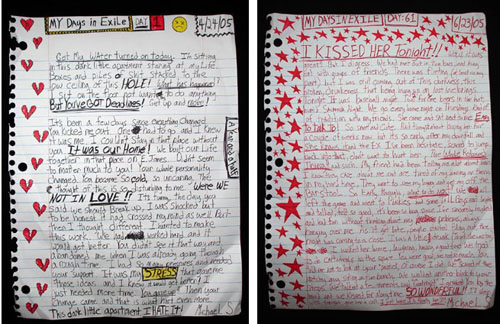
For the Balelatina HOT ART FAIR 2008, Michael Scoggins is presenting a new series of his signature drawings on large blue-lined spiral bound notebook paper. Scoggins uses simple materials used in childhood such as graphite, crayon, and marker to illustrate more complex issues concerning American politics as well as the artist’s own personal and emotional life. This Savannah College of Art and Design alumnus (and member of MoMA‘s permanent collection) has met universal acclaim due to his clever ability to present adult issues through a child’s perspective and medium, thus making these issues less taboo and forcing the viewers to examine and reflect upon their own experiences.

Scoggins addresses war, romantic break-ups and crushes, mood swings, and mental disturbances in an incredibly appealing and accessible manner. The enlarged notebook paper (67″ x 51″) provides the canvas for his sketches, with their size lending importance to the work. Some of the artist’s works replicate school day ephemera (graded math tests, notes to friends, doodles), most deal with more adult topics, all while placing the viewer in the sometimes uncomfortable position of voyeur. The tattered ends and crumpled up appearance of the paper make us feel as if we have come across something we are not supposed to be reading, but the immersive nature of the piece immediately contradicts this notion. All of the works are emotionally charged, presenting the viewer with anger, humiliation, and of course, nostalgia.

Share

Pornography or Art?: The Controversial Photography of Bill Henson

Bill-Henson-1.jpg

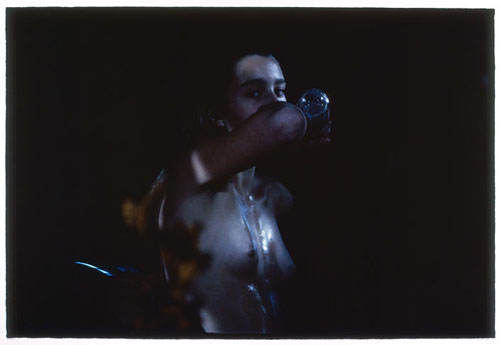
Over the last fortnight Sydney’s Roslyn Oxley9 Gallery was scheduled to host an exhibition showcasing the work of acclaimed Australian photographer, Bill Henson. However, just hours prior to its programmed debut, the gallery was stormed by police confiscating 12 works on display and another 20 from the storeroom, while the gallery website was also forced to remove the offending imagery from its server. Such censorship was in play due to the depiction of naked adolescents within many of Henson’s prints.

This story has dominated Australian tabloids and news broadcasts since its occurrence, with sensationalist headlines such as “Gallery raided as Bill Henson child porn art removed” appearing in leading newspapers, while news bulletins slander Henson a pedophile. The artist and gallery owners are now facing possible child pornography charges, causing debate to erupt over the distinction between art and pornography.

With Australia’s own prime minister, Kevin Rudd declaring the images as “absolutely revolting,” it’s no wonder so many people have such an ignorant and philistine view on the topic. Boorish online groups entitled “Bill Henson is disgusting, perverted and a creator of child pornography,” are being created while gallery owners Roslyn and Tony Oxley have even received anonymous phone messages from people threatening to burn down the gallery.

Bill-Henson-3.jpg

Yet much vocal support is also being shown in favour of the artist, aided with the defense of former child models who appear in Henson’s earlier works, declaring they never felt violated when posing for the artist. Numerous high profile people have also voiced their support for Henson, including fellow artist Callum Morton, playwright Michael Gow and acclaimed actress Cate Blanchett.

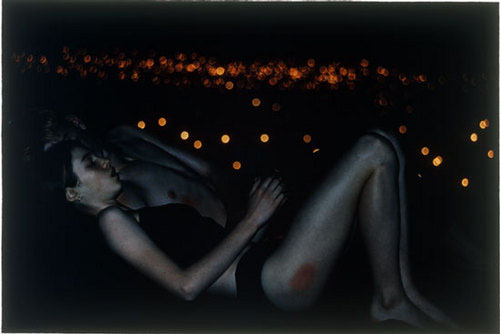
Part of the current mass hysteria can be attributed to the way these images are being shown cropped, censored or out of context within the media. Close ups of adolescent girls’ breasts or figures with blurred genitalia certainly demean the artist’s broader body of work and have absolutely nothing to do with the way these images were intended to appear within a gallery environment.

One of the most shocking elements regarding the incident is Henson’s global reputation as a respected artist. His work has been displayed within many major institutions around the world including the Guggenheim, New York, the Museum Moderner Kunst, Vienna and the Victoria and Albert Museum, London- all without vilification. Within Australia his photographs are even studied as part of high school visual arts curriculum.
Bill-Henson-2.jpg

The current controversy in accordance with the Australian police force has required several other galleries, who have been displaying Henson’s prints for years to also remove his photographs from their walls. In 2005 the Art Gallery of New South Wales (a somewhat “conservative” art institution), hosted a large scale retrospective of Henson’s photography, which received no public objection whatsoever. Images within the exhibition contained the same form of adolescent nudity as present within the artworks at Roslyn Oxley9. The retrospective contained hundreds, possibly close to a thousand of Henson’s prints and nobody seemed to say a word. So why now?

As a fellow Sydney-sider and art lover, my deepest condolences are with Henson and those affiliated with Roslyn Oxley9. These are certainly very dark days for the Australian art world.


Share

Jaime Pitarch

Jaime-Pitarch-6-2-08.jpg

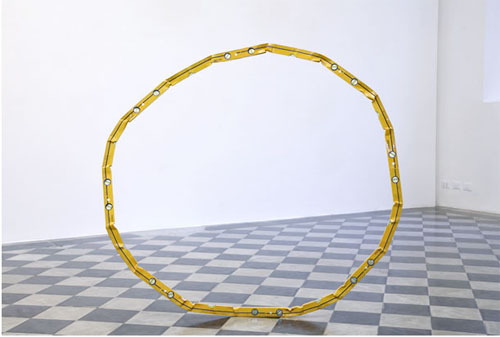
The work of Spanish artist Jaime Pitarch uses photography, video, sculpture, drawing and installation. The artist often focuses his attention on the altercation of everyday objects such as guitars, tables, glasses and hardware, which render the original function of the object useless. Pitarch’s work is steeped in parody and humor and challenges the viewer’s perception of items that are constantly used, though rarely considered. Pitarch’s works are humble, yet are consistently presented with fierce craftsmanship and wit. The artist currently lives and works in Barcelona. He received his degree from Chelsea College of Art and his Master’s from the Royal College of Art in London.

Pitarch has exhibited internationally with shows at Spencer Brownstone Gallery in New York City, Mjellby Konstmuseum in Halmstad, Sweden, and Galeria Fucares in Madrid.

Share

Nancy Macko

Nancy-Macko-6-1-08.jpg

Commissary Arts is currently showing Hive Moments, an exhibition featuring the prints and mixed media works on paper of Los Angeles-based artist Nancy Macko. Macko explores the themes of society, art, science, and technology through the matriarchal culture of the honey bee. In honey bee society, a queen bee reigns over the hive and controls the activity of other bees. This matriarchal society inspires Macko, who grew up in a household of only women after her father died at age six. The interactive and organized realm of school became her world and separated her from the chaos at home. The hive, with its highly controlled chaos, combined both of these realms for the artist.

Macko is presenting recent etchings and lithographs in two parts, In the Garden of the Bee Priestess and The First Ten Prime Numbers. In addition, that artist will present mixed media works on paper from her series Conversations. Macko incorporates the intrinsic shapes of both a plumb bob and circular reinforcements used for paper into her compositions. The rotundity of the plumb bob evokes the female shape and the body of a bee. The artist scans, photocopies and layers images of these shapes to create one compelling image. The small circular reinforcements represent unity and float freely and in clusters through her carefully constructed worlds.

Using repetition with this unique visual language, Macko creates abstract scenes of a feminist-inspired universe, which is at once conceptually compelling and visually beautiful.

Macko cites Nancy Azara, Nancy Spero, and Ana Mendieta as influential and inspirational female artists. Macko participated in the making of The Dinner Party in 1979 and has studied feminist utopian societies in science fiction novels.

Macko is originally from New York and attended University of Wisconsin, River Falls. She received her M.F.A. in Studio Art from the University of California at Berkeley and an M.A. in Education. Macko is currently the Chair of the Department of Gender and Women’s Studies at Scripps College. She has had over 20 solo exhibitions, participated in over 140 group shows, and received over 30 research and achievement awards for her work. Hive Moments is the artist’s first solo exhibition since her mid-career survey show in 2007 and will be on view at Commissary Arts until June 14th.

Share