





Summer Session

Summer Session – @Large: Ai Weiwei at Alcatraz

Our current Summer Session topic is celebrity, and today from our sister publication Art Practical we bring you a review by Heidi Rabben of artist Ai Wei Wei’s controversial show @Large. Rabben takes Ai’s position as an artist–activistprovocateur to task, suggesting that the show relies too heavily on his reputation without delivering the content to match. This review was originally published on November 24, 2014.
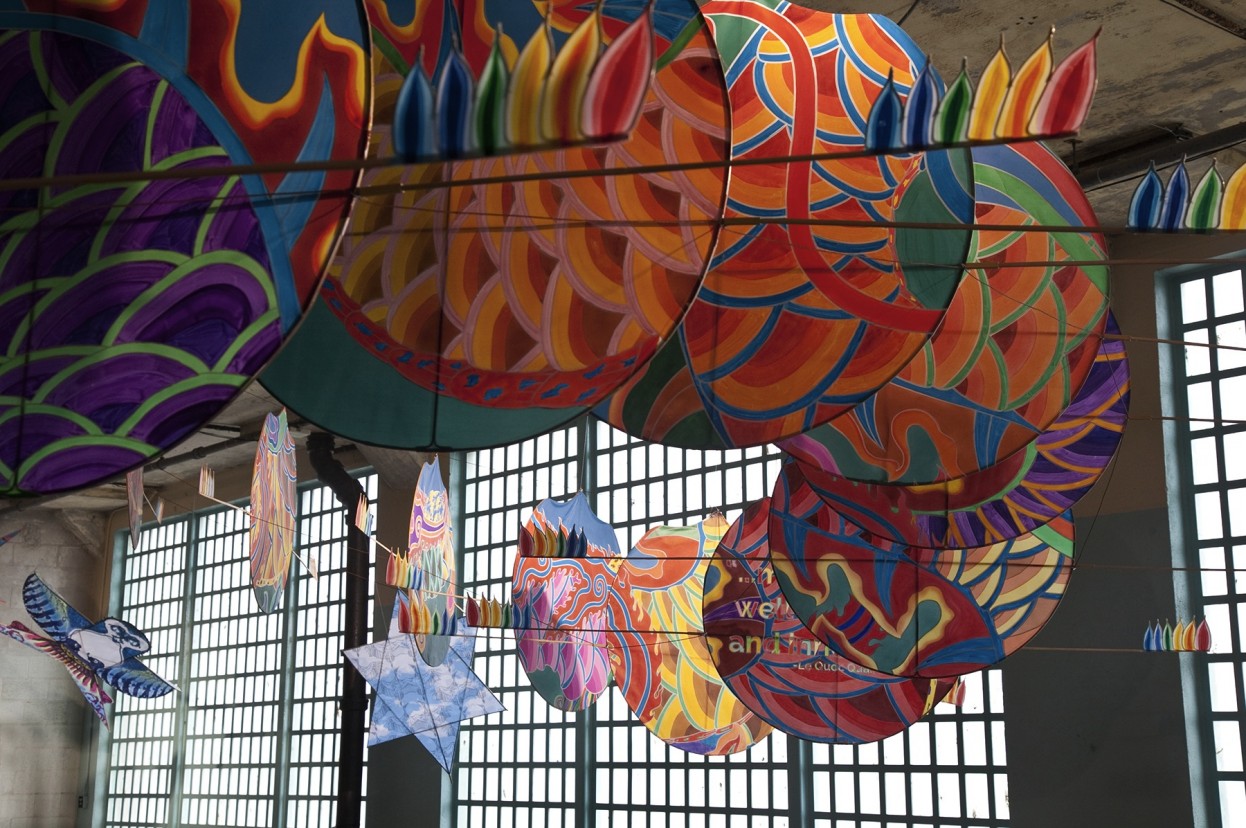
Ai Wei Wei. With Wind, 2014; installation detail, New Industries Building, Alcatraz. Courtesy of FOR-SITE Foundation. Photo: Jan Stürmann.

Ai Wei Wei. With Wind, 2014; installation detail, New Industries Building, Alcatraz. Courtesy of FOR-SITE Foundation. Photo: Jan Stürmann.

This text is likely neither the first nor the last thing you will read about @Large: Ai Weiwei on Alcatraz. Substantial coverage began far in advance of the insurgent artist’s opening in late September, and the hype has continued steadily since. So it is not without reservation that I contribute another drop in the bucket. But for a project that professes to be predicated entirely on freedom—of thought and of speech in particular—the vast majority of the @Large analysis is, at best, cautiously complimentary, and, at worst, reductive and descriptive. A number of factors may be contributing to this reserved reception, including the scale and budget of the project, the number of volunteers and assistants who assembled and help maintain it, the exhibition’s lengthy duration, and the nuance of its touristic setting. A section of the project website is even dedicated to these statistics, stressing the impressiveness of the undertaking. While surely significant, these elements overwhelmingly eclipse criticism about the artworks themselves. And beyond the stats looms an implicit hesitation about evaluating such socially conscious intentions, or perhaps further, of critiquing an artist–activist–celebrity like Ai Weiwei—a figure who, ironically, professes to invite and value serious critique. So in the spirit of one of the exhibition’s taglines, “Liberty is about our rights to question everything—Ai Weiwei” (which literally appears on the commemorative luggage tag), this review will question some of the core works and motivations in @Large.

Read the full review here.

Share

Summer Session

Summer Session – ART THOUGHTZ: Damien Hirst

As we wrap up our month-long consideration of celebrity, we bring you this video from Hennessy Youngman’s web series Art Thoughtz. One of the most infamous celebrity figures of the art world is Damien Hirst, and while Youngman has no real problem with Hirst’s status as an art-market darling, he does take issue with his presentation. This video was originally uploaded on January 10, 2012. 

Share

Summer Session

Summer Session – Melody Set Me Free 4.0: “We Kiki”

For this Summer Session the topic is celebrity, and we’re investigating the various ways celebrity, pop culture, and art inform and reflect one another. Today we bring you an episode from artist Kalup Linzy’s web series Melody Set Me Free, in which actor Macaulay Culkin guest-stars as a music producer. This video was originally uploaded on July 23, 2014.

Share

Summer Session

Summer Session – #Hashtags: Rebel Rebel

This July we’re talking about celebrity, and today we bring you an article from our #Hashtags column that explores the intersection of art, social issues, and global politics. In this essay, author Anuradha Vikram talks about how the queerness of countercultural artists becomes appropriated as they achieve stardom, leaving behind the precariousness that first defined them while it continues to define their colleagues. This article was originally published on April 21, 2014.

Leee Black Childers. David Bowie as Ziggy Stardust, Philadelphia, 1973. Digital C-print.

Leee Black Childers. David Bowie as Ziggy Stardust, Philadelphia, 1973; digital C-print.

As a young art-school graduate trying to understand the artist’s life that I had chosen, I could have had no better tutor than Leee Black Childers, who died April 6 at age 68. Childers, photographer and minder for rock stars and transgender icons, led the sort of life that the rest of us only read about. His generation, in the East Village and elsewhere, lived with a precarity and an immediacy that somehow produced enormous creativity. The rewards of that artistic output accrued unevenly to its creators, such that I came to know a man who had worked intimately with Andy Warhol, David Bowie, and Iggy and The Stooges as a colleague at what was, for me, a transitory job at a photography lab while I worked out bigger plans. Reflecting, I am reluctant to romanticize an era that left such crucial participants a hair’s breadth from mainstream celebrity yet financially destitute, but I’m awed by the tenacity and fearlessness that they brought to their art and to their lives.

Read the full article here.

Share

Summer Session

Summer Session – Work of Art! Reality TV Special

Today for our Summer Session topic of celebrity, we bring you an episode from artists Chris Vargas and Greg Youmans’ web-based trans/cisgender sitcom Falling in Love…with Chris and Greg. In this satirical video, Vargas and Youmans edit an episode of the short-lived reality TV show Work of Art, demonstrating the vital linkages between Pop art and queer art, and how commercially successful iterations of both are evacuated of their radical, political meanings in order to become consumable products. 

Share

Summer Session

Summer Session – Punk Thing

For this month’s Summer Session were thinking about celebrity, and today we bring you an article by Brandon Brown from our sister publication Art Practical on perhaps one of the most iconic and enduring cultural genres: punk. Simultaneously existing as both an infamously commercialized stylization and a sincere, perennial style, punk remains an inexhaustible testament to the inextricability of power and aesthetics. This article was originally published on September 10, 2015.

Still from the X-Ray Spex performing "Oh Bondage! Up Yours!" circa 1977. From the documentary Punk in London (Metrodome, 1977).

Still from the X-Ray Spex performing “Oh Bondage! Up Yours!” circa 1977. From the documentary Punk in London (Metrodome, 1977).

in memoriam Peter Culley

“Punk was not a musical genre; it was a moment in time that took shape as a language anticipating its own destruction.” —Greil Marcus, Lipstick Traces

“I’m mad, but I ain’t stressin’.” —Kendrick Lamar

Do you know that great Sappho poem about all the things some people say are so great? “Some say marching cavalry, some say foot soldiers / others call a bunch of ships the most beautiful of sights / offered by the dark earth / but I say it’s whatever you love best.”1 The rhetorical device Sappho uses to open this poem—“some say…but I say”is called a priamel, a list of possibilities that the speaker ultimately disdains in favor of her true feeling.

This literary device been used by countless poets since Sappho. Poly Styrene makes use of it for one of my favorite songs, “Oh Bondage Up Yours!” by X-Ray Spex: “Some people say that little girls should be seen and not heard, but I think…oh bondage, up yours!!” Part of the genius of this particular priamel is the transformation of Poly Styrene’s voice, which begins subdued, even resigned, but rapidly becomes a loud, feral “fuck you.” The scream is one of both affirmation and refusal, deftly iterating the way the phrase “Oh Bondage” both celebrates and utterly rejects the quotidian masochism of life under dominion.

What happens right after this vocal leap can only be described in terms of utopian time travel. A sixteen-year-old white Brit who calls herself Lora Logic blows one long note into a saxophone, a note that stubbornly drones before distorting into a crude statement of the melody. Then Poly Styrene’s voice returns: swinging, furious, perfect. Her sense of timing is extraordinary, stretching out the o of oh just slightly, but long enough that up yours suffers a soft elision. When she screams “up yours!” she has to squeeze the two syllables into one and a half. It’s a little out of step, but so is Poly.

Read the full article here.

Share

Summer Session

Summer Session – Do You Believe in Television? Chris Burden and TV

This Summer Session we’re thinking about celebrity, which necessarily includes the ways in which celebrity is most easily produced and consumed—that is, were also thinking about television. Today we bring you an excerpt from an article published on East of Borneo by Nick Stillman, regarding Chris Burdens television performances of the 1970s, which used the medium of television to challenge the consumerist ethos it perpetuated, unlike its complicit emulation seen in the Pop Art movement. This article was originally published October 10, 2010.

Chris Burden, still from TV Hijack, 1972. Photo: G. Beydler. Courtesy of the artist and Gagosian Gallery, © Chris Burden.

Chris Burden, still from TV Hijack, 1972. Courtesy of the Artist and Gagosian Gallery, © Chris Burden. Photo: G. Beydler.

It’s generally known that Chris Burden made a few commercials for television in the 1970s. But any pursuit of why, expanding meaningfully beyond the descriptive synopses Burden himself provides for most of his individual works, has been curiously rare. Burden—then living in Venice Beach—was concurrently making live performance work that deployed television monitors as critical signifiers of voyeurism. This link between his use of the television set as an object or prop in performances like Do You Believe in Television or Velvet Water and his works that actually took place on television is crucial to parsing why arguably the foremost performance artist of his generation began to resituate a live performance practice to a medium that seems antithetical to live art. Television as both communicative and manipulative vessel is a major focus in Burden’s work from 1971 to 1977. Burden usually downplays the political connotations or intentions of his art, but this body of television work seems like an examination of militaristic training, specifically, how authority results in belief.

Read the full article here.

Share




