Matthew Ronay

Matthew Ronay.jpg

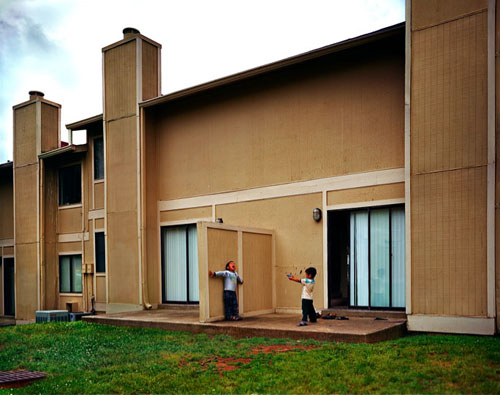
Matthew Ronay’s sculptures are based on the possibility or implausibility of future revolution in America. Focusing on scenarios of American homogenization and the manipulation of genetic science to create an ideal population, Ronay allows each piece to investigate what new value would arise from such a fundamental social shift. These narrative metaphors are intended to act as a visual puzzle and are often quite indiscernible as a result. The artist was born in Louisville, Kentucky, and is an MFA graduate from the Yale University School of Art. Last year, Ronay exhibited “Oh My God What Are We Gonna Do” with Vacio 9 in Madrid, Spain, and “Going Down, Down, Down” at Parasol Unit in London. The artist is currently represented with the Andrea Rosen Gallery in New York City and has been involved in several notable group exhibitions, including “Make It Now: New Sculpture in New York” at the Sculpture Center in Long Island City and “Uncertain States of America: American Art in the 3rd Millennium” at the Astrup Fearnly Museum of Modern Art in Oslo, Norway.

Share

Richard Barnes

Richard Barnes.jpg

On view now at Howard House in Seattle is the photographic series Animal Logic by artist Richard Barnes. The ongoing series documents the strange world of the natural history museum, depicting crates of stuffed animals, large environmental sets and scenes of objects mysteriously wrapped in clear plastic. The artist’s investigation of the museum calls into question the ideas of collection, preservation and display, as well as viewer relation and understanding of the natural world. Physically, the photos are large-scale and as full of wonder as the actual exhibitions that they document. The images carefully convey the mystery and fragility of these now man-made structures and translates the inherent beauty of both the objects and the display.

Barnes regularly contributes to magazines and newspapers such as the New York Times, and works as a nationally celebrated architectural and archeological photographer. In 2005, the artist was the recipient of the Rome Prize, and has now exhibited works at The Metropolitan Museum of Art, the Philadelphia Museum of Art, San Francisco Museum of Modern Art and Los Angeles County Museum of Art, among many others.

Share

Greg Miller

Greg Miller-11-14-08.jpg

Opening this weekend at David Salow Gallery in Los Angeles will be the recent photographs of Greg Miller, in an exhibition titled Nashville. As a native to the city, Nashville recalls a sense of truth that is all to real. The artist presents everyday people in everyday scenes, however there is always an emotional element that is a askew and disrupts the narrative of the image. Technically. Miller uses a large format 8 x 10 wooden camera with a lens plane that moves independently of the film stock, resulting an a hyper crisp image.

Greg Miller is the 2008 Guggenheim Fellowship recipient, and exhibited in the show Three Generations of Nashville Photographers at The Arts Company in Nashville, TN. He received his BFA from the School of the Visual Arts in New York City and has exhibited with PowerHouse Arena in Brooklyn, NY and Yossi Milo Gallery in Manhattan.

Share

Karin Olah

134.jpg

Currently on view at the Dobbs Gallery in Birmingham, Alabama are new fabric collages by Karin Olah. The Dobbs Gallery is a new space in Birmingham, devoted to showing work of established and emerging contemporary artists. The exhibition, titled Arrivals, cleverly marks the artist first solo exhibition with the gallery as well as a new body of work. Olah has gained a reputation in the SouthEast for her fabric collages which attempt to mimic elements of the natural world through the formal vocabulary of line, form, color and space. Olah’s work responds to the history of textiles and quilt making by using fabric to mimic the line and texture of paint.

Olah is a graduate of the Maryland Institute College of Art, in Baltimore with a major in Fiber Arts and currently lives and works in Charleston, South Carolina. She was recently included in the publications American Contemporary Art and Art Business News. Recent exhibitions have included works in the South Carolina State Museum, Redux Contemporary Art Center and Eva Carter Gallery in Charleston, South Carolina, as well as the Torpedo Factory Art Center in Alexandria, Virginia.

Share

Omer Fast

Omer-Fast.jpg

Through January 3, the School of the Art Institute of Chicago Rymer Gallery will present the first Chicago solo exhibition by video artist Omer Fast, winner of the 2008 Whitney Biennial‘s highest honor, the Bucksbaum award.

Born in 1972 in Jerusalem and now based in Berlin, Fast’s reexaminations of past and present histories and narratives have catapulted him onto the international scene. The exhibition marks the U.S. premiere of Fast’s recent work, the single channel video Looking Pretty for God (After GW) (2008), co-commissioned by the School of the Art Institute and the Manifesta Foundation. Filmed primarily in Chicago with assistance from a team of SAIC alumni, Looking Pretty for God combines a fictional photo shoot and interviews with funeral directors, revealing how their occupation is emblematic of modernity’s segregation between work, the worker, and the resulting product as it is subsequently displayed for the public.

Also showing will be the four-channel video The Casting, which intertwines two narratives told to Fast by an American soldier: the story of a destructive love affair in Germany, and an accidental killing in Iraq. Combining near–tableau vivant portrayals of what appear to be scenes from the narratives on one side of the screens, projected onto the reverse are documentary-style shots of Fast, as interviewer, and the soldier as raconteur.

“In the past,” says Fast, “I’ve searched for documentary subjects with problematic credentials: individuals with firsthand experience of inauthentic or staged events. Their stories were then complicated through various editing and installation strategies. Recently, I’ve tried to strip down the process, to create beautiful things that speak about the human condition more simply.”

Share

Samuel Francois

samuel francois.jpg

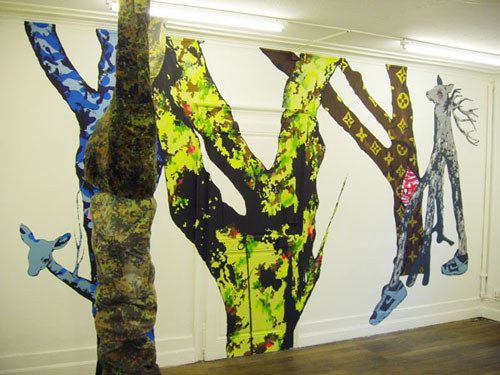
Samuel Francois is currently showing work in Brussels at ALICE Gallery in the exhibition Il Etait Une Fois Une Fois until November 30, 2008. The artist, an active member in the collective Inkunstruction, works in a broad range of artistic practices, including drawing, installation, urban intervention, and outdoor sculpture. He often uses silkscreen and spray paint, as well as felt tip markers when drawing.

His installations, both in and out of the gallery, have an element of spontaneity and exhibit a clever mixture of material and color. Cultural symbols are carefully placed and manipulated in his object/painting hybrids. The artist’s drawings depict characters of culture, portraits of people donning urban apparel, such as sunglasses, jewelry, hats, and casual clothing. The subjects are executed in fine-tipped marker, bright and colorful against monochromatic backgrounds.

Francois has previously exhibited at Duplex in Geneva, Cruce Galerie in Madrid, and Addict Galerie in Paris, as well as several other solo and group exhibitions.

Share

Gumier Maier

Gumier-Maier-11-10-08.jpg

Currently showing at Braga Menendez Gallery in Buenos Aires is a solo exhibition of new work by Gumier Maier, entitled El Baile de las Cosas (“The Dance of the Things”). Maier made a name for himself in the 1990s with his geometrical sculptures, but has now transitioned to more ephemeral means of working. After retiring in the Parana River Delta, Maier began collecting the trash that floated through the river system. This refuse became his newest media and informed by his sculptural background, Maier continues to construct various figures and collages from these discarded objects.

Since the Dadaists, we have seen the construction or reinterpretation of the found object, but Maier’s work makes a different point than Duchamp once did. There is no sense of rebellion or real feeling of tension; only a quiet contemplative quality to the work, no matter how colorful and textured it may be. Alternatively, the work cannot be simply interpreted through the lens of collage because there is such an unintentional construction to the pieces. The exhibition’s title suggests that the “dance” of the objects has less to do with the artist’s hand than the organic process that Maier and the “things” take equal part in. Plastic ice trays and shampoo bottles commingle with two-by-fours and dirty wash cloths to create the vague essence of a male figure. The aesthetics of the work are only part of the conversation however, in this age of “going green”. The social and ecological implications of a gallery full of works of art created by trash found floating in a South American river cannot go unnoticed. Maier leaves the dialog flexible and unforced in El Baile de las Cosas, inviting the viewer to begin that discussion on his or her own. El Baile de las Cosas is on view in the second floor gallery of Braga Menendez through November 15th.

Gumier Maier is represented by Braga Menendez and Diana Lowenstein in Buenos Aires and Miami and has exhibited internationally in Argentina, Brazil and the United States, including apexart in New York.

Share