Nathalie Djurberg

NATHALIE DJURBERG-1.jpg

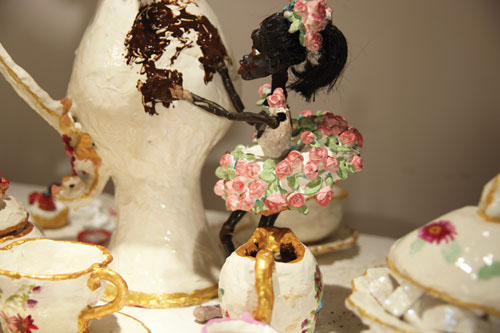
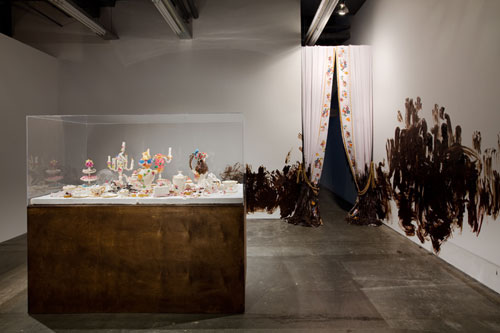
Currently on view at Zach Feuer Gallery in Manhattan is an exhibition featuring recent work by the Swedish-born, Berlin-based artist Nathalie Djurberg. Using a variety of media including stop motion animation, installation, sculpture and drawing, the artist constructs dark narratives that investigate human behavior through nightmares and fears. Without much restraint, these narratives open a dialogue addressing violence, dominance, gluttony, racism and sex. In her new exhibition with Zach Feuer, Djurberg presents the video I found myself alone, featuring a young ballerina climbing through a large table set for tea. The impeccably constructed set contains an array of desserts that the dancer destroys, eventually ending in her demise. Contents of the video are presented throughout the gallery as both sculptural objects and installation.
NATHALIE DJURBERG-1-3-09.jpg

Djurberg received her master’s degree from Malmo Art Academy in Sweden. She currently has a solo exhibition on view at the Hammer Museum in Los Angeles. The artist has completed solo exhibitions with the Prada Foundation in Milan, Kunsthalle Winterthur in Switzerland and Kunsthalle Wien in Austria. In addition, her work has been featured in exhibitions at the Tate Modern in London and the Solomon R. Guggenheim Museum, New York.

Share

Kurt Hentschlager


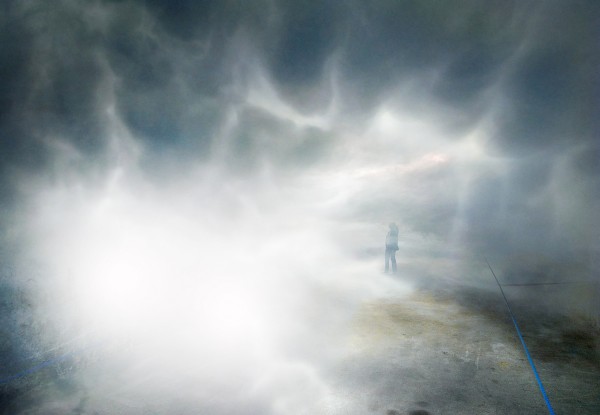
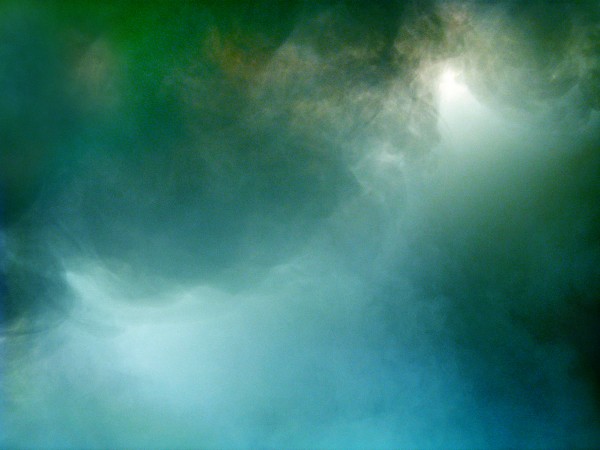
The Chicago-based Austrian artist Kurt Hentschlager’s installation ZEE, which just closed at Wood Street Galleries in Pittsburgh, is impossible to accurately document or describe. In this exhibition, Hentschlager creates an immersive environment of sight and sound reflecting on the nature of human perception and the accelerated impact of new technologies on both individual and collective consciousness. The installation is comprised of a room of an indeterminable size filled with fog such that each viewer is able to see their own hands at best. Somewhere within the space is a visual strobe-like component with corresponding audio. The effect is a completely immersive experience that lasts 17 minutes, and might best be described as pseudo-psychedelic.

Trained as a fine artist, Hentschlager began to exhibit his work in 1983, building surreal machine-objects and then video, computer animation and sound works. Between 1992 and 2003 he worked collaboratively as a part of the duo Granular- Synthesis. Employing large-scale projected images and drone like sound-scapes, his performances confronted the viewer on both a physical and emotional level, overwhelming the audience with sensory stimulation.

Hentschlager is a recipient of numerous prizes and large scale commissions. He has represented Austria at the 2001 Venice Biennial and has shown his work internationally for two decades. Selected presentations include the Millennium Museum, Beijing; Stedelijk Museum, Amsterdam; Anchorage (Creative Time), New York; MAC – Musee d’Art Contemporain, Montreal; MAK – Museum of Applied Arts, Vienna; National Museum of Contemporary Art, Seoul; Ars Electronica Festival, Linz; ICC Inter-Communication-Center, Tokyo; Fondation Beyeler, Basel; and Palacio de Bella Artes, Mexico City.

His recent performance, FEED, premiered at the 2005 Venice Theatre Biennial and is currently touring. The procedural installation KARMA/cell was commissioned in 2006 by Le Fresnoy, Studio National des Arts Contemporains, France.

Share

The Beauty and the Beast: Artists and their Pets in 20th Century Art

The Beauty-1-1-09.jpg

A new exhibition at the Art Institute of Chicago chronicles something unexpected and sentimental: the relationship between artists and animals. Ranging from Caravaggio to Pablo Picasso and Pierre Bonnard, the exhibition traces the roles pets have played in the progression of Western art.

Held in the Ryerson and Burnham Libraries, The Beauty and the Beast features books from the Museum’s collection that explore animals’ presence from ancient and mystical eras into 20th Century art. The theme may be a little quirky, but it is far from flimsy. For some artists, like Benvenuto Cellini, pets were weightily symbolic and for others, like Frida Kahlo, they were tender accomplices.

Picasso’s drawings and paintings of dogs are as comical as they are iconic. And the dogs in Bonnard’s work provide subtle social commentary. The Beauty and the Beast opens on January 7, 2009.

Share

To Illustrate and Multiply: An Open Book

To Illustrate and Multiply: An Open Book, currently on view at the Museum of Contemporary Art’s Pacific Design Center, surveys artists books from the 20th Century to the present. The exhibition’s title comes from a book by artist Raymond Pettibon and an impressive span of artists are included, among them are illusionist and perceptual artist Olafur Eliasson, parodic sculptor Lara Schnitger, Belgian artist and musician Arno Hintjens, multi-talented sculptor and filmmaker Michael Snow, designed-inspired Jorge Pardo, and the ever-relevant Andy Warhol. The work dates back to 1965. All books were printed in editions of 100 or less and some can be handled by viewers in an on-site reading lounge.

MoCA Librarian Lynda Bunting and Director of Publications Lisa Gabrielle Mark co-organized the exhibition and both wrote accompanying essays. The exhibition specifically addresses how artists approach time and interaction, and, as Mark points out, the work explores the ways in which “the book (the embodiment of the intentions of the artist) may concern itself with present, past, and/or future – even suspending time – in myriad different ways.” The above video moves through a self-reflexively subdued 1975 photographic book by Michael Snow called Cover to Cover.

To Illustrate and Multiply continues through March 1, 2009.

Share

Patch Dynamics – Six New Invasions to the Field

Lawrimore Project in Seattle is currently presenting a group show titled Patch Dynamics – Six New Invasions to the Field. The exhibition, which is jointly curated by Scott Lawrimore and Yoko Ott, has its concept rooted in the patch, a fundamental characteristic of landscape ecology theory.

Patch Dynamics-2.jpg

The pioneers of landscape ecology theory define patch as “a component within a landscape that differs in appearance or structure from its surroundings.” Similarly, the new exhibition at Lawrimore Project seeks to bring together six emerging artists from the Northwest who are either new to practicing art or new to the geographic area. Outside of those two binding characteristics, the works of Michael Simi, Justin Colt Beckman, Heide Hinrichs, Caleb Larsen, Matt Browning and Vesna Pavlovic seem rather disparate as if engaged in a schizophrenic dialogue.

Patch Dynamics-1.jpg

Topics within the exhibition range from the investigation of the male experience to metaphors of social interconnectedness. The curators and artists of the exhibition have developed a series of social activities such as artist talks, exhibition tours and film screens that seek to explore the various ideas and influences that have shaped the individual works of art as well as the exhibition as a whole.

Share

Thomas Ruff

Thomas-Ruff-12-29-08-2.jpg

Currently on view at the Budapest Mucsarnok Kunsthalle is a retrospective for the German photographer, Thomas Ruff. The artist uses a wide range of imagery to explore several major developments in the art of photography, including digital image making and manipulation. Each photo is presented in a large scale format and slightly out of focus. Ruff was educated in Dusseldorf in the early 80’s , along side Andreas Gursky and Thomas Struth, and was a member of the first generation of artists who learned about photography in an academic art setting. While the artist gained initial recognition for his portraiture, he soon made major advancements in several areas of photography. The work on view at Mucsarnok spans the artist’s career, focusing on both the endless series of dissolved JPEG images as well as his portraits and other works.

Thomas-Ruff-12-29-08.jpg

Ruff was appointed by Bernd Becher to be a professor of art at the Dusseldorf Academy in 2000 and remained in the position until 2006. In 1995, the artist represented Germany at the Venice Biennale and has exhibited his work worldwide over the past 20 years.

Share

Tine Furler and Gerard Hemsworth

Tine-Furler-12-28-08.jpg

Galerie Michael Janssen in Berlin will be presenting the work of two artists, Tine Furler and Gerard Hemsworth, in January and February of 2009. Both Furler’s show, Vererbungslinie Vampyropoda, and Hemsworth’s show, Now Then, will be on display at the gallery from January 17-February 28, 2009. The opening will take place on Friday, January 16th from 7-9.

Berlin-based artist Furler began as a painter and currently combines collage, multimedia, and painting. Her works often reference evolutionary and social history while emitting some ominous tone through her selection of imagery. Some works are vicious and startling while others seem more serene and contemplative. Furler studied under Dieter Krieg at the Kunstakademie in Dusseldorf and participated in the third Prague Biennial in 2007.

MJ-Furler-Goldvulkan-12-28-08.jpg

Gerard Hemsworth is currently a Professor of Fine Art at Goldsmiths College, University of London where he is Director of Postgraduate Studies in Fine Art. He studied at St. Martin’s College in London from 1963-1967. His simplistic paintings are executed with a purity and restraint of line and evoke peculiar narratives, often involving cartoonish characters. Hemsworth was originally associated with the conceptual movement in the 1960s and 70s, but has expanded his practice to include painting and printmaking. In 2000, he was a winner of the Royal Academy Summer Exhibition Charles Wollaston Prize.

Share