Asgar/Gabriel

Asgar-Gabriel-2.jpg

Daryoush Asgar and Elisabeth Gabriel, the Austrian collaborative duo that makes up Asgar/Gabriel, focus of the current Mark Moore Gallery exhibition “Bucolica Obscura,” cites the breadth of art history (with specific nods to Baroque and Abstraction) as influences of the large-scale oil on canvas works of their latest collection. Despite this, the dwellers of their paintings (attractive, scantily clad contemporary twenty-somethings in various states of loungey boredom) seem to speak exclusively to an MTV audience. The figures, who listlessly strum instruments, sneer, pass out, and sip from red plastic party cups are half-heartedly transported to centuries of yore with haphazardly added accessories like Marie Antoinette wigs and photorealistic bouquets that recall those from Flemish still life painting. Perhaps just for chaos’ sake, we also find strange Surreal objects like a giant elephant’s head, dogs, flames, and firearms.

Asgar-Gabriel-1.jpg

The contemporary accoutrements of the works go beyond their glossy inhabitants. The massive canvases are littered with abundant neon colors showcased by drippy, graffiti-style texts that scream words like “ABYSS” or “EXODUS”, air brushy clouds of bubblegum pink, acid yellow, and tangerine, and psychedelic patterns that aim to enhance the noise of these compositions. The problem with the paintings is not their celebration of the present, but the lack of juxtaposition with the past by which they claim to be equally inspired. Labeling their disjointed narratives “postmodern” only excuses the lack of balance it would require to successfully marry the old and the new. While Asgar/Gabriel likens their work to previous Pop Art icons like Andy Warhol or Jasper Johns, their latest collection does not seem to be a joyous and ironic appreciation of Pop culture, but rather a lackluster, manufactured hodgepodge of the superficial.

Share

Wade Guyton

Wade Guyton 1.jpg

On view until March 19th, Gio Marconi gallery in Milan is presenting a series of large-scale printed works by American artist Wade Guyton. Displayed in the ground floor area of the gallery, Guyton’s elegant Xs and stripes are an emblematic manifestation of the concept of mechanical reproduction within the art-making process. Guyton’s ‘paintings’ are produced by printing and re-printing the same digital file drawn by the artist in Photoshop on pieces of folded, oversize, pre-primed linen, first on one side, and then on the other. Focusing attention on the medium is definitely characteristic of Guyton’s ‘paintings’. Each one, bearing marks of its somewhat ‘forced’ making process, becomes a visual record of the action of the forty-four inch wide Epson 9600 Ultrachrome inkjet printer used by the artist. The works should not merely be regarded as finished artifacts but as physical traces of a conceptual operation, and as records of the process of their production: the central, vertical line, or seam, shows exactly where the linen was accurately folded to pass through the printer. A reference to 20th century art history and American abstract expressionism is more or less detectable in the exploitation of the medium. Just as the action painters of the mid-20th century relied on the physical act of painting and the chance effects of dripping and spilling paint onto the canvas, Guyton turns to a device to transfer his ‘paintings’ from a computer onto primed linen, letting the medium decide.

Currently living and working in New York City, Wade Guyton was born in 1972 in Hammond, Indiana, and received a B.A. from the University of Tennessee in 1995 and his MFA from Hunter College in 1998. He has recently exhibited with solo shows at Galerie Chantal Crousel in Paris, at Portikus in Frankfurt and at LAXART in Los Angeles. Represented by Friedrich Petzel Gallery in New York, his works are in the collections of the Museum of Modern Art in New York, the Whitney Museum of American Art in New York and the Mamco (Musee d’Art Moderne et Contemporain) in Geneva.

Share

War on Terror: Inside/Out

Photographs from Christopher Sims and Stacy Pearsall turn the War on Terror: Inside/Out, as if showing us its seams. Sims documents American-made Iraqi and Afghan villages, used to train soldiers in North Carolina and Louisiana, in his series Home Fronts: The Pretend Villages of Talatha and Braggistan. Pearsall, a military combat photographer since age 17, presents the facts of her experience, daily life that is dark, but captured with elegance and expression, and deeply humanistic. We are allowed an extended gaze into these otherwise restricted worlds. Curator Mark Sloan at College of Charleston‘s Halsey Institute has met his goal “to plumb the ironies and contrasts for all I could get.”

War on Terror-3.jpg
Christopher Sims: Jihad Lamp

Read More »

Share

Claire Barclay

Clair-Barclay-2-11-09.jpg
Claire Barclay Openwide, courtesy of The Fruitmarket Gallery, Photo: Ruth Clark

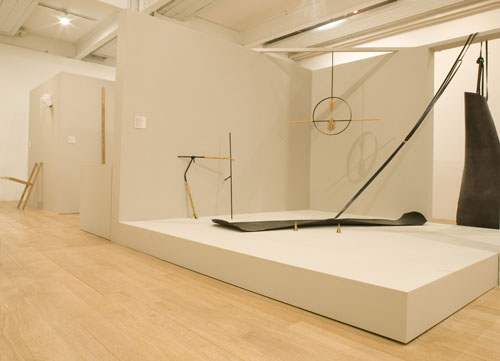
The Fruitmarket Gallery‘s current solo exhibition, Openwide, appropriately features Scottish artist Claire Barclay in retrospective for the first time. Barclay, who represented Scotland in the 2003 Venice Biennale, typically works in large-scale sculptural installations inspired by site. Openwide presents surviving sculptural elements from past installations in new arrangements on plinths and display spaces of Barclay’s design. Innovative placement imbues the objects with a singular importance not found in their original context and highlights the presence of recurrent motifs and themes in Barclay’s work. The artist’s sculptural objects of leather, metal, wood and cloth, among others, share an intriguing juxtaposition of the organic and industrial, of ambiguity and tactility, and of stasis and flux. Such themes are equally evident in Barclay’s screen prints of simple, fluid shapes in either a monochromatic or a dichromatic palette (A LIfe Livelier, a series of 10 screen prints was commissioned by the Fruitmarket Gallery).

Openwide also features two large-scale sculptural installations commissioned by The Fruitmarket Gallery. The meticulously spontaneous environments created by Barclay’s Caught in Corners and Subject to Habit encourage exploration of the varied sculptural pieces. The consistently machined and industrial character of Subject to Habit is the largest departure.

Claire Barclay was born in Paisley, Scotland in 1968. She received her BA in Fine Art from the Department of Environmental Art at the Glasgow School of Art in 1990 and her MFA also from the Glasgow School of Art in 1993. She has exhibited internationally since the 1990s, with solo shows at Doggerfisher in Edinburgh in 2002 and 2005, the Stephen Friedman Gallery in London in 2005, the Tate Britain in 2004, and more recently at the Camden Arts Center in London in 2008. The artist lives and works in Glasgow.

Openwide is on view through 12 April 2009.

Share

Erin Cosgrove

erin_cosgrove.JPG

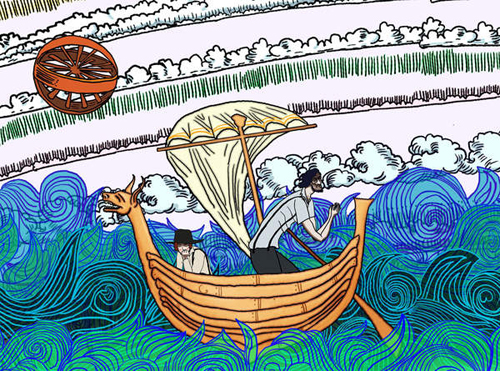
Smart and acerbically funny, Erin Cosgrove‘s What Manner of Person Art Thou? brings puritanical righteousness into the sphere of moral relativity. The animated feature–it runs for approximately an hour–is currently showing in the Hammer Museum‘s upstairs project space and, while it’s a time commitment, Cosgrove’s film is certainly worth the investment. What Manner of Person Art Thou? chronicles the fictional characters Yoder and Troyer as they journey through North America in search of the kin. Struck by the world’s moral depravity, and fueled by visions from God, Yoder and Troyer leave a blood trail behind them, executing those they find corrupt and offensive. The film’s visuals were inspired by Britain’s Bayeux Tapestry and its dark plot is lightened by timely jabs at U.S. pop-culture.

Based in Los Angeles, Cosgrove received an MFA from UCLA in 2001. She has exhibited at Angstrom Gallery, Carl Berg Gallery, and the LA Municipal Gallery, among other venues. She was a recipient of a 2007 City of Los Angeles (COLA) Fellowship and also received a Center for Cultural Innovation Investing in Artists Grant. What Manner of Person Art Thou? will be screening at the Hammer through March 15, 2009.

Share

Elisabeth Higgins O'Connor

Elisabeth-Higgins-O'Connor1.jpg

Elisabeth Higgins O’Connor‘s anthropomorphic creatures congregate and come to life in her solo exhibit at the David Salow Gallery in downtown Los Angeles. The seven-foot tall beasts known as No Names are on display through February 28th. Overall, O’Connor’s larger than life characters have temperaments like mischievous house pets, each with a unique and memorable personality.

The artist builds her sculptures by attaching well-worn scraps from upholstery, clothing, and bedding to lumber armatures. The conglomerate of domestic fabrics lends her otherwise menacing creatures an air of comfortable familiarity. Standing beneath them, we’re stimulated by an array of textures that seems barely contained by the twine, yarn, and quilting pins that hold them together.

O’Connor manipulates textiles to give her sculptures the same painterly quality existing in her earlier two-dimensional work. Paint drips translate into segments of unraveling yarn or dangling fringes. When she traces vacant eye cavities and grimacing mouths with layers of fabric it’s as if she is drawing, using seams instead of charcoal. Unlike the her drawings, the sculptures feature decorative pattern. Color is contained in large and small patches like chromatic shapes in a French Nabi painting.

Elisabeth-Higgins-O'Connor2.jpg

O’Connor stuffs her pieces with materials that would normally end up in a land-fill: worn-out carpet padding, cut-up mattress pads, and used upholstery. Some materials were collected from thrift stores while the members of the artist’s community donated others. The mishmash assembly is more coordinated than first meets the eye. Simply look at the fashion statement made by a tarp and a moving blanket on No-Name (moving blanket head), a particularly impish member of the No Names who sports a hooded cape ensemble that matches her audacious stance.

Elisabeth Higgins O’Connor’s work is represented in public and private collections across California and parts of the Midwest. During her studies at the University of California, Davis, where she received her MFA in 2005, O’Connor received five different fellowships and grants. She was also the recipient of the notable Joan Mitchell Foundation Master of Fine Arts Fellowhip. She has twice been invited to work as an artist-in-residence at the Kohler Company’s Arts/Industry Program in Kohler, Wisconsin. Currently, O’Connor fills an academic appointment at Sierra College in Rocklin, CA.

Share

Zoe Leonard

zoe leonard.jpg

Zoe Leonard first exhibited her photographs in 1979 and her work has since been included in Documenta IX (1992) and Documenta XII (2007), as well as the 1993 and 1997 Whitney Biennials. The artist and longtime resident of the Lower East Side began taking photographs of her neighborhood in 1998 to record the gradual decline of the city’s identity due to the influx of large chain stores. These photographs became Analogue, a complete project which consists of hundreds of photographs, each measuring an intimate 9″ x 9″. Included in Analogue is Bundle, 2003, photographs capturing the forces of globalization through the rag trade by showing bundles of New York’s cast-off clothing routed to Africa, thereby upsetting the local textile production and becoming unhelpful in a certain way.

Approximately 400 photographs from Analogue are currently on view at Dia at the Hispanic Society of America in New York in a two part exhibition, Derrotero. The second part of the exhibition is Leonard’s selection of navigational charts and cartographic maps pulled from the Hispanic Society‘s remarkable historical collection. Leonard contextualizes her work with this cartographic material, drawing further attention to where we are in the world, how we are connected to other people and places, and how many ways we can potentially track these relationships.

The exhibition will remain at the Hispanic Society until April 12th.

Share