PhotoDimensional

PhotoDimensional.jpg

Now on view at the Museum of Contemporary Photography in Chicago is PhotoDimensional. The Exhibition features Works by John Coplans, Katalin Deer, Leslie Hewitt, Bettina Hoffmann, Pello Irazu, David Ireland, Melinda McDaniel, Heather Mekkelson, Laurent Millet, Vik Muniz, Susana Reisman, Lorna Simpson, and Florian Slotowa.

The exhibition features works by contemporary artists who investigate the relationship between sculpture and photography, between two and three dimensions, and explore perceptual issues intrinsic to those relationships. Their works resist the notion that the world simply gets folded into the two-dimensional surface of the photograph. As a result, their works are almost always layered, with subjects translated in ways that invite one to imagine passing from the experience of one dimension to another, and sometimes back again. Thus, perceiving their works provokes feelings of unsettledness, a wavering between seeing and knowing in our minds, a tension that becomes an engaging condition of their artwork.

Highlights amongst the myriad of works on view are, Melinda McDaniel (American, b. 1978) and Susana Reisman’s (Venezuelan/Italian, b. 1977) offerings. Both make sculptures out of photographic materials. Reisman prints photographs onto long strips of canvas and molds the strips into forms that allude to the photograph’s original subject matter. McDaniel places strips of photographic paper outside for days at a time to achieve varying degrees of exposure and imprints of weather, revealing the subtle color gradations inherent in the paper’s chemistry. She then exhibits the uniformly shaped strips in the gallery in a deliberate, regimented manner that recalls minimalist sculpture and creates a tension with the random, abstract patterns of the weather marks on the paper.

Share

Robbie Conal


Los Angeles-based artist Robbie Conal has made a name for himself over the past several decades for his poignantly irreverent and ultra-humorous political posters featuring unforgettable one-liner jokes. The artist wittingly simplifies issues that surround political figures and delivers the work to a mass audience by creating reproductions of his painting, pasting the posters in cities throughout the country. His clever insight can be seen over countless paintings such as a rendering of Dick Cheney with bunny ears bearing the simple phrase ‘Enronergizer Bunny’ over a hot pink ground.

In his current series of work, the artist has begun to move away from his well-known political poster portraits and has been investigating other, equally clever, connections between popular culture and politics.

The artist recently exhibited a new painting in the retrospective exhibition Beautiful/Decay: A to Z, which opened at the Kopeikin Gallery in Los Angeles last weekend. In addition, Conal recently teamed up with By Osmosis TV and Beautiful/Decay magazine to produce a short interview video that features the artist at work in his studio.

Share

Elias Sime

Elias-Sime-Filega4.jpg

Eye of the Needle, Eye of the Heart is a celebratory exhibition honoring the creative accomplishment of Ethiopia’s most prolific contemporary artist , Elias Sime. The scope of the work is staggering– the Santa Monica Museum‘s main gallery is completely filled with a selection of more than 100 of his mixed media pieces, all done within the last 20 years. Sime fabricates sculptures, stuffs goat skins, stitches canvases, and assembles thrones while thoroughly utilizing scraps from his surroundings. His intense labor of love elevates street culture, transforming trash and debris into treasured artifacts.

Sime was born and raised in the rough, crowded neighborhood of Cherqos, Addis Abeba, Ethiopia, where he continues to live and work. Growing up in an area known for prostitution and the sale of contraband goods could have made for a grim childhood, but instead, Sime uses the experience to gleam his artistic vision. His intense connection to life in Cherqos is integral to his work. Sime frequently depicts vibrant open market scenes, stitching texture and atmosphere with varying hues of yarn and cloth. Hand stitching is intrinsic to Sime’s process, each scrap of yarn intentionally placed and purposefully sewn with the utmost care. Buttons, plastic, clothing, and bottle caps are flawlessly embedded in his compositions. For the children of Cherqos, Sime is a true model of resourcefulness and sustainability. Enchanted youth bring weekly offerings of rusty bottle caps and street detritus that permeate his work.

Elias-Sime-mudsculptures.jpg

Eye of the Needle Eye of the Heart, was co-curated by world renown theater director and UCLA professor, Peter Sellars and revered Ethiopian curator and anthropologist, Meskerem Assegued. Together, they chose pieces in which Sime’s subject matter, symbolism, and iconography highlight the ineffable qualities of love. His stuffed goat skins are arranged in twosomes, as if embracing or communicating tender feelings. These sculptures share the name, What Is Love?, also the title of a previous exhibit curated by Assegued in Addis Abeba in February 2008.

Many pieces from What Is Love are present in Eye of the Needle, Eye of the Heart. Sellars also worked with Sime in 2006, when he included the artist in New Crowned Hope, the Viennese festival that celebrated the 250th anniversary of Mozart’s birth. Sellars’ enthusiasm for Sime is contagious, transferred to us through his role as narrator in a documentary film that accompanies the exhibition. The acclaimed filmmakers, Valerie Faris and Jonathan Dayton, met Sime in Ethiopia in December 2008 to document his daily life and bring insight to his process. Faris and Dayton’s work is an integral part of the exhibition. Without their visual journal of Sime’s life, we would not understand the full extent to which he integrates life and art. Especially impressive is the footage of Sime mixing mud and straw with his feet, then using the mixture to construct the home he is currently building in Addis Abeba. Like his art, Sime’s structure is a sanctuary of affection, kinship, and underlying oneness with nature.

Encouraged by his father, Elias Sime began making art at a young age. He taught himself how to sew and repair furniture, always collecting and recycling materials along the way. In 1986, he passed the rigorous entrance exam required to attend Addis Abeba University’s School of Fine Art and Design. There, he obtained a degree in graphic design. Sime has had numerous solo shows, and has participated in many group exhibitions including the Studio Museum in Harlem, New York; the Dak’Art Biennale 2004, in Dakar, Senegal; the Zoma Contemporary Art Center and the National Museum in Addis Abeba. In mid-April, Sime’s thrones will be featured in Peter Sellars’ production of Stravinsky’s Oedipus Rex at Walt Disney Concert Hall in downtown Los Angeles.


Share

Wang Guangyi

wang guangyi.jpg

Currently on view in its last week at the Louise Blouin Institute in London is a solo exhibition of work by internationally acclaimed contemporary Chinese artist Wang Guangyi. Guangyi is generally considered to have been the leader of the New Art Movement generation following the Cultural Revolution. The exhibition, entitled Cold War Aesthetics, marks the first solo show of Guangyi’s work in the UK, and is part of the Institute’s ongoing “Culture Beyond Borders” series.

As Guangyi departs from the historically kitschy and pop imagery of his celebrated Great Criticism series, he now confront the issues of the time more boldly. The ambitious installation in Cold War Aesthetics, which includes around 50 life-size sculptures depicting “Cold War preparedness”, accompanied by watercolor sketches of the sculptures and a large twelve-panel mural, visually revisits the haunting imagery of China’s Cold War past while telling a cautionary tale to present-day audiences of the horrors of war, and confronting the contemporary global position of treading in this familiarly dangerous territory once again.

Wang Guangyi, born in 1956/7, currently lives and works in Beijing. He studied oil painting at the prestigious Zhejiang Academy of Fine Arts in Hangzhou. His work has been exhibited at important institutions around the world.

Share

John Gerrard

john gerrard.jpg

Simon Preston Gallery in the Lower East is currently presenting two impressive new media works by John Gerrard in his first New York solo exhibition. Oil Stick Work is a virtual sculpture that manifests itself as a projection on the main wall of the gallery. This projection depicts an aluminum corn silo which was digitized based on several photographs taken at the building’s physical site in Richfield, Kansas. The virtual sculpture exists in real time, with simulated weather patterns based on those in Kansas. Angelo Martinez, a Mexican American builder arrives to the silo at daybreak with a single oil stick crayon. He colors a black square on the exterior of the structure, working six days a week, slowly covering each facade in oily black pigment. The builder will continue this simulated job until the year 2038 when he will complete his task, leaving a black slick punctuating the pristine landscape, a powerful farewell to an age of oil.

A second virtual sculpture, Grow Finish Unit, is based on a large pig production factory in Kansas. The cycle of this work is 6-8 months, the amount of time pigs (themselves largely sustained by petroleum) spend in these facilities before a truck comes for removal and replacement. Commenting on the automated husbandry of farm animals, Gerrard’s prophetic use of time as medium in both works deepens a sense of discomfort as our own ethics of consumption are disturbingly questioned.

Gerrard lives and works in both Vienna and Dublin. Oil Stick Work will be included in the Venice Biennial in June 2009 as part of an independent project by the RHA, Dublin.

Share

Hank Willis Thomas

Hank-Willis-1.jpg
Christopher Sims: Absolute No Return, 2008, Light-jet prink

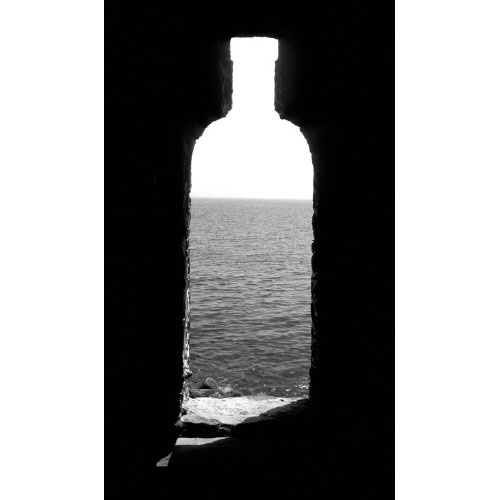
Hank Willis Thomas is selling something. This is clearly evidenced in the works included in Pitch Blackness, his second solo exhibition currently on view at Jack Shainman Gallery in Chelsea. Thomas, who is well versed in undermining the loaded visual language of the advertising media–think Air Jordan meets the Hottentot Venus–relies here once again on visual trickery and deftly executed slight of hand in distilling key iconic media imagery.

Thomas is at his strongest in rendering works that not only conflate, but also leave room for interpretation. Absolut No Return, (2008) a digital photographic manipulation, skillfully invokes the iconic Vodka ad campaign by marrying the all-too-familiar spirits bottle silhouette with a photograph that invokes, perhaps, the solemn first-person view of an African American slave peering out of the window of a crumbling “port factory” – a way station for slaves before their forced exodus on the Middle Passage to the New World. At the same time, the seascape pictured offers an ironic riff on the all too familiar “Come to Jamaica and Feel All Right!” suite of ads.

Hank_Willis_Thomas-2.jpg
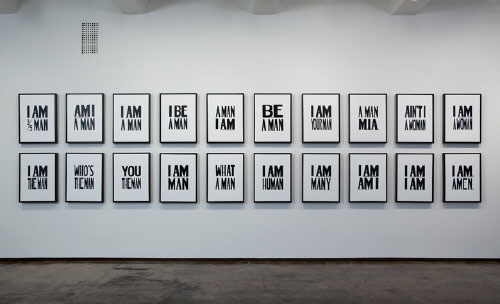
Christopher Sims: I Am A Man, 2008, Liquitex on canvas

I Am A Man, (2008), a seductive suite of twenty works on canvas, pays homage to Ernest C. Withers’ photograph of the 1968 Memphis sanitation workers strike led by Dr. Martin Luther King, Jr. A strong case for the power of reductive minimalism, scaling back the psychological distance between the minority consumer and luxury products, the work ingeniously expands the scope of the “I AM A MAN” placards carried by the strikers by reordering the text to read, “I AM THE MAN”, “AM I A MAN” and ultimately “I AM HUMAN”.

As is the case with most sophisticated forms of media outreach, I prefer to feel as if I am somehow involved in the process (that I’m in on the secret). It is only when Thomas leaves room for the viewer to enter the work that he succeeds in hitting his target demographic.

Hank Willis Thomas has exhibited his work nationally at venues such as the Smithsonian Institution, the Birmingham Museum of Art, Birmingham, AL, and the Yerba Buena Center for the Arts, San Francisco, CA. He was included in the recent exhibition, “After 1968: Contemporary Artists and the Civil Rights Legacy”, at the High Museum, Atlanta, GA; in Frequency at The Studio Museum in Harlem in 2005; and in the 2006 California Biennial at The Orange County Museum of Art. His work is featured in several public collections including the Studio Museum in Harlem, the International Center of Photography in New York, and the Museum of Fine Arts in Houston, Texas.

Share

Michael Light and Christian Houge

M. Light.jpg

The landscape photographs of Michael Light and Christian Houge are simultaneously austere, reflective, and, as described by the Hosfelt Gallery in San Francisco where they are currently exhibiting, bleak. The interesting combination of two distinct photographers creates a specialized viewing experience within the large warehouse-like galleries at Hosfelt. Michael Light lives and works in San Francisco and focuses his practice primarily on the American West. Christian Houge is a Norwegian artist grounded in the documentation of his Arctic homeland. Carefully shot from a self-piloted airplane or hired helicopter, Light’s images of the Sierra Nevada region, Southeast California and Phoenix, Arizona present a still life of manufactured landscapes set in the sage-brush fields of the American West. At the opposite side of the gallery, Houge’s work displays slow exposed panoramas of snowy white fields lightly dotted with man-made scientific instruments. Together, their work engages the viewer in a conversation that speaks to the vastness of the earth’s surface, humanity’s deep impact on it, and the overall balance of the natural world with that of the constructed.

Christian Houge.jpg

Michael Light and Christian Houge will be in view until March 21, 2009.

Share