Scott Anderson

Scott Anderson-1.jpg

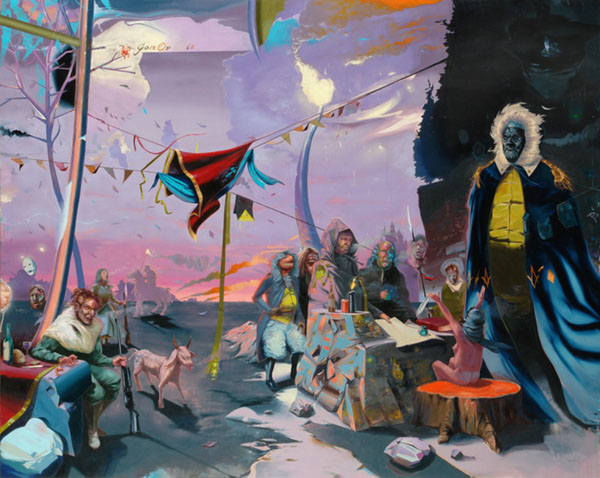
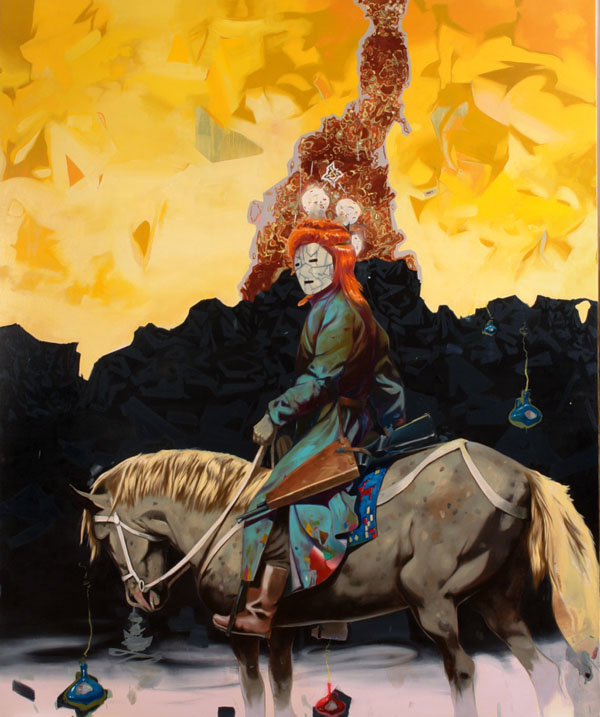
Opening next weekend at the Stefan Stux Gallery in Chelsea will be Join or Die, new paintings and drawings by artist Scott Anderson. The included paintings continue to employ references in composition to historical religious and landscape painting, while introducing an entirely new vocabulary of distortion and deconstruction. The images drip with a hyper-color palette which cause the subject to exist within a surreal world, which is full of symbols that refer to nationalism, military and war, loaded with strange characters, ritualistic activity and apocalyptic landscapes. The artist has stated that his work is concerned with “various moments of cultural and political upheaval, such as the naive embrace of unchecked capitalism in the American Revolution, and the inevitable fascism of the Russian Revolution.” The viewer is left to navigate these fragmented images, which can cause the feeling of being trapped in a dream or nightmare with total chaos, constructed with a complete disregard to logic.

Scott Anderson-2.jpg

Anderson is a graduate of the University of Illinois at Urbana-Champaign. His recently solo exhibitions include Rendezvous Point at the Light and Sie Gallery in Dallas and Misiisto at Kavi Gupta Gallery in Chicago. The artist has also completed exhibitions with Kavi Gupta Gallery in Berlin and Mark Moore Gallery in Santa Monica. The artist also exhibited in the Beautiful/Decay retrospective group exhibition, A to Z, this spring at the Kopeikin Gallery in Los Angeles.

Share

Charles Timm-Ballard

Charles Timm-Ballard_big1.jpg

Opening this Friday, May 1st at 643 Project Space in Ventura, CA is a solo show of work by Washington based artist Charles Timm-Ballard. The exhibition, entitled Terra Form, displays work that contains many of the aesthetic elements found in contemporary landscape painting, yet it is created out of ceramic material. The thick slabs of clay are a testament to the sculptural and tactile qualities of ceramics, while the painterly images pay homage to the tradition of abstract landscape painting through light, shadow and a certain diaphanous representation of nature. The juxtaposition is created in a typically postmodern manner, not allowing the work to be fully one thing or the other– rather it finds itself straddling the lines concerning media and disrupting the hierarchical categorization of genres. Terra Form runs through May 29, 2009.

Charles Timm-Ballard earned his MFA at the University of Nebraska-Lincoln and his BFA from the University of Wisconsin-Milwaukee. He is currently the chair of the art department at Whitman College. He has held residency at the European Ceramic Workscentre in the Netherlands. His work is in the permanent collection of the Daum Museum of Contemporary Art and has been exhibited in solo shows at the Pomona College Museum of Art in Claremont, CA; The Clay Studio in Philadelphia, Pennsylvania; the Wisconsin Academy of Arts and Sciences Gallery in Madison, Wisconsin; Thomas Barry Fine Arts in Minneapolis, Minnesota and in a group exhibition at the Art Museum of the Americas in Washington, DC, among others. He is represented by Sherry Leedy Contemporary Art in Kansas City, MO.

Share

Edward Clive

Edward Clive.jpg

Continuing through the rest of the month at Holzmarktstrasse 3 in Berlin-Mitte is an installation of new works by Berlin artist Edward Clive entitled In The Future We Will Exercise For Fun. The ambitious suite of works contains several large sculptural display units; complete with shelfs, photographs, and small sculptures, they describe an uncanny, and occasionally monstrous relationship of the body to space.

What makes the works so at home in the the large unfinished office space is the base quality of their materials. The works’ plastic sheeting, unfinished drywall, and rudimentary armatures, are well-paired with the space’s unpainted walls, exposed ventilation system, and raw concrete floor. While the works employs such ubiquitous materials, each work rewards the curious viewer as photographs, notes, and easily overlooked, well-made formal nuances abound.

Found squatting behind walls or loitering in the far reaches of the space are a number of small sculptures. One entitled Lump Goddess (2008) is a squat and abstracted mutant figure composed of select found objects. Faceless, it sports four round cylinder legs and a single metallic claw, made from fake nails in their plastic case. Another similar work, Goth Or Hip-Hop (2009), conflates the aesthetics of science fiction with those of mid-century modernist sculpture. With fake nails, mustaches, teeth, and scars in a number of works, the aesthetic of costume cosmetics is central to the sculptures, making biological what would otherwise be inanimate. Along with a saran-wrap labyrinth containing a number of internet-found images relating to the body, Clive’s work is both detritus from a grade-school science fair sometime in the far future and an acute description of how form constructs the body and space.

Edward Clive (b. 1982) is an artist living and working in Berlin. He received his B.A. in Sculpture from the University of Brighton. His work has been previously exhibited at Keith Talent Gallery in London, BabelKunst in Trondheim, Norway, and ETC Gallery in Prague.

Share

Gao Yu

The plantation on the moon.jpg

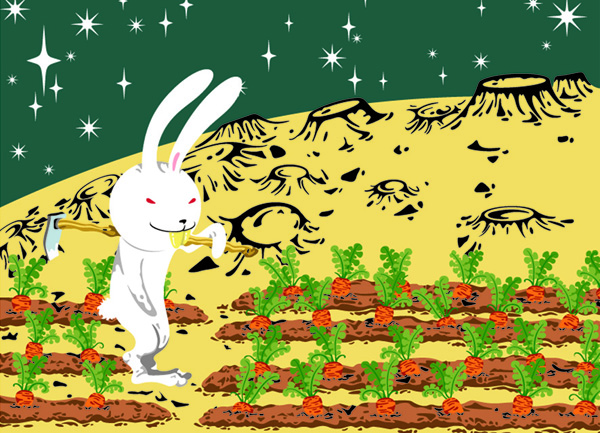
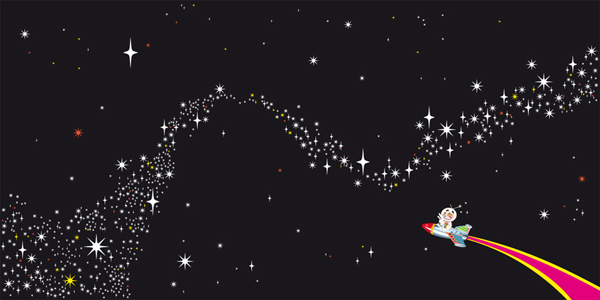
Currently on view at Primo Marella Gallery in Milan, Singing Stars is a solo exhibition dedicated to young Chinese artist Gao Yu. Exhibiting outside of Asia for the first time, Gao Yu introduces us to a series of mixed-media works that represent some of the successful contemporary art from super modern China. 28-year-old Gao Yu exploits a cartoon-like imagery, and thus confirms the challenge brought by animation as an autonomous art form. He draws on ideas and forms from pop and teenage culture, comics, and fiction, offering a vivacious and at the same time bizarre reinterpretation of traditional Chinese icons. The artist’s characters–his favorite apparently being the panda and the lunar rabbit–inhabit a surreal, almost psychedelic place which is rendered through the application of distinct, and often resonant, acrylic colors. The works are indeed playful, vibrant and beautifully cheeky, but sometimes there is also a disturbing and grotesquely sinister halo to the innocent looking cartoon figures. It is precisely this combination of innocence and wickedness that takes the viewers to the realm of Japanese comic and animation–manga and anime–which Gao Yu obviously riffs on. And, as manga and anime inspired works from Japan have affirmed themselves in mainstream contemporary art–with Yoshitomo Nara, “pop art star” Takashi Murakami, but also Kaikai Kiki‘s Chiho Aoshima and Aya Takano among others–Gao Yu has everything he needs to remain a top representative of the Chinese art circuit.

Milky way hero.jpg

Born in Guizohou, China, in 1981, and currently living and working in Chongqing, Gao Yu graduated from Sichuan Fine Art Institute in 2003. With Chen Ke, Zhang Hui, Wei Jia, Han Yajuan, and Feng Zhengquan, Gao Yu is one of the most important members of the “cartoon generation”, a group of young artists who debuted with a show titled “A Cartoon Generation”, held in Beijing in 2005, and who are associated with the dynamic contemporary art scene of China.

Singing Stars will be on view at Primo Marella Gallery from April 4th 2009-May 23rd 2009.

Share

Yayoi Kusama

yayoi kusama.jpg

Gagosian Gallery is presenting two major exhibitions in New York and Beverly Hills to celebrate Yayoi Kusama‘s eightieth year. The artist, born in Japan in 1929, started painting with polka dots and nets as motifs around the age of ten. She moved to the United States in 1957, where she showed large scale paintings, soft sculptures, and environmental installations using electric lights and mirrors. From 1998-1999, a major retrospective opened at the Los Angeles County Museum of Art and traveled to the Museum of Modern Art in New York, the Walker Art Center in Minneapolis, and the Museum of Contemporary Art in Tokyo.

The exhibition in New York, which opened on April 16th, features a large yellow pumpkin sculpture with black spots in a specifically designed space at the front of the gallery. This piece is based on a similar work Kusama showed at the Japanese pavilion at the Venice Biennale in 1993 – a mirrored room filled with pumpkin sculptures in which the artist resided in color-coordinated attire. The pumpkin, made of fiberglass and reinforced plastic, represents a type of self portrait or alter ego for the artist, whose compulsive covering of surfaces and infinite repetition of dots, patterns, and forms is characteristic of her entire body of work.

kusama installation.jpg

For the back of the gallery, Kusama has constructed a hypnotic optical environment, Aftermath of Obliteration of Eternity (2009), featuring the infinite interactions between lights, mirrors, and water. Viewers step into a dark chamber that is softly lit by several gleaming golden lights, closing the door behind them. Standing on a platform surrounded by water, the viewer is reflected in this “infinity room” by walls of mirrors. This experiential encounter with oneself represents the artist’s “preoccupation with mortality, as well as with enlightenment, solitude, nothingness, and the mysteries of the physical and metaphysical universe,” as stated in the press release.

The exhibition in California will open on May 30th and last until July 17th. The exhibition in New York will remain at the gallery’s location on West 24th Street until June 27th.

Yayoi Kusama currently lives and works in Tokyo, Japan.

Share

Matthew Stone

peckhamskylinewt1.jpg

British artist Matthew Stone‘s current solo exhibition, Interconnected Echoes, is the inaugural show in Galerie Paul Freches‘ series on the British art scene. Stone, a graduate of Camberwell College of the Arts, has become known for his involvement in the !WOWOW! collective, a group of young British creatives who have been staging events and parties in unoccupied South London buildings.

Stone’s own work is perhaps simultaneously a re-phrasal of art historical tropes and an exploration of myspace-style youth cultural. He installs his photographs sculpturally, a move that echoes the interactive nature of his many of his projects, and he often uses friends as his models.

Stone regularly updates his blog, Optimism as Cultural Rebellion, and has recently been interviewed by a number of arts and culture publications, including Vice Magazine and Flasher. Interconnected Echoes will be on view at Galerie Paul Freches through May 30th.

Share

Prop Master

Prop Master-1.jpg

Prop Master, a collaborative one-room exhibition by Susan Harbage Page and Juan Logan, recontextualizes portraits from the permanent collection at the Gibbes Museum of Art in Charleston, SC and other local artifacts by displaying them alongside their own works, although within the institution. Living around the many decorative and luxurious antebellum homes of Charleston is a challenging experience. We see the majesty of architecture, but also the skewed wealth of slavery. Buildings are preserved as traditions are too; Old South remains a commodity in a tourist economy.

Upon entering the main gallery, first noticed is a gleaming tile-like floor with colonnade border in front of Juan Logan’s face-shaped video collage Welcome Home. Glimpses of a KKK rally in Washington and shots from popular films like D.W. Griffith’s Birth of a Nation and Disney’s Song of the South are seen across white and black paper boxes that compose the raised floor of an empty room-like sculpture. White and black are clearly contrasted; white outnumbers black, white are the columns, and black forms the base. Not obvious was that the piece was intended to represent the 10,000 works at the Gibbes Museum, most of which were produced by “whites.”

Prop Master-2.jpg

This stark black/white reading is contrasted with Harbage’s Famous Last Names, a series of new photographic portraits set beside old paintings. With the concept of some familiar relation as motivation, I look for evidence of “black” and “white.” I’m struck by my own use of ethnic stereotypes, feeling some guilt about doing this. The portrait of a security officer next to the column of a facade reminds us that he does not own this place. A young man’s gold necklace is adorned with a Masonic “G,” reclaiming the symbol of a group that did not traditionally admit slaves as members. Unfortunately, there are no last names presented to us; valuable historic information is left out of the work.

The artists’ combined interests in “race, class, gender, power, and place” culminate in Sexually Ambiguous, a series of manipulated portraits and works from the Gibbes. We start to pick out “man” and “woman” features across racial lines, looking for stereotypes in much the same way as Famous Last Names. Gender is obvious in some, but imagined in others, given the context. The artists make some identities totally obscured, for example, by placing a plain white box or floral KKK-like hood over the face.

Bundled white cloth packages tied up with ribbon sit underneath or near decorative dark-varnished chairs in front of Famous Last Names. The significance of these objects and their relationship to the furniture is unclear. Upon reading the wall text, we learn that the bundles are antique Klansmen garb and the furniture once belonged to Charles Pinckney, both on pedestals “propped up by whiteness.” Although the artists succeed in giving us some “particular portrait of society,” the work depends on the explanations provided by the wall texts. Logan’s efforts to show the “frightening power of racial caricatures to shape our current perceptions and actions” are felt through all the works, as ominous renditions of ‘Dixie’ and other songs penetrate the atmosphere.

Juan Logan and Susan Harbage Page are studio art professors at UNC Chapel Hill. Their collaboration will be on view until July 19th.


Share