Venice Biennale: Vladimir Dubossarsky and Alexander Vinogradov

Vladimir Dubossarsky and Alexander Vinogradov.jpg

The Russian artist duo Vladimir Dubossarsky and Alexander Vinogradov present Danger! Museum at the 53rd Venice Biennale. In this playful installation of paintings and video, the artists continue their exploration of painting’s art historical past and the legacy of Socialist-realism. In this instance their paintings are created through the lens of the the Italian Renaissance, highly appropriate for the Biennale’s setting.

Dubossarsky and Vinogradov’s exhibition both celebrates and satirizes the history of art while engaging our own contemporary period. A large-scale work like Lera – Venere is a modern take on the prevalent reclining female nude, complete with dreadlocks and black underwear. It is certainly in dialogue with Titian’s Venus of Urbino–an artist whose connections to Venice are palpable. In Happy Birthday Mynheer Rembrandt, the revered artist is celebrated by repeating his many famous self-portrait images against a modern cityscape.

Dubossarsky and Vinogradov also depict the important 20th century artists, Pablo Picasso and Andy Warhol as a pirate and a knight, respectively. In a particularly interesting painting, Barack Obama, a 21st century hero, is also transported to the past through the archetypal image of leader on horseback.

DubossarskyandVinogradov.jpg

The artists also explore the relationship between the audience and the paintings on display. While each visitor walks through the exhibition, the paintings are, in effect, actually looking back at them through hidden cameras. This fact is revealed to the visitor in the very last room of the exhibition, in which multiple surveillance-style screens are set up. Here, the audience is able to watch their own image move through the exhibition in what makes for an hilarious and interesting viewing experience.

The artists Vladimir Dubossarsky and Alexander Vinogradov both attended the Moscow Art College and the Moscow State Art Institute. They have shown internationally since founding their artistic partnership in 1994. The artists both live and work in their native Moscow.

Danger! Museum is presented at the Venice Biennale as a Collateral Event by the Moscow Museum of Modern Art and the New Rules Foundation along with the patronage of the Ministry of Culture of the Russian Federation. It will be on display at the Palazzo Bollani throughout the Biennale, which concludes 22 November 2009.

Share

Venice Biennale: Steve McQueen

Steve-Mcqueen.jpg

Steve McQueen’s newly commissioned work, Giardini, represents Great Britain at this year’s Venice Biennale. Giardini takes its name and subject matter from the main venue of the Biennale, the Giardini di Castello, on two separate, highly horizontal film screens placed seamlessly side by side. The images on each screen in turn interact with one another, offering different vantage points of the same imagery. Each screen is alternately blank at certain points during the film.

Unlike past work by Steve McQueen, Giardini lacks an overt social message. Instead, McQueen offers quite reticent imagery that captures the character of the Giardini during the long off season of the Venice Biennale. The camera work of this film is very still and patient while framing aesthetically interesting compositions that each stay on the screen for some time. The camera remains still while it captures passing images and movements. It’s presence is made known through the absence and return of the image to the screen and during the obvious switch from scene to scene. McQueen also makes use of the camera’s focus to zero in on details while blurring the background. The accompanying sound is largely applicable to the site of the filmed scenes, including dripping water and rain. There is also the addition of booming sound (like a cheering stadium of football fans), which further emphasizes the absence of people on the grounds.

steve_mcqueen_installation1.jpg

In Giardini the viewer is offered the antithesis to the experience of visiting the Biennale, which takes place during the height of Venice’s tourist season every other summer. In its place, the viewer sees rainy, cold conditions. The formidable grounds and national pavilions are abandoned and vacant aside from a pack of dogs, the occasional local walking through, and for illicit late-night rendezvous. The only hint at the festival’s high-profile bustle are its remains in the form of piles of garbage and the odd scattering of confetti. McQueen’s film takes on the guise of a nature show, pointing out the various bugs, spiders, plants and puddles that occupy the empty grounds and by taking the viewer from day to night. Giardini is highly relevant and site-specific to the Biennale context. It differentiates itself from the artist’s rich body of past work by maintaining an everyday quality and not addressing international issues of contemporary relevance.

Steve McQueen has been a prominent multi-media artist working in primarily video and film since attending the Chelsea School of Art (1989-90), Goldsmith’s College (1990-93), and the Tisch School of the Arts in New York University (1993-94). Among many prestigious awards, McQueen has received the Turner Prize (1999) and the Camera d’Or and International Federation of Critics Award, Cannes Film Festival (2008). In 2003, McQueen was appointed as the Official War Artist (for the current Iraq War) by the Imperial War Museum. The artist lives and works in London and Amsterdam.

Giardini by Steve McQueen was commissioned by Andrea Rose and curated by Richard Riley with support from the British Arts Council, the Thomas Dane Gallery, and the Marian Goodman Gallery, The Art Fund Charity, and Outset Contemporary Art Fund. The film will remain at the British Pavilion through 22 November 2009.

Share

Venice Biennale: Krzysztof Wodiczko

Wodiczko4.JPG

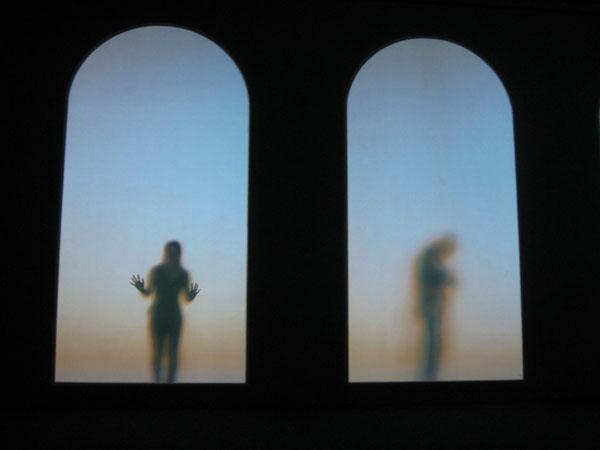
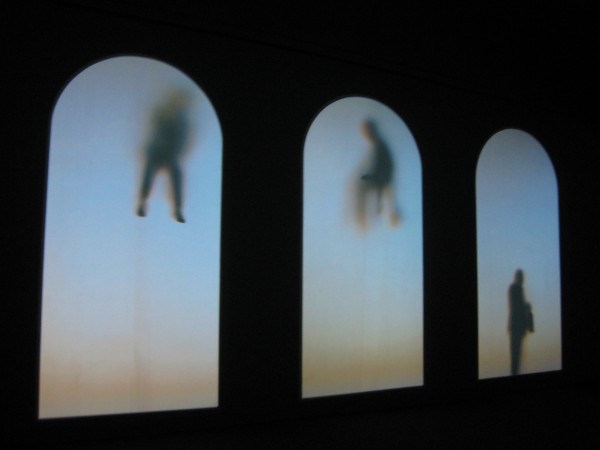
Krzysztof Wodiczko’s Guests represents Poland at this year’s 53rd Venice Biennale. Wodiczko’s video projection installation is at once an aesthetic and a political work. While much contemporary art addresses social and political issues, it is an exceptional achievement for an artist to convey such commentary through powerful aesthetic means as Wodiczko manages to do in this work.

Guests is realized by the projection of large-scale windows physically surrounding the viewer on the walls and ceiling of the darkened Polish Pavilion. The windows create an invisible but obvious barrier that cannot be crossed by the shadowy, silhouetted figures behind them. It is clear that these figures are immigrants and refugees through the installation’s accompanying sound element featuring voices discussing their struggle for work visas, opportunity, and national identity. These stories are pulled from Wodiczko’s own research into the experiences of immigrants from around the world residing in Poland and Italy. Throughout the length of the looping installation (approximately 17 minutes) various vignettes of people come in and out of focus as they are alternately burdened with luggage, washing windows, blowing leaves, sweeping, and selling umbrellas. In a few poignant instances the shadowy figures look inside, touching the window panes, underscoring their exclusion.

Wodiczko brings the highly relevant predicament of restrictive immigrant policies into the gallery space to educate and to confront the typically elite Biennale audience. Wodiczko’s Guests certainly presents an idealized account of the immigrant figure, but in doing so creates an effective argument that perceived ‘outsiders’ and ‘others’ are vital members of society. Wodiczko’s own intent can be summarized by the quote he includes at the pavilion’s entrance: “Refugees driven from country to country represent the vanguard of their peoples.” (Hannah Arendt, 1943)

Krzysztof Wodiczko earned his MFA from the Academy of Fine Arts in Warsaw in 1968. As a prominent contemporary artist, Wodiczko has been awarded many prizes including the Hiroshima Art Prize (1998) and the Katarzyna Kobro Prize (2006). He is also a prolific writer and theorist. Wodiczko is currently Director of the Center for Advanced Visual Studies at MIT and professor at the Warsaw School of Social Sciences and Humanities. He lives and works in New York, Cambridge, Massachusetts, and Warsaw.

Kryzstzof Wodiczko’s Guests was curated by Bozena Czubak. It was commissioned by Agnieszka Morawinska and the Zacheta National Gallery of Art along with other supporting institutions for the Venice Biennale. It will remain at the Polish Pavilion through 22 November 2009.

Share

53rd Annual 2009 Venice Biennale

Over the next five days, DailyServing.com will bring exclusive coverage of this year’s 53rd Annual Venice Biennale. DailyServing writers Arden Sherman and Kelly Nosari traveled to Venice earlier this month and attended the exhibitions, and over the next five days will report on some of the most noteworthy work in this year’s Biennale.

Baldessari facade.jpg

Despite the tough economic times and talk of a more “serene biennale,” the 2009 Venice Biennale remains a fervent display of blue chip art and its dedicated following. Exhibition curator Daniel Birnbaum has stayed committed to his title of Making Worlds by including both established and emerging artists in the international fair. “My hope is that the Biennale does not merely present fragments of something that has been broken down” Birnbaum has said, contextualizing the Biennale in the current financial market, “but will offer a glimpse of something still to come–if not a new and totally coherent vision, then at least as an emerging plurality of possibilities” (interview with Artforum, May 2009).

The most notable change in this year’s exhibition is the opening of the Palazzo delle Esposizioni. Formally the Italian Pavilion, the Palazzo houses half of the Making Worlds exhibition and will remain open to the public year-round, providing a place for future, multi-disciplinary projects. To emphasize this new permanence, Birnbaum invited artists Tobias Rehberger, Rirkrit Tiravanija, and Massimo Bartolini to create functional spaces within the Palazzo. Rehberger, for his part–a fully functioning cafeteria–received the Golden Lion for the best artist of the exhibition, the highest of Biennale honors. In addition to the Making Worlds exhibition in both the Palazzo and the Arsenale (the former warehouse of the Venetian fleet), the historic national pavilions in the Giardini remained vibrant, and 2009 marked the inclusion of first-time participants Montenegro, Principality of Monaco, Republic of Gabon, Union of Comoros, and United Arab Emirates.

UNITED STATES OF AMERICA.jpg

Bruce Nauman’s exhibition, Topological Gardens, represented in the first place United States Pavilion, was additionally exhibiting in two other Venice venues, the Universita Iuav di Venezia at Tolentini and the Exhibition Spaces at Universita Ca’ Foscari. American artist John Baldessari was also a big presence in Venice. Besides being presented with the Lifetime Achievement Award (alongside Yoko Ono), Baldessari’s works and interventions could be seen along the Grand Canal, most notably his photo-mural of an oceanfront which covered the entire front-facing facade of the Palazzo delle Esposizioni. In addition to today’s art stars, Birnbaum made an effort to represent emerging and, at the other end, even deceased artists like Andre Cadere and Lygia Pape, whose inclusion supported Birnbaum’s concept of a more complete “world”.

The Biennale will be on display until November 22, 2009 and will continue to host collateral performances, lectures and events until closing.

Share

Gavin Nolan

Gavin-Nolan-1.jpg

This month, Mark Moore Gallery is presenting new paintings by Gavin Nolan in an exhibition titled Hexen Reflex. Nolan’s paintings are presented opposite artist Julie Heffernan in the project room of the Bergamot Station gallery. Nolan’s new hyper-real portraits continue to border on surrealism, drawing reference from contemporary image sources coupled with a technical confidence on pair with the Old Masters. The works have a subtle visual shift or stutter that allows from a small amount to movement or time to take place on an otherwise static picture plan. The artist has stated “I build the paintings through a mixture of chance and control. I like them to slip between being a sloppy mess and a finished recognizable whole.”

Gavin-Nolan-2.jpg

Nolan is a graduate of Loughborough University School of Art in the UK, and received his masters from the Royal Academy of Art in London. Recent exhibitions included New London School, at the Changing Role Gallery in Rome/Naples, Italy, The Future Can Wait at Atlantis Gallery in London and Icons at Chung King Projects in Los Angeles.The artist currently lives and works in New York City.

Share

Dark Night of the Soul

David Lynch-1.jpg

Currently on view at Michael Kohn Gallery in Los Angeles is the exhibition Dark Night of the Soul, a collaborative installation by acclaimed filmmaker David Lynch and two-time Grammy Award winning musical artist and producer Danger Mouse. The two-room exhibition extends the artists’ original collaboration for Danger Mouse and Sparklehorse‘s recent album, Dark Night of the Soul, which featured artwork by David Lynch created specifically for the album. For the exhibition, 50 of Lynch’s photographs will be mounted in the gallery, accompanied by the continuous music from the Dark Night of the Soul album. This exhibition marks the first gallery presentation for Danger Mouse, and the most recent exhibition for David Lynch. The artists have also released both the music and images from the exhibition in an illustrated book by the same name, published by powerHouse.

David Lynch.jpg

Share

Misako Inaoka

Misako_Inaoka3.jpg

Survival Game , Misako Inaoka‘s, motley menagerie of animal hybrids, is currently on display through June 20th at the David Salow Gallery in Los Angeles, CA. The gallery is lined with tiny eye-level platforms staging metallic conglomerations in mid-stride. Perhaps they are on their way to complete utilitarian tasks for which their bodies have evolved industrial, and sometimes, military adaptations. Two chess boards complete with sets of dueling pawns, rooks, queens, knights, and bishops are also included in the show.

Inaoka creates these miniatures by seamlessly fusing plastic and rubber toys. She applies a metallic finish that enhances the textural details of the figurines and gives them the initial appearance of cast metal. Sometimes, she even uses battery operated motion sensors that detect changes in light or sound. As a result, when viewing Survival Game, a bird-walrus-chimpanzee with a shark on its rear end may begin to wiggle and chirp as you approach. But, Inaoka doesn’t need bells and whistles to entice viewers. She taps into the endless possibilities of adaptive radiation, a principle of animal classification that relates to evolution and metamorphosis within a group of organisms as they adapt to new ecological environments. The creatures’ radical combinations of animal species and man-made mechanisms are a challenge to the logic of natural selection and therefore, a catalyst to the imagination. In Inaoka’s world, an inefficient adaptation as seen in Sharksend or Double Deer Horns can be an asset simply because the form is so captivating.

Misako_Inaoka4.jpg

San Francisco galleries have been featuring Inaoka’s solo exhibits since 2002 when The Back Room Gallery presented The Microfiche. Her resume shows off an extensive list of awards, grants, and residencies ranging from her alma mater, Rhode Island School of Design‘s European Honors Program to a National Endowment for the Arts Artistic Excellence Grant for her MacDowell residency. Survival Game is Inaoka’s solo debut in southern California.

Share