Hilary Pecis

hp2.jpg

Beset with bling and astral opulence, Hilary Pecis‘ collages are popping up everywhere; in contemporary art blogs, and reputable print publications. Currently, the artist has work in a solo exhibition titled Intricacies of Phantom Content, on view at San Francisco’s multi-disciplinary art space, Triple Base Gallery and in the exibition Remix at Catherine Clark Gallery. Pecis is an emerging Bay Area artist whose work has been featured in Juxtapoz Magazine and twice in New American Paintings. In 2008, Pecis received the SF Examiner’s Mastermind Grant and the San Francisco Arts Commission‘s Murphy and Cadogan Fellowship. Over the past five years, while garnering awards and gallery shows, Pecis managed to complete both her BFA and MFA degrees from California College of the Arts.

hp6.jpg

Pecis entrances viewers with meticulous depictions of angular patterns, whether they are the varying facets of cut gemstones or the repetitive planes of her trademark ink doodles. She utilizes the four C’s of diamond grading in her own work: carat, cut, color, and clarity. All are working to entice and bedazzle the eye. Her collages are compositionally sound, linked by ribbons, shards, and broad patches of CMYK color. Cosmic landscapes are brimming with glimpses of society’s prized commodities, however, they are void of humanity itself. The absence of a human population evokes a post-apocalyptic feeling and causes us to contemplate the lifestyle that may very well lead to our demise.

Intricacies of Phantom Content will be on display at Triple Base until July 26th. A video Installation by Elyse Mallouk, Trickle-down: Yours for the Mining, accompanies the exhibit in the gallery’s basement. In addition, Pecis and Mallouk will curate a performance series throughout the month of July. The closing reception is on Sunday, July 26th from 3-6pm. There will be special performances by Raphael Noz & Trap Doors (Michael Guidetti.)

Share

Jason Yates

yates.install.01.web.jpg

The Rise and Fall of Shame, Jason Yates‘ summer exhibition at Circus Gallery, blurs the boundaries between high and low art, making the art world’s obsession with cultural elitism seem prosaic and stifling. On Circus’ first floor, Yates’ ink, paper and mylar “paintings” riff off of Jasper Johns’ Corpse and Mirror vocabulary, using hatch marks to set up a striking conversation between minimalist clarity and expressionist mark-making. Upstairs, Yates’ posters (he makes these under the name “Fast Friends Inc”) marry the same hatch-mark patterns with rock-fan exuberance. Jagged patterns drawn on the gallery walls make Yates’ point decidedly clear: there’s not much difference between the canvas-confined marks we art-snobs value and the language of taggers and punks.

Yates-1.jpg

In 2000, Yates’ graduated from Art Center in Pasadena. He has since shown at A+D Museum, Glendale College Gallery, and Black Dragon Society, among other venues (and non-venues–Yates doesn‚Äôt let his work be solely confined to galleries). Over the past two decades, he has also made posters for numerous bands and concerts.

Share

Ofer Wolberger

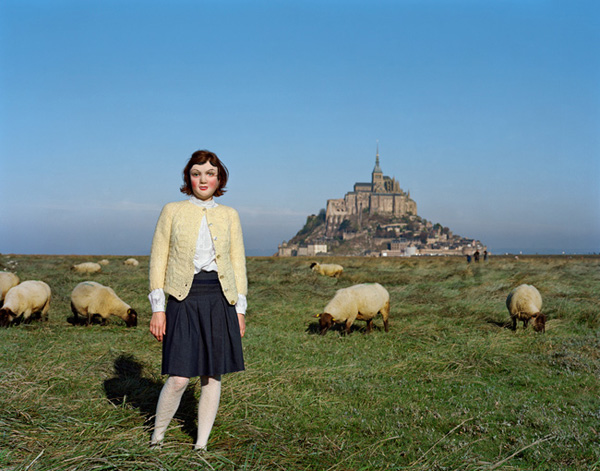
ofer wolberger_mont saint michel.jpg

Ofer Wolberger‘s solo exhibition, (Life With) Maggie, is currently on view at Michael Hoppen Contemporary in London. The photographs on view depict Maggie–a fictional character with a a rosy-cheeked, stale-smiled, plastic-masked face and a wardrobe that would make any fan of vintage swoon–posing stiffly at various locations around the world. Like a retro poster child for the Independent Woman, Maggie is traipsing the globe in search of self-identity within a global context. Wolberger presents us with Maggie’s journey in contrast to the web-based social networking that connects so many of us worldwide these days, though we generally do so without ever leaving our desk chair. The irony is that “Maggie” is portrayed by the artist’s fiance, Billie Martineau–whom Wolberger met via an online social networking site before meeting in person.

ofer wolberger_pensicola beach.jpg

Ofer Wolberger lives and works in New York. He received his MFA in Photography from The School of Visual Arts and his BA from State University New York. He is the recipient of The Humble Arts Foundation Spring 2008 Grant for Emerging Photographers. In 2009 his work has been or will be exhibited internationally in Seoul, South Korea; Berlin, Germany; and London, England, among other places. Last year his work was featured in Tim Barber’s Various Photographs as part of the New York Photo Festival, and in 2007 his work was featured in TH Inside’s Noise exhibition in both Milan and Berlin as well as in the accompanying exhibition catalogue. Ofer’s photographs have been featured in several international publications including The New York Times Magazine, Wired, Spin, GQ, Life and Big Magazine.

Share

Venice Biennale: Aleksandra Mir

AleksandraMir2.jpg

Aleksandra Mir‘s work at the 53rd Venice Biennale, VENEZIA (all places contain all others), is highly appropriate given that Venice is often considered to be the ultimate tourist destination. Responding to the global souvenir postcard phenomenon, Mir has printed one million copies of her own postcard designs for the exhibition. These postcards are available free-of-charge to each Biennale visitor in both the Arsenale and the Giardini exhibition venues. The artist’s basic intention is to have the participant write on and mail the stamped post card using an onsite letter box, dispersing the work globally.

In each of her 100 postcard designs, Mir pairs the designation ‘Venezia,’ with appropriated images of tourist destinations from around the world. However, none of the postcard images actually depict Venice. The locations vary widely, featuring tropical and snow-covered climates, cityscapes and miscellaneous natural wonders. At times, well-known landmarks such as the Ponte Vecchio in Florence and the Chateau de Chambord in France are attributed to Venezia.

AleksandraMir3.jpg

All of Mir’s postcard images contain bodies of water, which is the defining feature of Venice. Historically, the city’s location on water was the key factor in its development as a powerful trading empire. Yet, bodies of water are certainly not an exclusively Venetian characteristic. Water is shared by different geographies, and enables transportation, connecting distant areas around the world.

Mir’s ultimate goal seems to be for these postcards to connect places around the globe in a similar fashion as the bodies of water featured on the postcards. The gallery visitor completes Mir’s work by sending it out into our globalized world, thus creating unexpected encounters.

Aleksandra Mir was born in Lubin, Poland in 1967. Mir has shown internationally since the mid 1990s and was a founding member of the collective M.I.M.E. She attended Gothenburg University, the School of the Visual Arts (NYC) and the New School (NYC). Today, she is a citizen of both Sweden and the United States, while living and working in Palermo, Italy.

VENEZIA (all places contain all others) will remain at the Biennale until the closing on 22 November 2009.

Share

Venice Biennale: Ulla von Brandenburg

Singspiel 1.jpg

Upon entrance into Ulla von Brandenburg’s colorful installation entitled Singspiel, one is confronted with a sensation of curious exploration coupled with the particular anxiety of entering the unknown. The labyrinthine structure is made up of a series of solid colored fabrics forming an intervention in space and architecture. These colors refer to the color scale of Swiss Psychoanalyst Max Luscher, who in the 1950s conceived a model for personality types based on specific color preferences. At the end of this vivid and modestly Constructivist structure is a film projected onto the soft fabric wall. The guests–an eerie sense of “being expected” surfaces at this moment–are invited to sit and watch the film. Much like the physical journey of the viewer, the film depicts a slower, black and white journey through an architectural space. Filmed at Swiss architect Le Corbusier‘s famous building Villa Savoye, the voyage of the viewer continues through the historic ramps, partitions, and rooms of the Villa.

Singspiel 2.jpg

Like most of von Brandenburg’s work, Singspiel explores aspects of theater, performance, and psychological states and in this case, takes the form of a somber and still film. As the film travels through the Villa, a series of players appear and disappear, conjoin and separate upon the camera’s direction. The modernist imagery is juxtaposed with classical elements and mechanics of theater and performance, with much emphasis on the fundamentals of Brecht’s Epic Theatre. The transitions among the characters occur through song and the singer’s voice is high-pitched and peculiar, adding another layer to von Brandenburg’s tale. Sensations of melancholy and mystery are present in the film’s final scene which takes place in the house’s garden where the characters appear to be attending a performance of sorts (not coincidentally, they are sitting in stools that are identical stools of the viewer). A pronounced Brechtian curtain is drawn to reveal the players of this story in a sort of meta-situation–a play inside the play.

Von Brandenburg is a German-born artist who lives and works in Paris. Besides film and installation, she works in a wide variety of media including drawing, painting, and live performance.

Share

Venice Biennale: Grazia Toderi

GraziaToderi.jpg

Grazia Toderi’s 2009 work, Orbite Rosse, is featured in this year’s Venice Biennale as a part of the Making Worlds exhibition. Its two video screens feature images of cities captured at night from an aerial perspective. Toderi’s use of video, which uses light to create compositions, marries well with his choice to depict cities brightly lit at night. The resulting abstraction of these far-away cityscapes is celestial. The city lights form their own galaxies of light, which sparkle across the video screen in an exceptional aesthetic creation. These celestial qualities are underscored by the orbs at the center of both screens and the title of the work, which translates to ‘red orbits.’

Grazia Toderi was inspired to create Orbite Rosse by Italo Calvino’s 1972 book Invisible Cities and Jacopo de’ Barbari’s map, Venetie MD from about 1500. Both of these works create imaginative views of cities, which Toderi draws inspiration from and imbues with his own contemporary spin. Toderi’s aerial perspective of cityscapes illustrate the smallness of our own artificial worlds.

Grazia Toderi was born in Padua, Italy in 1963. His work is exhibited internationally, including recently at the Museo de Arte Contemporanea de Serralves, Portugal (2008) and the Miami Art Museum (2006). Toderi is represented by the Galleria f a Projects in London, Gio Marconi in Milan, and the Galleria S.A.L.E.S. in Rome. He lives and works in Milan and Turin, Italy.

Orbite Rosse will be on display in the Venice Biennale’s Arsenale venue through 22 November 2009.

Share

Venice Biennale: Union of Comoros

Union of Comoros.jpg

For their Biennale debut, the Union of Comoros is in participation with a project, Djahazi, by the Italian artist Paolo W. Tamburella. Comoros is a small series of islands located off the coast of Mozambique in East Africa, and Djahazi gets its name from the classic wooden boats the Comoros people used for centuries to transport goods and heavy cargo through the Mozambique Channel and the Indian Ocean. After the opening of the Suez Canal in 1869, the international use and presence of the Comoros islands greatly decreased. The djahazi vessel, however, remained a propitious means of transport within the African industry until 2006 when modern freight methods subverted these traditional modes. The boats were forsaken at the docks of Moroni, the main port of the Comoros, and continued to deteriorate on the sea floor.

COMOROS UNION OF.jpg

For the Biennale project, Tamburella resurrected and restored one of the twenty-eight boats found on the sandy ocean floor of the port. With the help of local Comorians, Tamburella restored the vessel to its original state. During the last decades of the djahazi’s use, it was common to see the boats carrying modern cargo containers from large ships to the port of Moroni. As a gesture towards the tradition, Tamburella has loaded a shipping container inside the restored djahazi. In Venice, the vessel is exhibited at the waterfront of the Giardini entrance. As described in the project summary by Octavio Zaya, “[the restored Djahazi] will stand as a metaphor for an ambivalent globality, bringing together hope and despair, hyper-rationalization and avant-garde extravagance, anti-modern nostalgia and exuberant narratives of progress, emergence and emergency…” While these semantics are, perhaps, idealistic, the Djahazi project is a simple and delicate gesture towards the power of tradition in today’s post-modern world.

Share