Urban Myth and Crime and Charity

Meggs.jpg

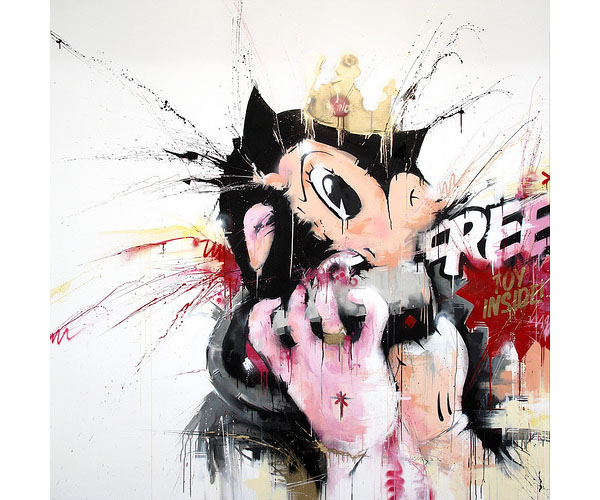
Two new exhibitions titled Urban Myth and Crime and Charity are opening this Saturday in Culver City’s Cerasoli Gallery. Cerasoli’s two front gallery spaces will contain Urban Myth a group exhibition curated by Inkie. The exhibition will feature thirteen UK-based street artists, including Mudwig, SHOK-1 and MauMau among others. Also on view will be a small solo exhibition by Australian artist Meggs titled Crime and Charity. Utilizing a framework of sequential art, Meggs creates a new hybrid of heroes and villains each subverted to reexamine the traditional notions of comic book iconography. The result is highly energetic albeit decomposing imagery that is as playful as it is violent.

Both exhibitions will be on view from July 11 – August 1st, 2009.

Share

Sean Higgins: Difficulties with Interplanetary Travel

Higgins-2.jpg

Collette Blanchard Gallery, a relatively new space on the Lower East Side of Manhattan, recently opened an exhibition of new photographic prints by Los Angeles-based artist Sean Higgins. The exhibition, titled Difficulties with Interplanetary Travel, features eleven digitally altered images of different terrain, some celestial and some worldly, all of which construct a new unidentifiable reality. All Each image begins as documentation of an actual event or location, either taken from the artist or sourced from online archives. Higgins then begins a meticulous process of altering the image, bringing it to state that is positioned directly between science fiction and reality, a state that is found all too often in contemporary life. The images, which are presented in a square format just shy of four-foot, marry a sense of mystery with the familiar, luring the viewer in while opening up an endless array of questions centered on image authenticity.

Higgins.jpg

Higgins recently completed an exhibition of similar prints with Ambach and Rice in Seattle and has also exhibited with LA Louver Gallery and Sixspace in Los Angeles. His current exhibition with Collette Blanchard was reviewed by the Danish publication, The Copenhagen Voice. Difficulties with Interplanetary Travel will be on view through July 31th.

Share

Join the Discussion

Hello DailyServing.com readers,

The DS Team wants to hear from you! Tell us which features you like, which you don’t and why. The best way to comment or start a discussion is through our discussion link at the bottom of each feature.

If posting comments publicly on the site isn’t really your thing, shoot us an email and let us know what’s on your mind. We are always interested to hear from you. Email us at info@dailyserving.com.

Share

Our Literal Speed

OurLiteralSpeed.jpg

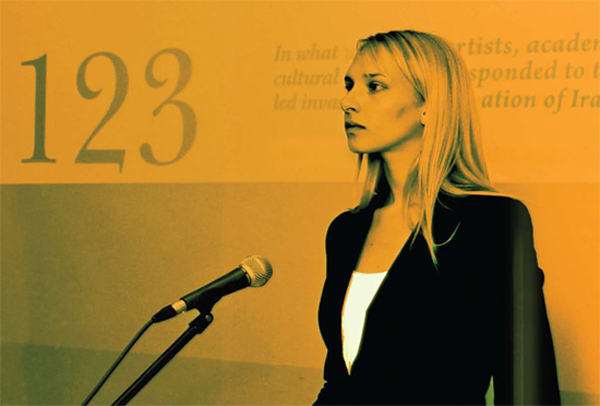
Closing this week at Gallery 400 at the University of Illinois at Chicago is the accompanying exhibition to OUR LITERAL SPEED. An event produced by the University of Chicago in association with Art Chicago, the Art Institute of Chicago, the University of Illinois at Chicago, the Renaissance Society, and the Smart Museum, OUR LITERAL SPEED is constructed as a conference with a schedule of events that includes lectures, performances, and an exhibition. The multi-faceted event manifests the imperatives that materialize the theoretical and the pedagogical. It’s organizers lay the ground work for this claim by stating:

“No longer can we interpret forms of academic and artistic professionalism as neutral, abstract backgrounds to the aesthetic and performative. These activities have produced their own distinctive surfaces and procedures: the ‘aesthetic’ has become discursive and ‘discourse’ has become aesthetic.”

Rather than a series of academic lectures, the conference/event is imagined as a kind of “media pop opera” or “administrative gesamtkunstwerk” that includes fluid and/or jagged transitions among scholarly presentations, panel discussions, artist’s talks, performances, and an art exhibition within an academic conference. The organizers further elaborate that: “These emerging, hybrid forms demand a synthesis of collective activity (OUR), a self-reflexive examination of art history and its constitutive technologies (LITERAL), and an intense concern for the pace and texture of our movement through institutional mediation (SPEED).”

The project offers a temporary laboratory in which a concerned public can investigate non-formulaic, experientially vibrant and theoretically precise responses to the modes of distribution, consumption, and circulation that drive contemporary art. OUR LITERAL SPEED will next manifest at the Getty Center in Los Angeles in the winter of 2010.

Share

Yinka Shonibare MBE at the Brooklyn Museum and The Newark Museum

yinka shonibare.jpg

James Cohan Gallery has announced two shows taking place in the New York area featuring the work of acclaimed British-born Nigerian artist Yinka Shonibare MBE. Shonibare’s artistic practice explores the construction of cultural identities by examining issues of class, race, and colonialism. He is known for his use of brightly colored wax-resist textiles, often seen clothing headless mannequins in tableaux-style installations, as in How To Blow up Two Heads at Once (Ladies), 2008.

These fabrics were initially associated with the Indonesian archipelago, and were later manufactured in the Netherlands and exported to Africa, where they became a symbol of national pride. Shonibare draws upon this complicated history to show the socioeconomic dominance of Europe established through trade and colonialism. The distinctly Victorian style of dress seen on the mannequins refers to the period of British history when Africa was colonized. The fabric is both a tool for investigating contemporary African identity and a metaphor for the interwoven, and often inequitable, historic nature of a global culture.

The Brooklyn Museum is currently exhibiting the most comprehensive survey of Shonibare’s work to date, featuring over twenty sculptures, paintings, large-scale installations and films. The exhibition was launched at the Museum of Contemporary Art in Sydney, Australia, and will later travel to the National Museum of African Art, Smithsonian Institution, in Washington, D.C. It will remain on view at the Brooklyn Museum until September 20th. The exhibition is accompanied by a catalogue which includes an interview conducted by Anthony Downey, Ph.D., Program Director of the M.A. in Contemporary Art at the Sotheby’s Institute of Art in London.

In addition to this survey exhibition, a site specific installation by Yinka Shonibare MBE is on view at The Newark Museum until January 3, 2010. Party Time: Re-imagine America was commissioned by the museum to celebrate their centennial anniversary. The installation is set in the dining room of the historic Ballantine House, a wing of The Newark Museum since 1937, which was originally built for the prominent Newark brewing family in 1885. The installation recreates a formal dinner party as it could have happened at the time of Jeannette and John Holme Ballantine, for whom the house was built. As stated in the press release, Party Time: Re-imagine America “considers at its core the discrepancy of wealth generated by turn-of-the-century enterprise, where excess and self-indulgence are achieved through the subservience of others.”

Shonibare was born in London in 1962. When he was three, his family moved to Nigeria, but maintained a residence in South London to spend summers. Shonibare attended Goldsmiths College from 1989-1991 (after Byam Shaw School of Art). The artist was short listed for the prestigious Turner Prize in 2004 and designated a Member of the British Empire by Prince Charles.

Shonibare has recently exhibited at James Cohan Gallery in New York as well as the Santa Barbara Museum of Art in California. In addition to the two exhibitions taking place now, the artist also has an upcoming show at the Museum of Fine Arts in Boston in 2010.


Share

Phillip Allen

phillipallen1.jpg

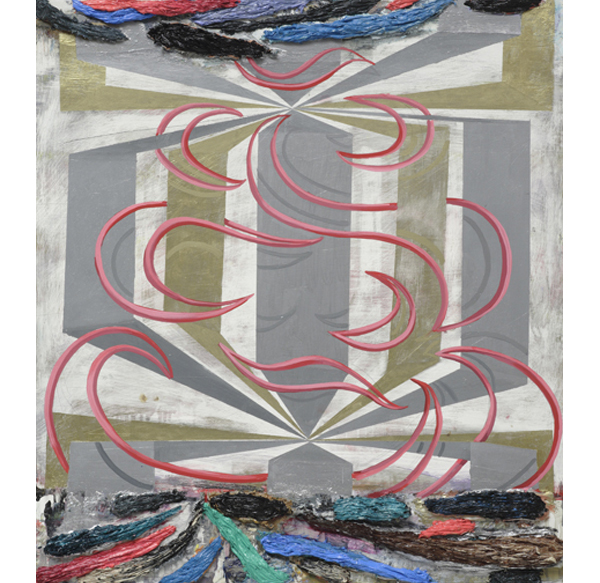
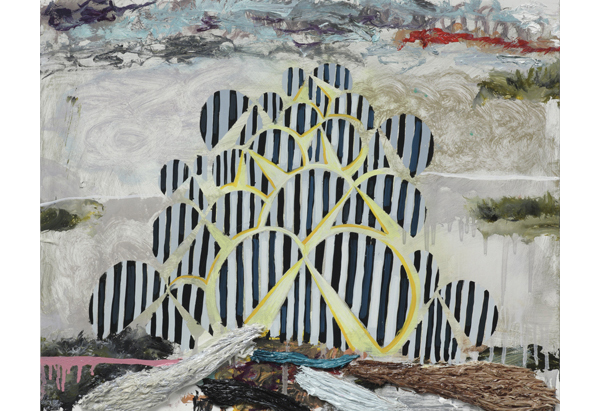
Currently on view at Kerlin Gallery in Dublin is a solo exhibition of new work by British painter Phillip Allen. The elements of Allen’s paintings exist almost independently of one another, with geometric patterns and blocks of color tidily trailing over the center of the canvas, while bright rays of beaming light penetrate the negative spaces and connect the shapes. And then, on the same canvas but in an entirely divergent approach, Allen layers thick applications of paint onto the top and bottom of the piece, as if rebelling against his own cleanly constructed geometries. The two styles seem to be at once fused through harmonious choices from the palette, and contradictory in terms of technique and style. Allen’s work is also on view right now inClassified: Contemporary Art at Tate Britain.

phillipallen2.jpg

Phillip Allen lives and works in London. He earned his BA at Kingston University, London and his MA at Royal College of Art, London. His work has been shown throughout the United Kingdom and internationally at Xavier Hufkens Gallery, Belgium, Brussels; PS1 Contemporary Art Center, New York, NY; and The Approach, London, UK, among others.

Share

John Wesley

John Wesley.jpg

John Wesley’s engaging retrospective is taking place at Fondazione Giorgio Cini on the island of San Giorgio Maggiore in Venice, in conjunction with the Venice Biennale, and will be on view until October 4th. The project, which is curated by Italian curator Germano Celant for the Fondazione Prada, features more than 150 works from 1961 to 2007.

John Wesley distinguishes himself for his highly recognizable style characterized by simple tracings, flat areas of color, and the use of a palette dominated by pastel-like colors. Light blue tones and a decorative yet sensuous pink seem to be his favorites. Poster-like, flat, colorful and figurative, Wesley’s paintings are a masterful fusion of tradition and pop cultural references. The linear technique, the essential painterly effects, and the often schematic format, all contribute to cartoons and comic strip appearance of Wesley’s work.

mousejoke.jpg

Associated with Pop Art, reductionism, Surrealism, Art Nouveau, as well as artists such as Matisse, Wesley also incorporates clues from popular culture and Japanese iconography and mixes humor and sex in a way which is unpredictable, seductive and poetic. Delightfully painterly, his unique and compelling compositions present a variety of female and male characters, pretty human faces, naked bodies, details of lips, legs and thighs, animals, comic book characters, all populating a narrative that loops between the dreamy-like imagery of the unconscious and contemporary culture. Glamorous and irresistibly appealing, the works on show in Venice certainly bolster Wesley’s position as one of America’s most significant artists.

John Wesley was born Los Angeles, California, in 1928. He has no formal art training, and after holding various jobs, he began painting at the age of 22. In 1960 he left his native Los Angeles to move to New York city, where he met many artists of the time–among them, Donald Judd, who soon became a friend and supporter. He started exhibiting his work at the Robert Elkon Gallery in 1963. The current retrospective at the Fondazione Giorgio Cini in Venice is Wesley’s second major solo show after the one held at the P.S.1 Contemporary Art Center in New York city in 2000. He currently lives and works in New York city.

Share