Alberto Gaitan

Alberto Gait√°n.jpg

Remembrancer (2009) is the title of a new installation at the Taubman Museum of Art‘s Media Lab created by Alberto Gaitan. For the exhibition, the artist has created three robotic painters that are programed to apply paint to a surface according to information gathered using non-stop sources of Internet news feeds from around the globe. The machines are searching for the frequency of keywords within a short frame of reference to inform their application, offering more paint in correlation to how often the term appears. The machine’s apply the paint within the RGB (red, green, blue) palette, just as all computer, television, and mobile phones transfer visual information in this limited palette. The artist has stated about the work, “Nobody has the capacity for total information awareness so we relinquish big chunks of our understanding to black boxes of knowledge whose provenance we don’t fully understand. We make important decisions and base stacks of assumptions on these. Our memories are rife with inaccuracies, placed there by similar simplification processes that are part of how our minds work. Forgetting or ignoring becomes a significant aspect of remembering.”

Gaitan is a composer and sound artist and also works as a programmer and system consultant. He has exhibited internationally and presented a similar version of Remembrancer in 2007 with the Curator’s Office in Washington DC. The artist is a core member of the international public art collective Art Attack and is a founding member of both NegEntrope and SLURrr post media ensembles.

Share

Lynn Richardson

Richardson.jpg

Currently on view at Redux Contemporary Art Center is Inside the Fence, a new site-specific installation by Canadian-born artist Lynn Richardson. The installation is saturated with imagery that suggests architectural development within a working landscape. Large construction blockades hover gracefully above the gallery floor, striped barriers adorn the walls and caution lights seem to illuminate the space. The installation is also activated by the viewer through motion and responds through sound and light. Richardson has engineered the work so that it responds to the viewer only when it is being engaged. If no one is engaging the work, no energy is consumed.

While the installation is certainly in dialogue with development, technology, industrialism, and nature, it also speaks to the principles of American minimalism and utilitarianism. Richardson hones in on the vocabulary of our landscape, often abandoning the need for individual creation in exchange for the efficiency of repetition.

The artist received her MFA from the University of Texas in Austin and a BFA from the University of Manitoba. Recent solo exhibition include Remapping the Northwest Passage at CSAW in Houston and Red State at the Michael Gibson Gallery in London, Ontario. In 2005, Richardson received the Joan Mitchell Foundation MFA Grant and was included in an exhibition at Cue Art Foundation in New York City.

Share

JURIED@BAC

Julie_Garner.jpg
Julie Garner

Tucked away amidst a tranquil, tree-shaded park in North Berkeley is the Berkeley Art Center, currently hosting an exhibition of mostly Bay Area artists who each have a refreshing take on traditional media. Eighteen artists were chosen by distinguished curators Rene de Guzman and Kate Eilersten, who have a wealth of experience in visual arts programming at cultural hubs like the Yerba Buena Center for the Arts, the Oakland Museum of California, and the Museum of Folk and Craft Art. Eilersten and de Guzman chose artists whose technical expertise and conceptual ideas come together as equal factions in a quotient yielding sublimity. Ultimately, the theme of JURIED@BAC: Works on Paper is transcendence–an evasion of the perceived constraints of a two dimensional media.

Leigh_Barbier.jpg
Leigh Barbier

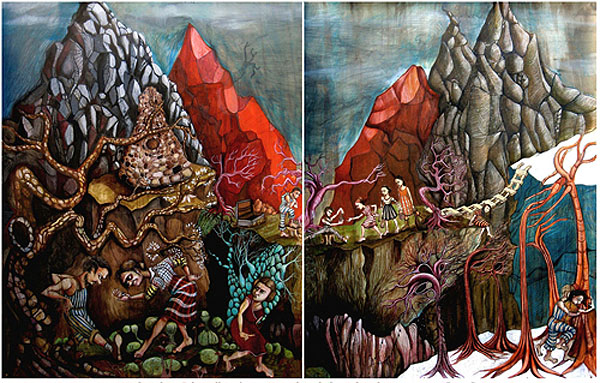
Leigh Barbier contributed paintings from her series, Mushroomville, an exploration of her fantasy world filled with women and their adolescent daughters on a mission to understand the insidious aspects of reality. The mothers take on a didactic role, using nature, particularly mushrooms, to explain the difference between the harmful and the nutritious. The scenes are absent of housework and other domestic chores, allowing the female characters to fully delve into their surroundings. Barbier’s ground planes are rocky and angular, treacherously winding underfoot, sometimes even extending out into the space of the viewer. Pushing out of the picture plane is a tactic that is reminiscent of the Byzantine painter, Giotto. However, Barbier’s figures are more volumetric and show more emotion than her Medieval predecessor.

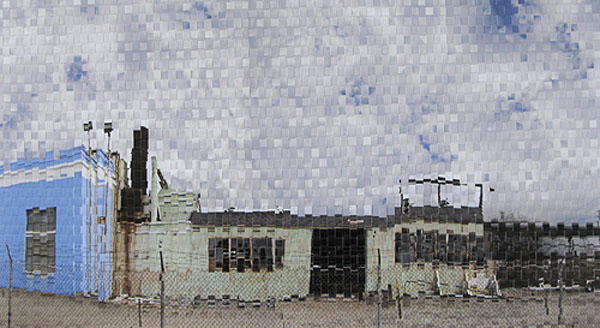
Collaging, piercing, and weaving were some of the other techniques artists used to go beyond the flatness inherent to paper. Iris Charabi-Berggren‘s piece, Bird Watching-Gyrfalcom literally weaves itself off the wall. Graphite tones describe the bird’s markings, texture, and brain-like headpiece, which flow into an undulating warp and weave. Julie Garner uses a similar technique in her work, Sugar Factory as she weaves multiple images of the same subject into one single image. Buoyant pneumatocysts and algae permeate the surface of Emily Clawson‘s pinhole drawings that she creates by puncturing the paper with the sharp point of a needle or pin. Masako Miki demonstrates how shaded planes of patterned paper can indicate linear perspective and bring order to her precariously stacked items.

In addition to the aforementioned artists, works by Henrique Bagulho, Mariet Braakman, Morgan Ford, John Hundt, Lisa Martin, Liz Maxwell, Anthony Lazorko, Camilla Newhagen, Henry Navarro, Sarah Newton, Jonathan Solo, Hyewon Yoon, and Alex Zecca are also exhibited. The show will be on display through September 20th, 2009.

Share

Another End to Irony

Second Nature, currently on view at the UCLA Hammer Museum, provides a freshly intelligent glimpse into Los Angeles’ past decade, depicting a world in which art can insouciantly assert itself without resorting to contrivance.

1. “‘There’s going to be a seismic change,” said Vanity Fair editor Graydon Carter after 9/11. “I think it’s the end of the age of irony. Things that were considered fringe and frivolous are going to disappear.” But, of course, Carter kept right on publishing his sleek, ad-filled nucleus of frivolity and irony kept thriving.

Rubi Neri The Lioness.jpg
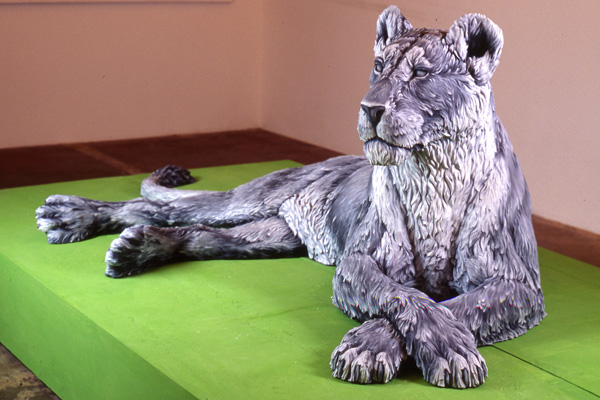
Ruby Neri. Untitled (Lioness), 1998-1999. 102 x 63 x 44 1/2 inches. Hammer Museum, Los Angeles. Gift of Dean Valentine and Amy Adelson. Image courtesy of the artist, and David Kordansky Gallery, Los Angeles.

Read More »

Share

Abe's Penny

Abespenny.jpg

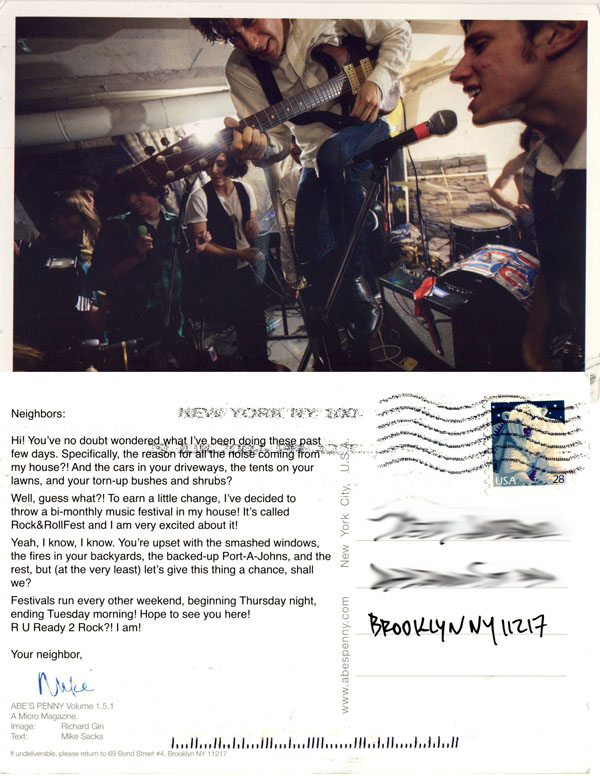
In a world saturated with electronic communication, it is becoming more rare to find anything in your physical mail box that is worth reading. Thanks to the efforts of Abe’s Penny, a new concept-based micro-publication founded by sisters Anna Knoebel and Tess Knoebel, snail mail has become interesting once again. Abe’s Penny takes the form of an ongoing post card series which features a narrative that unfolds over a four week period. Each month, the work of one visual artist and one writer is printed on a standard post card and mailed to subscribers of the Abe’s Penny publication.

The postcard shown above features a collaboration between photographer Richard Gin and writer Mike Sacks. Gin is a Brooklyn-based photographer who works freelance on a variety of editorial and commercial projects, and Sack is a prominent writer that has worked for Vanity Fair, The New Yorker and Vice among countless other publications.

Abe’s Penny offers a subscription rate so that you can add some excitement to your mailbox experience. Details are offered on their website.

Share

Chris Kaczmarek

kaczmarek-1.jpg
John Groo courtesy Real Art Ways

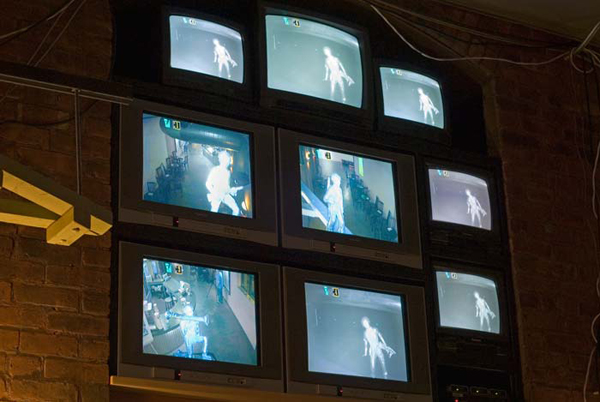
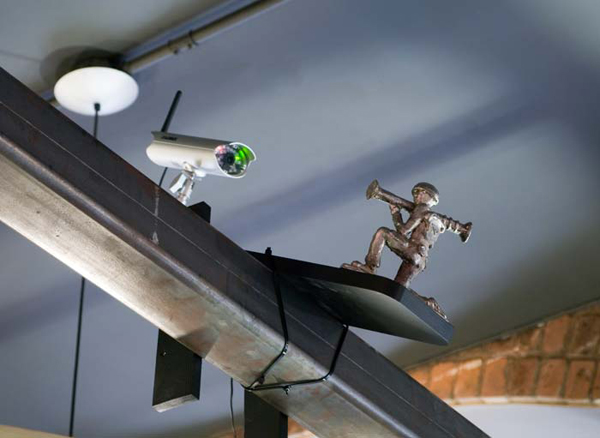
Currently on view at Real Art Ways in Hartford, Connecticut is a site specific installation by New York-based Chris Kaczmarek. Kaczmarek’s installation seems to tap into the artery of the Bush-era Red/Orange/Yellow zone thinking, wherein one was (is?) perpetually made aware of the changing safety of the current situation, as well as drawing on the theme of citizen surveillance — meant to heighten greater public safety, but which ultimately wafts a pungent scent of paranoia through the air. The installation, on view through September 13th , exhibits live video feeds of people moving about the space as well as footage of toy soldier-like figurines, sculpted by the artist, caught by discreetly placed cameras throughout Real Art Ways.

kaczmarek-3.jpg
John Groo courtesy Real Art Ways

Chris Kaczmarek earned his MFA in studio art and MA in modern and contemporary art history from State University New York at Purchase, and his BFA from Appalachian State University in Boone, North Carolina. His site specific installations and other works have been exhibited internationally, including at Trinity College Science Gallery, Dublin; Henry Street Abrons Art Center, New York; Springfield Museum of Art, Springfield, Ohio; and Starving Artist Gallery, Raleigh, North Carolina.

Share

David Bayus

david bayus2.jpg

On September 1st, from 5-10pm, the San Francisco Art Institute will hold The First Annual First Show, curated by Nicholas Miller, Karl Nelson, Casey Gray, and Romy Mariano. The show, which will take place throughout the outdoor spaces of the Institute, including the courtyard, quad, and amphitheater, will feature paintings, sculptures, photography, film, video, performance, installation, and live music. The purpose of the show is to create positive energy for the student body at the start of the school year, despite the ongoing political and economic uncertainty surrounding us.

david bayus3.jpg

SFAI M.F.A. candidate David Bayus will exhibit some of his mixed media collages alongside recent work by over 30 other graduate and undergraduate students. In his oil and digital collage seen above, Rock Biter Shit Face, Bayus charges the subtle palette of the rock face with vibrant reds and luscious greens, creating a visually dynamic composition. The lush emerald brushstrokes and the rich blazes seen in the foreground ignite the otherwise static landscape. Bayus received his M.F.A. in Painting from the Savannah College of Art and Design in 2005. He has previously shown his work at the Luggage Store Gallery and the Diego Rivera Gallery, both in San Francisco.

The First Annual First Show will take place at the San Francisco Art Institute this Tuesday, September 1st, from 5-10pm.

Share