Summer Session

Summer Session – Help Desk: Back to School

Our topic this Summer Session is Back to School, and today we bring you an article from our arts-advice column Help Desk about that very thing. Here, Bean Gilsdorf outlines her best advice for getting the most out of an arts program, particularly as an undergraduate, and how to jump-start personal development as an artist, whether you practice as a student, professionally, or independently. This article was originally published on August 20, 2012.

Barry McGee, Untitled #29, 2002. Paint (mixed media) on wood panels, 96 x 144 inches

Barry McGee, Untitled #29, 2002; paint (mixed media) on wood panels; 96 x 144 in.

I am currently attending art school (RISD) on the east coast to receive a BFA in painting. I will be a junior this coming year and feel that things have really started to pick up. The first half of my undergraduate education has gone fairly well. Foundation year was rigorous, and last year I explored a lot within my own work. I have multiple on-campus jobs and am beginning to feel good about my contact and personal relationships with the faculty. Besides my own personal goals to read a lot and really hit the ground running in the studio, I was wondering if you had any advice on what I can do to make the most out of my remaining two years in undergrad? Specific class topics? Outside experiences? Maybe taking advantage of the close vicinity to Boston and New York? Any advice would be great.

I’m glad to hear that you feel good about how things are going in general. Art school can be tough and competitive, but it sounds like you’re on an even keel and ready to work on your next steps. It’s been a long time now since I was an undergrad, but in order to answer your question I spent some time thinking about the beneficial things I did—and the things I wish I had done—when I was in school. Below are some ideas for you to consider, divided into the three categories of career, artwork, and personal development.

Career: I like that you have on-campus jobs and are cultivating good relationships with faculty. When you graduate, you’re going to run into a lot of people who will say, “Oh, you went to RISD? Do you know Professor X?” and it may be helpful if you’re able to say, “Yes.” Make sure that you get at least a little face time with all of the people in your own department.

Also, spend some time talking to teachers in other departments, because it’s easy to become conceptually isolated in the echo chamber of a particular department. You can figure out which people you want to contact by listening carefully when your friends discuss their classes and instructors. Who is a good teacher? Who gives good feedback? Who is friendly and generous? You want these people in your life, if for no other reason than they will create good energy and positive vibes for your practice (and I can say that with a straight face, because I live in California). If you hear of someone really phenomenal, ask for a studio visit. Inviting people from other departments to your studio will expand your understanding and your practice, which will serve you well after graduation. After all, there are no media-specific departments in real life. When you’re done with school you’re going to have to contend with the entirety of contemporary art, not just contemporary painting.


Read the full article here.

Share

Summer Session

Summer Session – Can You Make Your Own MFA?

For our Back to School Summer Session, we’re taking a look at education, pedagogy, and learning in the arts from all angles—be it through work informed by school or schools of thought, investigations into the current state of academia, or resources for those interested in either self-directed or formal education. Today we bring you an article by Shannon Stratton from our friends at Temporary Art Review that seriously considers the possibilities of creating an MFA outside of the academy. This article was originally published on May 12, 2014.

Sarah Hunter's logo for her experimental Summer Forum.

Sarah Hunter’s logo for her experimental Summer Forum.

A few months ago on Facebook I posted an idea I had about graduate school for visual artists. It is actually an idea I’ve had for some time, and one that seems increasingly relevant the more that is published on the arts being a career for the privileged or art schools ranking as the most expensive four-year programs in the nation. Having attended one of those expensive schools and now making (part of my living) teaching at it, I am embarrassingly familiar with the cost-benefit analysis of an education and career in the arts. In 2001 when I attended the School of the Art Institute of Chicago, I took a gamble on my future, taking nearly $70,000 in student loans to cover my two years of graduate school tuition (made a little bit more expensive by an extremely unfavorable exchange rate between the Canadian and American dollar at the time). I was 25 and had attended a visual arts college in my hometown of Calgary, Alberta, that had cost considerably less. When I got into SAIC I decided that the benefit of a larger art community, access to the American visual art world, the potential of finding better teaching jobs with a degree from SAIC, and the seemingly endless list of resources the school offered were well worth the investment. I had been hammered with the “invest in your future”/”student loan debt is ‘good debt’” rhetoric, and as the first person in my family (siblings, parents, or grandparents) to go to college, let alone graduate school, I was perhaps a little too caught up in the honor of being accepted to a “top school.” With no disrespect to the quality of education I did or one might receive at SAIC, I should have been a little less flattered, a little less starry-eyed. But at 25, hopeful that I would “make it” and filled with a kind of follow-your-dreams delusion, I felt that the arts shouldn’t be a career just for the rich, and that I would make this work for me…at all costs.

This isn’t a short article on regret, but some basic things I wish I had known: the percentage of tenure-track jobs versus adjunct positions in the job market and the average rate of pay and benefits for these positions; and the significant resources state schools had in terms of faculty and opportunities.

Read the full article here.

Share

Summer Session

Summer Session – Teaching While Black

Back to School is the theme of our final 2016 Summer Session, and in addition to exploring the relationship between the arts and education, we are also providing resources for those working within the academy. Today we bring you the series “Teaching While Black” from Patricia A. Matthew’s blog Written/Unwritten. In Part 1 Matthew highlights specific essays about dealing with student reactions from Robyn Magalit Rodriguezs “Resources for Women of Color Faculty,” which was posted as part of Back to School earlier this session, and offers advice for her white colleagues on how to support faculty of color. Below is an excerpt from Part 2, which provides a personal perspective from Matthews own experiences with students and student evaluations—a potentially devastating aspect of teaching for nonwhite (and non-male) professors and lecturers. Part 3 can be found through our friends at the New Inquiry, and expands upon how Matthews race and gender affects her students perceptions. Part 2 was originally published on December 1, 2013. 

Lorna Simpson. Five Day Forecast, 1991; five photographs, gelatin silver print on paper and fifteen engraved plaques, 24.5 x 97 in. Courtesy of the Artist and Salon 94, New York.

Lorna Simpson. Five Day Forecast, 1991; five photographs, gelatin silver print on paper and fifteen engraved plaques; 24.5 x 97 in. Courtesy of the Artist and Salon 94, New York.

It’s evaluation time and students have the chance to offer anonymous feedback about their experience in the classroom. As a tenured faculty member, I’m not required to undergo this process, but from time to time I do so anyway. Even when I don’t arrange for university evaluations, I ask my students for feedback about the semester. It’s always a bit unnerving, and I can never quite shake the feeling that it feeds into the consumerism mode of higher education, but I believe it can be a useful process. This year, as I’ve been thinking of what it means to be a professor of color in the academy for a solid decade, I’m thinking of the daily informal assessments that happen all the time, and I’m remembering the time I told a graduate student to take a seat.

Literally.

I’ll never know exactly what pushed this particular graduate student to stand up in the middle of my Research Methods course and shout, “You can’t lecture me!” He’d been terse and combative from the first day of the term, but it’s been so many years (easily seven or eight) that I’ve even forgotten what we were talking about when he forgot himself. It’s possible that he was angry that I hadn’t paid enough attention to Byron’s use of ottava rima in Don Juan (no, I’m not kidding). I remember being amused when he wanted to know if I knew this pertinent fact about the poem (of course, I did). And when he wanted to explain to me that feminism was a crock because men were responsible for good things like the Sistine Chapel, I remember trying to gently but firmly move the conversation towards more productive ground. I also remember feeling some genuine sympathy for him. Here he was, forced to take a course that was not of his choosing with an instructor he might not ever have chosen to study with. All graduate students in our program must take Research Methods, it’s only offered once a year and, at the time, I was the only instructor teaching it. He was white and his privilege expressed itself with a stridency I could tell made his classmates uncomfortable. He wasn’t the first student with this habit, but he was the most aggressive.

I don’t remember why this student stood up in a room of about twenty students and yelled, “You can’t lecture me!” but I do remember that, in the moment, my gallows humor crowded everything else out; in reply I said, dryly, “Well, actually, that’s my job. Literally. I mean it’s in my contract and everything.” I then told him he could either sit down or leave the class. He chose the latter.

Read the rest of the article here.

Share

Summer Session

Summer Session – Too Cool for the Cool School

This Summer Session we’re going Back to School, and in addition to providing pedagogical resources and investigating the state of arts education, we are also looking at work that is informed by the idea of “school.” Today we bring you a review from Catherine Wagleys column L.A. Expanded, wherein Wagley reviews separate gallery exhibitions by Craig Kauffman and Liz Craft. Wagleys analysis pivots around the notion of “school” as a particular aesthetic within an artistic movement and “school” as a craft aesthetic, drawing an intriguing connection between the obsession with materiality seen in both Kauffmans “Cool School” sleekness and the disheveled aggression of Crafts sculptures. This article was originally published on April 30, 2010. 

Craig Kauffman, "Untitled," 2009. Drape-formed plastic with acrylic lacquer & glitter.

Craig Kauffman. Untitled, 2009; drape-formed plastic with acrylic lacquer & glitter.

Craig Kauffman has a shoe fetish. He’s had it since he was a child. “My mom wore high heels,” Kauffman explained in a 2008 interview, the same interview in which he talked about the affect campy lingerie ads from Frederick’s of Hollywood had on his adolescent mind. (“Blow-up bras, stuffed padded bras, rear ends,” Kauffman recalled. “[Frederick] was a genius.”) The work that stems directly from Kauffman’s fetish—dumb-fisted, transparent paintings that L.A. Times critic Christopher Knight recently referred to as “rather tepid”—is far from compelling. But the fact that the artist known for sleek, vacuum-formed abstractions lusts after stilettos and patent leather pumps? That is compelling, especially since freshly lacquered custom car parts are more often assumed to be Kauffman’s main muse.

New Work, Kauffman’s soon-to-close exhibition at Frank Lloyd Gallery, features two paintings of shoes, but these hang on an unobtrusive side wall. The central attraction, a series of delicate, drape-formed plastic shells that look like glitter-filled candy dishes, hang in the main gallery. The glitter is real and, like the acrylic wall reliefs Kauffman began making back in the 1960s, each shell has a perfectly smooth surface. The hot pink, aqua, Astroturf green, and lavender that color these sculptures have the manicured gloss suited to a Prada showroom.

Read the full review here.

Share

Summer Session

Summer Session – Five Tips for Teaching with Works of Art

For our countdown to September we’re going Back to School, which means examining works concerned with teaching and learning, revisiting the state of education in the arts, and providing pedagogical resources for teachers and students. Today we bring you a video from our friends at the Museum of Modern Art that offers strategies for teaching with works of art. While the video is geared toward teaching younger children, the tips provided can also be useful for any audience that is not familiar with thinking through artwork. This video was originally uploaded on December 30, 2013.

Share

Summer Session

Summer Session – Syllabus: Black Lives (Don’t) Matter

In addition to examining pedagogy and learning in the arts as part of this Summer Session’s topic of Back to School, we are excited to provide resources for both teachers and students alike that could inform and enrich their art and pedagogical practices. Today we bring you a syllabus by scholar M. Shadee Malaklou from her Jesus Fucking Christ Blog. An assistant professor and Mellon Faculty Fellow at Beloit College, Malaklou’s open-source visual studies syllabus investigates whether, given the epistemological limits of Western philosophy, Black lives can ever matter. This syllabus was originally published on July 18, 2016.   

Left: WWI propoganda poster. Right: LeBron James and Gisele Bundchen on the April 2008 cover of Vogue Magazine.

Left: WWI propaganda poster. Right: LeBron James and Gisele Bundchen on the April 2008 cover of Vogue.

Course description: If the movement Black Lives Matter indexes the precarity of black life, then this course interrogates how and why Black lives don’t matter or, better yet, how and why Black lives, categorically excluded from human protections, can’t (epistemologically) matter. Course topics and themes examine how new media platforms like Facebook and Twitter and old media platforms like broadcast and print journalism reproduce racial spectacle and cultivate anti-Black viscera, gut, and instinct in viewer-consumers. Students will learn how to read for anti-Blackness in global contexts but the focus will be on media production and consumption in American contexts. Born at the hour of another Black Lives Matter movement—to abolish chattel slavery—and tasked with cohering the imagined community of a broken nation, American media in the 19th century made blackface minstrelsy the first mass-produced popular entertainment in the United States. In minstrel shows, Negroes are excluded from the species of Man; theirs is concurrently a genre of sub- and supra-humanity in which blacks are vulnerable like chattel but dangerous like demons, and regardless, gratuitously open to receive violence. Blackface caricatures evidence racial slavery as a social good and justify anti-Black violence at the precise moment in which Blacks might qualify as human, or at the precise moment in which Black lives might matter.

Students will consider how blackface, an alibi for routine anti-Black violence, survives today to inform American media production and consumption, including its new media variations, ensuring that, irrespective of advances by Black Twitter to “say her name” (and his name, and their names, and hir name), black bodies are counted in new media “without counting.”

Read the full syllabus here.

Share

Summer Session

Summer Session – Sole Student in USC Roski School’s Struggling MFA Program Drops Out

Today for this Summer Session’s topic Back to School we bring you an article from our friends at artnet News, where Brian Boucher reports on USC Roski School’s dwindling admissions. With the notoriously high tuition of MFA programs and their insecure guarantee of success in the art world, the accusations of mismanagement levied against the Roski School by its sole MFA student highlight the political and economic issues that hover around higher arts education. This article was originally published on June 21, 2016.

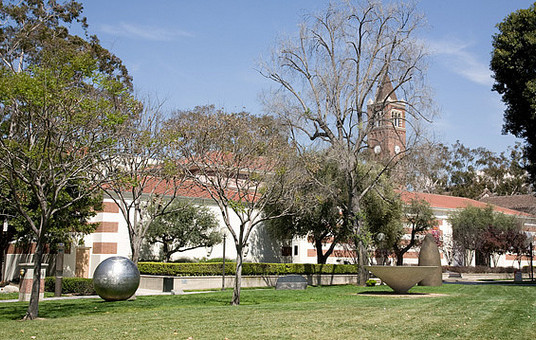
University of Southern California's Roski School campus.

University of Southern California Roski School’s campus.

HaeAhn Kwon, the one student who accepted an offer of admission to the MFA program at the beleaguered Roski School of Art and Design at the University of Southern California last year, has now dropped out.

Kwon, who came to USC on an International Artist Fellowship from Seoul, received a BFA from the Cooper Union in 2009, according to LinkedIn. She distributed an open letter to provost Michael Quick that explains her decision, based on what she calls the school’s “downward spiral of predatory, wrongheaded, and woefully oblivious decision making,” and calls the administration “delusional.”

The news comes as the latest blow to a program that has been at the center of controversy over the last year.

An entire class of MFA students dropped out of the school in May 2015. Among other complaints about faculty and curriculum changes, students maintained that the school had rescinded financial offers (the dean denied the students’ claims). Many observers see the school’s problems as intimately bound up with its formation of the Jimmy Iovine and Andre Young Academy for Arts, Technology, and the Business of Innovation, a program funded by a $70 million gift from record producer Iovine and rapper Dr. Dre. The school appointed composer Erica Muhl as founding executive director of the Iovine Academy and dean of the Roski School in 2013. The students who dropped out in 2015 pointed out that she has no experience with the visual arts.

Read the full article here.

Share