Play With Your Own Marbles

RippedPaper_fs.jpg
Karl Haendel

Play With Your Own Marbles is the title of a new exhibition currently on view at San Francisco’s NOMA Gallery. The exhibition, which is curated by Betty Nguyen, Creative Director of First Person Magazine, brings together three Los Angeles-based artists in an examination of artistic process and its relation to utility, both in object and image. The exhibition highlights the objects and cyanotypes of Walead Beshty, the meticulously rendered photorealist drawings of Karl Haendel, and the formal concrete “paintings” of Patrick Hill.
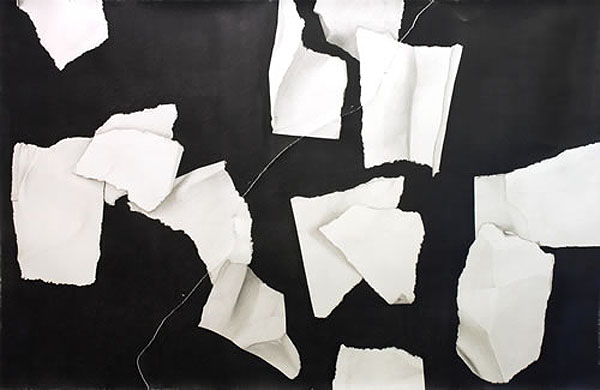
Play With Your Own Marbles is not only linked through the evident formal and aesthetic concerns of each artist, as the show is remarkably connected through its homogenized temperament, graphically monochromatic palette, and overall deconstructionist sensibility, but each artist also plays with a strong sense of irony through material, form and method of display.
PH_08-016a_fs.jpg
Patrick Hill

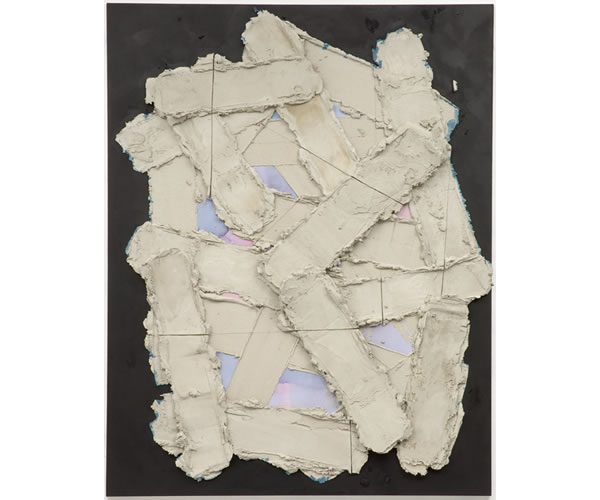
Patrick Hill has applied thick bands of concrete, absorbed and stained into a black velvety surface revealing small crevices of color, opening a dialogue between a strictly modernist approach to painting and the everyday utilitarian material of concrete.

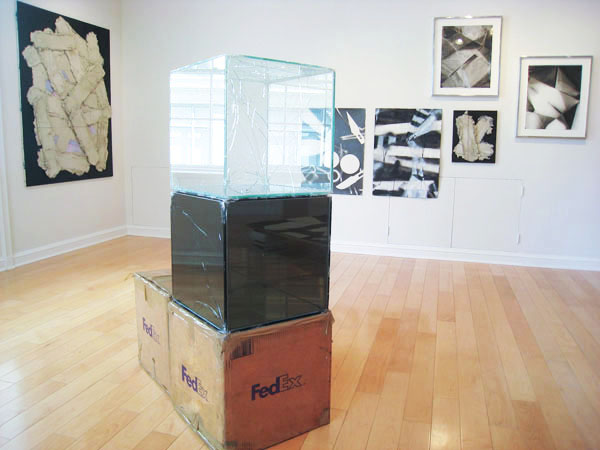
Walead Beshty’s FedEx Kraft Box………… sculpture, which contains custom shatter proof glass cubes placed inside standard Fed-ex boxes, displays the evidence of wear as an object travels from one location to another. These ready made materials are further “improved” by the imposing alteration of travel. In addition to the sculpture, Beshty also presents several photographic images of isolated objects produced by placing the otherwise utilitarian forms on photosensitive paper, rendering them useless of their original function. Images of crumpled paper and eyedroppers begin to resemble abstracted paintings, drawings and monoprints further removing the viewer from the object’s original state and placing it more in the realm of the artifact.

Karl Haendel’s photorealist graphite drawings subvert functional objects by manipulating scale, content and source imagery. Haendel’s imagery and method of presentation is generous in it ability to be easily recognized though careful rendering and specific depiction of everyday materials such as paper, razor blades, nails and paper clips. However, the work subtly unfolds and challenges the viewer through its coded symbols and methods of display. Haendel presents a delicately drawn image of ripped paper on a plywood platform supported by stacks of art magazines, which plays with the viewer’s physical perspective to drawing and the repetition of material (paper) through multiple forms. This work is presented along side images of blades mounted to wood gently resting against a wall and large scrolls of paper containing references of would be titles for the exhibition, all of which playfully discuss the relationship between concept and material.
 

Marblesfedexview.jpg 

The collections of work in Play With Your Own Marbles are subtly seductive, engaging the viewer first through a whisper and later through a tug of the ear. Each work takes the utilitarian object and subverts it to reveal new potentials that have the ability to exist on a sliding scale of completion, remaining in a state of flux both formally and conceptually.

Play With Your Own Marbles will be on view in San Francisco through October 3rd.

Share

Perth

Why do we do the things we do

R Nolan LR.jpg
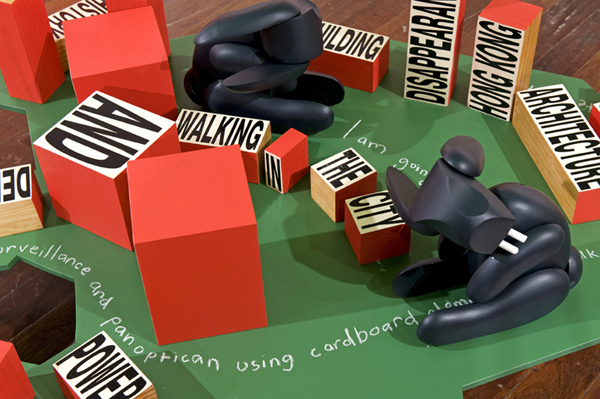
Emily Floyd, The Cultural Studies Reader (2001) Photo; Eva Fernandez

For the exhibition, Why do we do the things we do, nine artists turn the mirror on their creative process with honesty and biting self irony. This group exhibition at the Perth Institute of Contemporary Arts, Australia, curated by Jacqueline Doughty, tackles the often misunderstood process of making art, with many of the artists playing on the ambitions, anxieties and pressures that filter into their practice.

The romantic image of the artist as genius, or perhaps idiot savant, receives particular scrutiny. Doughty positions this selection of mostly text-based works in relation to the written artist’s manifestos that accompanied many 20th century movements, which she notes “are generally characterized by a boldness of language and a utopian conviction in their objectives and their methods”. While the text works in this exhibition are manifestos of a sort, they also lack any trace of the optimism, certitude and confidence of the heroic modernist artist.

Tom Polo‘s Continuous One Liners are a collection of roughly painted phrases on ready made surfaces which quote offhand remarks: “sore winner”, “well done”, “I’m worst at what I do best”, “maybe try video art”. This stream of consciousness narrative parodies the insecurities of the emerging artist trying to make it big.

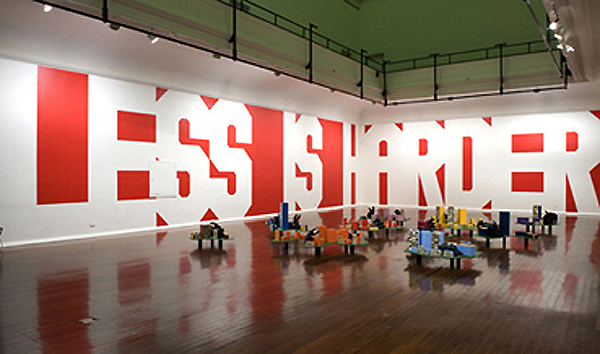
Rose Nolan‘s monumental text work “Big Words – LESS IS HARDER” uses the visual language of 20th century propaganda to express the private uncertainties that would ordinarily be kept from public view.

E Floyd LR.jpg
Rose Nolan, Big Words – LESS IS HARDER (2009) Photo: Eva Fernandez

Emily Floyd‘s The Cultural Studies Reader: 38 Topics for a Group Show parodies the theoretical impulse that can afflict artists in academic contexts – bunnies scrawl ambitious proclamations in wavering chalk script between building blocks, sporting key quotes: “My work is about the relationship between Malevich and electronica”, “I am making a post-colonial critique of history by restaging colonial paintings in alternate color schemes”, and “I am subverting the dominant paradigm”.

Despite its pathos, the playfulness of “Why do we do the things we do” keeps it from descending into melancholy, with each artist still striving to transmit an experience to the viewer. Doughty reflects, “It is the optimism of this gesture that encapsulates why we do the things we do”.

Share

Ultrasonic IV at Mark Moore

Azzarella_Josh1.jpg
Josh Azzarella Untitled #27 (Unknown Rebel) (2006), Video

Mark Moore Gallery has been organizing its annual Ultrasonic exhibitions for four years now, featuring emerging artists from the U.S. and elsewhere. This year’s installment, Ultrasonic IV: Fresh Perspectives, more subdued than its high-strung title suggests, seems to confront the present through the lens of the past, rephrasing visual legacies in a way that suggests nostalgia can be prescient.

It’s a fascinating trend: in a time when technology allows the production of slick, seamless images, artists return to the antiquated media of the past.

Azzarella_Josh2.jpg
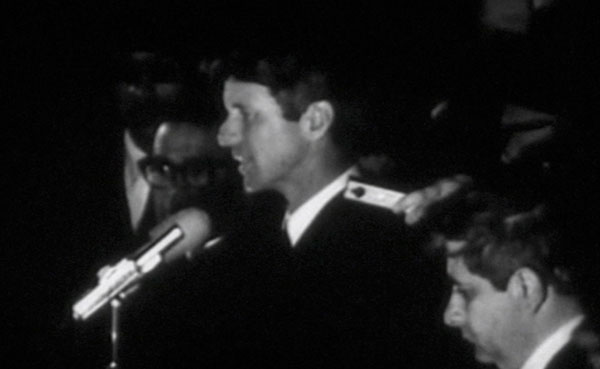
Josh Azzarella Untitled #46 (The Awful Grace of God) (2007), Video

Josh Azzarella‘s videos, collages of grainy found and reedited footage, turn profound political moments into silent lulls. In Untitled #46 (The Awful Grace of God), just over two minutes in length, Robert Kennedy stands before a crowd that appears loyal but listless. Kennedy doesn’t ever speak – or, at least, he doesn’t look like he does – and the soundless, blurred film makes a melancholic moment out of something that should have been empowering. Though of course, in retrospect, any footage of Bobbie Kennedy is melancholic.

Tim Barber‘s cinematic photographs, with their the-world-is-bigger-than-you-are presentiment, evoke 1960s Cinema Verite – they approximate in-the-moment truth except, once framed, truth becomes another form of fantasy. Barber’s subjects don’t acknowledge the camera. For the most part, their faces are obscured, directed away or literally distorted by a flash of light or suspended foliage. But in one image, Untitled (wrapped in plastic), a woman’s perfectly legible, pristinely made-up profile rests inside a plastic bag. Exaggerated yellows make the image look like it’s been imported from a past decade and the plastic wrapping suggest an attempt to keep a dead face picturesque. Does this attempted preservation act as a protest against immediacy? Or is it simply an inability to let go?

Barber_Tim2.jpg
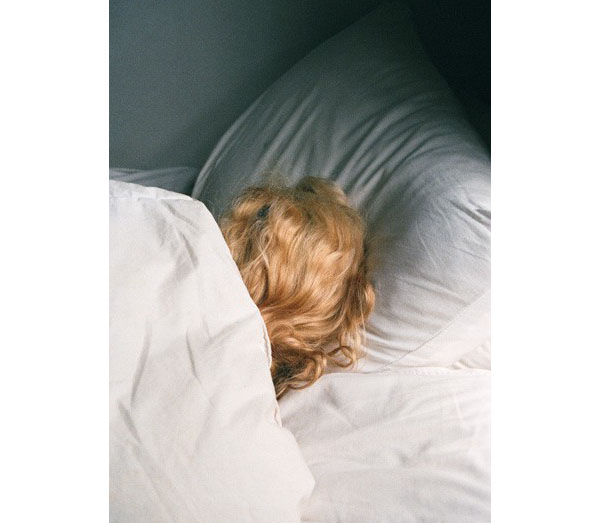
Tim Barber Untitled (pillow) (2008) Digital c-print

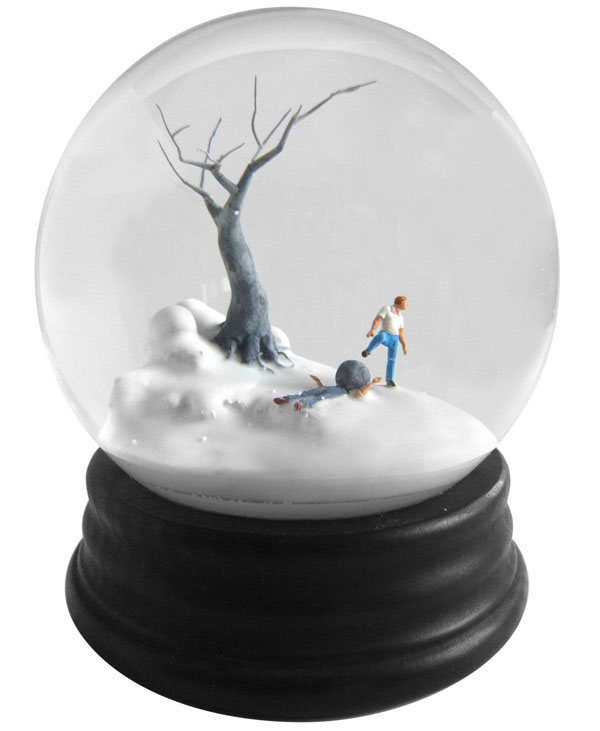
While Ultrasonic IV certainly deals with nostalgia’s heaviness, it also offers plenty of levity. Walter Martin and Paloma Munoz re-imagine the snow globe, taking sentimental keepsakes and making them sinister. As objects, the globes are kitschy as the real things; as narratives, they’re absurd and callous. Had the Coen brothers depicted Narnia, the result might have been similar: miniature figures climb through stony ruins, find themselves chained together in the midst of forests, nearly fall from cliffs, and use boulders to stomp one another into the snow. It’s winter wonderland gone terribly wrong.

Looking back, remixing and sampling are things art, like music, has gotten good at, and they’re things Ultrasonic IV does well. The urge to revisit what already exists makes sense; the world has so much information in it already (and so much misunderstood, overlooked information) that taking the remix approach seems economical.

Martin_Munoz2.jpg
Walter Martin & Paloma Munoz Traveler CCLVII (2009)

At the end of her novella The Dog of the Marriage, Amy Hempel wrote, “I see the viewfinder swing wide across the lawn, one of those panning shots you always find in movies, where the idea is to get everybody in the audience ready for what will presently be revealed” – Except that Hempel’s characters never really get past the panning shot, and neither does contemporary art. The lingering question seems to be whether we should keep anticipating the reveal, or accept that rear-views are the closest we can get to looking forward.

Share

Roxy Paine

roxy paine2.jpg

Roxy Paine‘s Maelstrom is a massive stainless steel sculpture that stretches from one end of the Metropolitan Museum of Art‘s Cantor Roof Garden to the other, rising 29 feet overhead. Weighing more than 7 tons, the tree-like sculpture is 130 feet long and 45 feet wide, making it Paine’s largest and most ambitious work to date. The arboreal structure is composed of 10,000 pieces of stainless steel which range from three-eights of an inch to 10 inches in diameter. Visitors are able to walk within and around the steel branches in the garden-like atmosphere of the roof garden, overlooking Central Park.

Maelstrom asserts that man and human culture are not removed from, but very much a part of nature. The sculpture’s network of branches mimics organic and biological systems as well as industrial systems, such as plumbing and piping, thus pointing to the connection between the natural world and the built environment. Poised above Central Park, Maelstrom echoes the element of controlled nature represented by the urban park, which was designed by Frederick Law Olmsted and is in fact almost entirely landscaped. However, as the title suggests, there are certain elements in nature that remain unbridled by man.

Roxy Paine, born in New York in 1966, studied both at the College of Santa Fe in New Mexico and Pratt Institute in New York. His work has been exhibited internationally and is included in major collections such as the Hirshhorn Museum and Sculpture Garden in Washington, D.C. and the Israel Museum in Jerusalem. For the 2002 Whitney Biennial, he erected a 50 foot stainless steel tree in Central Park. The artist was previously featured on DailyServing in 2006.

Maelstrom opened in April and will remain on the roof until November 29, 2009 (weather permitting).

Share

Sandow Birk

Birk_American Qur'an_Sura.jpg

American Qur’an, which opened at the Catharine Clark Gallery earlier this month, is one phase of Southern California artist Sandow Birk‘s ongoing project to hand-transcribe the 114 suras, or chapters, from the Holy Qur’an. Birk juxtaposes the text with images from contemporary American life to create a narrative which addresses the misconceptions of Islam by U.S. culture by posing the question: how did two religions that originated out of the same region of the world end up in such polarized states? Birk comes the closest to presenting an answer with the works American Qur’an/Sura 47 (A-B), 2005 and American Qur’an/Sura 44 (A-B), 2003, where he illustrates Sura 47 titled “Muhammad” with images of American soldiers in Iraq; and Sura 44, titled “Smoke” with images of the destruction of the World Trade Center. Here Birk captures the chasm between what both religions, Islam and Judeo-Christianity, purport to teach and what has actually been manifested at the hands of men. American Qur’an is being concurrently exhibited at the Koplin Del Rio Gallery in Los Angeles and another installment of the project will be exhibited at PPOW in New York in 2010.

Birk_American Qur'an_Sura 44_web.jpg

Sandow Birk received his B.F.A in painting from the Otis Art Institute of Parsons School of Design in Los Angeles. His work has an emphasis on social issues and his past work has included Los Angeles barrio life, inner-city violence, graffiti, prisons, surfing, skateboarding, Dante’s Divine Comedy and the War in Iraq. Birk has received an NEA grant, a Guggenheim Fellowship, a Fulbright Fellowship, a Getty Fellowship, and a City of Los Angles Fellowship. His most recent project, The Depravities of War, was published as a monograph by HuiPress, Makawao, Hawaii and Grand Central Press, Grand Central Art Center, California State University, Fullerton. Birk often collaborates with his wife who is also a practicing artist, Elyse Pignolet. Birk has exhibited with Catharine Clark Gallery since 1994.

Share

Rosalind Nashashibi

Rosalind Nashashibi1.jpeg

London’s ICA is currently showing new works by artist Rosalind Nashashibi. This solo exhibition aims to present a comprehensive look at Nashashibi’s work at a time when she is emerging as a prominent British film artist. Despite Nashashibi’s relatively young career and the fact that the earliest work included in the exhibition dates to 2005, the breadth and evolution of the artist’s work is evident in the five films and two photographic series on view. While Nashashibi’s career began with an observational, almost documentary-style approach of depicting the everyday, the ICA gallery visitor is presented with the artist’s developing focus upon the transformative potential of cinema and theatre.

In Eyeballing (16mm film with sound, 10 min) from 2005, images of uniformed New York City police officers alternate with anthropomorphic images (or ‘masks’) of the human face found in features of the city, such as fire hydrants and shop windows. This is a pivotal film for Nashashibi in the way it visualizes theatrical transformation in an everyday context. While Nashashibi primarily works in 16 mm film, photography remains an important aspect of her oeuvre for its utility in exploring recurring themes in her work. In Rehearsal (2009), a new photographic installation, features over 100 silver gelatin prints along with a sound recording – both depicting a specific theatre rehearsal. This work literalizes and dramatizes the artist’s interest in ‘physicalization’ or the transformation of people into characters.

Rosalind Nashashibi2.jpg

Jack Straw’s Castle (2009, 16 mm film with sound), a new commission, alternates between real footage set in day light and dramatized footage that is set at night. The film begins with various real footage shots of a London park and a cruising area. The artist’s mother, Pauline Nashashibi, bridges the two halves of the film as she walks through the park at dusk and happens upon and interacts with a film set in a clearing. The artist’s primary focus in this work is rather self reflexive. According to ICA’s website, the film aims to evoke ‘the dream space of cinema’ or to articulate film’s potential for metamorphosis.

The ICA exhibition, Rosalind Nashashibi, is accompanied by a catalogue publication. It will be on view through 1 November 2009. The show is then set to open on 13 November in Norway’s Bergen Kunsthall where it will remain until 20 December 2009.

Rosalind Nashashibi received her MFA from the Glasgow School of Art in 2000. The artist, who has shown internationally, is currently represented by Doggerfisher in Edinburgh while living and working in London. Nashashibi has been selected by the British Council for the Accented Residency Programme at Townhouse Gallery in Cairo, which she will complete in November and December of this year.

For this summer’s Edinburgh Festival Doggerfisher presented new work from Nashashibi in partnership with artist Lucy Skaer – a duo that has repeatedly collaborated since 2005. Nashashibi / Skaer’s film installation Our Magnolia (2009) remains on view through 25 September – closing at the end of this week.

Share

Doug Aitken: Migration

Aitken-1.jpg
Installation view: Regen Projects, Los Angeles 2009 Photography by Brian Forrest

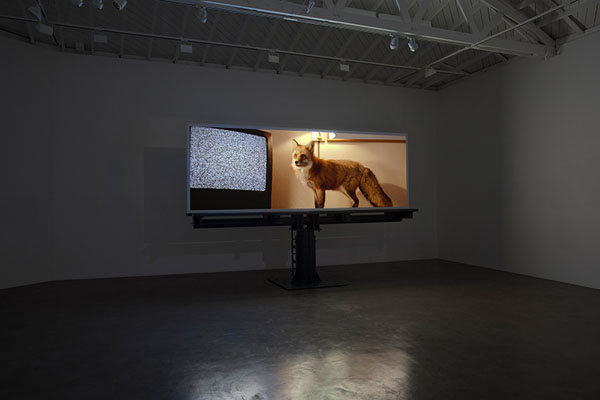
Sometimes simplicity can be stunningly difficult. Doug Aitken‘s film Migration has an apparent enough premise: migrating animals occupy hotel rooms, bringing together the instinctive and unfamiliar aspects of travel. And Aitken uses pristine, focused images to realize this premise. Yet the effect is something more nuanced and confusing: migration becomes precariously noble, the virtual and the actual slip in and out of each other, and bittersweet anticipation pervades each scene.

Aitken, the SoCal native who is now as much an East Coast as West Coast artist, long ago dismissed the fugitive, homegrown approach of many video artists. He’s an expert audio-visual craftsman. His work reminds me of those feature filmmakers, Jane Campion or Ang Lee for instance, who gravitate toward provocative subject matter yet also toward sublime cinematography, dragging their viewers into a weird, subconscious battle between the need to understand and the desire to bask in beauty.

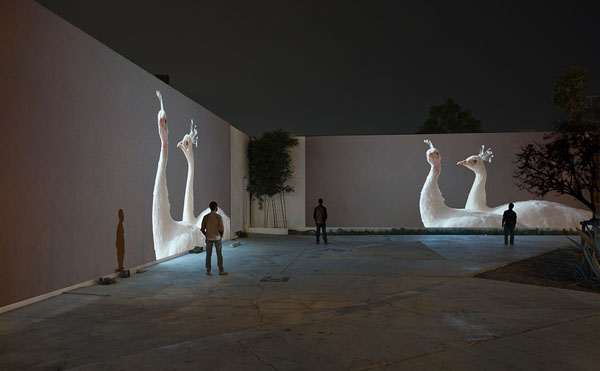
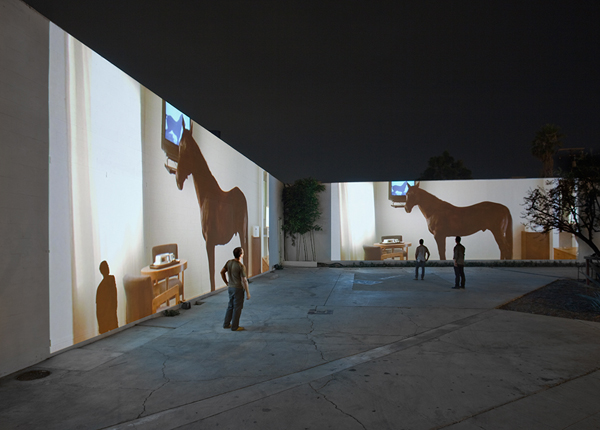
Aitken filmed Migration on location, in motels across the country. The film made its New York debut a year ago exactly, appearing on three industrial-sized screens at 303 Gallery, and then on the face of a building at the 55th Carnegie International. It took a year to travel – migrate – to Los Angeles. Now it’s projected in two places: on a screen inside Regen Projects‘ Almont Street gallery and, when the sun sets, as a two channel installation on two exterior walls of Regen’s Santa Monica Blvd building.

Aitken-02.jpg
Installation view: Regen Projects II, Los Angeles Photography by Brian Forrest

I watched Migration inside first. Alone in the space, I felt like a solitary witness to everything on screen. When I first walked in, the camera was lingering on a motel bed with a pink spread and an aura of oldness – this motel probably didn’t belong to a national chain. The first creature on screen, a horse, couldn’t be recognized at first because rays of sunlight turned its profile into a shadowy structure. Then, once the shadow turns into a body, the film really began: animals waiting in empty, clean, but rudimentary rooms, sometimes watching themselves on television – a meta-narrative that, given the context, seems more factual than profound (watching one’s own species on TV is intricate to the traveling ritual). Every movement that happens in these rooms is restrained, like the horse hoof that beats against the carpet, or the mountain lion that wrestling a pillow but never puncturing its cotton skin. Running water, a motif in journey narratives, enters Aitken’s film only in spirit. The faucet filling bath, coffee dripping into pots, pool surfaces vacillates slightly – no rushing rivers puncture the stillness.

The creatures in Migration are going somewhere, there’s no doubt, but their destination must be unknown or foreboding because the hotel rooms they occupy seem more like psychological respites than physical resting points.

When I came back at night to view the outdoor incarnation of Migration, I was alone again. A steady stream of cars drove by, but only about six people walked in front of the gallery and fewer really looked at the dual projections playing on Regen’s walls. This inattentiveness surprised me at first, but, actually, outside, that line between provocation and beauty that Aitken straddles so nicely, fuzzed in favor of beauty. And pretty things on walls are second nature to the West Hollywood-Beverly Hills neighborhood Regen occupies.

Aitken 03.jpg

Installation view: Regen Projects, Los Angeles 2009 Photography by Brian Forrest

Seen inside the gallery, the best moments of Migration had to do with the strangeness of being alone, and watching creatures, also alone, use man-made conventions of comfort to satiate some some mysterious anxiety. Outside, the best moments had to do with distortion – like when a close-up of a door latch took over, when striped carpet looked like a candy-colored corn-field, or when a buffalo‚Äôs eye filled the walls so abstractly that it wasn’t clear what it was. These moments, I hoped, could interrupt passers-by, showing them that they didn’t intuitively understand what they saw.

Migration focuses on something that is intuitive, but isn’t understood, and that’s what makes it difficult. The urge to journey certainly may be familiar – most of us, if we haven’t felt it, know it exists – and yet, the tendency to view everything through a familiar lens is even stronger than the tendency to venture out. The animals in Aitken’s hotel rooms seem to willingly, maybe even sacrificially, accept a lifestyle that doesn’t belong to them, and the unfamiliar consequences of this makes Migration unsettling but also hopeful.

Share