Seven new paintings from New York-based artist Francine Spiegel are currently being presented at Deitch Projects‘ 76 Grand St Gallery, in a new exhibition titled Mud and Milk. This exhibition marks the artists first solo project with the gallery. The artist’s work examines the idea of the “monstrous feminine” and consists of portraiture of women doused in a variety of sloppy fluids, half dead and fully animated. To create the source material for her new paintings, Spiegel created a massive performance that called for “10 pounds of grits, 5 jugs of pancake syrup, 10 squirt bottles of grape jelly, 5 bottles of Pepto-Bismol, 20 buckets of tempura paint, 20 cans of whipped cream; plus silly string, shaving cream, Fruit Loops, flour, Kool-Aid, glitter, pie, marshmallow Fluff, fake arms, fake blood and chocolate syrup.” These ingredients were researched and taken from Fangoria Magazine‘s behind the scene horror movie ingredients. ForMud and Milk, the artist has created mini-vignettes that allow multiple scenarios and an extended narrative to exsist on a single picture plane.
The Department of Photography’s continuing series On the Scene showcases the Art Institute of Chicago‘s commitment to collecting and exhibiting the most dynamic new work by emerging artists. The third exhibition in the series explores the diverse range of art being produced by Jason Lazarus, Wolfgang Ploger, and Zoe Strauss.
Jason Lazarus’s installation grew out of the artist’s fascination with the family snapshot and its durability in our digital era. After amassing a small archive of found photographs, Lazarus became especially compelled by the handwritten texts on the backs of the photos and began arranging the snapshots to create small conversations based on the text, tonality, and spacing of surrounding photos. Importantly, the dates of the photographs comprising the unique installation at the Art Institute range from 1899 to 1996, beginning roughly a decade into the personal snapshot craze initiated by Kodak and continuing up to the threshold of the digital era.
Inspired by another found collection of language, Wolfgang Ploger’s work Make No Mistake about This uses the text of death row inmates’ final statements. Wanting to incorporate these last words into his work without making them readily discernible simply through the act of reading, Ploger handwrote the statements on lengths of film celluloid and projected this flickering calligraphy onto the wall. Ploger also removed the projector’s take-up reels so that as the last statements race and loop throughout the gallery, their speed and scale necessitate that viewers strain to make sense of glimpses of language that might convey error, confession, or apology.
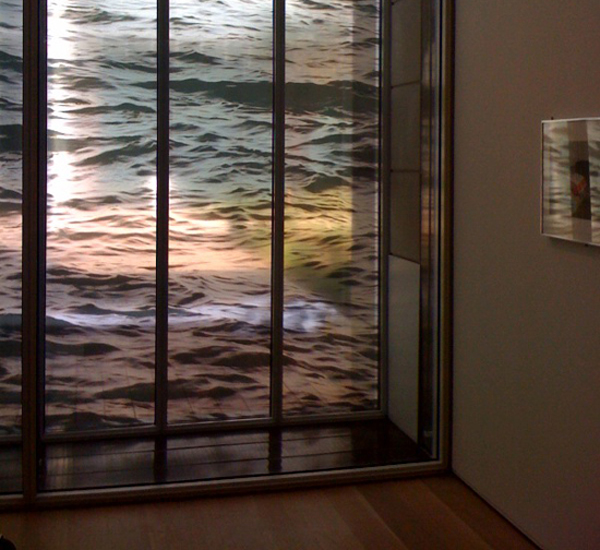
The third work in the exhibition, Zoe Strauss’s site-specific installation Week of the Perfect Game, suggests the idiosyncrasies, exchanges, and moments of one week in Chicago this past July. Traveling south from the Loop to Gary, Indiana, Strauss captured the Chicago atmosphere on a grand national scale, as Barack Obama’s hometown and a finalist city in the bid to host the 2016 Olympics, as well as on a more intimate scale, as the location of an ongoing hotel-workers’ strike and a commemoration of a teen gunned down on its streets. Together Strauss’s photographs provide an open-ended and all-encompassing narrative set against the backdrop of Lake Michigan. The work is one of the museum’s most recent acquisitions.
Frieze Art Fair (which shares its name with contemporary art magazine, Frieze) is held annually each October in Regent’s Park, London. This year, over 150 leading contemporary art galleries from around the world are represented on site – allowing the visitor to both view and purchase contemporary art. The Frieze Fair also hosts a curatorial program of newly commissioned artworks, a talks program and an artist-led educational program under the direction of the (non-profit) Frieze Foundation – all of which add depth and variety to the market-driven focus of the fair.
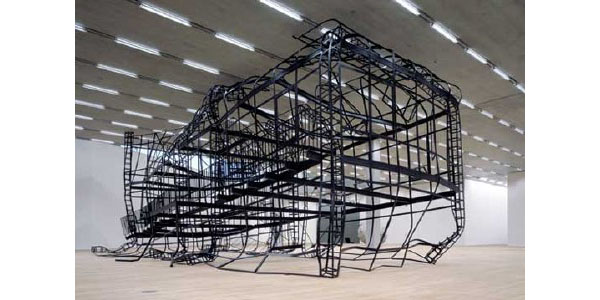
This year’s Frieze Projects is curated by Neville Wakefield with the aim, in his words, to ‘create aesthetic opportunity out of the uncertainty that has become the hallmark of our troubled times.’ But what is most apparent is that the works commissioned each engage either the actual exhibition space or the concept of the mega-art fair, which at its most essential level facilitates market exchange. Artists included are Mike Bouchet, duo Kim Coleman and Jenny Hogarth, Ruth Ewan, Ryan Gander, Per-Oskar Leu, Monika Sosnowska (pictured below), and Stephanie Syjuco. Arte Contempo (Lisbon) and Contemporary Art Centre (Vilnius) each contribute their own curated projects as well.
British, London-based artist Ryan Gander‘s work We are Constant is worth noting for the way it forces the Frieze visitor to take note of the presence of ‘consumption’ and ‘spectacle’ at the fair. Gander’s installation work is placed prominently at the entrance to the fair. It consists of photographic portraits of visitors alongside their choice of art work found at the fair. These portraits are added to the installation throughout the duration of the fair.
This year’s Frieze Film commission features a new film by the Danish artist collective, Superflex (excerpt video above). Superflex which has chosen to take the present economic crisis as its subject. Fittingly for the art market, which is a microcosm of our larger world economy, Financial Crisis (Session I-IV) addresses the recent and current economic troubles that have been felt worldwide. The four parts, entitled The Invisible Hand, George Soros, You and Old Friends each feature visually spare frames of a respectable-looking middle aged man against a black background. The man looks directly out at the viewer as he calmly and deliberately speaks on the topic of the financial crisis. As the Frieze site states, Superflex chooses to approach the ‘economic crisis as a psychosis to be treated therapeutically, hypnosis is used to relive the stages of financial meltdown.’
The Frieze Foundation’s Cartier Award, which supports emerging artists from outside of the UK was given to Jordan Wolfson. An American artist based in Berlin and New York, Wolfson will also present a site specific work at Frieze.
The 2009 Frieze Art Fair takes place in London from 15-18 October in Regent Park.
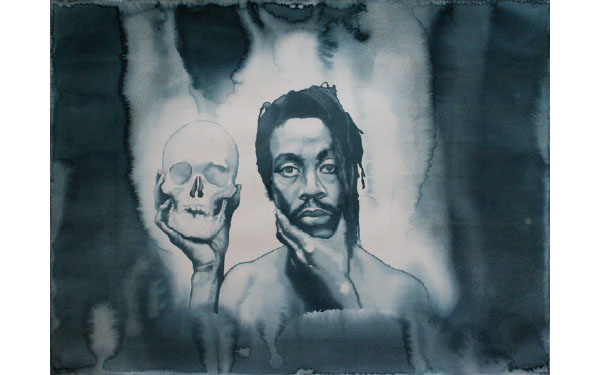
The Guild Art Gallery in Mumbai and Jack Shainman Gallery in New York City have partnered to present Blood and Spit, an exhibition of new paintings by artist T.V. Santhosh. The exhibition, which opened yesterday, includes five large-scale hyper-color figurative paintings and eight monochromatic watercolor paintings. The source images of the paintings have a familiar quality, as many of them are sourced from or reference current media and contemporary events. At times, the images can be aggressive, political and deep humanistic. Santhosh creates deeply psychological paintings that call into questions ideas of war, terrorism and violence.
The artist is a prominent figure of the Indian art community and has developed an international reputation. He has exhibited recently with Grosvenor Vadehra Gallery, in London, Avanthay Contemporary in Zurich, and Aicon Gallery in New York City.
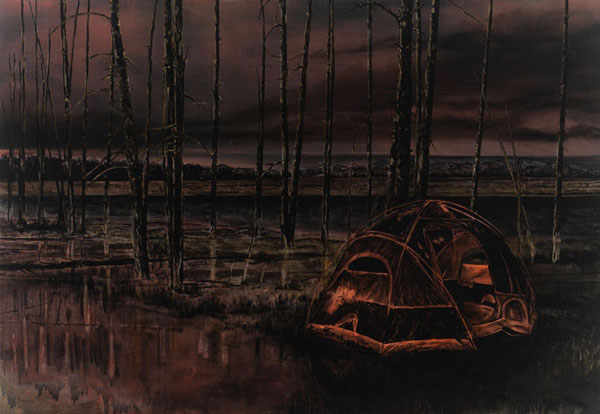
Nightology is the title of a new exhibition by Swiss artist Stefan a Wengen. Currently on view at Black and While Gallery in New York City, the exhibition marks the artist’s first solo exhibition in the United States, and includes a new series of paintings that continue his interest in isolation and the cloak of the night. The subdued images are punctuated with electric color, seducing the viewer into various mysterious landscapes. Each painting contains a central object that acts to “trigger collective memory” and which builds a psychology within the image that makes it distantly familiar, yet still out of place.
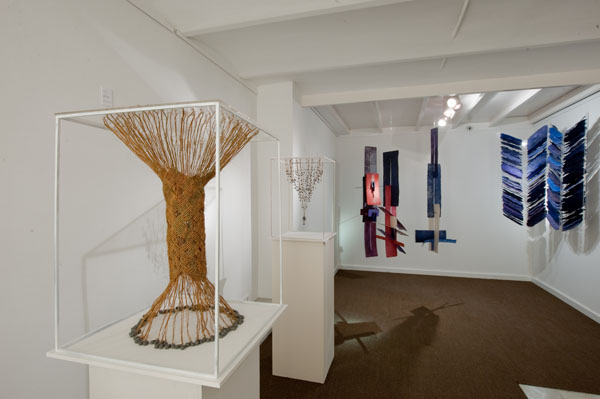
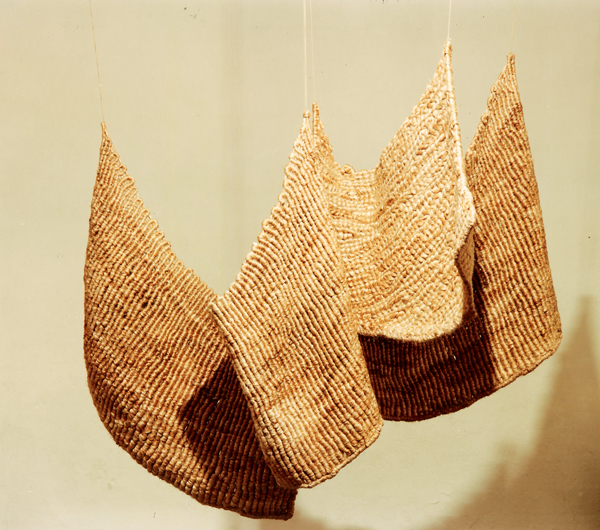
Currently exhibiting at the N2 Gallery in Barcelona, Spain are the works of Spanish artist Aurelia Munoz. The works on display are delicate, yet formidable, sculptures made of materials ranging from handmade paper to textile fibers. The piece Entre Social, 1976, is a large-scale macrame sculpture that serves as testimony to Munoz’s ability to beautifully marry geometry and abstraction with natural textiles, creating an entirely new three-dimensional artistic vocabulary. Mandala con flores, 1988, gives new meaning to the term “work on paper”. Made from tiny pieces of handmade paper, suspended on tiny strips of flax linen, Munoz successfully straddles the two and three-dimensional planes, capturing the ever-elusive medium of shadow. This exhibition, which will be on view through November, marks the first gallery exhibition for the 83 year-old in nearly thirty years, as her work primarily is shown in museums.
Kathy Aoki is currently presenting a solo show at Oakland’s Swarm Gallery entitled The Museum of Historical Makeovers. In her faux-museum exhibition, Aoki takes on the role of a curator from the year 3011 at a cultural history museum. The exhibition specifically follows Gwen Stefani as if humanity has uncovered artifacts from her clothing lines and accepted them as culturally significant. The museum consists of several sculptural works in the vein of egyptian artifacts, (canopic jars, maps of burial sites), as well as etchings and illustrations detailing modern makeover processes including Brazilian waxings and anal bleaching. Finally, the museum hosts a tomb room of Stefani burial artifacts that is “temporarily closed” due to vandalism, allowing only a small peep-hole-style viewer for museum patrons. As is evident with this exhibit’s tongue-in-cheek portrayal of feminine social standings, Aoki considers herself a “sneaky feminist,” inserting subtle statements of accepted female beauty “norms” into her work concerning feminine gender roles.
Kathy Aoki received her MFA in printmaking from Washington University in 1994 and currently lives and works in Santa Clara, California where she is an assistant professor at Santa Clara University. She has shown at a large variety of galleries, including San Jose Museum of Art, Smith Anderson Editions, as well as participating in San Fransisco Arts Commission‘s Market St. Kiosks in 2004. The Museum of Historical Makeovers runs until October 25th, and is accompanied by an artist talk on October 14th with Aoki playing the role of the Museum curator.








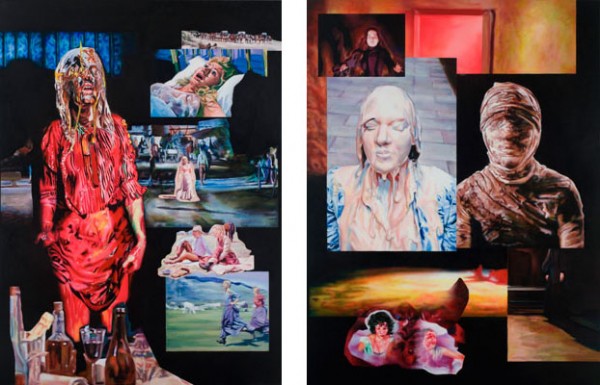 Seven new paintings from New York-based artist Francine Spiegel are currently being presented at Deitch Projects‘ 76 Grand St Gallery, in a new exhibition titled Mud and Milk. This exhibition marks the artists first solo project with the gallery. The artist’s work examines the idea of the “monstrous feminine” and consists of portraiture of women doused in a variety of sloppy fluids, half dead and fully animated. To create the source material for her new paintings, Spiegel created a massive performance that called for “10 pounds of grits, 5 jugs of pancake syrup, 10 squirt bottles of grape jelly, 5 bottles of Pepto-Bismol, 20 buckets of tempura paint, 20 cans of whipped cream; plus silly string, shaving cream, Fruit Loops, flour, Kool-Aid, glitter, pie, marshmallow Fluff, fake arms, fake blood and chocolate syrup.” These ingredients were researched and taken from Fangoria Magazine‘s behind the scene horror movie ingredients. ForMud and Milk, the artist has created mini-vignettes that allow multiple scenarios and an extended narrative to exsist on a single picture plane.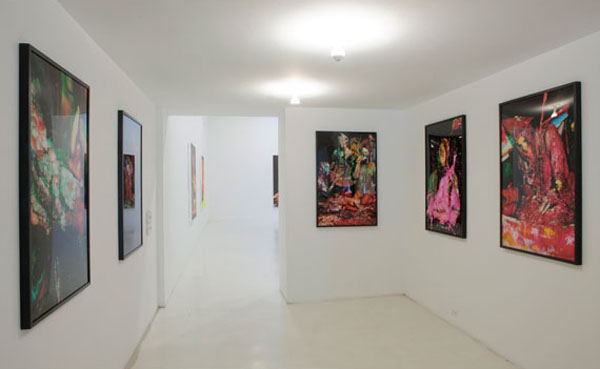

 The Department of Photography’s continuing series On the Scene showcases the